Out of India theory: what does genetics say?
Did the Indo-European languages begin in India? Ancient DNA lets us test the question.
What "Out of India" means
Where did Sanskrit come from? In India this question can start an argument faster than most. Did the languages of the Indo-European family, from Sanskrit and Hindi to Persian, Greek, Russian and English, begin in India and spread outward? Or did an early form of them reach India from outside? The Out of India theory, often shortened to OIT, says the first.
Three different ideas get mixed up in this debate. The first is the old Aryan invasion theory, the colonial-era picture of fair-skinned conquerors riding in and destroying the Indus cities. No geneticist or mainstream historian defends it today. The second is the migration model, which most researchers now accept: over several centuries in the second millennium BCE, people carrying an early Indo-Aryan language moved into north-west India and mixed with the people already living there. The third is OIT itself. Throughout, "Aryan" is used as a label for a language and culture, not for a race or a genetic group [33].
OIT comes in two versions. The strong version says the whole Indo-European family began in the Indian subcontinent, and that the speakers of Iranian, Anatolian, Greek, Slavic, Celtic and Germanic languages all descend from people who left India. The weaker version, often called Indigenous Aryans, makes a smaller claim: the Vedic people were native to north-west India, the Rigveda was composed there, and no significant group of Indo-Aryan speakers came in from outside. The case for OIT comes first below, in its supporters' own terms, as Edwin Bryant did in his surveys of the debate [7, 8].
The strongest case for Out of India
The most detailed textual argument comes from Shrikant Talageri. In The Rigveda: A Historical Analysis (2000) and The Rigveda and the Avesta: The Final Evidence (2008), he builds a relative order for the ten books of the Rigveda and argues that the oldest books (6, 3 and 7) are set in the Haryana and western Uttar Pradesh region [1, 2]. In his reading, the geography of the hymns moves from east to west over time, which fits an emigration out of India better than an arrival into it. He also argues that the vocabulary shared by the Rigveda, the Avesta and the Mitanni names belongs to the later Rigveda.
Koenraad Elst, in Update on the Aryan Invasion Debate (1999), set out the wider case against migration and questioned many of its linguistic and archaeological supports [3]. Nicholas Kazanas argues on linguistic grounds for a very early date for the Rigveda [34]. B.B. Lal, a former Director-General of the Archaeological Survey of India, made the archaeological case in The Rigvedic People (2015): he found no sign of an outside population arriving in the archaeological record and saw continuity from the Harappan period onward [4].
A large part of the argument rests on the river Sarasvati. The Rigveda praises it as a great river. Michel Danino, in The Lost River (2010), identified it with the Ghaggar-Hakra, a now largely dry channel along which many Harappan sites lie [5]. If the Vedic hymns describe a mighty Sarasvati, and if that river dried up around the end of the Harappan period, then, the argument goes, the Rigveda must be older than that and its authors must have been the Harappans themselves.
Before ancient DNA, genetics also seemed to offer support. Several studies in the 2000s found that the Y-chromosome lineage R1a, often linked with Indo-European speakers, was common and diverse in India, and two of them reported little sign of a Central Asian influx [21, 22]. Swarkar Sharma and colleagues went furthest in 2009, arguing that R1a began in India and that Brahmins and the caste system had an indigenous origin [6]. Supporters of OIT also point out, correctly, that very little ancient DNA has been recovered from India itself, so some conclusions rest on samples from its edges.
What the theory has to predict
Any theory about the past can be tested if it makes clear predictions. If OIT is right, we should expect to find the following:
- No Steppe ancestry arriving from outside. If Indo-Aryan speech was native, the Harappans should already carry whatever ancestry the Vedic people carried, and no new ancestry should appear later.
- No late arrival of R1a. The R1a lineages common in India should be old and local, without a sudden expansion in the Bronze Age.
- Indian ancestry abroad. If the speakers of Iranian, Greek, Slavic and Germanic languages came out of India, the ancient people of Europe, Iran and the steppe should carry a clear share of South Asian ancestry.
- An Indian homeland. The oldest branch of the language family, and the reconstructed vocabulary of its speakers, should point to India.
- Native horses and chariots. The domestic horse and the spoke-wheeled chariot, which the Rigveda knows well, should be found early in India.
The weak version needs only the first two to hold. The strong version needs all five.
What the genes show
The first large study of Indian genomes, by David Reich, Kumarasamy Thangaraj and colleagues in 2009, found that most Indians are a mix of two ancestral groups, which they called Ancestral North Indians and Ancestral South Indians [12]. Priya Moorjani and colleagues later dated the mixing of these two to between about 1,900 and 4,200 years ago [13]. That date is already hard to square with OIT. If the ancestry that makes North Indians different had always been in India, there would be no reason for the mixing to start so late.
Then came ancient DNA. In 2019 Vagheesh Narasimhan and a large team published DNA from 523 ancient people from Iran, Central Asia and northern Pakistan [15]. The ancestry of the Indus people, as best they could reconstruct it, was a mix of Iranian-related ancestry and an indigenous South Asian hunter-gatherer ancestry known as AASI, with no Steppe ancestry at all. Vasant Shinde and colleagues then published the first genome from inside an Indus city, from a woman buried at Rakhigarhi in Haryana. She had no Steppe ancestry either [16].
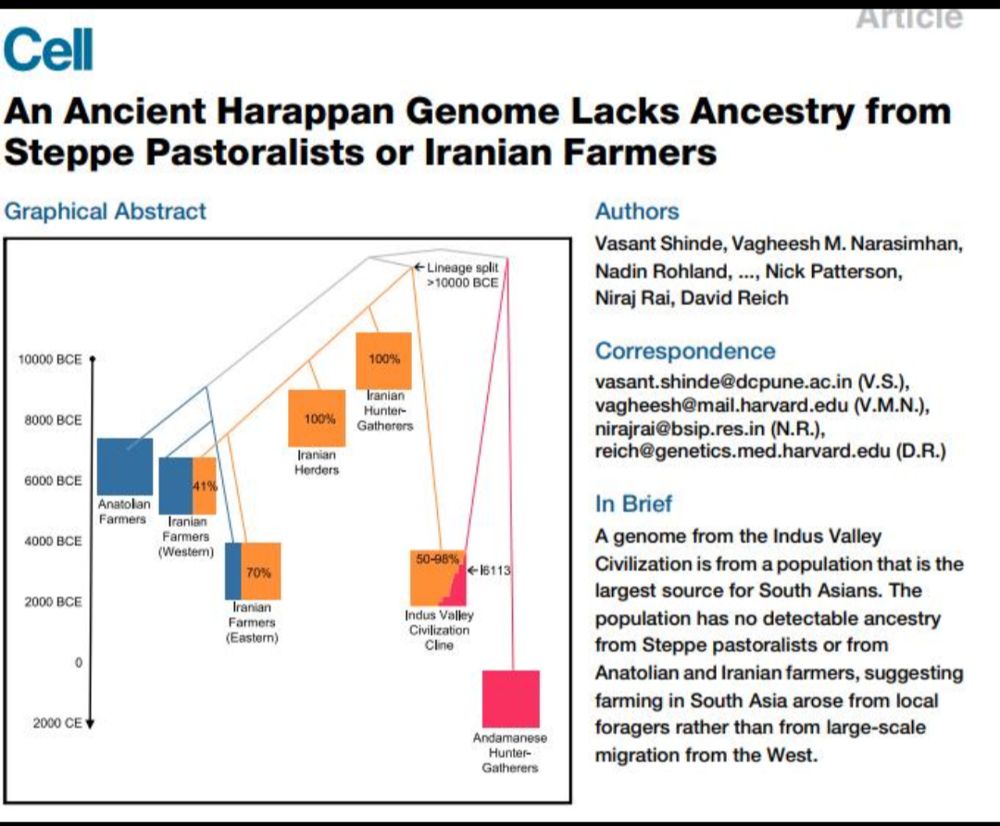
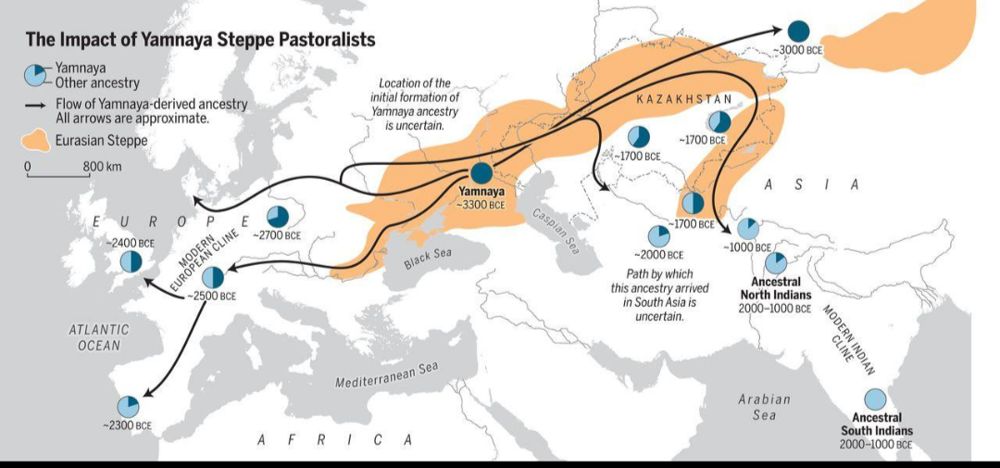
On the first prediction, then, OIT supporters are right. The Harappans were not invaded, and they were not carrying Steppe ancestry. But the same data shows the Steppe ancestry arriving later. Narasimhan's team found it reaching Central Asia between about 2100 and 1700 BCE and mixing into people in the Swat Valley of northern Pakistan between about 1900 and 1500 BCE [15]. The Steppe ancestry in South Asia has the same profile as that in Bronze Age Eastern Europe. So this ancestry was new. It came in from the north-west after the Indus cities had passed their peak. The migration model expects this. OIT does not.
The second prediction fails in a similar way. When Peter Underhill and colleagues mapped R1a in detail in 2015, using more than 16,000 men from 126 populations, they found that it splits into a mostly European branch (Z282) and a mostly Asian branch (Z93). They concluded that R1a first diversified somewhere near present-day Iran [17]. The Z93 branch common in India has a star-like shape, and geneticists read that shape as a sign of fast, recent growth from a few ancestors. Earlier claims for an Indian origin of R1a, such as Sharma's, rested on the variety of short repeat markers in living men, a method that can make a recently arrived lineage look old [6]. Marina Silva and colleagues, combining maternal, paternal and genome-wide data, found that Indian maternal lineages are mostly deep and local, while the paternal side records a Bronze Age influx from Central Asia that was "strongly male-driven" [18].
The third prediction matters most for the strong version. If Europeans, Iranians and steppe herders descend from emigrants out of India, their ancient remains should carry South Asian ancestry. They do not. The Yamnaya herders of the steppe and the Corded Ware people of Europe, studied by Wolfgang Haak and others, carry no meaningful AASI ancestry [20]. Narasimhan's team did find a small amount, about 2 to 5 percent, of ancestry related to South Asian hunter-gatherers in people of the Bactria-Margiana culture of Central Asia. OIT writers sometimes cite this as evidence of an outflow. It shows contact between the Indus region and its Central Asian trading partners, which archaeology already knew about. A share this small, in one neighbouring region, cannot account for a language family spreading across Eurasia [15].
The fourth prediction concerns the homeland. In 2025 Iosif Lazaridis and his colleagues traced the Yamnaya and the early Anatolian speakers, the Hittites among them, to a common ancestral population living between the Caucasus and the lower Volga between about 4400 and 4000 BCE [19]. That population contributed most of the ancestry of the Yamnaya, whose descendants spread the later branches of the family, including Indo-Iranian. No population from India appears among the sources.
The largest study of modern Indian genomes so far, by Elise Kerdoncuff and colleagues in 2025, sequenced 2,762 people from across the country. It found that most Indians carry ancestry from three main groups: South Asian hunter-gatherers, Neolithic farmers related to Iranian and Central Asian cultures, and Eurasian Steppe herders [14]. On the ingredients, and on the order in which they arrived, the studies now agree.
What language and archaeology add
Language and archaeology give two more lines of evidence, and both point the same way as the genes.
The oldest written Indo-Aryan words were found in the Mitanni kingdom of northern Syria, where a treaty of about 1380 BCE names the gods Mitra, Varuna, Indra and the Nasatyas, and a horse-training manual by a man named Kikkuli uses Indo-Aryan numbers [9]. OIT writers read these as signs of an early emigration from India. Most linguists read them as a branch of Indo-Aryan speakers that moved south-west from Central Asia while another branch moved into India.
Two kinds of loanwords help decide between these readings. Alexander Lubotsky identified a set of words shared by early Indo-Aryan and Iranian that have no Indo-European root and seem to come from a Central Asian language, probably that of the Bactria-Margiana culture [23]. Indo-Iranian speakers must therefore have lived in Central Asia before their languages split. Early Indo-Iranian words were also borrowed into the ancestor of the Uralic languages, the family of Finnish and Hungarian, which was spoken in the forests north of the steppe. The Finnish word sata, "hundred", is one example. Such contact is easy to explain if Indo-Iranian speakers lived on the steppe, and very hard to explain if they lived in India [24, 25].
The linguists' family tree points the same way. Anatolian, the branch of Hittite, is the oldest to split off, and it was spoken in Turkey. Computer-based studies of the family's history disagree on dates and homelands. Remco Bouckaert and colleagues favoured Anatolia in 2012 [28], Will Chang and colleagues favoured the steppe in 2015 [27], and Paul Heggarty and colleagues proposed a mixed model with a homeland south of the Caucasus in 2023 [26]. Heggarty's study has been strongly criticised, and the debate is still open. But none of these models places the homeland in India.
Archaeology adds the horse. The Rigveda is full of horses and fast chariots. Pablo Librado and colleagues showed in 2021 that modern domestic horses come from the lower Volga-Don region of the steppe and spread across Eurasia from about 2000 BCE, together with the spoke-wheeled chariots of the Sintashta culture [29]. In the Harappan cities no secure remains of the domestic horse have been found. Bones from Surkotada in Gujarat were once claimed as horse, but Richard Meadow and Ajita Patel showed that they cannot be told apart from those of wild asses [30].
OIT writers often cite the 2018 finds at Sinauli in Uttar Pradesh. The excavators found wooden vehicles with copper fittings in elite burials of the early second millennium BCE and described them as war chariots. They are an important discovery. But their wheels are solid, not spoked, and no horse remains were found with them. Asko Parpola reads them as carts drawn by bulls, linked to Central Asian models, with the true horse chariot arriving later [31].
The Sarasvati argument has also been tested. Liviu Giosan and colleagues showed in 2012 that the Ghaggar-Hakra was fed by the monsoon during the Holocene, not by Himalayan glaciers [10]. Ajit Singh and colleagues found in 2017 that the Sutlej had left this valley about 8,000 years ago, long before the Harappan towns grew along it [11]. The great river of the hymns was not flowing there in Harappan times. The Rigvedic Sarasvati may be a memory, a different river or a poetic ideal, but it cannot be used to date the Rigveda before the Harappans.
People who did leave India
India has also sent people out, many times. OIT's supporters are right to stress this, and the record is worth setting down.
From the early centuries CE, merchants, priests and scholars carried Indian religions, scripts and Sanskrit across the Bay of Bengal. The temples of Angkor in Cambodia, Borobudur in Java and the many local versions of the Ramayana still show that influence. In 1025 CE the Chola king Rajendra I sent a naval expedition against Srivijaya, the sea power of Sumatra and the Malay peninsula [36]. People moved as well as ideas. Piya Changmai and colleagues found South Asian ancestry in several Southeast Asian groups: about 12 percent in the Mon, Cham and Burmese, and about 9 percent in Cambodian Khmer. They dated the mixing to between roughly 450 and 1,300 years ago [35].
The Roma of Europe are the best known case. Their language, Romani, belongs to the Indo-Aryan family. Priya Moorjani and colleagues found that their South Asian ancestry comes mainly from north-west India. It mixed with European ancestry about 850 years ago, after the group passed through a severe founder event on its journey [37]. One study, by Irina Pugach and colleagues, also reported gene flow from India into Aboriginal Australians about 4,230 years ago [38]. No ancient DNA has yet confirmed it.
The largest movements came under British rule. Between 1834 and 1917, more than a million Indians left as indentured labourers for plantations in Mauritius, British Guiana, Trinidad, Fiji, Natal in South Africa and other colonies [39]. Dutch Suriname took Indian workers from 1873. Many never returned. Their descendants are the majority in Mauritius and form large communities in Guyana, Trinidad, Suriname, Fiji and South Africa. Migration continues today. The Kerala Migration Survey 2023 counted about 2.2 million emigrants from Kerala alone, with the United Arab Emirates now their top destination [40]. Malayali, Gujarati, Punjabi and Tamil families now live on every continent.
These movements show India as a source of people as well as a destination. But all of them happened within the last 4,000 years, most within the last 2,000. The emigrants carried the mixed ancestry already present in India, and the Roma came from the north-west, where Steppe ancestry was common by then. None of these movements is old enough to have carried the Indo-European languages into Europe and the steppe before 3000 BCE, which is what the strong form of OIT needs.
The Rakhigarhi episode: one study, two headlines
The Rakhigarhi results reached the public in a confused way. On 6 September 2019, at a press conference in Delhi, the Rakhigarhi team's lead author, Vasant Shinde, presented the findings as setting aside the Aryan migration theory and said the Harappans were the Vedic people. Many newspapers repeated the claim. A week later Shoaib Daniyal of Scroll.in reported that several co-authors did not agree. Vagheesh Narasimhan said he could not support the claim that the Harappans were the Vedic people. Niraj Rai said he did not agree with the statement. Nick Patterson disagreed that the Indus people spoke an Indo-European language [32].
The companion paper in Science, published by many of the same authors on the same day, argued for a Steppe origin of South Asia's Indo-European languages [15]. A Harappan genome without Steppe ancestry was exactly what that model predicted. In 2024, NCERT revised the Class 12 history chapter on the Harappan civilisation to stress "unbroken continuity for 5,000 years" and to cite the Rakhigarhi DNA, according to Scroll.in. That was a decision about teaching, and no new study lay behind it. Readers who want to know what the research found are better off reading the papers than the press coverage.
What a GenoConnect report can tell you
GenoConnect's ancient DNA report models a person's genome against ancient source populations from five periods, from the Palaeolithic to the Late Bronze Age. For most Indians, the Bronze Age models return three main ingredients: an Indus Periphery source, an AASI source and a Steppe source. A report like this can show you how much of each you carry, and the period-by-period models show how those layers built up over time.
What a single report cannot do is settle the homeland question. A high share of Steppe ancestry or an R1a Y-chromosome is not evidence for or against OIT, and neither is a high share of AASI or Indus Periphery ancestry. One living person's genome cannot show the direction in which people moved or the date they arrived. Those answers come from many genomes, and especially from ancient genomes with known dates, which is where the case against OIT is strongest. Your report tells you about your own mix. The history behind it comes from the research described above.
What we still do not know
Some questions remain open. Ancient DNA from India is still scarce. There is one genome from inside the Indus Valley Civilisation and none from the Ganga plain or from burials of the Rigvedic period. The date and place of the Indo-European homeland are still debated between the steppe and the region south of the Caucasus. And genes are not languages. The Steppe ancestry shows that people moved. That Sanskrit came with them is an inference. It is a strong one, because the timing of the genes fits the evidence of language and archaeology.
On present evidence, the two versions of OIT fare differently. The weak version is right that the Harappans were not invaded and that older invasion stories were wrong. Its central claim, that no Indo-Aryan speakers came in from outside, does not survive the arrival of Steppe ancestry in the second millennium BCE. The strong version, that the whole family began in India, fails on every genetic test so far. India has sent migrants out many times in historical periods, but none of those journeys can explain how the language family spread. New ancient genomes from more Indian sites could still change parts of this picture.
Where the starting line falls
Much of the heat in this debate comes from a feeling that every group shares: that it is the people of this land. Genetics seems to threaten that feeling, because it shows that everyone's ancestors came from somewhere else. But every claim to be first depends on where the clock starts. Start it 4,000 years ago, and the Harappans are the natives and the Steppe herders are newcomers. Start it 10,000 years ago, and the Harappans' own forebears are mixing with older hunter-gatherers. Start it 50,000 years ago, and every Indian descends from recent arrivals from Africa. No starting line is natural. People choose one, usually the one that puts their own group first.
This does not make belonging meaningless. It means belonging comes from somewhere other than DNA. A community belongs to a place because it has lived there over many generations, shaped the land and been shaped by it. The same point protects Adivasi communities, whose claims rest on long, continuous life in their forests and hills and on the history of being pushed out of them. A migration thousands of years ago does not cancel those claims. Read this way, the genetic evidence takes nothing away from any Indian. It shows that the people of this land were made here, out of many journeys.
References
- [1]Talageri, Shrikant G. The Rigveda: A Historical Analysis. New Delhi: Aditya Prakashan, 2000.
- [2]Talageri, Shrikant G. The Rigveda and the Avesta: The Final Evidence. New Delhi: Aditya Prakashan, 2008.
- [3]Elst, Koenraad. Update on the Aryan Invasion Debate. New Delhi: Aditya Prakashan, 1999.
- [4]Lal, B.B. The Rigvedic People: 'Invaders'? / 'Immigrants'? or Indigenous? Evidence of Archaeology and Literature. New Delhi: Aryan Books International, 2015.
- [5]Danino, Michel. The Lost River: On the Trail of the Sarasvati. New Delhi: Penguin Books India, 2010.
- [6]Sharma, Swarkar, et al. "The Indian Origin of Paternal Haplogroup R1a1* Substantiates the Autochthonous Origin of Brahmins and the Caste System." Journal of Human Genetics 54, no. 1 (2009): 47–55. doi:10.1038/jhg.2008.2.
- [7]Bryant, Edwin. The Quest for the Origins of Vedic Culture: The Indo-Aryan Migration Debate. New York: Oxford University Press, 2001.
- [8]Bryant, Edwin F., and Laurie L. Patton, eds. The Indo-Aryan Controversy: Evidence and Inference in Indian History. London: Routledge, 2005.
- [9]Witzel, Michael. "Autochthonous Aryans? The Evidence from Old Indian and Iranian Texts." Electronic Journal of Vedic Studies 7, no. 3 (2001): 1–115.
- [10]Giosan, Liviu, et al. "Fluvial Landscapes of the Harappan Civilization." Proceedings of the National Academy of Sciences 109, no. 26 (2012): E1688–E1694. doi:10.1073/pnas.1112743109.
- [11]Singh, Ajit, et al. "Counter-Intuitive Influence of Himalayan River Morphodynamics on Indus Civilisation Urban Settlements." Nature Communications 8 (2017): 1617. doi:10.1038/s41467-017-01643-9.
- [12]Reich, David, Kumarasamy Thangaraj, Nick Patterson, Alkes L. Price, and Lalji Singh. "Reconstructing Indian Population History." Nature 461 (2009): 489–494. doi:10.1038/nature08365.
- [13]Moorjani, Priya, et al. "Genetic Evidence for Recent Population Mixture in India." American Journal of Human Genetics 93, no. 3 (2013): 422–438. doi:10.1016/j.ajhg.2013.07.006.
- [14]Kerdoncuff, Elise, et al. "50,000 Years of Evolutionary History of India: Impact on Health and Disease Variation." Cell 188, no. 13 (2025): 3389–3404. doi:10.1016/j.cell.2025.04.027.
- [15]Narasimhan, Vagheesh M., et al. "The Formation of Human Populations in South and Central Asia." Science 365, no. 6457 (2019): eaat7487. doi:10.1126/science.aat7487.
- [16]Shinde, Vasant, et al. "An Ancient Harappan Genome Lacks Ancestry from Steppe Pastoralists or Iranian Farmers." Cell 179, no. 3 (2019): 729–735. doi:10.1016/j.cell.2019.08.048.
- [17]Underhill, Peter A., et al. "The Phylogenetic and Geographic Structure of Y-Chromosome Haplogroup R1a." European Journal of Human Genetics 23, no. 1 (2015): 124–131. doi:10.1038/ejhg.2014.50.
- [18]Silva, Marina, et al. "A Genetic Chronology for the Indian Subcontinent Points to Heavily Sex-Biased Dispersals." BMC Evolutionary Biology 17 (2017): 88. doi:10.1186/s12862-017-0936-9.
- [19]Lazaridis, Iosif, et al. "The Genetic Origin of the Indo-Europeans." Nature 639 (2025): 132–142. doi:10.1038/s41586-024-08531-5.
- [20]Haak, Wolfgang, et al. "Massive Migration from the Steppe Was a Source for Indo-European Languages in Europe." Nature 522 (2015): 207–211. doi:10.1038/nature14317.
- [21]Sengupta, Sanghamitra, et al. "Polarity and Temporality of High-Resolution Y-Chromosome Distributions in India Identify Both Indigenous and Exogenous Expansions and Reveal Minor Genetic Influence of Central Asian Pastoralists." American Journal of Human Genetics 78, no. 2 (2006): 202–221. doi:10.1086/499411.
- [22]Sahoo, Sanghamitra, et al. "A Prehistory of Indian Y Chromosomes: Evaluating Demic Diffusion Scenarios." Proceedings of the National Academy of Sciences 103, no. 4 (2006): 843–848. doi:10.1073/pnas.0507714103.
- [23]Lubotsky, Alexander. "The Indo-Iranian Substratum." In Early Contacts between Uralic and Indo-European, edited by C. Carpelan, A. Parpola and P. Koskikallio, 301–317. Helsinki: Suomalais-Ugrilainen Seura, 2001.
- [24]Anthony, David W. The Horse, the Wheel, and Language: How Bronze-Age Riders from the Eurasian Steppes Shaped the Modern World. Princeton: Princeton University Press, 2007.
- [25]Mallory, J.P., and D.Q. Adams. The Oxford Introduction to Proto-Indo-European and the Proto-Indo-European World. Oxford: Oxford University Press, 2006.
- [26]Heggarty, Paul, et al. "Language Trees with Sampled Ancestors Support a Hybrid Model for the Origin of Indo-European Languages." Science 381, no. 6656 (2023): eabg0818. doi:10.1126/science.abg0818.
- [27]Chang, Will, Chundra Cathcart, David Hall, and Andrew Garrett. "Ancestry-Constrained Phylogenetic Analysis Supports the Indo-European Steppe Hypothesis." Language 91, no. 1 (2015): 194–244. doi:10.1353/lan.2015.0005.
- [28]Bouckaert, Remco, et al. "Mapping the Origins and Expansion of the Indo-European Language Family." Science 337, no. 6097 (2012): 957–960. doi:10.1126/science.1219669.
- [29]Librado, Pablo, et al. "The Origins and Spread of Domestic Horses from the Western Eurasian Steppes." Nature 598 (2021): 634–640. doi:10.1038/s41586-021-04018-9.
- [30]Meadow, Richard H., and Ajita Patel. "A Comment on 'Horse Remains from Surkotada' by Sándor Bökönyi." South Asian Studies 13 (1997): 308–315. doi:10.1080/02666030.1997.9628545.
- [31]Parpola, Asko. "Royal 'Chariot' Burials of Sanauli near Delhi and Archaeological Correlates of Prehistoric Indo-Iranian Languages." Studia Orientalia Electronica 8, no. 1 (2020): 175–198. doi:10.23993/store.98032.
- [32]Daniyal, Shoaib. "Two New Genetic Studies Upheld Aryan Migration Theory. So Why Did Indian Media Report the Opposite?" Scroll.in, 12 September 2019.
- [33]Thapar, Romila, Michael Witzel, Jaya Menon, Kai Friese, and Razib Khan. Which of Us Are Aryans? Rethinking the Concept of Our Origins. New Delhi: Aleph Book Company, 2019.
- [34]Kazanas, Nicholas. Vedic and Indo-European Studies. New Delhi: Aditya Prakashan, 2015.
- [35]Changmai, Piya, et al. "Indian Genetic Heritage in Southeast Asian Populations." PLoS Genetics 18, no. 2 (2022): e1010036. doi:10.1371/journal.pgen.1010036.
- [36]Kulke, Hermann, K. Kesavapany, and Vijay Sakhuja, eds. Nagapattinam to Suvarnadwipa: Reflections on the Chola Naval Expeditions to Southeast Asia. Singapore: Institute of Southeast Asian Studies, 2009.
- [37]Moorjani, Priya, et al. "Reconstructing Roma History from Genome-Wide Data." PLoS ONE 8, no. 3 (2013): e58633. doi:10.1371/journal.pone.0058633.
- [38]Pugach, Irina, Frederick Delfin, Ellen Gunnarsdóttir, Manfred Kayser, and Mark Stoneking. "Genome-Wide Data Substantiate Holocene Gene Flow from India to Australia." Proceedings of the National Academy of Sciences 110, no. 5 (2013): 1803–1808. doi:10.1073/pnas.1211927110.
- [39]Lal, Brij V. "'Such a Long Journey': The Story of Indenture." In Routledge Handbook of the South Asian Diaspora, edited by Joya Chatterji and David Washbrook. London: Routledge, 2013.
- [40]Gulati Institute of Finance and Taxation and International Institute of Migration and Development. Kerala Migration Survey 2023. Thiruvananthapuram, 2024. https://iimad.org/wp-content/uploads/2024/06/KMS-2023-Report.pdf.