

Bishnoi Community
The Bishnoi Community is an ethno-religious community primarily found in Rajasthan, Haryana, Punjab, and parts of northern India. Founded by Guru Jambheshwar (Jambhoji) in 1485 CE, the community follows 29 principles that emphasize environmental conservation, compassion for all living beings, vegetarianism, and sustainable living. The Bishnoi are renowned for their protection of wildlife and the historic Khejarli Sacrifice of 1730, making them one of the world's earliest organized conservation communities. Their rich cultural heritage, traditions, and strong connection with nature continue to define their identity today.
The Bishnoi: India's First Ecological Community
Hidden within the dry landscapes of the Thar Desert, where survival itself is a challenge, lives a community that has protected nature for more than 500 years. The Bishnoi (also spelled Vishnoi) are a Hindu religious community whose way of life is guided by 29 principles taught by Guru Jambheshwar in the 15th century. For the Bishnoi, caring for trees, animals, and the environment is not just a responsibility; it is an act of faith. Long before the world began talking about environmental conservation, the Bishnoi had already made it a central part of their religion and daily lives.
Today, the Bishnoi are widely known for their remarkable commitment to protecting wildlife and preserving trees, earning them a reputation as some of the world's earliest environmentalists. Unlike communities such as the Jats or Rajputs, however, the Bishnoi were not formed from a single ancestral or ethnic group. Instead, the community was established in 1485 CE when Guru Jambheshwar attracted followers from the farming and pastoral communities of the Marwar region, united not by common ancestry but by shared beliefs.
This history raises an interesting genetic question. After more than five centuries of living as a distinct religious community, do the Bishnoi now possess a unique genetic identity of their own, or does their DNA still largely reflect the broader Rajasthani populations from which their ancestors came?
Origins and Early History:
The Bishnoi Panth was founded by Guru Jambheshwar, popularly called Jambhoji, who was born in 1451 in the village of Pipasar in present-day Nagaur district, Rajasthan, into a Panwar Rajput family. Accounts describe him as an unusually quiet child who spent much of his youth tending cattle in the desert. At the age of 34, following a prolonged drought and famine that devastated Marwar, he retreated to a sand dune called Samrathal Dhora. It was here, in 1485, that he is said to have attained spiritual realisation and founded a new creed grounded in compassion for all living beings and disciplined, sustainable living suited to desert conditions.
Jambhoji preached for the next 51 years, composing 120 hymns known collectively as the Shabadwani, which remain the central scripture of the sect. He passed away in 1536 at Mukam, near present-day Bikaner, where his samadhi (memorial shrine) still stands as the community's most sacred site.
The name "Bishnoi" comes from the Marwari words bis (twenty) and nau (nine) a direct reference to the 29 principles that define the faith. The community itself does not treat "Bishnoi" as an ethnic or racial marker; it is, at its root, a chosen religious identity that historically drew converts from a wide range of existing social groups across Rajasthan.
The Khejarli Sacrifice:
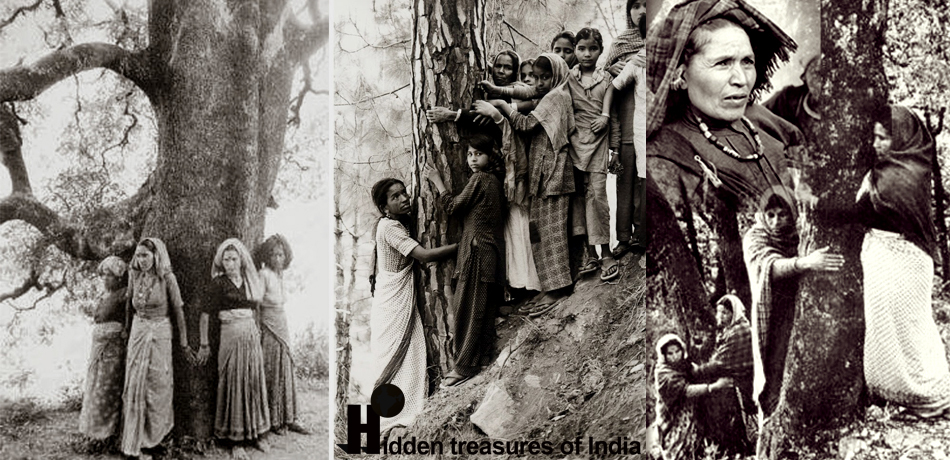
No single event defines Bishnoi identity more than what happened at Khejarli in September 1730. Maharaja Abhai Singh of Marwar had ordered his men to fell green khejri trees near the village to burn lime for a new palace. Cutting a living tree is a direct violation of Bishnoi principle, and a local woman, Amrita Devi, confronted the royal party. When they refused to stop, she is remembered to have embraced a tree and declared that a severed head was a fair price for a saved tree and was beheaded along with her three daughters as they followed her example.
Word spread to eighty-three neighbouring Bishnoi villages. Community members gathered at Khejarli and resolved that for every tree cut, one person would offer their life in its place. By the time the Maharaja called off the felling and personally apologised, 363 Bishnois from 49 villages had died. He subsequently issued a royal decree, inscribed on copper plate, permanently banning the felling of trees and hunting of animals within Bishnoi village boundaries a protection that, remarkably, still holds informal force today. The Government of India recognises 11 September as National Forest Martyrs' Day in memory of the sacrifice, and the event is widely cited as a direct inspiration for the Chipko movement of the 1970s.
The Genetic Backdrop:
Northwest Indian Ancestry Like other populations of Rajasthan, Punjab, and Haryana, Bishnoi ancestry sits within the broader Northwest Indian genetic zone, the region with the highest proportion of steppe pastoralist ancestry found anywhere in South Asia, layered on top of the older Iranian-related farmer and Ancient Ancestral South Indian (AASI) components shared by all Indians.
| Ancestry Component | Typical Share in NW Indian / Rajasthani Groups | Origin |
|---|---|---|
| Steppe Pastoralist | 15–25% | Bronze Age migrations from the Central Asian steppe, arriving after ~1200 BCE |
| Iranian-Related Farmer | 40–50% | Ancient farming-linked ancestry related to, but distinct from, Zagros/Iranian Neolithic populations |
| AASI (Ancient Ancestral South Indian) | 30–40% | he indigenous South Asian lineage present in the subcontinent for 50,000+ years |
Because Bishnoi families are drawn from Jat and Rajput lineages of Marwar, their expected ancestry profile falls within these same ranges among the higher steppe-ancestry populations of India, alongside other Jat, Rajput, and Khatri groups of the northwest.
Y-Chromosome Lineages:
What Jat and Rajput Studies Show No dedicated Y-DNA or genome-wide study of the Bishnoi community as a distinct population has been published to date. However, because the community is overwhelmingly composed of Jat and Rajput families, published haplogroup studies of these groups offer the closest available proxy for Bishnoi paternal lineages.
● A 2017 study analysing 302 Y-chromosome haplotypes from Jat men in India and Pakistan found that the population's paternal lineages trace to at least nine different ancestral source regions, rather than a single common ancestor.
● Haplogroup L, linked to the Pamir Knot region of Central Asia, was the most frequent lineage identified, at roughly 37% of the sample. ● Haplogroup R including R1a subclades associated with Bronze Age steppe migrations was the second most common, at roughly 29%.
● Smaller proportions of haplogroups J2, R2, H, G, and others were also present, reflecting West Asian and long-resident South Asian contributions.
● Studies of Rajput populations show a broadly similar picture: a mix of R1a (steppe-linked), J2, L, and other lineages, with meaningful variation from clan to clan and region to region
. The overall conclusion from this body of research is that neither Jats nor Rajputs and by extension the Bishnoi drawn from them descend from one single ancestral population. Their Y-DNA is a composite shaped by millennia of migration, settlement, and admixture across northwestern South Asia.
Five Centuries of Community Endogamy: A Modest Founder Effect
What genetics can meaningfully say about the Bishnoi is less about deep ancestry and more about recent population structure. Since 1485 CE, Bishnoi families have tended to marry within the community, a practice reinforced by shared religious identity, dietary and lifestyle rules, and geographic concentration in the same districts of western Rajasthan for roughly 20–25 generations.
In population genetics, this kind of sustained in-group marriage can produce a mild “founder effect”: certain gene variants carried by the sect's early followers become more common in the present-day community simply through repeated inheritance, while the population as a whole remains genetically close to its Jat and Rajput source groups. This is a very different scale of isolation from India's older endogamous castes and tribal groups, some of which have married within a few thousand individuals for well over a thousand years and show much stronger drift and elevated rates of recessive genetic conditions as a result. A religious community founded five centuries ago, drawing from a large regional gene pool and continuing to number in the hundreds of thousands, would be expected to show, at most, a subtle version of this effect.
Confirming this would require a dedicated genome-wide study comparing Bishnoi individuals against neighbouring Jat and Rajput populations of Marwar research that, as of 2026, does not yet appear to have been published in the peer-reviewed literature.
How Bishnoi Ancestry Likely Compares to Other Indian Populations
| Population | Estimated Steppe-Related Ancestry | Note |
|---|---|---|
| South Indian Tribal Groups | Minimal | Highest AASI, lowest steppe ancestry in India |
| South Indian Non-Brahmin Groups | Low | Predominantly Iranian-related + AASI ancestry |
| North Indian Non-Brahmin Groups | Moderate | Intermediate steppe ancestry |
| Jat, Rajput & Bishnoi (Rajasthan/Marwar) | Moderate to High | Reflects Northwest Indian agro-pastoral and lineage history |
| Northwest Indian Groups (broadly) | Highest in South Asia | Greatest proportion of Bronze Age steppe ancestry on the subcontinent |
Folklore and Oral Tradition:
Bishnoi villages carry a rich body of oral legend built around Jambhoji's life. Stories recount his childhood silence being broken only when he began speaking in spiritual verse; his years as a herdsman during which he is said to have communed easily with wild animals; and miracles performed during the famine years that convinced sceptical villagers of his teachings. The Samrathal Dhora dune itself is treated as hallowed ground, described in oral tradition as the place where the earth "listened" to the Guru's first sermon.
Animal folklore is especially strong. Blackbuck and chinkara (Indian gazelle) feature in numerous village stories as creatures under the personal protection of the Guru, explaining why these animals today graze undisturbed in Bishnoi fields and will approach villagers without fear a relationship visitors to the region often remark upon as genuinely unusual for wild ungulates. Similarly, the khejri tree is spoken of less as vegetation and more as kin, sometimes referred to in village speech as the "Kalpavriksha," the wish-fulfilling tree of Hindu cosmology, on account of how thoroughly desert life depends on it for shade, fodder, and fuel.
Beliefs and Religious Practice:
Bishnoism sits within the wider Vaishnava tradition of Hinduism devotion centres on Vishnu, worshipped in the local dialect as "Vishan." The core theology blends monotheistic devotion with an ethic in which ecological restraint is treated as inseparable from spiritual discipline: harming a tree or an animal is understood as a lapse in devotion, not merely bad conduct.
The 29 principles are traditionally grouped into four broad clusters:
Eight principles concerned with preserving biodiversity and encouraging responsible animal husbandry prohibiting the felling of green trees, the killing of animals, and even the castration of bulls.
Seven principles guiding social conduct honesty, contentment, forgiveness, and abstention from intoxicants.
Ten principles concerned with personal hygiene and health a daily pre-dawn bath, use of filtered water and milk, and periods of ritual segregation around childbirth and menstruation, framed as measures for maternal and community health in a resource-scarce environment.
Four principles concerned directly with daily worship praying twice a day, performing the evening aarti, observing a fast on each Amavasya (new moon), and conducting a havan (fire ritual) withdevotion.
Daily practice for observant Bishnois includes morning and evening prayer, and vegetarianism is treated as non-negotiable — meat, along with several vegetables considered to require killing a living plant outright (such as certain root vegetables when uprooted destroys the whole plant) are avoided by especially devout members, alongside a strict avoidance of alcohol and tobacco. Cremation grounds and daily rites also carry distinct customs: burial is traditionally practised in some contexts rather than cremation, echoing older ascetic Vaishnava practice, though this varies by region and family.
Prayers and Worship
Worship centres on the Shabadwani, whose 120 verses are recited or sung, often to simple devotional melodies, during morning and evening prayer and at community gatherings. A commonly cited devotional refrain associated with the sect is an invocation to Vishnu urging the devotee toward mindfulness of God in daily life. Aarti the ritual offering of a lit lamp accompanied by devotional song is performed in the evening in most Bishnoi households and at temples, and the fire ritual (havan) is conducted on important occasions with the stated intention of collective welfare rather than personal gain.
Festivals and Important Dates
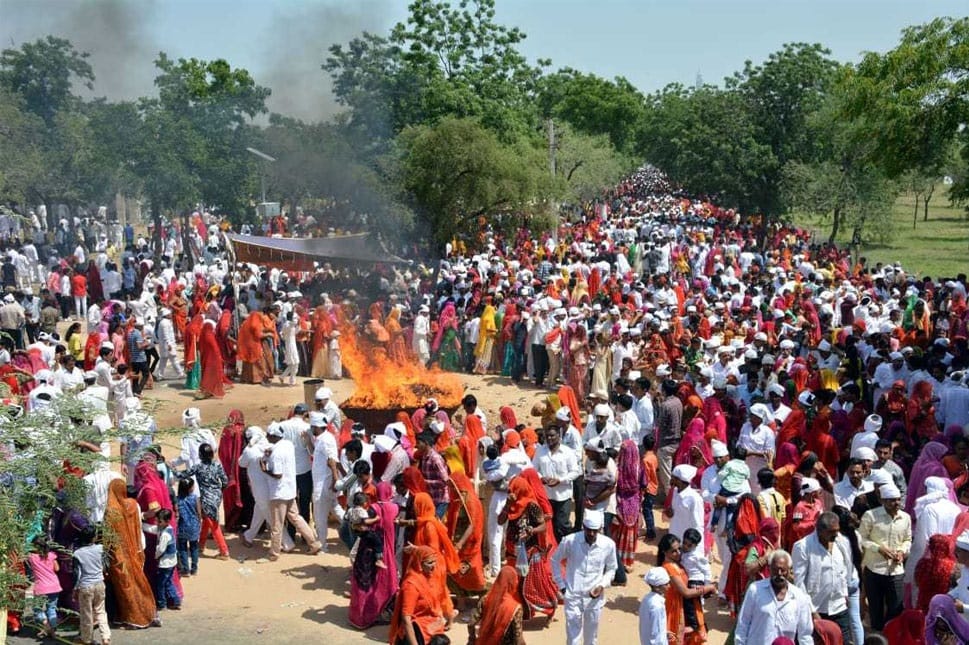
The Bishnoi calendar is built around the lunar cycle, with the Amavasya (new moon) of every month treated as a fasting day. Two dates carry special weight:
Phalgun Amavasya (typically February–March): the larger of the two annual fairs (melas) held at Mukam, drawing several hundred thousand pilgrims from across northern India to the samadhi of Guru Jambheshwar and to Samrathal Dhora.
Asoj (Ashwin) Amavasya (typically September–October): the smaller of the two Mukam fairs, said to have been instituted by a disciple, Vilhoji, in the 17th century.
11 September: observed in memory of the Khejarli martyrs, and recognised nationally as Forest Martyrs' Day.
Pilgrims visiting Mukam also travel to Pipasar, Jambhoji's birthplace, as part of the same circuit. Beyond these sect-specific occasions, Bishnoi households also observe mainstream Hindu festivals such as Holi and Diwali, adapted to the community's vegetarian and abstemious customs.
Sub-Sects, Gotras, and How They Formed
A distinguishing feature of Bishnoi society is that it was never a single caste absorbing converts from one background it drew members from across the existing social spectrum of Rajasthan and neighbouring regions. Historical accounts (including 19th and early 20th-century colonial-era ethnographic surveys) record that Bishnoi identity was adopted by people originally belonging to Jat,Bania (merchant), Brahmin, Rajput, Ahir, Sonar (goldsmith), Khati (carpenter), Chauhan, and other groups. On accepting the 29 principles, converts typically dropped their earlier caste names and identified simply as Bishnoi.
This convert-origin explains two features of Bishnoi social organisation that might otherwise seem contradictory for a sect founded partly in reaction against caste discrimination:
1. Endogamous sections by origin. In several regions, particularly Punjab and parts of northern India, descendants of converts from a given original background have tended to marry among themselves Jat-origin Bishnois marrying other Jat-origin Bishnois, and so on producing loosely observed internal divisions even though the sect formally treats all members as equals.
2. A gotra (clan) system. Bishnois retain an inherited clan structure reportedly numbering some 360 gotras, including Godara, Pawar, Khichore, Dhaka, Biria, and others carried over from the caste system their ancestors belonged to. Marriage within one's own gotra is prohibited, mirroring the exogamy rules of the broader Hindu caste milieu, even though Bishnoism itself explicitly rejected caste hierarchy as a discriminatory practice.
In effect, the "sub-sects" of the Bishnoi are not doctrinal splits there is no significant theological schism within the Panth but social strata inherited from the very caste backgrounds the faith asked its followers to set aside. Conversion into the community in the classical sense is now rare, though the sect in principle remains open to anyone willing to adopt its 29 principles.
Language:
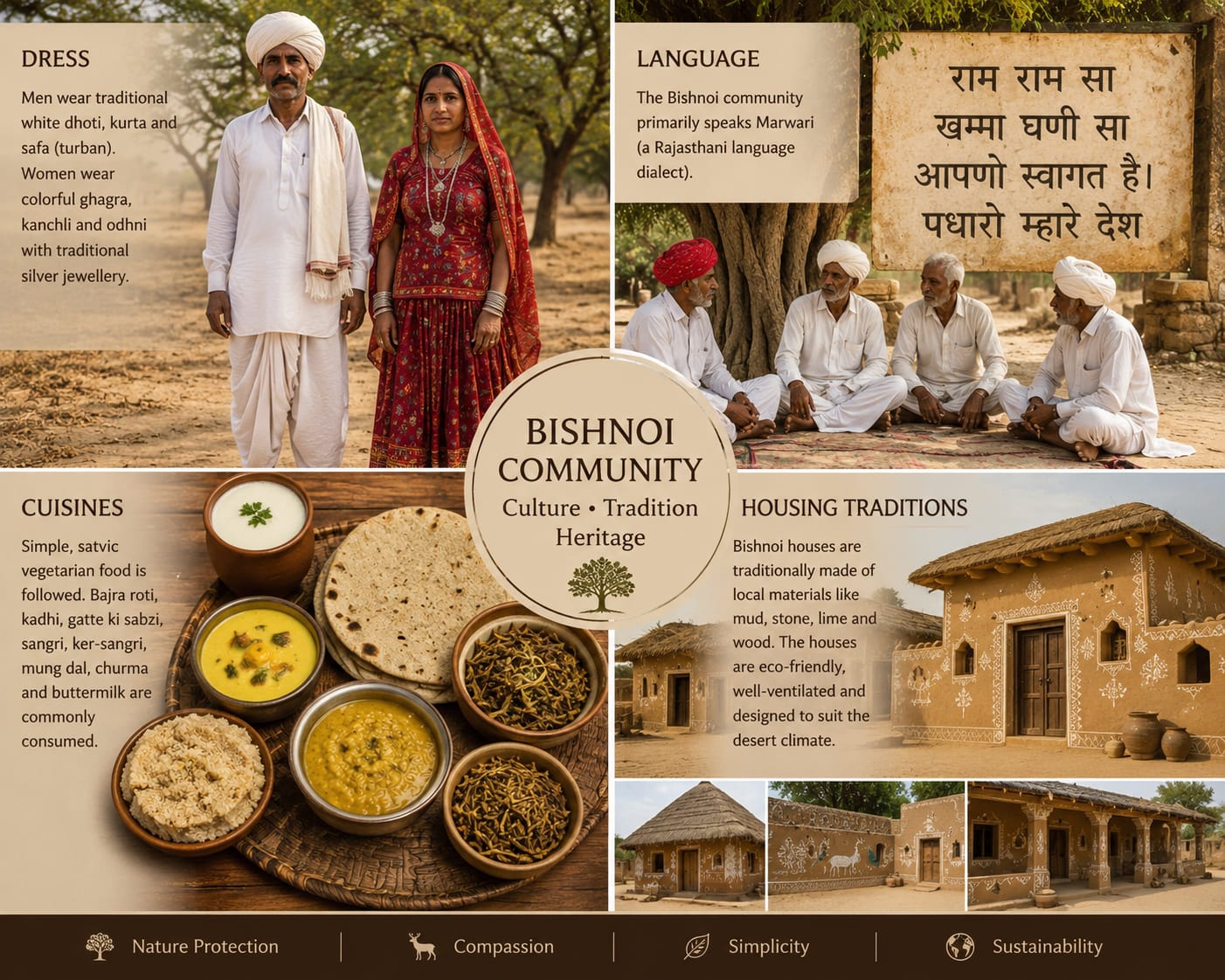
Bishnois are concentrated in a linguistically layered belt of northern India, and most are multilingual as a matter of daily life. Marwari (and its Bagri/Bikaneri dialects) is the dominant home language in Rajasthan, alongside standard Hindi for education, administration, and media. In Haryana and Punjab, Bishnoi communities commonly speak Haryanvi and Punjabi respectively, while retaining Marwariinflected vocabulary tied to religious practice and older generations. Devotional literature the Shabadwani in particular is preserved and recited in an older form of Marwari-Rajasthani, giving the language a role akin to a liturgical register distinct from everyday speech.
Dress:
Traditional Bishnoi dress is shaped directly by desert climate and by the community's agrarian lifestyle. Men typically wear a dhoti or loose pyjama with a long angrakha or kurta, and a turban (safa or pagri), whose colour and style of tying can indicate region, occasion, or marital status. Women traditionally wear the ghagra (a long, gathered skirt), an odhni or chunri (veil/wrap), and a fitted kanchli or kurti, typically in vivid colours red, yellow, and orange are considered auspicious with heavy silver jewellery at the neck, wrists, ankles, and ears, an ornamentation style shared broadly with other Rajasthani agrarian communities. The overall silhouette — loose, layered, and light-coloured orreflective in the case of festive wear is well suited to reflecting heat and allowing air circulation in the desert.
Cuisine:
Bishnoi cuisine follows strict lacto-vegetarian principles, shaped by what the desert can reliably grow and by the sect's prohibition on unnecessary harm to living things. Staples include bajra (pearl millet), the community's principal monsoon crop, ground into rotis or porridge, and legumes such as moong and moth beans. The khejri tree contributes directly to the table: its beans, dried and cooked, form sangri, the base of ker sangri, a signature Rajasthani-Bishnoi dish combining khejri beans with ker berries in a spiced, tangy preparation designed to keep well in desert heat without refrigeration. Dairy milk, buttermilk (chaas), and ghee from cattle and camels features heavily, both as food and as an item with ritual significance, since milk is one of the substances the 29 principles specifically direct followers to keep filtered and clean. Onion and garlic are avoided by many observant households in line with broader Vaishnava dietary custom, and alcohol is prohibited outright.
Housing Traditions:
Bishnoi settlement patterns reflect both the ecology of the Thar and the community's environmental ethic. Villages are traditionally organised as small hamlets called dhannis, clusters of a few round mud huts rather than large concentrated townships, allowing cattle-keeping households room to manage livestock and fields without overcrowding scarce grazing land. The huts themselves round or oval with thatched, conical roofs are built to shed heat efficiently; walls and floors are plastered with a mixture of mud and cow dung, valued for its insulating properties and its effectiveness in keeping insects and vermin at bay. Interiors typically include a small granary for stored grain and a sump or pit for water storage, both essential given the region's unpredictable rainfall. Trees, particularly khejri, are deliberately left standing around and within homesteads, doubling as windbreaks against sand erosion and a fallback source of fodder during drought years village planning, in effect, doubling as conservation practice.
Physical Characteristics:
Because the Bishnoi community absorbed converts from Jat, Rajput, Bania, Brahmin, and artisan castes across Rajasthan, Haryana, and Punjab, there is no single distinct physical "type" associated with the group in the way there might be for a genuinely isolated tribal population. Members generally share the general phenotypic range common to north-western Indian and Rajasthani populations build, complexion, and features consistent with their Jat, Rajput, or other originating communities rather than any trait unique to Bishnois as such. Popular accounts sometimes describe Bishnois as robust and weather-hardened, a plausible reflection of generations of agro-pastoral life in a harsh desert environment, but this is a lifestyle-linked observation rather than a documented genetic distinction.
Genetics:
It is worth being precise about what is and is not known here. The Bishnoi are not a tribal or biologically isolated population in the anthropological sense they are a multi-origin religious sect assembled over five centuries from Jat, Bania, Brahmin, Rajput, Ahir, Sonar, Khati, and other communities of Rajasthan and its neighbouring regions. That founding history is itself the most important "genetic" fact about them: rather than descending from a single ancestral population, Bishnois carry forward the genetic diversity of whichever caste or community their ancestors converted from, layered with roughly 500 years of religious endogamy (marriage largely within the Panth, and in some regions within originbased sub-groups) combined with continued clan (gotra) exogamy.
No large-scale, dedicated population-genomic study of Bishnois as a distinct group appears to have been published to date. What exists instead is a broader body of research on Rajasthani and northwestern Indian populations generally studies of Jat, Rajput, Brahmin, and other groups using autosomal STR markers, Y-chromosome and mitochondrial DNA haplogroups which consistently finds that Rajasthani populations, while showing measurable differentiation between endogamous groups, remain genetically close to and continuous with the wider Indian gene pool rather than forming sharply bounded clusters. Given that Bishnois are drawn from exactly these same source populations, the reasonable inference is that they would show a similar pattern: internal diversity reflecting their castes of origin, some degree of genetic drift from five centuries of religious endogamy, but no wholesale genetic distinctiveness setting them apart as a population isolate. This remains, properly speaking, an open question for future population genetics research rather than a settled finding a notable gap given how well-documented the community's social and cultural history is by comparison.
Geographic Distribution:
The historical heartland of the Bishnoi community is western Rajasthan particularly the Jodhpur, Bikaner, Nagaur, and Churu districts of the Thar Desert region, along with the Ganganagar and Hanumangarh belt. Significant populations are also established in Haryana and Punjab (where Bishnoi households are often noted as comparatively prosperous landowners), and smaller numbers are found in Madhya Pradesh, Uttar Pradesh, and Gujarat. Population estimates vary considerably by source and by year, ranging from roughly 600,000 to well over a million, reflecting both the difficulty of counting a religiously-defined rather than administratively-defined group and genuine population growth over recent decades.
Diaspora:
Bishnoi migration beyond India has followed the same broad channels as other Rajasthani and northIndian agrarian communities labour and business migration to the Gulf states, and family settlement in the United States, Canada, the United Kingdom, and Australia over the past few decades. Diaspora Bishnoi associations in these countries generally organise around maintaining the Mukam pilgrimageconnection, funding temple and gaushala (cattle shelter) projects back in Rajasthan, and marking the two annual melas and Forest Martyrs' Day with community gatherings abroad. Compared to older, more institutionally organised diasporas from South Asia, the Bishnoi diaspora is smaller and more recent, and much of its associational life still runs through kinship and village-of-origin networks rather than large formal federations.
Social Contributions:
The community's most visible modern contribution remains environmental. The Bishnoi Tiger Force, formed in the late 1990s in the aftermath of a high-profile poaching case involving protected blackbuck near a Bishnoi village, has since registered hundreds of poaching complaints and works alongside forest department officials on night patrolling against wildlife crime in Rajasthan and Punjab's Abohar sanctuary belt. Community-run rescue centres for injured wildlife deer, blackbuck, birds are common in Bishnoi-dominated areas, staffed largely by volunteers. Individual conservationists from the community, such as the late Radheshyam Bishnoi, who worked for years documenting threats to the critically endangered Great Indian Bustard before his death in 2025, have drawn national recognition, including the Sanctuary Nature Foundation's Young Naturalist Award.
Beyond conservation, Bishnoi villages are frequently cited in agricultural and rural-development literature for relatively strong practices around water conservation (traditional johads and step-wells), afforestation, and cattle welfare, several of which predate and arguably anticipated present-day sustainable-development vocabulary by centuries.
Prominent Figures:
Guru Jambheshwar (1451–1536) — founder of the Panth and author of the Shabadwani.
Amrita Devi (c. 1700–1730) — the Khejarli martyr whose sacrifice remains the community's defining moral reference point, commemorated today through the Amrita Devi Bishnoi Wildlife Protection Award.
Rampal Bhawad — advocate and co-founder of the Bishnoi Tiger Force, a leading figure in the community's modern wildlife-law activism.
Radheshyam Bishnoi (d. 2025) — wildlife conservationist known for his work protecting the Great Indian Bustard in the Thar.
Ravi Bishnoi (b. 2000) — international cricketer from Jodhpur, a leg-spin bowler who has represented India in T20 and ODI cricket, among the community's most visible present-day public figures in sport.
The Community Today:
The present-day Bishnoi occupy an interesting position: a rural, agriculturally rooted community whose younger generations are increasingly moving into engineering, government service, law, and the armedforces, while the sect's core environmental ethic has, if anything, gained relevance rather than faded. Villages continue to enforce informal social sanction against tree-felling and hunting well beyond what state wildlife law requires, and the twice-yearly Mukam melas remain large enough to function as a genuine census moment for the diaspora as well as the settled population. Whether examined through folklore, ritual, dress, cuisine, or their long-running legal campaigns against poaching, the throughline across five centuries is remarkably consistent: an ethic in which the desert's other inhabitants trees, deer, birds are treated not as resources to be managed but as members of the same moral community as the people who share their land with them.
Frequently Asked Questions
Are Bishnoi people a separate ethnic group genetically?
No. Bishnoi is a religious identity founded in 1485 CE by Guru Jambheshwar. Genetically, the community is drawn mainly from Jat and Rajput lineages of the Marwar region of Rajasthan, so its ancestry closely mirrors these Northwest Indian populations rather than forming a distinct genetic lineage.
What ancestry do Bishnoi people carry?
Based on studies of the Jat and Rajput populations the community descends from, Bishnoi ancestry is expected to combine Iranian-related farmer ancestry, Ancient Ancestral South Indian (AASI) ancestry, and a moderate-tohigh proportion of Bronze Age steppe pastoralist ancestry — a profile typical of Rajasthan and the wider northwest of the subcontinent.
What Y-DNA haplogroups are common among Bishnoi families?
No haplogroup study has been published specifically on the Bishnoi. Studies of the Jat population, from which most Bishnoi families descend, show haplogroup L as the most common lineage (around 37%), followed by haplogroup R, including steppe-linked R1a subclades (around 29%), with smaller shares of J2, R2, H, and other lineages.
Has 500 years of community marriage made Bishnoi genetically distinct?
Possibly to a small degree, though this has not been directly measured. Sustained in-group marriage since 1485 CE could have produced a mild founder effect, but because the community was founded from a large regional population and remains several hundred thousand strong, any resulting genetic distinctiveness would likely be modest compared with India's much older endogamous castes and tribal isolates.
Can a DNA test show Bishnoi ancestry specifically?
Not as a named category. Because Bishnoi is a religious community rather than a genetically distinct population, consumer DNA tests report ancestry in terms of broader components such as Northwest Indian, Iranian-related, AASI, and steppe ancestry. A Bishnoi individual's results would be expected to resemble those of other Jat and Rajput populations from Marwar.
Conclusion:
The Bishnoi community's story is a reminder that not every distinct Indian community is a distinct genetic lineage. Founded on a shared code of conduct rather than shared descent, the Bishnoi carry the ancestry of the Jat and Rajput populations of Marwar from which Guru Jambheshwar drew his followers in 1485 CE a blend of Iranian-related farmer, AASI, and steppe pastoralist ancestry typical of Northwest India. What may genuinely distinguish the community is five centuries of relatively closed-community marriage, a modest founder effect that, so far, remains to be measured directly. Until a dedicated genetic study of the Bishnoi is published, the clearest picture of their DNA comes from the wider Rajasthani populations whose history they share.