

Gujar Community
Discover the rich history, diverse culture, and ancestral roots of the Gurjar community in India, Pakistan, and Afghanistan.
The Gurjar Community
History, Culture, and Identity of a Pastoral and Agrarian Community of South Asia
1. Introduction: Who Are the Gurjars?
The Gurjar (also spelled Gujjar, Gujar, or Gurjara) are a large and historically significant ethnic and agro-pastoral community of the Indian subcontinent, found principally in India, Pakistan, and Afghanistan. Traditionally engaged in agriculture, cattle and buffalo herding, and, among some groups, seasonal pastoral migration (transhumance), the Gurjars form one of the most widely distributed communities in northern and western South Asia, divided internally into numerous clans and sub-groups.
The community is religiously and linguistically diverse. While a majority of Gurjars in India are Hindu, a substantial number, particularly in Jammu and Kashmir, Himachal Pradesh, Pakistan, and Afghanistan, are Muslim, and a small number are Sikh. Many Gurjars retain their own language or dialect, known as Gojri (also called Gujari), alongside the regional languages of the areas in which they live.
This profile draws on published historical scholarship and government records to summarise what is reliably known about the community's origins, geographic spread, social organisation, customs, cuisine, folklore, and notable members, while noting that historians continue to debate several aspects of early Gurjar history.
2. Origins and Early History
The precise origins of the Gurjars have long been debated by historians and remain an open question in South Asian historiography. Several theories have been proposed:
- Indigenous origin theory: One scholarly view holds that the ancestors of the Gurjars were present in northwestern India (present-day Rajasthan and Gujarat) from around the early centuries of the Common Era, where they were gradually accorded high social status.
- Association with the Gurjaradesa kingdom: Most historians trace the emergence of a distinct Gurjar identity to the rise of a Gurjara kingdom in present-day Rajasthan and Gujarat around the 6th century CE, from which the community is believed to have dispersed to different parts of the subcontinent.
- Central Asian migration theory: An older theory suggested that the Gurjars migrated from Central Asia in the early medieval period, possibly linked to the Hephthalites (or “White Huns”); this view is treated by most contemporary historians as speculative and not firmly established.
The earliest known textual reference to the term “Gurjara” appears in the Harshacharita, a 7th-century biography of the north Indian emperor Harshavardhana written by the court poet Banabhatta, which refers to a Gurjara king or kingdom. Inscriptions of the Gurjaras of Lata, a dynasty based at Bharuch in Gujarat, claim rule in that region from as early as the 5th century CE.
Between the 6th and 10th centuries CE, present-day Rajasthan and Gujarat were known as Gurjaratra or Gurjarabhumi (“land of the Gurjars”), and it is from this name that the modern state of Gujarat derives its own name. During this period, several Gurjara dynasties rose to prominence in northern and western India, including the Gurjara-Pratihara dynasty, one of the major powers of early medieval North India. Historians differ on the precise relationship between these ruling dynasties and the ancestors of today's Gurjar community, and this remains a subject of ongoing academic discussion rather than settled fact.
After the decline of the major Gurjara dynasties following the 10th century CE, historical records continue to mention Gurjar chieftains, landholders, and warrior groups across northern India through the medieval and Mughal periods. Districts such as Saharanpur in present-day Uttar Pradesh were historically known as Gurjargadh owing to the presence of numerous Gurjar landholders (zamindars) in the area, and several forts and small principalities in the Meerut, Bulandshahr, Saharanpur, and Gwalior-Chambal regions are associated with Gurjar chiefs of the 18th and 19th centuries.
3. Geographic Distribution Today
Gurjars today are spread across a wide geographic area encompassing India, Pakistan, and Afghanistan, with regional communities adapted to very different environments — from the desert and agricultural tracts of Rajasthan to the high Himalayan pastures of Jammu and Kashmir and Himachal Pradesh. The table below summarises the community's principal regional presence:
| Country / Region | Predominant Faith | Main Occupation Today |
|---|---|---|
| Rajasthan, Haryana, Gujarat, Delhi, Madhya Pradesh, Maharashtra (India) | Predominantly Hindu | Agriculture, dairying, government service, business |
| Jammu & Kashmir and parts of Himachal Pradesh (India) | Predominantly Muslim, some Hindu | Transhumant pastoralism (buffalo herding), agriculture |
| Uttarakhand (Van Gujjars) and Uttar Pradesh (India) | Muslim (Van Gujjars) and Hindu | Forest-based pastoralism, dairying, agriculture |
| Punjab and Khyber Pakhtunkhwa (Pakistan) | Predominantly Muslim | Agriculture, herding, urban trades and services |
| Northeastern provinces (Afghanistan) | Predominantly Muslim | Pastoralism and small-scale farming |
Within India, Hindu Gurjars are found mainly in Rajasthan, Haryana, Gujarat, Madhya Pradesh, Delhi, western Uttar Pradesh, Punjab, and Maharashtra, while Muslim Gurjar communities are concentrated in Jammu and Kashmir, parts of Himachal Pradesh, and the Himalayan foothills of Uttarakhand, where the semi-nomadic Van Gujjars (“forest Gurjars”) practise seasonal transhumance with herds of water buffalo between the Shivalik foothills in winter and high alpine pastures in summer. In Pakistan, Gurjars form a significant population in Punjab province, giving their name to cities such as Gujranwala, Gujrat, and Gujar Khan, and are also present in Khyber Pakhtunkhwa and Azad Kashmir. In Afghanistan, Gurjar communities are found in the northeastern provinces, including Kapisa, Baghlan, Badakhshan, and Nuristan, and were officially recognised as one of the country's ethnic groups under its former constitution.
India's 2011 Census recorded close to 1.5 million Gurjars (together with the related Bakarwal community) in Jammu and Kashmir alone, making it one of the largest concentrations of the community in the country.
4. Social Structure and Clans
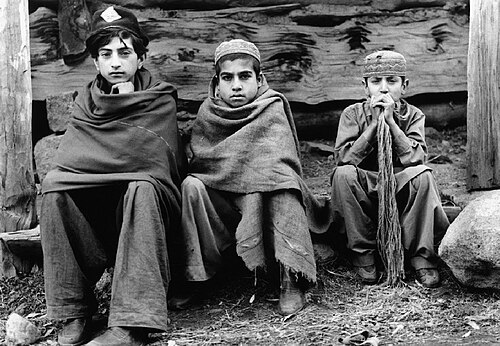
Gurjar society is traditionally organised into numerous exogamous clans, known as gotras among Hindu Gurjars, which regulate marriage alliances (members of the same gotra generally do not marry one another) and provide a shared sense of lineage and identity. Well-documented clan names include Bhati, Chauhan, Kasana, Khatana, Chechi, Panwar, and many others, some of which are associated with the names of historical rulers or regions.
Kinship, clan loyalty, and respect for elders are central to traditional Gurjar social life, and important community decisions, including matters relating to marriage customs and social conduct, have historically been discussed and resolved through community assemblies known as panchayats or, for larger gatherings, mahapanchayats. In Haryana, for instance, community assemblies have periodically set guidelines for the conduct of weddings and other social functions.
Occupationally, the community has historically combined agriculture with animal husbandry; in and around Delhi and northern India, Gurjars have long combined settled cultivation with cattle and buffalo herding and the sale of milk, while in the Himalayan regions pastoralism and dairying remain the primary livelihood for many families.
5. Religion and Language
Gurjars practise several faiths. The majority in India are Hindu, worshipping a range of deities including Surya (the sun god), Shiva, and the goddess Bhavani; Gurjars of North Gujarat, western Rajasthan, and Punjab also traditionally worship the goddess Sitala. A distinctive feature of Rajasthani Gurjar religious life is devotion to Devnarayan, a folk deity venerated as an incarnation of Vishnu (described further in Section 8). A significant proportion of Gurjars, especially in Jammu and Kashmir, Pakistan, and Afghanistan, are Muslim, and there is also a small Sikh Gurjar population.
Many Gurjars, across religious lines, speak Gojri (also spelled Gujari or Gurjari), an Indo-Aryan language with its own oral literary tradition of folk tales, proverbs, and poetry, alongside the dominant regional languages of the areas where they live, such as Hindi, Rajasthani, Punjabi, Urdu, and Pashto.
6. Culture, Customs, and Social Life
Gurjar culture places strong emphasis on hospitality, community solidarity, and the maintenance of family and clan ties. Music and oral performance occupy an important place in community life: Gurjar Goth, a form of collective chant-like singing performed by men and women, often narrates episodes from the Devnarayan epic, while Gojri-speaking communities maintain their own repertoire of folk songs such as Chann and Mahia, traditionally performed with instruments including the algoza (a double flute) and the jori (a paired drum).
Seasonal festivals such as Teej and Vasant (spring) are occasions for communal singing and dance, particularly among women, and embroidery is a valued domestic art, with women decorating clothing and household textiles with intricate needlework.
The community has, in recent decades, also placed growing emphasis on social reform in areas such as the discouragement of dowry practices at community assemblies, reflecting a broader trend toward simplifying wedding expenses in many parts of rural India.
7. Traditional Dress, Cuisine, and Dairying
Dress and Ornaments
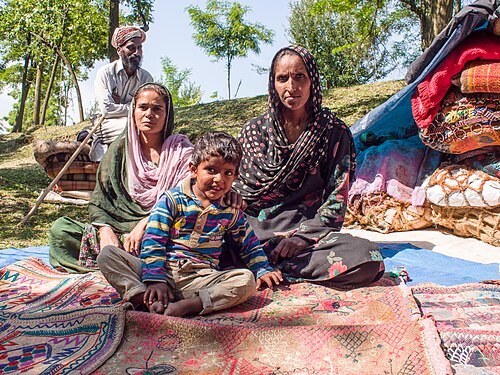
Traditional Gurjar dress varies by region but commonly includes the pagh (a turban) and tehmad (a wrapped lower garment) for men in the Himalayan regions, along with a long, flowing beard traditionally dyed with henna among some Muslim Gurjar elders. Women traditionally wear colourful garments, often with cotton or wool fabrics suited to a pastoral, outdoor life, and adorn themselves with ornate jewellery, including distinctive heavy earrings that remain a recognisable marker of Gurjar identity in parts of Rajasthan.
Cuisine
Gurjar cuisine reflects the community's long-standing pastoral and agrarian occupations, with dairy products occupying a central place in the everyday diet. Milk, buttermilk (lassi), yoghurt (dahi), butter, ghee, and regional dairy specialities such as kalari and churpi are staples, reflecting the community's traditional livelihood as cattle, buffalo, sheep, and goat herders. In the plains and agricultural tracts, staple foods include makki ki roti (maize flatbread) served with sarson ka saag (mustard greens), along with wheat- and millet-based breads. Many Gurjar communities, particularly in the northern plains, have traditionally followed a largely vegetarian diet centred on dairy, cereals, and vegetables, though dietary practices vary by region and religion.
Livelihood and Dairying
Dairy farming remains one of the community's most enduring economic contributions. In many parts of northern India, local households continue to rely on Gurjar herders for fresh milk, curd, butter, and paneer, and the community's traditional knowledge of animal husbandry, herd management, and seasonal grazing patterns (particularly among transhumant groups such as the Van Gujjars and the Gujjars and Bakarwals of Jammu and Kashmir) reflects generations of accumulated ecological expertise.
8. Folklore and Religious Tradition: The Epic of Devnarayan
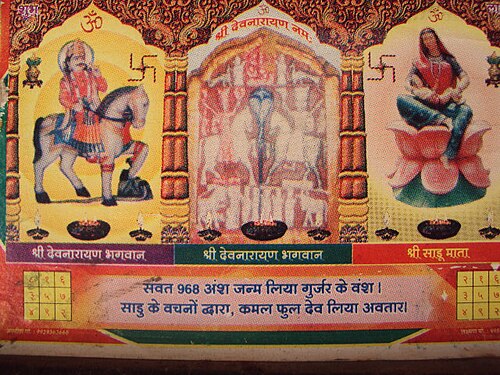
One of the richest expressions of Gurjar oral tradition is the epic of Devnarayan (also written Devnarayan ji), a folk deity of Rajasthan revered by the Gurjar community as an incarnation of the god Vishnu. According to tradition, Devnarayan was born to Sawai Bhoj Gurjar and Sadu Mata in the Gurjar community and is remembered as a warrior and protector who used his strength for public welfare.
The story of Devnarayan is preserved and transmitted through one of the longest oral epics of Rajasthan, comprising several hundred songs traditionally performed across many nights by professional priest-singers known as Bhopas. The Jamat Bhopas associated with the Devnarayan tradition are drawn specifically from the Gurjar community. In performance, the epic is often accompanied by a phad, a large painted scroll depicting scenes from Devnarayan's life, which the Bhopa unrolls and narrates to an audience, sometimes accompanied by a stringed instrument called the jantar.
Devnarayan's principal temple stands at Asind in the Bhilwara district of Rajasthan, on the banks of the Khari river, and a major fair is held there each year at Makar Sankranti; another significant shrine is located at Jodhpuriya in Tonk district. These sites remain important pilgrimage destinations for the Gurjar community and draw devotees from across Rajasthan and neighbouring states.
9. Marriage Customs
Marriage among Gurjars traditionally follows clan-exogamous rules, meaning that individuals marry outside their own gotra, and alliances are often arranged with the involvement of extended family and community elders. Weddings are important social occasions marked by community participation, and in several regions, community assemblies (panchayats and mahapanchayats) have in recent decades issued guidelines aimed at simplifying wedding expenses and discouraging dowry, reflecting the community's continuing emphasis on collective social norms.
10. Education, Livelihood, and Socioeconomic Profile
Historically a community of agriculturists, cattle-keepers, and, among some groups, semi-nomadic pastoralists, Gurjars have diversified considerably over the past century into government service, the armed forces, business, and the professions, while dairying and agriculture remain important livelihoods, especially in rural Rajasthan, Haryana, Uttar Pradesh, and the Himalayan states. In the Himalayan regions of Jammu and Kashmir and Himachal Pradesh, many Gurjar families continue to follow a traditionally nomadic and pastoral way of life, migrating seasonally with their herds between valley and high-altitude pastures.
11. Notable Figures
The Gurjar community has produced individuals of distinction in military service, folk religion, and public life. A few well-documented examples include:
- Devnarayan ji — a Rajasthani folk deity and warrior-hero of the Gurjar community, venerated as an incarnation of Vishnu and central to one of Rajasthan's major oral epic traditions (see Section 8).
- Sepoy Kamal Ram, VC (1924–1982) — born into a Gurjar family in Bholupura, Karauli district, Rajasthan; serving with the 8th Punjab Regiment of the British Indian Army during the Second World War, he was awarded the Victoria Cross, the highest British and Commonwealth award for gallantry, for actions in Italy in May 1944, becoming one of the youngest Indian recipients of the honour.
- Ram Chandra Vikal — an early Gurjar community political leader from Bulandshahr district, Uttar Pradesh, recognised as one of the first prominent Gurjar leaders in post-independence Indian politics.
- Rajesh Pilot (1945–2000) — an Indian politician from a Gurjar family of Ghaziabad district, Uttar Pradesh, who served as a Union minister, including as Minister of State for Internal Security, in the Government of India.
This list reflects individuals whose community background is well documented in published and encyclopaedic sources; it is illustrative rather than exhaustive, and the community includes many more contributors to military service, public administration, agriculture, and cultural life across India, Pakistan, and Afghanistan.
12. Conclusion
The Gurjars represent one of South Asia's most geographically widespread and historically layered communities — a group whose story runs from the early medieval Gurjara kingdoms of Rajasthan and Gujarat, through centuries of agrarian and pastoral life across the plains and mountains of the subcontinent, to a present-day population spread across India, Pakistan, and Afghanistan and encompassing Hindu, Muslim, and Sikh Gurjars alike. From the painted scrolls and sung epics of Devnarayan in Rajasthan to the seasonal migrations of the Van Gujjars in the Himalayan foothills, Gurjar identity today combines deep-rooted oral tradition, distinct dairying and agricultural livelihoods, and an evolving role in the modern civic, military, and political life of the region.
References
- [1]1. Wikipedia. “Gurjar.” https://en.wikipedia.org/wiki/Gurjar
- [2]2. Wikipedia. “List of Gurjar clans.” https://en.wikipedia.org/wiki/List_of_Gurjar_clans
- [3]3. Wikipedia. “Devnarayan.” https://en.wikipedia.org/wiki/Devnarayan
- [4]4. Wikipedia. “Devnarayan Ki Phad.” https://en.wikipedia.org/wiki/Devnarayan_Ki_Phad
- [5]5. Wikipedia. “Dev Dham Jodhpuriya.” https://en.wikipedia.org/wiki/Dev_Dham_Jodhpuriya
- [6]6. Wikipedia. “Bhopa.” https://en.wikipedia.org/wiki/Bhopa
- [7]7. Wikipedia. “Kamal Ram.” https://en.wikipedia.org/wiki/Kamal_Ram
- [8]8. Wikipedia. “Gurjara.” https://en.wikipedia.org/wiki/Gurjara
- [9]9. Chattopadhyaya, Brajadulal (1994). The Making of Early Medieval India. Oxford University Press.
- [10]10. Puri, Baij Nath (1957/1986). The History of the Gurjara-Pratiharas.
- [11]11. Kothiyal, Tanuja (2016). Nomadic Narratives: A History of Mobility and Identity in the Great Indian Desert. Cambridge University Press.
- [12]12. Census of India, 2001 and 2011. Population data for Jammu and Kashmir. https://censusindia.gov.in/
- [13]13. Dabral, Shweta; Malik, S.L. (2004). “Demographic Study of Gujjars of Delhi: Population Structure and Socio-cultural Profile.” Journal of Human Ecology, 16.
- [14]14. Neuman, Daniel; Chaudhuri, Shubha; Kothari, Komal (2007). Bards, Ballads and Boundaries: An Ethnographic Atlas of Music Traditions in West Rajasthan. Seagull.
- [15]15. Tourism Rajasthan. “Devnarayan Mandir, Asind, Bhilwara.” https://www.tourism-rajasthan.com/devnarayan-mandir.html
- [16]16. Brighter Kashmir. “The Gujjars: A Living Legacy of Culture and Tradition.” https://brighterkashmir.com/the-gujjars-a-living-legacy-of-culture-and-tradition
- [17]17. LEISA India. “Balancing the Old and the New.” https://www.leisaindia.org/balancing-the-old-and-the-new/
- [18]18. Victoria Cross Online. “Kamal Ram VC.” https://victoriacrossonline.co.uk/kamal-ram-vc/