

Sikh Genome Project Community
Explore the Sikh community in India. Discover Sikhism's history, Gurus, core values, langar, & Khalsa. Connect with your identity & heritage.
SIKHISM IN INDIA
History, Faith, Culture, Institutions, Traditions and Contemporary Life
1. Introduction: Who Are Sikhs?
Sikhism, or Sikhi, is an Indian religious tradition that emerged in the Punjab region in the late fifteenth century through the teachings of Guru Nanak and the nine Gurus who followed him. Sikh teaching centres on devotion to the One Divine Reality, remembrance of the Divine Name, truthful living, honest work, sharing with others, service and the equal dignity of human beings. The Sikh tradition recognizes ten human Gurus, from Guru Nanak to Guru Gobind Singh, after which the Guruship was vested permanently in the Guru Granth Sahib.
Sikh identity is fundamentally religious rather than ethnic or genetic. Sikhs in India come from different social, regional and linguistic backgrounds and live in both rural and urban settings. Punjab is the historical and demographic heartland, but Sikh communities are found throughout India, including in Haryana, Delhi, Rajasthan, Uttar Pradesh, Uttarakhand, Jammu and Kashmir, Himachal Pradesh, Maharashtra and many other states. Sikh communities are also established in countries across the world.
The Sikh tradition combines spiritual devotion with active participation in society. The ideal Sikh is not expected to withdraw from ordinary life. Instead, religious discipline is practiced through family life, work, prayer, community participation, charity and service. Institutions such as the gurdwara, sangat and langar make these principles visible in everyday community life.
2. Origins and Early History
Guru Nanak Dev Ji was born in 1469 at Rai Bhoi di Talwandi, now Nankana Sahib in Pakistan. Sikh tradition remembers him as a spiritually searching teacher who challenged empty ritualism and social discrimination while emphasizing remembrance of the One, truthful conduct and compassion. He eventually established a community at Kartarpur, where devotional singing, shared meals, work and collective religious life became important features.
The Sikh tradition developed in the religious and cultural environment of medieval Punjab. The region contained Hindu, Muslim, Bhakti and Sufi communities and traditions. Sikh scripture reflects this diverse environment: the Guru Granth Sahib includes compositions of the Sikh Gurus as well as devotional compositions attributed to Bhagats and other contributors. This does not make Sikhism a mixture of other religions; rather, it reflects the Sikh scriptural emphasis on devotion to the One and the spiritual value of truthful, God-centred teaching.
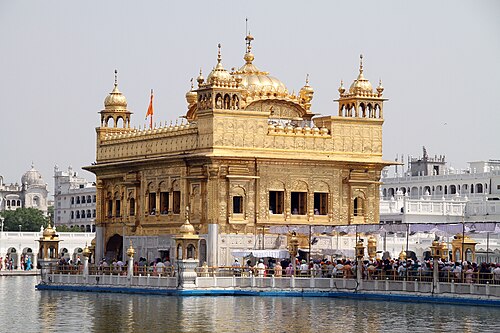
During the sixteenth and seventeenth centuries, the Sikh community developed stronger institutions. The Gurus established centres of congregation, encouraged the singing and preservation of Gurbani, and developed systems of community organization. Amritsar became particularly important, and the sacred pool and central shrine associated with Harmandir Sahib developed into the principal centre of Sikh pilgrimage.
The seventeenth century also involved periods of conflict and persecution. Guru Arjan Dev Ji was executed in 1606 and Guru Tegh Bahadur Ji was executed in 1675. Sikh historical memory regards both martyrdoms as important examples of religious commitment and resistance to injustice. Under Guru Hargobind Ji, the Sikh community increasingly combined spiritual and temporal responsibilities, an idea commonly associated with miri-piri.
3. The Ten Sikh Gurus
| Guru | Principal significance |
|---|---|
| Guru Nanak Dev Ji (1469–1539) | Founder of the Sikh tradition; emphasized devotion to the One, truthful living, honest work, sharing and service. |
| Guru Angad Dev Ji (1504–1552) | Second Guru; associated with the development and standardization of the Gurmukhi script tradition and strengthening of Sikh institutions. |
| Guru Amar Das Ji (1479–1574) | Third Guru; expanded congregational organization and strengthened langar and social equality. |
| Guru Ram Das Ji (1534–1581) | Fourth Guru; founded the settlement that developed into Amritsar and is closely associated with its sacred pool. |
| Guru Arjan Dev Ji (1563–1606) | Fifth Guru; compiled the Adi Granth and developed major Sikh institutions; remembered as the first Sikh Guru to be martyred. |
| Guru Hargobind Sahib Ji (1595–1644) | Sixth Guru; emphasized the integration of spiritual and temporal responsibility, commonly expressed through miri-piri. |
| Guru Har Rai Ji (1630–1661) | Seventh Guru; maintained Sikh institutions and is remembered for compassion and service. |
| Guru Har Krishan Ji (1656–1664) | Eighth Guru; became Guru as a child and is remembered particularly for service to people affected by illness in Delhi. |
| Guru Tegh Bahadur Ji (1621–1675) | Ninth Guru; composed hymns included in the Guru Granth Sahib and is remembered for defending freedom of conscience. |
| Guru Gobind Singh Ji (1666–1708) | Tenth human Guru; established the Khalsa in 1699 and transferred the Guruship to the Guru Granth Sahib. |
Sources: SGPC, Ten Guru Sahibs; standard Sikh historical chronology.
4. Core Teachings and Worldview
Sikh theology begins with belief in one ultimate, timeless and formless Divine Reality. The Mul Mantar at the beginning of the Guru Granth Sahib expresses foundational concepts concerning the One, divine truth, timelessness and grace. Sikh devotion is directed toward the Divine rather than toward a human Guru as a deity.
Three commonly used expressions summarize important aspects of Sikh practice: Naam Japna, remembering and meditating on the Divine Name; Kirat Karni, earning through honest work; and Vand Chhakna, sharing one's resources with others. These ideas place religious life within the household and community rather than requiring monastic withdrawal.
Sikh teachings strongly emphasize equality, humility, compassion, courage and responsibility. The Sikh tradition rejects untouchability and caste hierarchy as religious principles. The communal meal of langar provides a practical expression of equality by bringing people together for food without distinction of caste, religion or wealth.
Seva, or selfless service, is another central value. It can take many forms: preparing food, cleaning a gurdwara, helping elderly people, assisting disaster victims, supporting education or providing other voluntary services. Sikh community organizations in India and abroad frequently use seva as a basis for humanitarian work.
5. Guru Granth Sahib and Gurbani
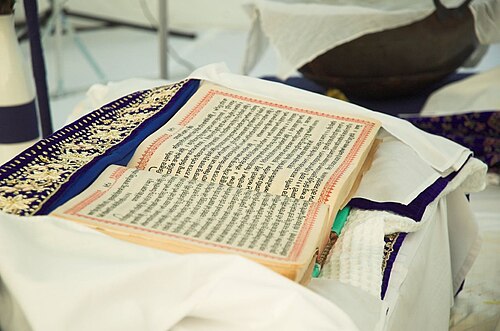
The Guru Granth Sahib is the central scripture of Sikhism and is regarded by Sikhs as the eternal Guru. Guru Arjan Dev Ji compiled the Adi Granth in the early seventeenth century, and it was installed at Harmandir Sahib in 1604. Guru Gobind Singh Ji later included the compositions of Guru Tegh Bahadur Ji and confirmed the scripture as the successor to the line of human Gurus.
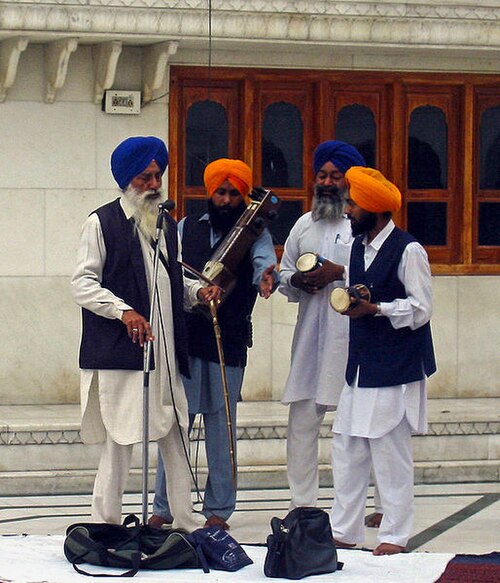
The scripture contains compositions of the Sikh Gurus together with compositions of Bhagats and other contributors. Its hymns are organized extensively by musical ragas, reflecting the importance of music in Sikh worship. Gurbani is therefore commonly sung as kirtan rather than treated only as written literature.
In a gurdwara, the Guru Granth Sahib is installed on a raised platform and treated with great reverence. The congregation may listen to a Hukam, a selected scriptural passage taken as guidance. Reading and singing Gurbani are central features of Sikh religious life.
Sources: SGPC; Sikh Rehat Maryada; Guru Granth Sahib.
6. The Khalsa and the Five Ks
Guru Gobind Singh Ji established the Khalsa at Anandpur Sahib in 1699. The creation of the Khalsa gave initiated Sikhs a distinctive collective discipline and identity. The first five initiated Sikhs are remembered as the Panj Piare, the Five Beloved Ones. The initiation ceremony is known as Amrit Sanchar or Khande di Pahul.
Initiated Khalsa Sikhs maintain the Five Ks:
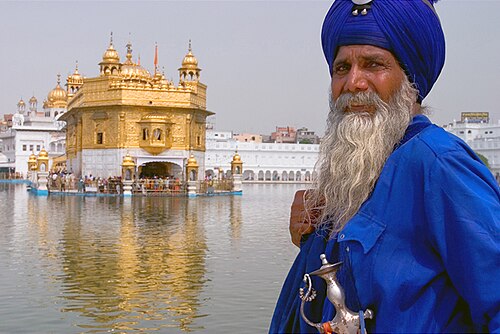
- Kesh — uncut hair, maintained naturally and commonly covered with a turban or other head covering.
- Kangha — a small comb kept in the hair, associated with cleanliness and order.
- Kara — a steel or iron bracelet, associated with discipline and remembrance of one's duties.
- Kachhera — a specific form of short undergarment associated with modesty and discipline.
- Kirpan — a ceremonial sword symbolizing courage, responsibility and the duty to protect and oppose injustice.
The Five Ks are especially associated with initiated Khalsa Sikhs. Not every Sikh has undergone Amrit initiation, so outward appearance varies considerably. Turbans are especially significant among many Sikh men, and some Sikh women also wear turbans. Sikh women and men may use other forms of head covering depending on family and personal practice.
7. Gurdwara, Sangat, Pangat and Langar
A gurdwara is a Sikh place of worship and community. It normally contains a space for the Guru Granth Sahib and facilities for prayer, kirtan and community activities. Gurdwaras may also operate schools, libraries, kitchens, charitable programmes and social services.
Sangat refers to the congregation or fellowship of Sikhs. Pangat refers to sitting together in a common arrangement, especially in the context of langar. Langar is the free community meal traditionally offered in Sikh gurdwaras. It is open to everyone, regardless of religion, caste, gender or economic status.
Langar is maintained through donations and seva. Volunteers may purchase or prepare ingredients, cook, serve meals, wash dishes and clean the kitchen. The food is generally simple and vegetarian so that it can be shared widely. Langar is one of the most visible expressions of Sikh hospitality and equality.
8. Prayer, Worship and Daily Religious Life
Sikh worship commonly includes kirtan, recitation of Gurbani, Ardas and the taking of Hukam. Kirtan means musical singing of scriptural hymns and is central to congregational worship. Sikhs may also practice individual recitation and meditation at home.
The Sikh Rehat Maryada describes a daily discipline of prayer. Morning prayers include Japji Sahib, Jaap Sahib and Tav-Prasad Savaiye; Rehras Sahib is associated with evening prayer; and Kirtan Sohila is recited at night. Individual practice varies, but these prayers form an important framework of traditional Sikh discipline.
The gurdwara is not only a place for formal worship. It is also a centre for learning, fellowship, remembrance, community decision-making, charity and service. This combination of religious and social functions is a defining characteristic of Sikh communal life.
9. Life-Cycle Traditions
Birth and naming
A Sikh naming ceremony is commonly conducted in the presence of the Guru Granth Sahib. A Hukam is taken and a name beginning with the first letter of the selected hymn is chosen. Singh is traditionally used by Sikh boys and men and Kaur by Sikh girls and women, although contemporary naming practices can vary.
Amrit Sanchar
Amrit Sanchar is the formal initiation into the Khalsa. The ceremony is conducted by the Panj Piare and includes the preparation and administration of Amrit, recitation of prescribed prayers and acceptance of the Khalsa discipline.
Anand Karaj
Anand Karaj is the Sikh marriage ceremony. It takes place in the presence of the Guru Granth Sahib and centres on the four Laavan, hymns traditionally attributed to Guru Ram Das Ji. The ceremony presents marriage as a partnership involving spiritual growth and shared responsibility.
Antam Sanskar
Sikh funerary practice emphasizes remembrance of God, acceptance of divine will, prayer and community support. Cremation is traditional, while the Sikh Rehat Maryada discourages superstition and excessive ritual. The emphasis is on spiritual remembrance rather than attachment to the physical body.
10. Festivals and Major Observances
Sikh commemorative life includes gurpurabs, which mark important events associated with the Gurus, together with other historical and seasonal observances. Guru Nanak Gurpurab, commemorating the birth of Guru Nanak, is among the most widely observed occasions.
Baisakhi has both agricultural and religious significance in Punjab and is particularly important to Sikhs because the Khalsa was established on Baisakhi in 1699. Gurdwaras may hold kirtan, processions, lectures, langar and other community activities.
Hola Mohalla is associated particularly with Anandpur Sahib and developed as a festival of martial displays, community gatherings, poetry, kirtan and traditional demonstrations such as gatka. Sikh communities also observe commemorations associated with the martyrdoms of Guru Arjan and Guru Tegh Bahadur.
Sikh festival dates can differ depending on calendrical conventions, so a careful profile should not assume that every observance has a permanently fixed Gregorian date.
11. Sacred Places and Sikh Architecture
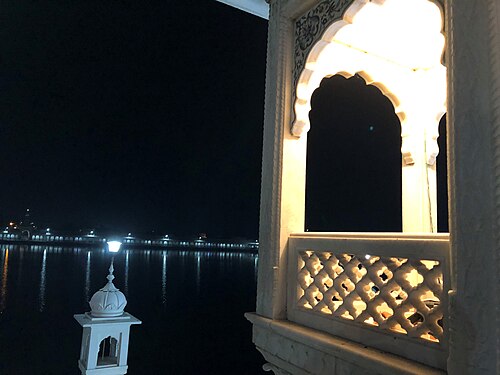
Harmandir Sahib in Amritsar is Sikhism's most prominent pilgrimage centre. The complex includes the Amrit Sarovar, the central shrine, the Akal Takht and other important institutions. The shrine's architecture and location within the pool have become powerful symbols of Sikh religious identity.
The five Takhts traditionally recognized in Sikhism are Akal Takht Sahib at Amritsar, Takht Sri Kesgarh Sahib at Anandpur Sahib, Takht Sri Damdama Sahib at Talwandi Sabo, Takht Sri Patna Sahib at Patna and Takht Sri Hazur Sahib at Nanded.
Other major historic sites include Nankana Sahib and Kartarpur Sahib in present-day Pakistan, Anandpur Sahib, Tarn Taran, Goindwal Sahib, Sultanpur Lodhi and Paonta Sahib. These sites connect contemporary Sikhs with the historical geography of the Gurus and the early community.
12. Language, Literature, Music and Oral Tradition

Punjabi is the language most strongly associated with Sikh cultural life, although Sikhs in India use many languages. Gurmukhi is the principal script associated with Punjabi in Sikh religious contexts and is the script used for the Guru Granth Sahib.
Sikh literary culture includes Gurbani, historical narratives, janamsakhi traditions, poetry, katha, biographies, devotional literature and modern Punjabi writing. The janamsakhi tradition preserves narratives about Guru Nanak's life and travels. Such narratives are culturally significant, but individual stories may exist in different versions and should not automatically be treated as contemporary historical records.
Music is fundamental to Sikh worship. The Guru Granth Sahib is organized by ragas, and kirtan is an important form of congregational devotion. Historical Sikh musical traditions include instruments such as rabab, saranda, taus, dilruba and jori, alongside instruments commonly used today.
Oral traditions remain important in families and local communities. Stories of the Gurus, accounts of martyrdom, folk songs, devotional recitations and memories of historic gurdwaras are transmitted across generations. These traditions help preserve identity and historical memory while existing alongside written sources and academic historical research.
13. Family, Marriage, Dress and Social Customs
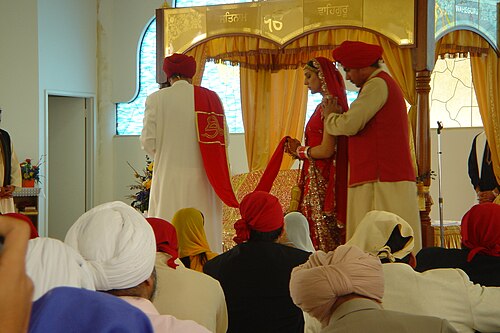
Sikh tradition places considerable importance on household life. Respect for parents and elders, hospitality, honest work, family responsibility and community participation are widely valued. Sikhism does not require monastic withdrawal and instead encourages spiritual practice within ordinary social life.
Dress varies according to region, profession, generation and individual preference. The turban is especially important for many Khalsa Sikhs because it accompanies the commitment to keep uncut hair. Punjabi clothing such as the salwar kameez, kurta-pajama and regional dress remains culturally important, but contemporary Sikh clothing is diverse.
Marriage practices also vary. The religious ceremony is Anand Karaj, but families may have additional cultural customs surrounding engagement, music, food and celebration. These cultural practices should be distinguished from the formal religious elements prescribed by Sikh tradition.
14. Food and Culinary Traditions
Sikh food culture is closely connected to Punjabi cuisine but is not identical to it. Gurdwara langar commonly consists of simple vegetarian foods such as dal, roti, rice, vegetables and sweets. Karah prashad, prepared from flour, sugar and ghee, is distributed as a sacred offering in Sikh congregations.
The Sikh Rehat Maryada explicitly prohibits intoxicants such as tobacco and alcohol. Sikh dietary practices concerning meat have historically been interpreted in different ways within Sikh communities, so it would be inaccurate to claim that every Sikh follows exactly the same diet. Langar in mainstream gurdwara practice is vegetarian.
17. Sikhs in India's Freedom Movement and Public Life
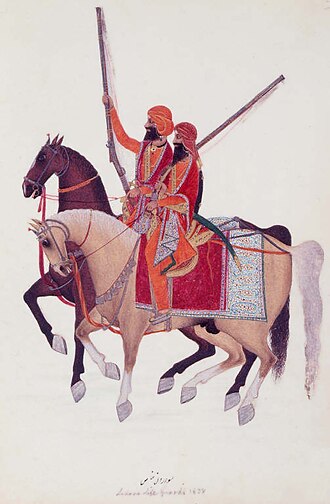
Sikhs participated in many forms of anti-colonial activity. These included the Ghadar movement, the Gurdwara Reform movement, revolutionary organizations, the Akali movement and broader Indian nationalist politics. Individual Sikh activists did not all share the same political ideology, so Sikh participation should be described as diverse rather than as a single political programme.
Figures such as Kartar Singh Sarabha and Udham Singh are remembered for anti-colonial activism, while Bhagat Singh remains one of the most famous revolutionaries associated with Punjab. Sikh soldiers also served in large numbers in the British Indian Army and later in the Indian armed forces.
Since independence, Sikhs have contributed extensively to agriculture, business, education, science, law, medicine, public administration, armed forces, arts, sport and politics. Sikh participation in agriculture was particularly significant during the Green Revolution in northwestern India.
18. Sikh Diaspora and Global Connections
Sikh migration beyond Punjab developed in several stages, including movement during the British colonial period to East Africa and Southeast Asia and later migration to the United Kingdom, Canada, the United States, Australia, New Zealand, Europe and the Gulf region. Sikh communities now exist across the world.
Diaspora gurdwaras frequently function as religious and cultural centres. They may provide langar, Punjabi-language education, youth programmes, kirtan, sports, cultural events, humanitarian assistance and community support. Gurdwaras can therefore be important institutions of both religious practice and social integration.
Diaspora Sikhs maintain connections with India through family relationships, pilgrimage, charitable activity, business, education and cultural exchange. At the same time, Sikh identity adapts to local languages and societies, producing diverse forms of contemporary Sikh culture.
19. Education, Professions and Community Life
Education has been highly valued in modern Sikh community development. The Khalsa educational movement helped establish schools and colleges, while Sikh organizations have subsequently supported universities, libraries, research institutions and religious education.
Sikhs in India participate in virtually every major occupation. Punjab is historically associated with agriculture, but Sikh communities also include professionals, teachers, doctors, engineers, lawyers, civil servants, entrepreneurs, industrial workers, traders, transport operators, students and people working in creative industries.
Community networks can support migration, business and employment, but socioeconomic circumstances are not uniform. Sikh society includes wealthy and poor households, rural and urban populations, landowners and landless workers, professionals and informal workers.
20. Genetics, Ancestry and Sikh Identity
Sikhism is a religion, not a biological population. There is no scientifically established single 'Sikh gene' or unique genetic profile that defines Sikh identity. Sikhs have diverse regional and social ancestries, and their genetic variation overlaps substantially with neighbouring populations.
Population-genetic studies can investigate historical migration, regional ancestry and patterns of relatedness among particular Punjabi or North Indian populations. Such research cannot determine whether an individual is religiously Sikh. A DNA test can provide an estimate of biological ancestry, but it cannot establish a person's faith, observance or membership of the Sikh community.
Some Sikh social groups have historically practiced endogamy, which can create measurable patterns of shared ancestry within particular communities. Such findings must not be generalized to every Sikh. Likewise, consumer ancestry tests depend on reference databases and statistical models and should be interpreted cautiously.
For genealogy and community history, oral histories, family records, archival documents and genetic evidence can complement one another. None should automatically override the others, and religious identity should never be inferred solely from DNA.
21. Demography of Sikhs in India
According to the 2011 Census of India, 20,833,116 people reported Sikhism as their religion, representing approximately 1.72% of India's population at that census. Punjab recorded 16,004,754 Sikhs, approximately 57.69% of the state's population, making Punjab the only Indian state with a Sikh majority in the 2011 Census.
Other substantial Sikh populations were recorded in Haryana, Delhi, Rajasthan, Uttar Pradesh, Uttarakhand, Jammu and Kashmir, Himachal Pradesh and Maharashtra. Sikh communities also live in many other states, particularly in urban centres and areas connected to historical migration.
Census figures measure reported religious affiliation. They should not be confused with Punjabi ethnicity, Punjabi-language use, ancestry or participation in Sikh cultural practices. They also do not represent the total global Sikh population.
22. Sikhism in Contemporary India
Contemporary Sikh life combines long-established religious traditions with urbanization, higher education, migration, technology and global cultural exchange. Gurdwaras remain central to community life, while Sikh families increasingly participate in universities, professional institutions, businesses and digital spaces.
Punjabi language, Sikh music, history and heritage continue to be important cultural markers. Younger Sikhs may express identity through traditional Khalsa practices, participation in kirtan and seva, Punjabi cultural activities, religious education or other forms of community engagement. Levels of observance vary significantly between individuals.
Sikh humanitarian activity remains highly visible. Gurdwaras and Sikh organizations have repeatedly organized food distribution, medical assistance, shelter and other forms of relief during disasters and emergencies. The principles of langar and seva provide an established framework for such activity.
Sikh identity in modern India is therefore both continuous and changing. Its religious foundations remain connected to the Guru Granth Sahib and the teachings of the Gurus, while its social and cultural expression differs by region, generation, profession and personal practice.
24. Conclusion
Sikhism is a major Indian religious tradition whose historical centre is Punjab but whose community is now global. From Guru Nanak's teachings on devotion, truthful living and human dignity to Guru Gobind Singh's creation of the Khalsa, Sikh tradition combines spiritual discipline with responsibility in society.
The Guru Granth Sahib is the permanent Guru, while the gurdwara, sangat, langar, kirtan and seva provide the institutions and practices through which Sikh teachings are lived. Sikh history is also closely connected with the cultural and political history of Punjab and with the wider history of India.
A balanced description should recognize both Sikh ideals and social diversity. Sikh doctrine strongly emphasizes equality and rejects caste hierarchy, while historical Sikh society has included diverse social groups and has not been free from wider South Asian social structures. Similarly, Sikh identity is religious and cultural rather than a biological category.
The purpose of this profile is therefore to present established information without sensationalism, sectarian polemic or unsupported claims. Where a distinction between religious teaching, historical tradition and modern scholarship matters, the wording has been chosen to avoid presenting uncertain interpretations as settled facts.
References
Shiromani Gurdwara Parbandhak Committee (SGPC), “Ten Guru Sahibs.” https://sgpc.net/ten-guru-sahibs/
Shiromani Gurdwara Parbandhak Committee (SGPC), “Sikh Faith.” https://sgpc.net/sikhism/
Shiromani Gurdwara Parbandhak Committee, “Main Principles.” https://new.sgpc.net/sikhism/main-principles-2/
Shiromani Gurdwara Parbandhak Committee, Sikh Rehat Maryada: The Code of Sikh Conduct and Conventions. https://sgpc.net/wp-content/uploads/2025/06/Sikh-Rehat-Maryada-English-n.pdf
Office of the Registrar General & Census Commissioner, India, Census 2011. https://censusindia.gov.in/
National Commission for Minorities, Government of India, Minority Population (2011 Census). https://www.ncm.nic.in/home/pdf/statistical%20report/minority_population.pdf
Government of Punjab, District Amritsar, “Places of Interest.” https://amritsar.nic.in/places-of-interest/
Encyclopaedia Britannica, “Sikhism.” https://www.britannica.com/topic/Sikhism
Encyclopaedia Britannica, “Guru Nanak.” https://www.britannica.com/biography/Guru-Nanak
Wikipedia, “Sikhism.” https://en.wikipedia.org/wiki/Sikhism
Wikipedia, “History of Sikhism.” https://en.wikipedia.org/wiki/History_of_Sikhism
Wikipedia, “Guru Granth Sahib.” https://en.wikipedia.org/wiki/Guru_Granth_Sahib