Is Imputation a Guess Work? the Science of Improving of DNA Test
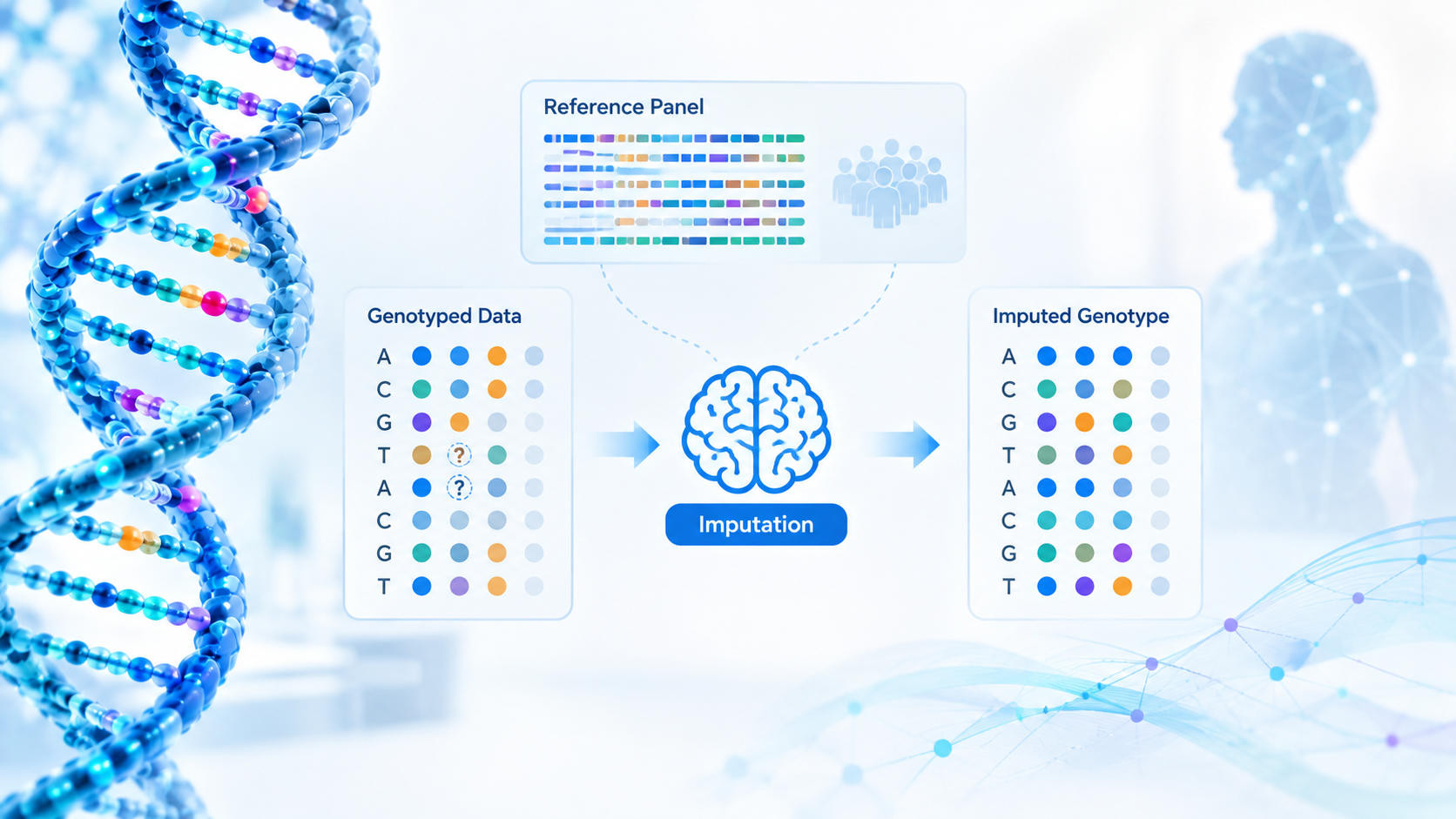
Genotype imputation is a computational method used to estimate missing genetic variants using known genotypes and reference panels. Learn how genotype imputation works, how accurate imputed genotypes can be, and what factors affect reliability.

When you hear that a genetic test can “impute” DNA variants that were not directly measured, it is natural to wonder:
Is imputation just a sophisticated guess?
The short answer is no—but it is also not the same as directly reading your DNA.
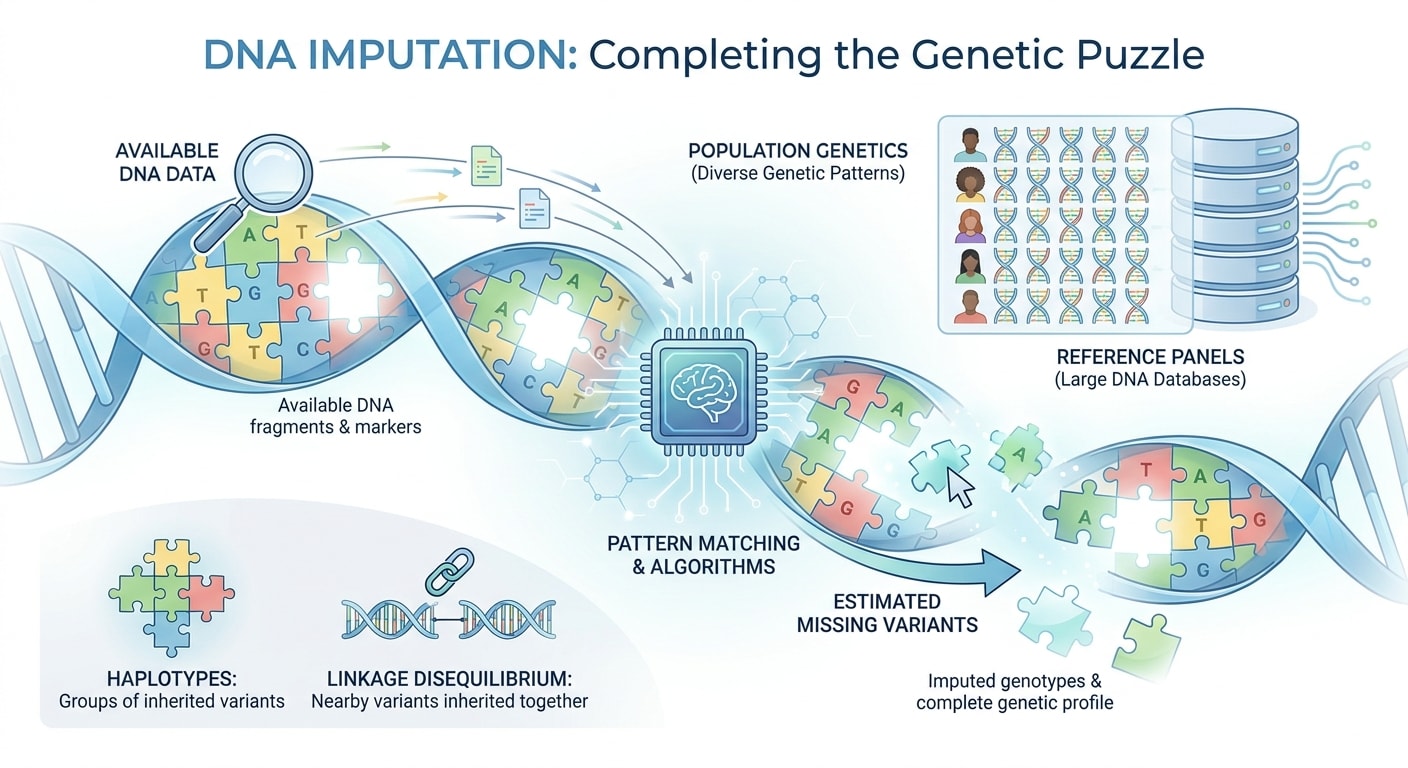
Genotype imputation is a statistical method that uses patterns observed in large collections of genetic data to infer genetic variants that were not directly measured in a particular individual. Modern imputation methods use information about haplotypes, linkage disequilibrium, population genetics, and reference panels to estimate which variants are most likely to occur at an unmeasured position.
The result is not a random guess. It is a probability-based inference with measurable confidence.
Understanding that distinction is important when comparing genotyping, imputed data, and Whole Genome Sequencing (WGS).
How Can Missing DNA Variants Be Estimated?
DNA tests do not always read every position in your genome. When some genetic information is missing, imputation can be used to make an informed estimate of what may be present at those locations.
Think of it like completing a partly missing puzzle. If you can see many of the surrounding pieces, you can make a reasonable guess about what a missing piece might look like.
To make these estimates, computers compare your available DNA information with large collections of genetic data from people whose genomes have been studied more extensively. They look for patterns in how nearby genetic variants tend to occur together and how common those patterns are in different populations.
For example, if certain DNA variants are frequently found together in a particular region of the genome, seeing some of those variants in your data can provide clues about another variant that was not directly measured.
This process uses several types of genetic information:
Haplotypes: groups of DNA variants that tend to be inherited together.
Linkage disequilibrium (LD): a tendency for nearby genetic variants to be inherited together more often than would be expected by chance.
Population genetics: information about how genetic variants are distributed among populations.
Reference panels: large collections of DNA data from people that researchers use as a comparison.
Statistical models — methods that estimate which genetic variants are most likely given the available evidence.
The result is an estimate, not a direct measurement. The accuracy depends on the quality of the original DNA data, the reference panel used, and how well the reference population represents the person being studied.
How Does Imputation Help with Low-Pass Whole-Genome Sequencing?
Imputation is not limited to genotyping data. It can also be used with low-pass Whole Genome Sequencing (WGS).
Whole Genome Sequencing looks across the genome, but the amount of sequencing data collected at each position depends on the sequencing coverage. In low-pass WGS, the genome is sequenced at relatively low coverage, so some variants may not be observed clearly enough to determine directly.
This is where imputation can help.
Think of low-pass WGS as looking at a large picture through a few snapshots. You can see many important details, but some areas may be unclear. By comparing the information, you can observe with large collections of more completely sequenced genomes, computational methods can identify genetic patterns and estimate variants that are not clearly captured in the low-pass data.
For example, if several nearby DNA variants are commonly inherited together, observing some of those variants can provide clues about another variant that was not confidently detected.
The important distinction is that imputation estimates a variant; it does not directly read it.
Low-pass WGS provides genome-wide sequencing information, while imputation can use that information together with reference data to recover additional variants with a measurable level of confidence.
The quality of the result depends on factors such as sequencing quality, sequencing coverage, the reference panel, population representation, variant frequency, and the genomic region being analyzed.
So, rather than thinking of imputation as simply “filling in missing DNA,” it is better to think of it as using observed genetic evidence and known patterns to make a statistically informed estimate of variants that are not clearly observed.
What Exactly Is Genotype Imputation?
Imagine that your DNA test measures only a selected set of positions across your genome.
You may know the genetic variants at those positions, but there are millions of other positions that were not directly measured.
Genotype imputation attempts to infer some of those missing variants using the genetic patterns surrounding the positions that were measured.
A simplified example:
Suppose a DNA test observes:
A — C — G — T — ? — A — G — C
The missing position is not directly measured.
Researchers can look at large reference datasets containing people whose genomes have been sequenced in much greater detail. If particular combinations of variants frequently occur together, the observed pattern around the missing position can provide evidence about which allele is likely to be present.
So instead of saying:
“We don't know this variant, so let's randomly choose one.”
the algorithm asks:
“Given the variants we can observe, the haplotype patterns in the reference panel, and the statistical relationships between nearby variants, which genotype is most probable?”
That is the fundamental idea behind genotype imputation.
Why Can Scientists Infer Something They Didn't Directly Measure?
The answer lies partly in a phenomenon called linkage disequilibrium (LD).
Genetic variants located relatively close to one another on a chromosome are not always inherited independently. Certain combinations of variants can travel together through generations.
These combinations form haplotypes.
If a particular haplotype pattern is well represented in a reference population, observing part of that pattern can provide information about variants that were not directly measured.
For example, imagine that a reference panel contains many chromosomes with a pattern like:
A – C – G – T – A – G
If your measured DNA contains a highly similar pattern:
A – C – G – T – ? – G
the algorithm may determine that the missing position is likely to be A, based on the haplotypes observed in the reference data.
The important point is that the inference comes from existing genetic relationships and population-level data, not from inventing DNA sequence.
The Reference Panel: The Dataset Behind the Inference

One of the most important components of genotype imputation is the reference panel.
A reference panel contains individuals whose genetic variation has been measured at much higher density, often using Whole Genome Sequencing.
These sequenced genomes provide the patterns that imputation algorithms use to infer variants missing from lower-density datasets.
The quality and composition of the reference panel therefore matter enormously.
Research has shown that imputation accuracy can depend on factors including:
The size of the reference panel
How well the reference population represents the individual being studied
The frequency of the variant
The genetic markers already measured
Linkage disequilibrium patterns
Genotyping and phasing quality
This is why there is no universal statement such as “imputation is 99% accurate.”
Accuracy depends on what is being imputed, for whom, and using which reference panel.
How Does the Algorithm Actually Work?
There is no single accuracy percentage that applies to every imputed genotype.
The reliability of genotype imputation depends on several factors, including:
Reference panel: A reference panel that closely represents the target population can provide more informative haplotype matches.
Variant frequency: Common variants are generally easier to impute than very rare variants.
Population representation: Underrepresented populations may have lower imputation accuracy when relevant haplotypes are poorly represented in the reference data.
Input genotype quality: Missingness, genotyping errors, and phasing quality can affect downstream imputation.
Linkage disequilibrium: Stronger correlations between nearby variants can provide more information for inference.
Genomic region: Imputation performance can vary across different regions of the genome.
Imputation method: Different algorithms and reference resources can produce different results.
For this reason, an imputed genotype should be evaluated using appropriate quality metrics rather than assuming that every inferred variant has the same confidence.
In short: genotype imputation can be highly accurate for some variants and datasets, but accuracy is context-dependent.
Frequently Asked Questions About Genotype Imputation
How accurate are DNA tests in India?
DNA test reliability depends on the testing method, data quality, genetic variants being analyzed, and how the results are interpreted. Directly measured and computationally inferred variants represent different types of genetic evidence.
Are DNA ancestry results reliable for Indians?
Ancestry results depend partly on the reference populations and datasets used by the testing provider. Because Indian and South Asian populations are genetically diverse, the representation of relevant populations can be important when interpreting ancestry estimates and inferred variants.
Why do reference panels matter for Indian DNA testing?
Reference panels provide genetic patterns that algorithms use to infer variants that were not directly measured. How well the reference data represent the population being studied can affect imputation performance.
Do DNA tests measure all genes?
Not necessarily. Genotyping tests measure selected genetic markers, while Whole Genome Sequencing generates sequence data across the genome. The amount and type of genetic information depend on the testing method and sequencing or genotyping data available.
Are imputed DNA variants directly measured?
No. An imputed variant is statistically inferred from observed genetic information and reference data rather than directly observed through genotyping or sequencing.
Does Imputation Tell You Exactly Which Variant You Have?
Not necessarily.
This is one of the most important things to understand.
An imputation algorithm can produce a probability distribution rather than a simple yes-or-no answer.
For example, a hypothetical result might indicate:
Variant A: 96% probability
Variant G: 4% probability
Another variant might have:
Variant A: 55%
Variant G: 45%
These two results clearly do not carry the same level of confidence.
Imputation software therefore provides quality metrics that researchers can use to filter variants according to the requirements of their analysis.
One commonly used concept is an imputation quality measure such as R², which describes how well an imputed genotype is expected to correspond with the underlying true genotype under the model being used.
The exact interpretation and thresholds depend on the method and application.
Why Are Common Variants Usually Easier to Impute?
Variant frequency matters.
A genetic variant that occurs frequently within a population generally has more supporting observations in a reference panel.
Rare variants are more challenging because there may be fewer reference individuals carrying the same variant and haplotype background.
Studies comparing imputation performance have consistently shown that variant frequency and linkage disequilibrium can affect imputation accuracy.
This leads to an important principle:
A result that is highly reliable for a common variant may not have the same reliability for a rare variant.
That is why imputation quality should be considered at the variant level rather than assuming that every inferred position is equally accurate.
Why Does Population Representation Matter?
Genetic variation differs between populations.
If a reference panel contains many individuals with genetic backgrounds similar to the target sample, it may provide better matching haplotypes for that population.
On the other hand, underrepresented populations can have more difficulty when their haplotypes or rare variants are poorly represented in the reference dataset.
Research using population-specific reference sequences has shown that adding individuals from an underrepresented population can improve imputation performance, particularly for lower-frequency variants.
This is an important consideration for global genetic studies.
A large reference panel is valuable, but representation matters alongside size.
How Does Genotype Imputation Affect Indian and South Asian DNA Results?
For Indian and South Asian populations, genotype imputation can be influenced by how well the reference panel represents the genetic diversity of the population being studied.
India and South Asia contain genetically diverse populations with different patterns of genetic variation. When observed DNA markers are compared with a reference panel, the availability of similar haplotypes can affect how confidently additional variants are inferred.
This does not mean that an imputed result is unreliable simply because someone is of Indian or South Asian ancestry. Instead, imputation accuracy can vary between populations, variants, and reference datasets.
Important factors include:
Reference panel representation: Whether relevant populations and haplotypes are adequately represented.
Variant frequency: Common variants are generally easier to infer than very rare variants.
Population structure: Genetic differences between populations can affect haplotype matching.
Input data quality: Genotyping errors, missing markers, and phasing quality can affect imputation.
Linkage disequilibrium: Correlations between nearby variants provide information for inference.
Genomic region: Some regions are more difficult to impute than others.
For this reason, people interpreting genetic results should consider not only what variant is reported, but also whether it was directly measured or computationally inferred and what quality information is available.
Imputation vs. Whole Genome Sequencing

This brings us to an important distinction.
Genotyping
Genotyping measures a predefined collection of genetic markers.
It can be relatively efficient and useful for many applications, but it does not directly observe every position in the genome.
Imputed Genotypes
Imputation uses measured markers plus statistical information from reference panels to infer additional variants.
It can substantially increase the number of variants available for analysis without sequencing every individual at high depth.
Whole Genome Sequencing
Whole Genome Sequencing directly sequences DNA across the genome.
Instead of relying primarily on a reference panel to infer an unmeasured position, WGS generates sequencing observations across the genome, with the amount of evidence depending on sequencing coverage and data quality.
This distinction can be summarized simply:
Genotyping → measures selected markers
Imputation → infers additional variants from genetic patterns
WGS → directly sequences across the genome
Imputation and WGS therefore serve different purposes and should not be treated as interchangeable technologies.
If Imputation Is So Powerful, Why Do We Need WGS?
Because inference has limits.
Imputation can be extremely useful for research, especially when working with large datasets where sequencing every participant may not be practical.
However, imputation depends on the information available to the algorithm.
If a rare variant is absent from the reference panel, or if the surrounding haplotype pattern does not provide enough information, accurately inferring that variant may be difficult.
Whole Genome Sequencing can provide direct sequence evidence that does not depend on the same reference-panel matching process.
Large sequencing reference panels have significantly improved imputation capabilities, but researchers still need to consider population representation, variant frequency, sequencing quality and genomic context.
Is Imputed Data Good Enough for Research?
Often, yes—but it depends on the research question.
Genotype imputation has become an important part of genomic research, particularly in genome-wide association studies (GWAS).
It can increase the number of variants available for analysis, improve statistical power, support fine-mapping, and help researchers combine datasets generated using different genotyping platforms.
But researchers should not simply assume that every imputed variant is equally trustworthy.
Quality control and appropriate filtering are essential.
For applications involving rare variants, specific disease-associated variants, or clinical interpretation, the limitations of imputation become particularly important.
So, Is Imputation Guesswork?
Not in the everyday meaning of “guessing.”
Imputation is a computational inference based on measurable genetic evidence.
It uses:
Observed genetic markers
Haplotype patterns
Linkage disequilibrium
Reference populations
Statistical probability models
Quality-control metrics
But there is an equally important second half to the answer:
An inferred genotype is not the same thing as a directly observed sequence.
The strength of an imputation result depends on the evidence supporting it.
That means good scientific practice does not simply ask:
“Was this variant imputed?”
“How confidently was this variant imputed, using which reference panel, for which population, and for what purpose?”
What Does This Mean for Your DNA Data?
For people exploring their genetic data, the distinction between measured, sequenced and imputed information can help put DNA results into perspective.
A genotyping dataset may contain a limited number of directly measured markers.
Imputation can expand that dataset by statistically inferring additional variants.
Whole Genome Sequencing takes a different approach by generating sequence data across the genome, with greater sequencing depth providing more observations at genomic positions.
This is one reason raw genomic data can be valuable for researchers and advanced users: it preserves a much broader set of information than a small predefined marker set.
The Takeaway
Genotype imputation is not a random process and it is not simply filling in missing DNA with a guess.
It is a statistical prediction based on genetic patterns learned from reference data.
The science behind it is built on decades of research into haplotypes, linkage disequilibrium, population genetics and statistical modeling.
At the same time, imputation has boundaries.
The best imputation result is still an inference.
Its reliability depends on the quality of the observed data, the reference panel, population representation, variant frequency and the genomic region being analyzed.
Understanding these differences helps explain why genotyping, imputation and Whole Genome Sequencing are not the same thing—and why the amount and type of genetic data you start with can influence what can be learned from it.
Explore More About Whole Genome Sequencing
Want to understand how sequencing coverage changes the amount of genomic information available?
Explore the GenoConnect WGS Coverage Guide to compare different Whole Genome Sequencing options, including 1× WGS, 5× WGS, 5× WGS + 100× WES, and 15× WGS.
Ready to Explore Your DNA?
Your genome contains a unique record of your genetic history.
Start Your DNA Journey With GenoConnect
All GenoConnect kits include at least 1× WGS, with options to upgrade to higher sequencing levels during checkout or after kit activation.
Explore Your DNA with GenoConnect
Explore GenoConnect’s DNA testing options and choose the kit that matches your goals. Add your selected kit to the cart, then choose your preferred sequencing tier and coverage in the cart before completing your order.
👉 Browse GenoConnect Kits: https://www.genoconnect.co/product-category
🛒 Buy the GenoConnect DNA Kit on Amazon: https://www.amazon.in/GenoConnect-DNA-Kit/dp/B0DQTSQQXM/
DNA Reports: https://www.genoconnect.co/dna-reports
Raw Data Converter: https://www.genoconnect.co/tools/raw-data
Unlock Your Past. Shape Your Future!
Choose the GenoConnect kit that fits your needs, add it to your cart, and select your preferred sequencing tier and coverage before completing your order.