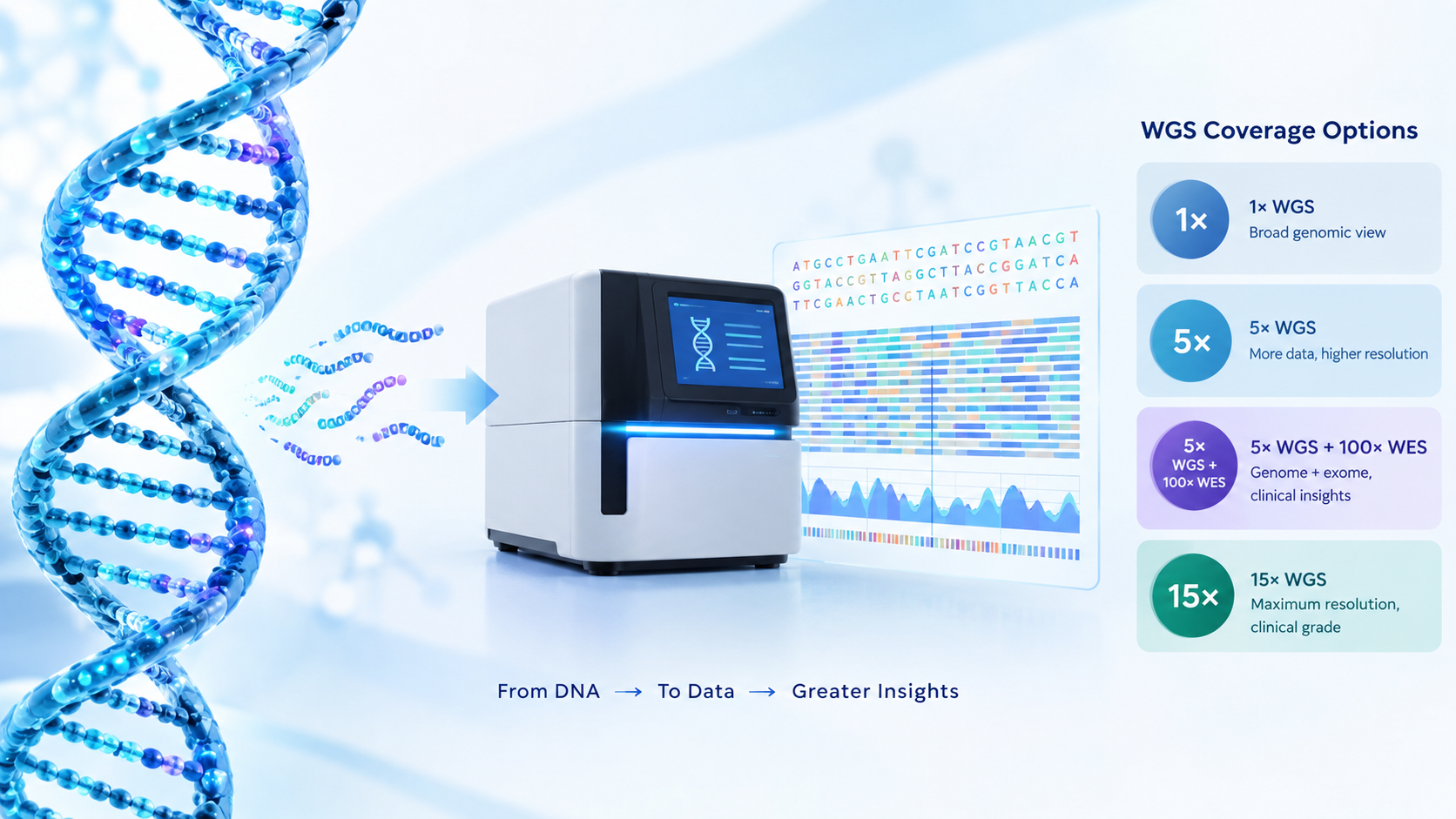
What Is Whole Genome Sequencing? Understanding WGS Coverage
Genotyping and whole genome sequencing (WGS) are two different approaches to understanding genetic information. While genotyping examines selected genetic markers, WGS provides much broader sequence data across the genome. This guide explains their key differences, applications, and the type of genetic information each approach can provide.
Your DNA contains billions of genetic letters. But how much of that information does your DNA test actually read?
If you are exploring DNA testing for ancestry, health insights, family history, or genetic genealogy, you may have come across terms such as 1× WGS, 5× WGS, 100× WES, and 15× WGS.
These numbers can look complicated, but they describe something important: how deeply your DNA is sequenced.
At GenoConnect, our sequencing options are designed to provide different levels of genomic information—from entry-level 1× Whole Genome Sequencing to deeper 5× WGS, a 5× WGS + 100× WES hybrid, and premium 15× WGS.
So, what does all of this actually mean?
Let's make it simple.
What Is Whole Genome Sequencing?
Whole Genome Sequencing (WGS) is a technology that reads DNA across the entire genome.
Your genome contains billions of DNA bases. These bases form the genetic information that makes you unique.
Traditional genotyping or SNP-array tests examine a selected set of genetic positions. WGS takes a broader approach by sequencing DNA across the genome.
This means that instead of asking only about a predefined list of genetic markers, WGS can provide a much larger genomic dataset for different types of analysis.
Whole Genome Sequencing can support applications such as:
Ancestry analysis
Genetic genealogy
Maternal and paternal haplogroup analysis
Genetic variant analysis
Health-related genetic insights
Research and future genomic analysis
But there is an important question:
How deeply is your genome being sequenced?
That is where coverage comes in.
What Does 1×, 5× or 15× Coverage Mean?
The “×” refers to sequencing coverage, also called sequencing depth.
In simple terms, coverage represents the average number of times a particular position in your DNA is read during sequencing.
For example:
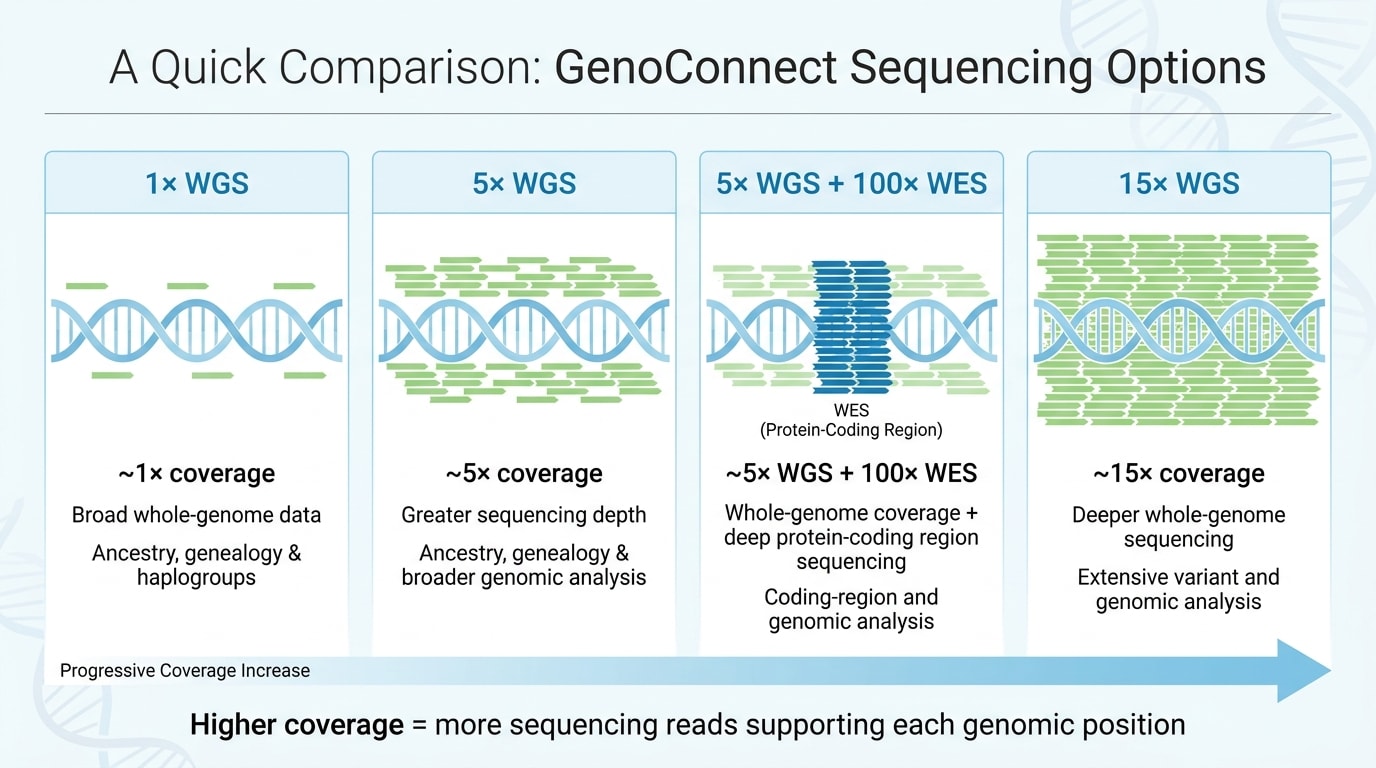
1× WGS → approximately one read on average
5× WGS → approximately five reads on average
15× WGS → approximately fifteen reads on average
More sequencing reads can provide more supporting information about a genomic position.
However, sequencing depth is only one part of the overall picture. Data quality, sequencing technology, analysis methods, and interpretation also affect the usefulness of genetic results.
So, which coverage is right for you?
Let's look at the options available through GenoConnect.
1× WGS: Your Entry Point to Whole Genome Sequencing
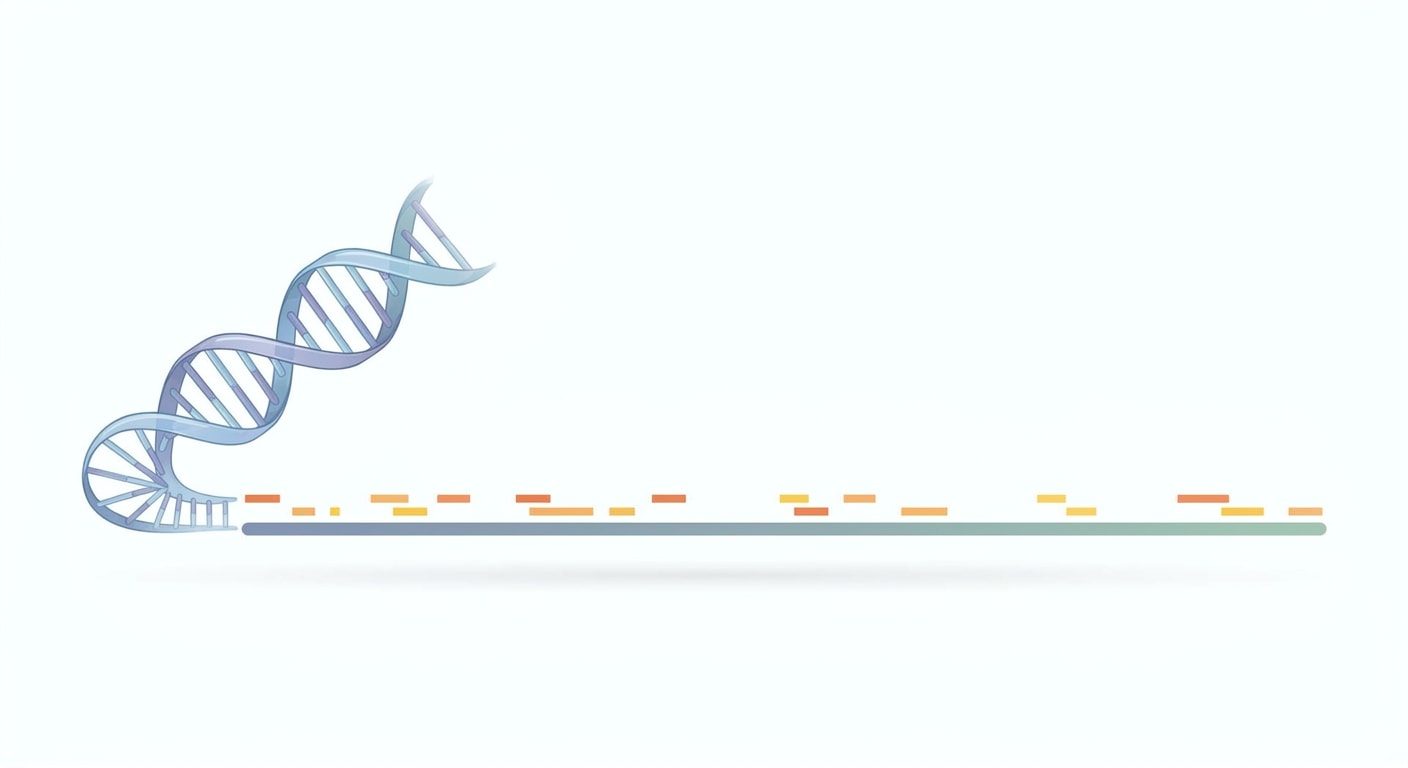
1× WGS sequences the entire genome at approximately 1× coverage.
It provides a broad genomic dataset while keeping the sequencing depth lower than the higher-coverage options.
According to GenoConnect's sequencing comparison, 1× WGS captures roughly 1.2 million SNPs with qpAdm coverage on the expanded ~2.1 million-marker AADR reference.
That gives you substantially more ancestry-related genomic data than many traditional consumer genotyping files.
What can you explore with 1× WGS?
With 1× WGS, you can explore:
Ancestry
Genetic genealogy
Maternal haplogroups
Paternal haplogroups
Genetic traits
Broader genomic information
One of the advantages of WGS compared with genotyping is that it sequences across the genome rather than checking only a fixed collection of markers.
What should you keep in mind?
Because 1× WGS has relatively low sequencing depth, some genetic variants may be missed or may have lower confidence.
It is therefore best understood as a broad, entry-level whole-genome sequencing option, rather than a high-depth clinical sequencing test.
In simple terms:
1× WGS gives you a broad view of your genome at a lower sequencing depth.
5× WGS: More Depth for More Genomic Information
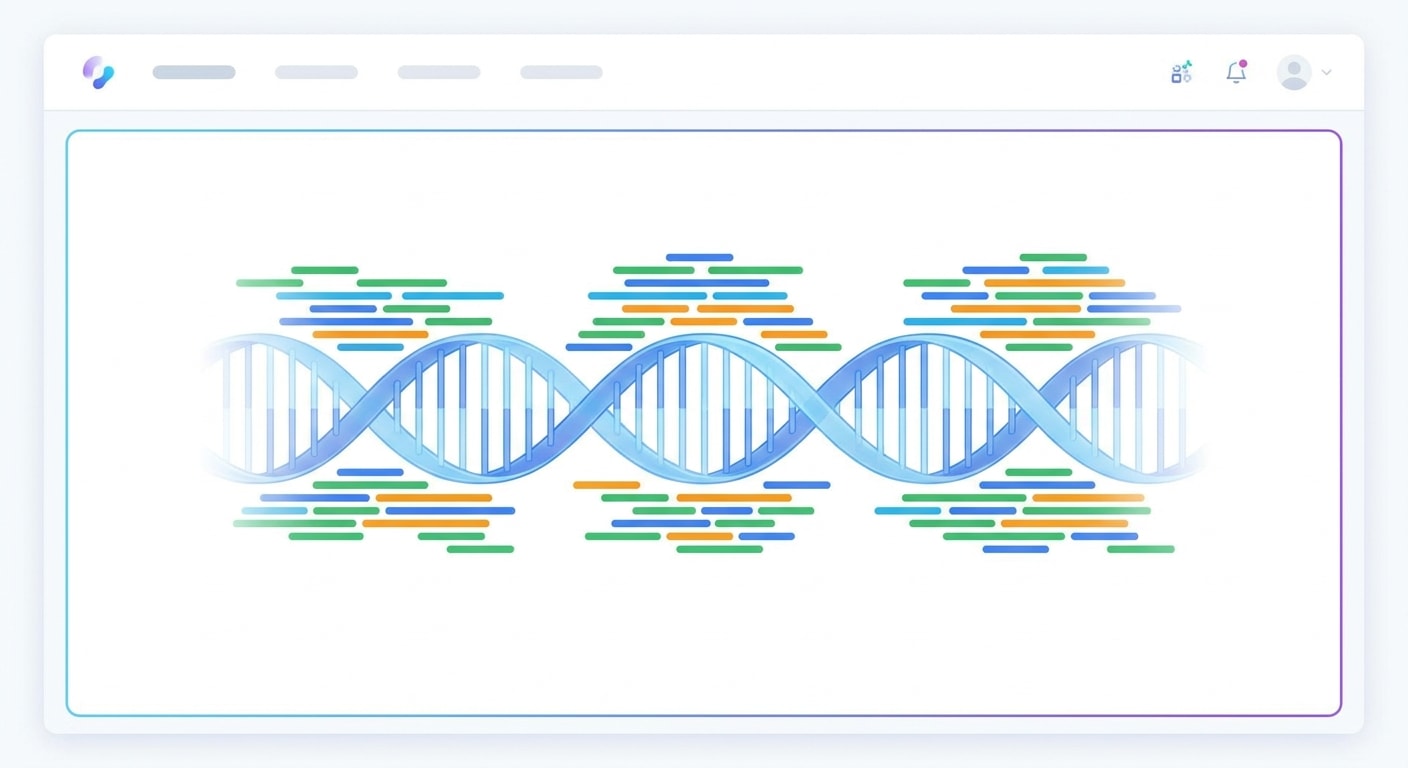
If you want greater sequencing depth, 5× WGS provides approximately fivefold coverage.
According to GenoConnect's current comparison, 5× WGS recovers approximately 1.45–1.6 million markers on the expanded ~2.1 million-marker AADR reference.
This provides a larger set of recovered markers for ancestry analysis compared with the 1× option.
GenoConnect currently highlights 5× WGS as its most popular option.
Why choose 5× WGS?
5× WGS can provide:
More sequencing depth than 1× WGS
Approximately 1.45–1.6 million AADR markers
Deeper ancestry analysis
More detailed maternal and paternal haplogroup analysis
A larger genomic dataset
Broader variant analysis
5× BAM data that can be used with Y-Full
For people particularly interested in ancestry and genetic genealogy, the additional sequencing depth can provide more information to work with.
In simple terms:
5× WGS gives you a deeper look at your genome while maintaining whole-genome coverage.
5× WGS + 100× WES: Combining Breadth With Depth
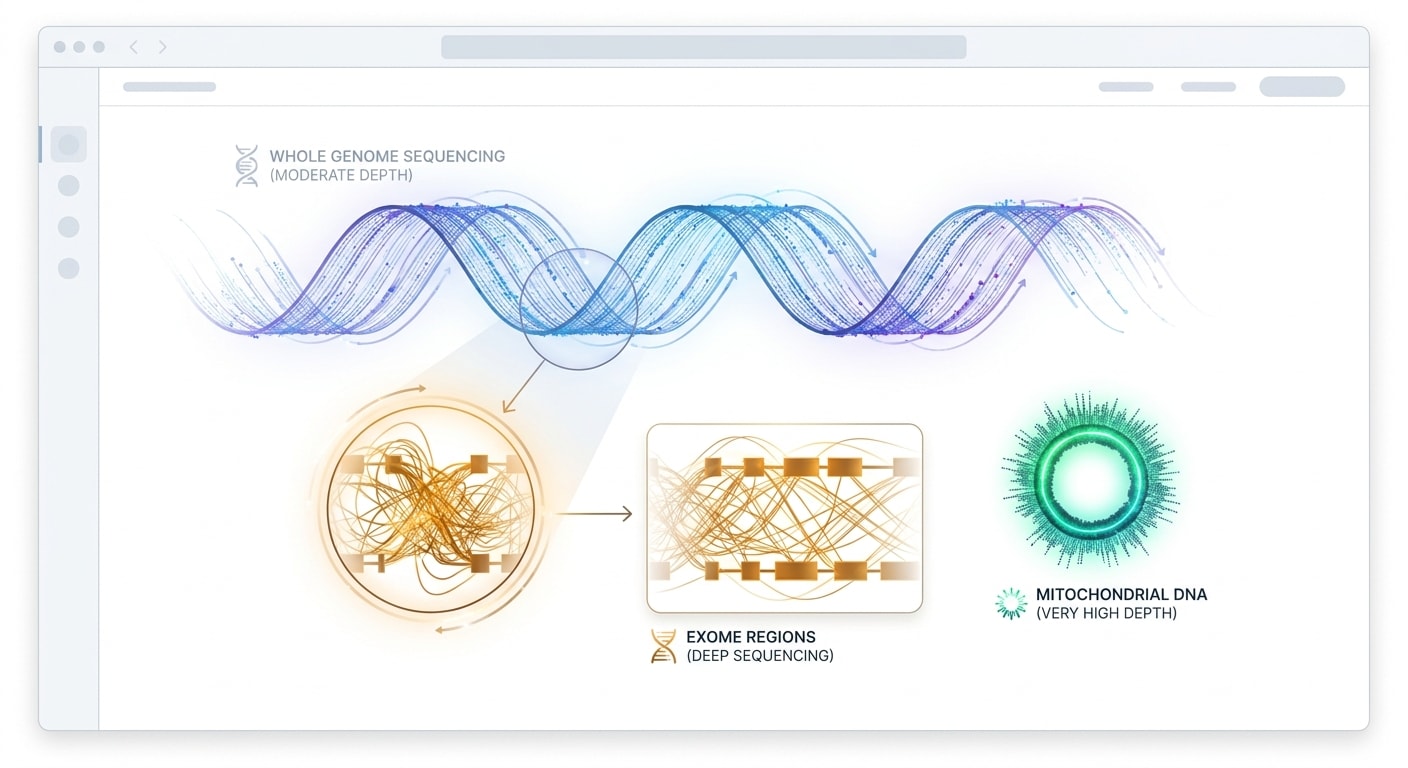
What if you want broad whole-genome information but also want deeper sequencing of protein-coding regions?
That's where the 5× WGS + 100× WES Hybrid option comes in.
This test combines:
5× Whole Genome Sequencing
with
100× Whole Exome Sequencing.
What is WES?
Whole Exome Sequencing (WES) focuses on the protein-coding regions of genes.
These regions represent a small part of the genome but are particularly important in genetic research and the study of many disease-associated variants.
The hybrid approach therefore combines two types of information:
5× WGS → broad genome-wide coverage
100× WES → deep sequencing of protein-coding regions
GenoConnect's hybrid option also provides approximately 3000× mitochondrial DNA sequencing, supporting detailed analysis of mitochondrial markers and mtDNA haplogroups.
Why consider the Hybrid option?
The Hybrid option can be particularly relevant if you are interested in:
Ancestry
Genetic genealogy
Health-related genetic analysis
Disease-risk research
Deep protein-coding variant analysis
Mitochondrial DNA analysis
Maternal haplogroups
Broad whole-genome data
It provides the same approximately 1.45–1.6 million AADR marker level described for the 5× WGS component, while adding 100× exome sequencing and high-depth mitochondrial sequencing.
In simple terms:
The Hybrid option combines a broad view of your genome with a much deeper look at protein-coding regions.
15× WGS: Deeper Whole Genome Sequencing
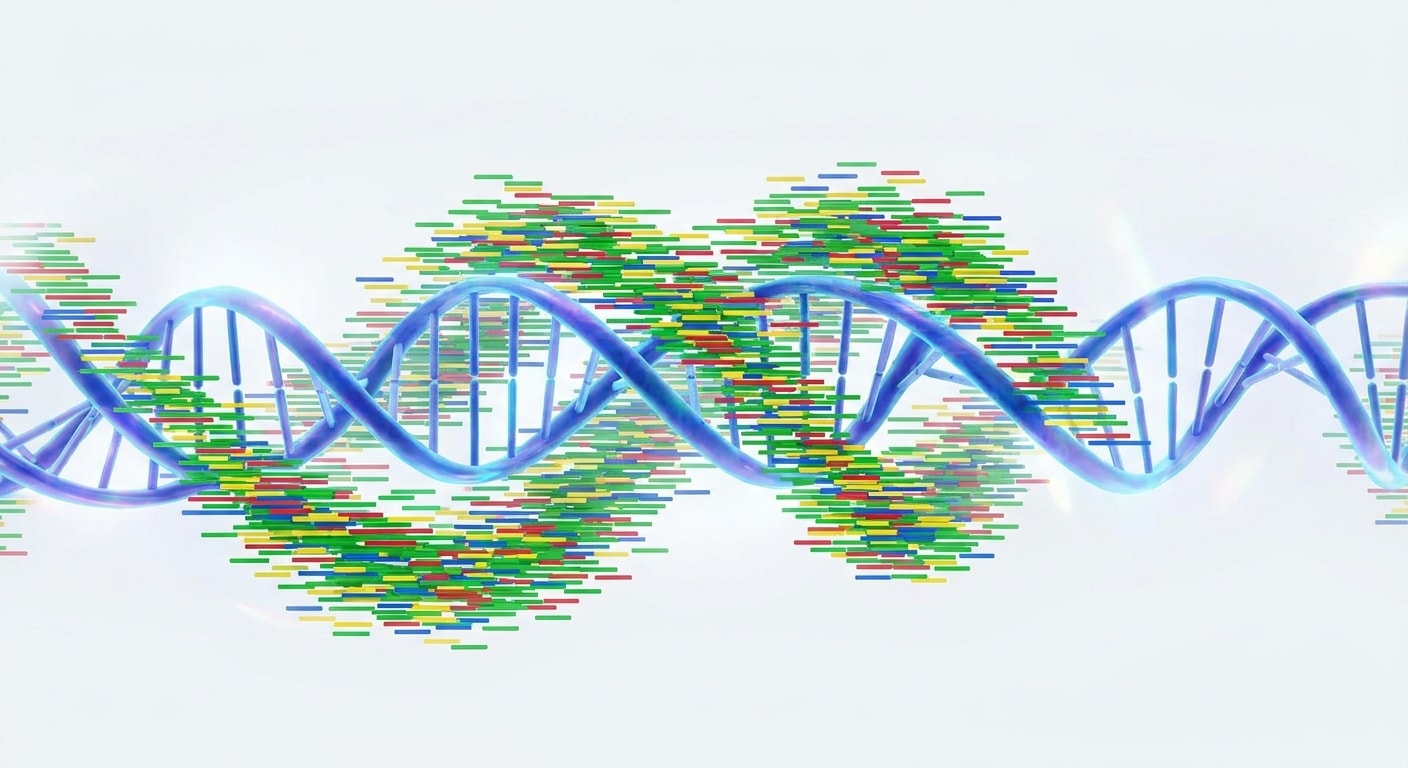
For users looking for deeper sequencing across the genome, GenoConnect offers 15× WGS as its premium whole-genome option.
At approximately 15× coverage, each genomic position is represented by substantially more sequencing reads on average than with 1× or 5× WGS.
GenoConnect's comparison page lists the 15× option with the full ~2.1 million-marker AADR reference panel for ancestry analysis.
What does 15× WGS offer?
According to GenoConnect's comparison, 15× WGS provides:
Approximately 15× sequencing coverage
Full ~2.1 million AADR marker coverage
High-confidence variant calling across the genome
Analysis of SNPs and indels
Structural variant detection
Copy-number variant detection
Deeper ancestry analysis
More extensive haplogroup analysis
The greater sequencing depth provides more supporting reads for genomic positions, which can improve confidence for many types of variant calling.
In simple terms:
15× WGS provides substantially deeper sequencing across your genome.
Genotyping vs Whole Genome Sequencing
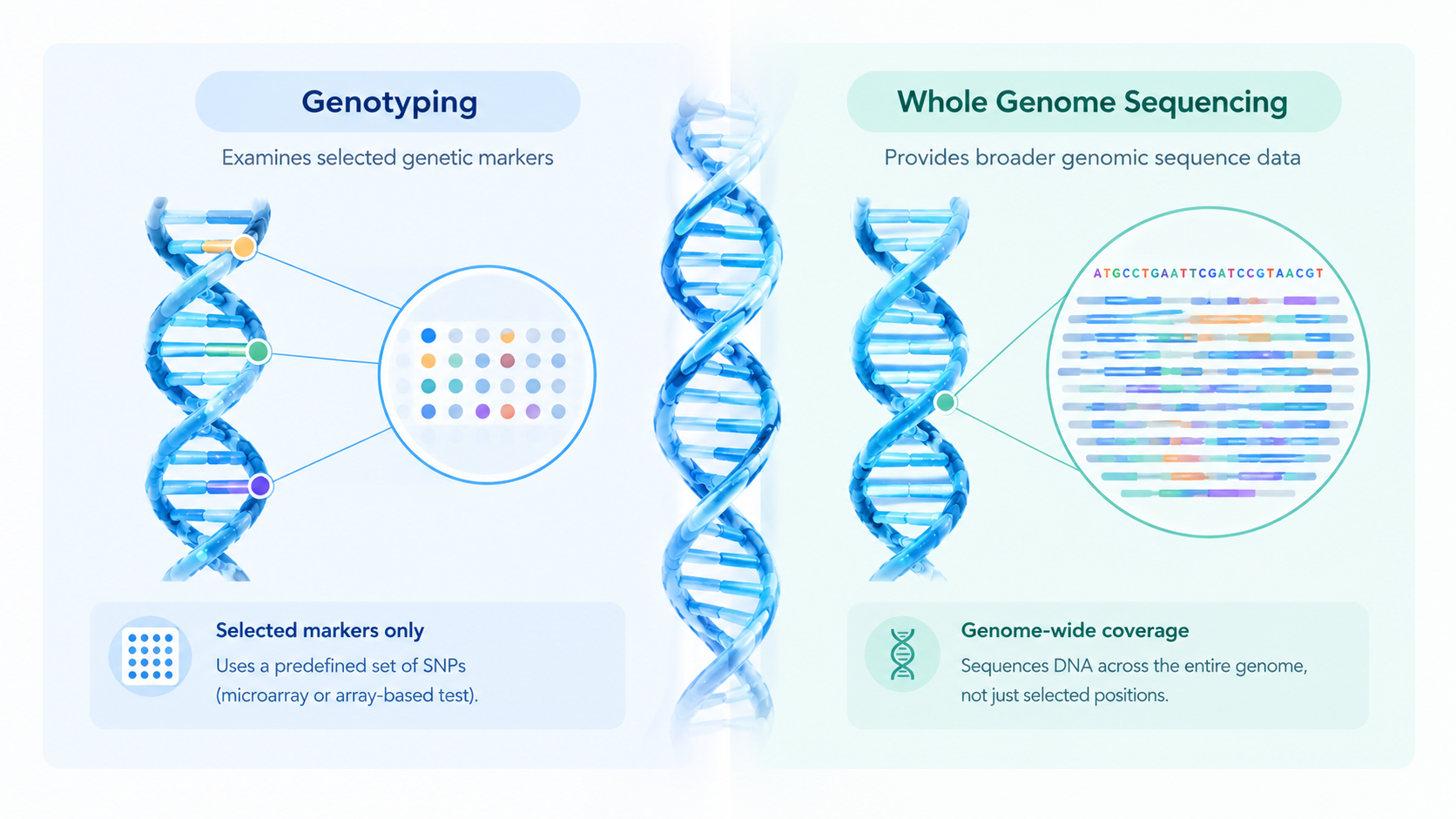
So how does WGS differ from traditional genotyping?
A genotyping or SNP-array test checks a pre-selected collection of genetic positions.
The number and location of those markers depend on the array being used.
For example, GenoConnect's comparison page notes that:
GSA arrays cover approximately 170,000 positions on the expanded ~2.1 million-marker AADR panel.
Ancestry.com-style data can contain approximately 350,000 markers.
GenoConnect's 1× WGS can capture roughly 1.2 million markers with qpAdm coverage.
5× WGS can recover approximately 1.45–1.6 million markers.
15× WGS reaches the full approximately 2.1 million-marker AADR reference used in the comparison.
The important difference is that genotyping checks selected positions, while WGS generates sequence data across the genome.
This broader dataset can be particularly useful for people interested in ancestry, genetic genealogy, haplogroups, and additional genomic analysis.
Why Does This Matter for Ancestry?
If ancestry is your main interest, the amount of genetic information available for analysis can make a difference.
A larger dataset provides more genetic markers that can potentially be compared with reference populations.
This can support:
Ancestry analysis
Genetic genealogy
Maternal lineage research
Paternal lineage research
Haplogroup analysis
Ancient DNA comparisons
Population genetics research
GenoConnect's WGS options also support deeper exploration of Y-DNA and mitochondrial haplogroups than many traditional genotyping datasets.
For genealogy enthusiasts, access to broader genomic data can be particularly useful because new databases and analytical methods continue to develop.
Why Does This Matter for Health?
Sequencing depth can also matter when analyzing genetic variants.
Lower-depth sequencing can provide broad genomic information, while deeper sequencing can provide more supporting reads for many variant calls.
The 5× WGS + 100× WES option is designed to combine broad genome-wide sequencing with deep sequencing of protein-coding regions.
The 15× WGS option provides deeper sequencing across the whole genome.
However, it is important to distinguish genetic information from medical diagnosis. A sequencing result alone does not necessarily establish that a person has a disease or will develop one. Health-related findings require appropriate interpretation and, where relevant, clinical evaluation.
Which GenoConnect Sequencing Option Is Right for You?
The right option depends on what you want to do with your DNA.
1× WGS
Choose this if you want:
Entry-level whole genome sequencing
Broad ancestry exploration
General genomic information
Haplogroup exploration
A larger dataset than a typical genotyping test
5× WGS
Choose this if you want:
More sequencing depth
Deeper ancestry analysis
Genetic genealogy
Deeper haplogroup exploration
More genomic information
5× BAM data for compatible downstream analysis
5× WGS + 100× WES
Consider this if you want:
Whole-genome sequencing
Deep protein-coding region sequencing
Health-related genetic research
Disease-risk research
High-depth exome data
High-depth mitochondrial DNA analysis
15× WGS
Consider this if you want:
Deeper whole-genome sequencing
Extensive ancestry analysis
Comprehensive genomic data
Higher-confidence analysis of many variants
Structural and copy-number variant analysis
A Quick Comparison
More Than Just a DNA Report
Your DNA data can be useful beyond the first report you receive.
Genomic research continues to evolve. New reference populations, databases, and computational methods can create opportunities for additional analysis in the future.
That is why access to your underlying DNA data can be valuable.
With WGS data, you can have a broader genomic dataset that may support compatible downstream analyses instead of being limited to a fixed list of genotyped markers.
For ancestry and genetic genealogy enthusiasts, this can open the door to deeper exploration of family history, haplogroups, and population relationships.
From a Simple Cheek Swab to Whole Genome Sequencing

Getting started with DNA testing does not have to be complicated.
GenoConnect uses a cheek-swab sample, making DNA collection simple and convenient.
The process is straightforward:
1. Order your GenoConnect kit
2. Collect your cheek-swab sample
3. Send your sample for processing
4. Receive your genomic results
All GenoConnect kits include at least 1× WGS, with options to upgrade to higher sequencing levels during checkout or after kit activation, according to the available product options.
Your Genome, Your Choice
Whole Genome Sequencing gives you a broader way to explore your DNA.
But the right sequencing option depends on how deeply you want your genome to be read and what you want to explore.
1× WGS provides a broad entry into whole-genome data.
5× WGS provides greater sequencing depth and is GenoConnect's most popular option.
5× WGS + 100× WES combines broad whole-genome sequencing with deep analysis of protein-coding regions.
15× WGS provides substantially deeper sequencing across the whole genome.
Whether your interest is ancestry, genetic genealogy, haplogroups, raw DNA data, or broader genetic analysis, understanding sequencing coverage can help you make an informed choice.
Ready to Explore Your DNA?
Your genome contains a unique record of your genetic history.
Start Your DNA Journey With GenoConnect
All GenoConnect kits include at least 1× WGS, with options to upgrade to higher sequencing levels during checkout or after kit activation.
Explore Your DNA with GenoConnect
Explore GenoConnect’s DNA testing options and choose the kit that matches your goals. Add your selected kit to the cart, then choose your preferred sequencing tier and coverage in the cart before completing your order.
👉 Browse GenoConnect Kits: https://www.genoconnect.co/product-category
🛒 Buy the GenoConnect DNA Kit on Amazon: https://www.amazon.in/GenoConnect-DNA-Kit/dp/B0DQTSQQXM/
DNA Reports: https://www.genoconnect.co/dna-reports
Raw Data Converter: https://www.genoconnect.co/tools/raw-data
Unlock Your Past. Shape Your Future!
Choose the GenoConnect kit that fits your needs, add it to your cart, and select your preferred sequencing tier and coverage before completing your order.