GRCh37 vs GRCh38: Understanding the Human Reference Genome
The Great DNA Map Upgrade — What the Numbers Mean, Why Genome Builds Matter, and Which One Should You Use?
Imagine trying to find an address in a huge city using a map that was printed more than a decade ago. The roads may still be there, but some roads may have been renamed, some locations may have been corrected, and some areas may have been mapped in greater detail. Something similar happens with the human genome. Scientists use a reference genome as a standard map for locating genes, genetic variants, and other DNA features. Over time, this map is improved and updated.
Two important versions you will frequently encounter are:
1. GRCh37, commonly called hg19
2. GRCh38, commonly called hg38
If you work with Whole Genome Sequencing (WGS), Whole Exome Sequencing (WES), variant calling, genetic testing, ancestry data, imputation, Genome-Wide Association Studies (GWAS), or clinical genomics, understanding these genome builds is extremely important.
But what do the numbers 37 and 38 actually mean?
Why was GRCh38 created?
Is GRCh38 always better?
Why is GRCh37 still used?
Do genome builds apply to plants and bacteria?
What happens if you use the wrong build?
And how does all of this affect your genetic data?
Let's understand it step by step.
First , What Exactly Is DNA?
DNA stands for Deoxyribonucleic Acid.
DNA is the molecule that stores genetic information in living organisms.
It is made using four chemical bases:
A — Adenine
T — Thymine
C — Cytosine
G — Guanine
You can think of these four letters as the alphabet used to write biological information. The order of these letters contains information that influences how our bodies develop, function, respond to the environment, and differ from one another.
For example:
A T G C C A T G A ...
A human genome contains billions of these DNA letters.
2. What Is a Genome?
A genome is the complete set of genetic material found in an organism. In humans, the genome contains approximately 3.2 billion DNA base pairs in a haploid genome.
A human genome contains:
Protein-coding regions
Regulatory regions
Introns
Intergenic regions
Repetitive sequences
Non-coding RNA regions
Other functional and non-functional sequence elements
So, the genome is much more than just genes.
Fun fact
Only a relatively small fraction of the human genome directly codes for proteins. That means most of our DNA is not simply a collection of protein-coding genes.
3. What Are Chromosomes?
DNA is organized into structures called chromosomes.
Most human cells contain:
23 pairs of chromosomes = 46 chromosomes
These include:
Chromosomes 1–22, called autosomes
X and Y chromosomes, called sex chromosomes
A typical XX individual has two X chromosomes, while a typical XY individual has one X and one Y chromosome. However, human chromosome variation is more diverse than this simplified XX/XY description. For genomic analysis, sex chromosomes may require special handling because their copy number and sequence representation differ from the autosomes.
4. What Is a Gene?
A gene is a region of DNA associated with a biological function. Some genes provide instructions for making proteins, while others produce functional RNA molecules. However, not every important part of the genome is a gene.
DNA outside traditional protein-coding genes can also influence:
1. Gene regulation
2. Chromosome structure
3. RNA production
4. Development
5. Cellular responses
6. Disease susceptibility
This is one reason why Whole Genome Sequencing (WGS) can provide a broader view of genetic variation than approaches that focus mainly on protein-coding regions.
5. What Is a Reference Genome?
Now we come to the most important concept. A reference genome is a standardized sequence and coordinate framework that researchers use as a genomic map. Think of it as a master map of the genome.
When a sequencing machine produces millions or billions of DNA fragments, scientists need to know where those fragments belong. The reference genome helps answer questions such as: “Where does this DNA sequence belong?”
or
“At what genomic position is this variant located?”
For example, a variant may be described using:
1. Chromosome
2. Genomic position
3. Reference allele
4. Alternate allele
Without a common reference, comparing genomic results between laboratories and studies would be much more difficult.
6. Is the Reference Genome the Genome of One Perfect Human?
No.
This is a very important point.
A reference genome should not be thought of as: “The DNA sequence of the perfect human.”
1. It is better understood as a reference map.
2. Human beings have enormous genetic diversity.
3. Different people and populations contain millions of genetic differences.
4. Therefore, one linear reference sequence cannot represent every form of human genetic variation.
5. This limitation has helped motivate newer resources such as the Human Pangenome Reference, which aims to represent human diversity more comprehensively.
7. What Is a Genome Assembly?
A genome assembly is a reconstructed representation of an organism's DNA sequence.
Scientists start with DNA sequence data and computationally determine how different pieces fit together.
A simplified process looks like this:
1. DNA is obtained and sequenced.
2. Sequencing produces many DNA fragments.
3. Overlapping sequences are identified.
4. Computational methods determine how fragments fit together.
5. Larger genomic regions are constructed.
6. These regions are organized into chromosomes or other genomic sequences.
7. Difficult regions and errors are investigated.
8. The resulting assembly becomes a reference framework.
As sequencing technologies and computational methods improve, scientists can improve the reference genome.
That is why different versions of human genome assemblies exist.
8. What Does GRCh Mean?
GRCh stands for:
Genome Reference Consortium human reference assembly
The Genome Reference Consortium (GRC) is responsible for maintaining and improving the human reference genome assemblies.
So, when you see:
GRCh37
or
GRCh38
you are looking at identifiers for different versions of the human reference assembly.
9. What Do the Numbers 37 and 38 Mean?
This is one of the most common questions.
Do 37 and 38 mean:
37 chromosomes?
38 chromosomes?
37 billion DNA letters?
38 billion DNA letters?
No.
They are assembly version identifiers.
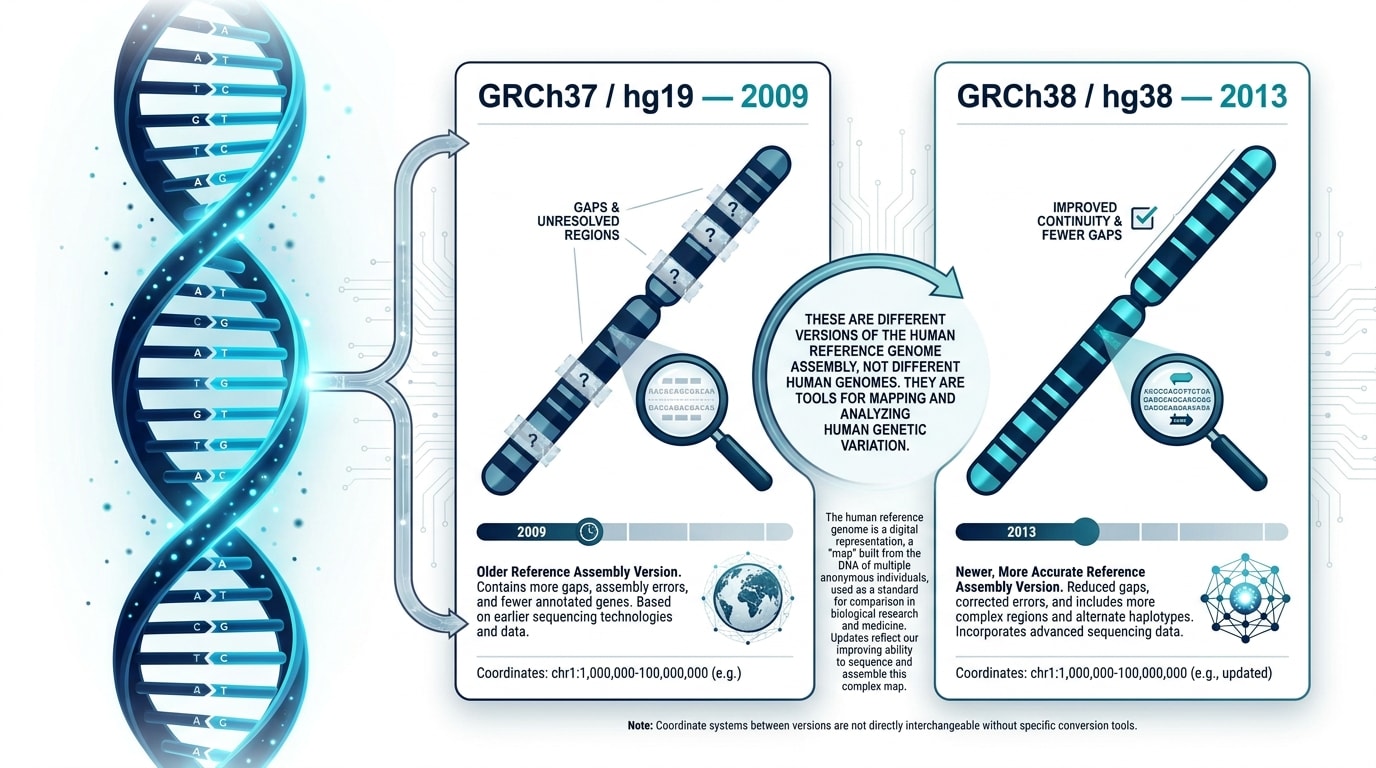
GRCh37 is an older reference assembly.
GRCh38 is a later reference assembly.
So the numbers are essentially part of the assembly naming system.
Simple example
Think of software:
Version 1
Version 2
Version 3
The number does not necessarily describe how many files the software contains.
Similarly:
GRCh37
GRCh38
are names identifying different human genome assembly versions.
10. What Are hg19 and hg38?
You may see another set of names:
hg19
hg38
These are commonly used by the UCSC Genome Browser.
The important relationship is:
GRCh37 = hg19
GRCh38 = hg38
So if a paper says: “The variants were mapped to hg19”
it is generally referring to the GRCh37 human reference assembly.
If it says: “The variants were mapped to hg38”
it is referring to GRCh38.
11. When Were GRCh37 and GRCh38 Released?
GRCh37
GRCh37 was released in 2009.
It became extremely important in genomic research and was used extensively in research studies, clinical pipelines, databases, and consumer genetic datasets.
GRCh38
GRCh38 was released in 2013.
It provided improvements to the human reference assembly, including corrections and better representations of difficult genomic regions.
n GRCh37 and another coordinate on GRCh38.
12. A Simple Timeline of the Human Reference Genome
| Year | Major event |
|---|---|
| 1990 | Human Genome Project begins |
| 2001 | Draft human genome sequences published |
| 2003 | Human Genome Project declared essentially complete |
| 2009 | GRCh37 released |
| 2013 | GRCh38 released |
| Recent years | Human pangenome resources increasingly developed |
13. Was GRCh37 or GRCh38 Part of the Human Genome Project?
Not directly.
The Human Genome Project (HGP) was a major international scientific project that began in 1990.
Its goal was to determine the sequence of the human genome and establish a foundation for genomic research.
The project was declared essentially complete in 2003.
However, genome science did not stop there.
Scientists continued improving the reference sequence.
GRCh37 and GRCh38 are later reference assemblies developed and maintained through the Genome Reference Consortium.
So a simple way to remember this is:
Human Genome Project → foundational human genome sequence
Genome Reference Consortium → later reference assembly improvements
14. How Did Scientists Actually Create the Human Reference Genome?
Creating a reference genome is not as simple as sequencing one person's DNA from beginning to end.
Historically, human genome assembly involved combinations of:
DNA sequencing
Physical mapping
Clone-based sequencing
Computational assembly
Chromosome-specific resources
Error correction
Gap identification
Subsequent sequencing improvements
Modern genome assembly can additionally use technologies such as:
Long-read sequencing
Highly accurate sequencing
Improved assembly algorithms
Chromosome-scale scaffolding
Population genomic information
The basic idea is to reconstruct a reliable genomic map from many pieces of sequence information.
15. Why Was GRCh38 Created?
GRCh38 was created because the previous reference assembly could be improved.
Scientists identified areas where the reference sequence could be:
Corrected
Extended
Better represented
More accurately assembled
Improved in complex genomic regions
GRCh38 therefore provides a revised genomic framework.
It should not simply be described as:
“The old genome plus millions of letters.”
The change is more meaningful than just adding sequence. GRCh38 includes improvements to sequence representation, assembly structure, difficult regions, and alternate representations of selected genomic regions.
16. Why Are Some Parts of the Genome Difficult to Assemble?
Some DNA regions are naturally difficult for sequencing and assembly technologies.
Examples include regions containing:
Long repetitive sequences
Highly similar DNA segments
Segmental duplications
Complex structural variation
Imagine trying to assemble a book when several pages contain almost exactly the same paragraph.
It becomes difficult to determine exactly which paragraph belongs where.
The genome can have similar problems.
Improving these regions can therefore improve the reference genome and downstream analysis.
17. What Are Alternate Loci?
Some genomic regions are too complex to be represented adequately by only one linear sequence.
GRCh38 includes alternate loci, which provide additional sequence representations for selected complex regions.
These can help researchers better represent certain forms of genomic variation.
However, alternate loci do not mean that GRCh38 contains every possible human genome.
Human genetic diversity is much broader.
18. What Is a Genomic Coordinate?
A genomic coordinate is like a street address for DNA.
For example:
Chromosome 7
Position 100000
This tells a researcher where a particular sequence or variant is located.
A variant can also be represented using:
Chromosome
Position
Reference allele
Alternate allele
For example:
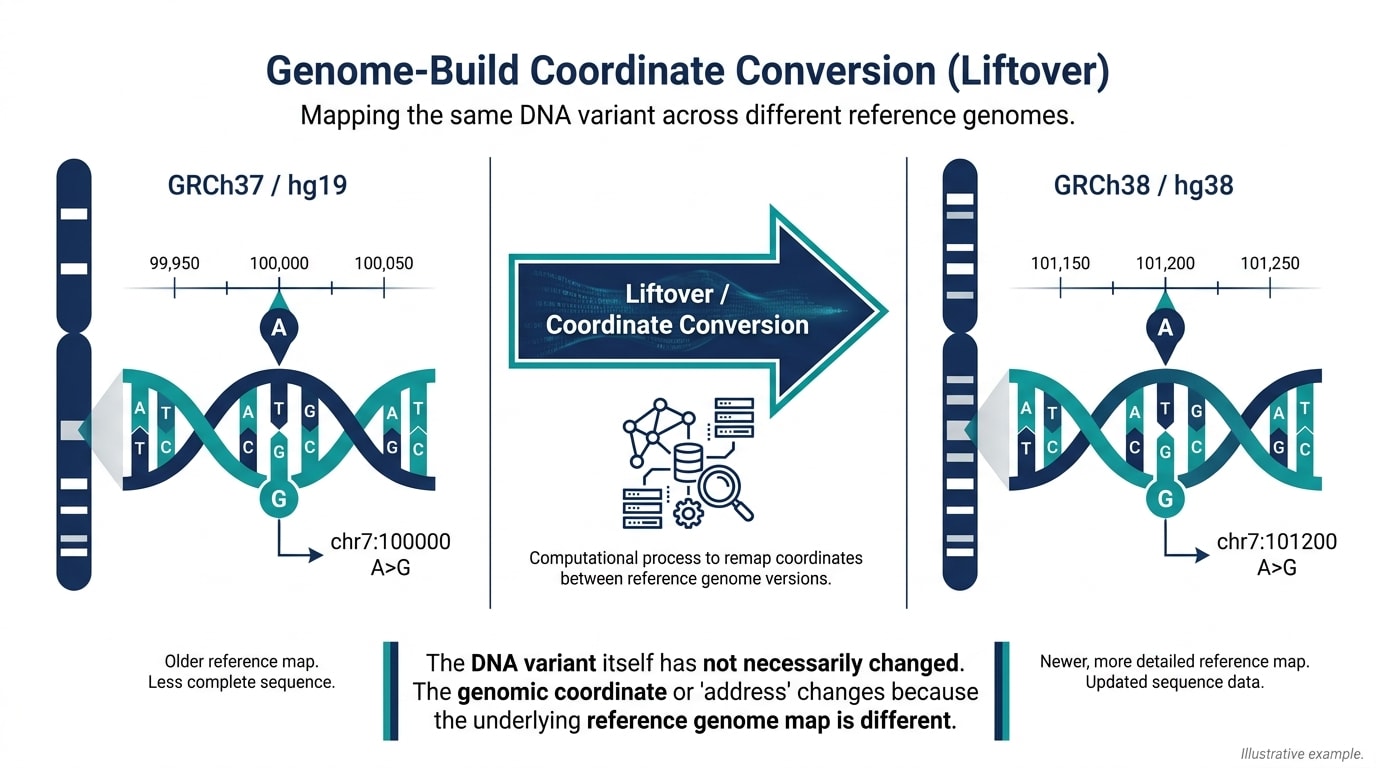
chr7:100000 A>G
This means that at a particular position on chromosome 7, the reference base is A and the alternate base is G.
But there is an important catch.
The genomic address depends on the map.
19. Why Can the Same Variant Have Different Coordinates?
Suppose you have two maps of the same city.
A shop might be:
Building 100 on Map A
but:
Building 105 on Map B
The shop has not moved.
The map changed.
The same principle applies to genome assemblies.
A biological variant may have one coordinate on GRCh37 and another coordinate on GRCh38.
Hypothetical example
Imagine a variant is represented as:
GRCh37: chr7:100000 A>G
After conversion to another assembly, it could be represented as:
GRCh38: chr7:101200 A>G
This is a simplified hypothetical example.
The actual coordinate change depends on the genomic region.
The important concept is:
Different genome builds can give the same biological location different genomic addresses.
20. What Is a Genetic Variant?
A genetic variant is a difference in DNA sequence.
Several common types exist.
Single-Nucleotide Variant (SNV)
A change involving one DNA base.
Example:
A → G
Single-Nucleotide Polymorphism (SNP)
A single-base genetic variant that is common in a population.
Insertion or Deletion (Indel)
DNA bases are inserted or deleted.
Structural Variant (SV)
A larger genomic change such as:
Deletion
Duplication
Inversion
Translocation
Genome-build compatibility can matter for all of these.
21. What Happens If You Use the Wrong Genome Build?
This is where the topic becomes extremely practical.
Imagine having a GPS that uses one city map while you enter coordinates from another map.
The location may not be found.
Or worse, it may point to the wrong place.
The same problem can occur in genomic analysis.
Suppose your variant file uses:
GRCh37
but your annotation database expects:
GRCh38
If you directly use the coordinates without conversion, you may experience:
Missing annotations
Incorrect genomic locations
Incorrect gene assignments
Failed variant matching
Problems comparing datasets
Incorrect downstream interpretation
This is why checking the reference build is one of the first steps in a genomic analysis pipeline.
22. What Is Liftover?
Liftover is the process of converting genomic coordinates from one genome assembly to another.
For example:
GRCh37 → GRCh38
or:
GRCh38 → GRCh37
Common tools include:
UCSC LiftOver
CrossMap
Picard LiftoverVcf
However, liftover is not magic.
Not every genomic coordinate will convert perfectly.
Some regions may:
Map to multiple locations
Fail to map
Change because of assembly differences
Require additional investigation
Therefore, whenever possible, it is preferable to use data generated specifically for the reference build required by the analysis.
23. Where Is GRCh37/GRCh38 Used?
Genome builds appear throughout bioinformatics and genomics.
23.1 Whole Genome Sequencing
Whole Genome Sequencing (WGS) aims to sequence DNA across the genome. After sequencing, the resulting reads are aligned to a reference genome. The genome build determines the coordinate system used for alignment and downstream variant reporting.
23.2 Whole Exome Sequencing
Whole Exome Sequencing (WES) focuses mainly on protein-coding regions known as exons. The sequencing data still needs a reference framework for alignment and variant identification. Therefore, genome-build compatibility remains important.
23.3 Variant Calling
Variant calling identifies differences between an individual's sequence and the reference.
Tools may produce files such as:
VCF — Variant Call Format
The coordinates in the VCF depend on the reference genome used.
23.4 Variant Annotation
Variant annotation adds biological information to genetic variants.
For example:
Which gene contains the variant?
Which transcript is affected?
Is it coding or non-coding?
Does it change an amino acid?
Is it associated with a known disease?
Has it been reported previously?
If the genome build is wrong, annotation can also become wrong.
23.5 Imputation
Genotype imputation is a computational method used to infer genetic variants that were not directly observed.
In low-pass Whole Genome Sequencing (WGS), sequencing depth is relatively low, so many genotypes may not be directly observed with high confidence.
A reference panel containing genetic data from many individuals can be used to infer additional variants.
Here, genome-build compatibility is extremely important.
The target data, reference panel, and analysis pipeline need compatible coordinates.
23.6 Genome-Wide Association Studies
GWAS stands for Genome-Wide Association Study.
GWAS examines genetic variants across the genome to identify associations with traits or diseases.
When combining data from multiple studies, researchers may need to harmonize genome builds.
Otherwise, the same variant can appear to have different coordinates.
23.7 RNA Sequencing
RNA-seq stands for RNA sequencing.
RNA-seq is widely used to study:
Gene expression
Differentially expressed genes
Transcript structure
Alternative splicing
Fusion transcripts
Depending on the analysis strategy, reads can be aligned against a genome or transcript reference.
The reference assembly therefore remains an important part of the workflow.
23.8 Clinical Genomics
Clinical genomics uses genomic information to support diagnosis, disease-risk assessment, treatment decisions, and other healthcare applications. A consistent reference assembly helps laboratories report genomic variants accurately and reproducibly.
24. Reference Genome vs Reference Panel: What Is the Difference?
These terms are sometimes confused. They are not the same.
Reference Genome
Think:
A map
It provides a coordinate framework.
Reference Panel
Think:
A collection of genetic examples
A reference panel contains genetic data from many individuals and can be used for applications such as:
Genotype imputation
Population genetics
Ancestry analysis
Phasing
This distinction is particularly important for low-pass WGS imputation.
25. Which Genome Build Do Doctors and Laboratories Prefer?
There is no universal answer.
A doctor generally does not manually select:
“Use GRCh37.”
The testing laboratory's validated bioinformatics pipeline usually determines the reference assembly. For new genomic projects, GRCh38 is often preferred when the complete pipeline and databases support it, because it is newer and includes important assembly improvements.
However, GRCh37 remains highly relevant.
Why?
Because genomic data is cumulative.
Older:
Research papers
Clinical reports
Variant databases
Genetic datasets
Consumer testing datasets
Third-party platforms
may still use GRCh37/hg19.
Therefore, the best reference build depends on the complete workflow.
26. Why Is GRCh37 Still Used?
If GRCh38 is newer, why haven't we simply stopped using GRCh37?
Because compatibility matters.
Imagine a researcher has ten years of historical data based on GRCh37.
Changing everything immediately would require:
Coordinate conversion
Pipeline validation
Database updates
l Reanalysis
Quality control
Comparison with historical results
That can be expensive and complicated.
Therefore, GRCh37 remains useful.
27. What About GEDmatch and Older Consumer Genetic Platforms?
This is particularly relevant for people working with consumer genetic data. Some third-party platforms and legacy consumer genetic datasets use or have historically used GRCh37/hg19. For example, users working with platforms such as GEDmatch may encounter legacy data that is based on older genome-build conventions.
This creates an important practical situation:
New analysis
You may prefer:
GRCh38
Legacy compatibility
You may need:
GRCh37/hg19
So if you want to compare your genetic data with an older third-party platform, the newer genome build is not automatically the better choice. Backward compatibility can be more important.
28. Which Build Should You Choose?
A simple rule is:
Choose GRCh38 when:
Starting a new project
Your tools support GRCh38
Your annotation databases support GRCh38
Your reference panel supports the required build
You want to use a newer human assembly
Choose GRCh37 when:
Working with legacy data
Reproducing an older study
Comparing with an older clinical report
Using a platform that requires hg19
Working with a third-party dataset based on GRCh37
Maintaining compatibility with historical results
The most important rule:
Do not choose a genome build in isolation. Choose the build that matches your entire workflow.
29. Does GRCh37/GRCh38 Apply to Plants, Animals, or Bacteria?
No.
This is another important clarification.
GRCh37 and GRCh38 are specifically human reference genome assemblies.
They do not represent: Mouse, Rat, Zebrafish, Fruit fly, Rice, Wheat, Arabidopsis, Bacteria, Fungi, Other organisms.
Other organisms have their own reference genomes and assembly naming systems. For example, researchers studying plants may use an organism-specific reference assembly. The concept of a reference genome is universal, but the assembly name depends on the organism.
30. Does the Human Reference Genome Differ Between Men and Women?
The reference genome is not simply divided into:
“male reference” and “female reference.”
The human reference framework includes autosomes and sex chromosomes.
However, sex chromosomes require special consideration.
Most typical XX individuals have two X chromosomes.
Most typical XY individuals have one X and one Y chromosome.
Because X and Y differ considerably in sequence and copy number, certain analyses require special handling.
For example:
Variant calling on chromosome X
Y-chromosome analysis
Copy-number analysis
Sex inference
Population genetics
may require sex-chromosome-aware methods.
31. Does GRCh38 Represent Every Human Population?
No.
This is one of the limitations of a single linear reference genome.
Human populations contain enormous genetic diversity.
Some variants may be:
Population-specific
Rare
Structurally complex
Poorly represented in a single reference
This is one reason genomic scientists are developing pangenome resources. A pangenome attempts to represent multiple genomic paths and a broader range of human diversity. The Human Pangenome Reference is therefore an important development in the future of genomics. But GRCh38 remains extremely useful because it is widely supported by existing tools, databases, pipelines, and publications.
32. How Big Is the Human Reference Genome?
The human haploid genome is approximately:
3.2 billion base pairs
A base pair (bp) represents a pair of complementary DNA bases.
Because genome files can contain billions of characters, reference genome FASTA files can be large.
33. What Is FASTA?
FASTA is a standard text-based format used to store biological sequences.
A FASTA file may contain:
DNA sequences
RNA sequences
Protein sequences
A reference genome is commonly distributed in FASTA format. For example, a human reference FASTA can contain sequences corresponding to chromosomes and other reference sequences.
34. Where Can You Find or Download GRCh37 and GRCh38?
Researchers can obtain human reference genome resources from major scientific databases and genome browsers, including:
Genome Reference Consortium (GRC)
National Center for Biotechnology Information (NCBI)
UCSC Genome Browser
Ensembl
Always check the assembly name before downloading.
For example:
hg19 → GRCh37
hg38 → GRCh38
Do not assume that two files called “human reference” are interchangeable.
35. GRCh37 vs GRCh38: Quick Comparison
| Feature | GRCh37 / hg19 | GRCh38 / hg38 |
|---|---|---|
| Human genome assembly | Yes | Yes |
| Release | 2009 | 2013 |
| Common UCSC name | hg19 | hg38 |
| Version | Older | Newer |
| Assembly improvements | Earlier framework | Improved representation and corrections |
| Difficult regions | More limitations | Improved representation in many regions |
| Alternate loci | More limited | Expanded support for selected complex regions |
| Legacy compatibility | Very high | Increasingly high |
| New projects | Useful when required | Often preferred when supported |
| Third-party compatibility | Important for many legacy datasets | May require conversion for older datasets |
Fun Facts About Genome Builds
Fun Fact 1: 37 Does Not Mean 37 Chromosomes
GRCh37 does not have 37 chromosomes.
Humans typically have 23 chromosome pairs.
The number 37 is simply part of the assembly name.
Fun Fact 2: 38 Does Not Mean 38 Billion Bases
GRCh38 does not contain 38 billion DNA letters.
The human genome is approximately 3.2 billion base pairs in its haploid representation.
Fun Fact 3: hg19 and GRCh37 Are Connected
When you see:
hg19
you should usually think:
GRCh37
And:
hg38
usually means:
GRCh38
Fun Fact 4: A Variant Can Have Two Addresses
The same biological variant can have different genomic coordinates depending on whether it is represented on GRCh37 or GRCh38.
Fun Fact 5: A Reference Genome Is Not a Perfect Human
It is a reference map.
No single reference can represent every genetic variant found across humanity.
Fun Fact 6: The Human Genome Is Still Being Improved
Even after the Human Genome Project, genome science continued evolving.
Scientists are now working toward increasingly complete and diverse representations of the human genome.
37. A Real-Life Example of the Wrong Build
Imagine that a researcher receives this variant file:
Sample_A_GRCh37.vcf
The researcher then uses a GRCh38 annotation database without checking the build.
The software sees coordinates from GRCh37 but expects GRCh38.
Possible consequences include:
Variant not found
Wrong genomic position
Wrong gene annotation
Incorrect transcript assignment
Failed database matching
Problems comparing the result with another dataset
The researcher might incorrectly conclude:
“This variant is missing.”
But the real problem could simply be:
The two datasets are using different genome maps.
This is why genome-build checking should be a routine quality-control step.
38. A Simple Bioinformatics Rule
Before starting analysis, ask:
What genome build am I using?
Then ask:
What genome build does my data use?
Then:
What genome build does my annotation database use?
Then:
What genome build does my reference panel use?
If the answers are different, determine whether coordinate conversion is required.
39. What Should You Check in a Genomic Dataset?
Before using a dataset, check:
Reference genome
Genome build
Chromosome naming convention
FASTA version
Annotation version
Variant coordinate system
Reference and alternate alleles
Reference panel, if applicable
Software compatibility
For example:
Reference genome: GRCh38
FASTA: GRCh38-compatible
Annotation: GRCh38-compatible
VCF: GRCh38 coordinates
Reference panel: GRCh38-compatible
This is much safer than assuming everything called “human genome” uses the same coordinates.
40. Why Does This Matter for Genomic Testing?
When people receive genomic data, they may think:
“My DNA is my DNA, so why does the reference genome matter?”
Your DNA sequence does not suddenly change because you choose GRCh37 or GRCh38.
The map used to describe it changes.
Think about a physical location.
The building stays in the same place.
But different maps can assign different coordinates or labels.
The same principle applies to genomic coordinates.
41. What Does This Mean for Whole Genome Sequencing and Whole Exome Sequencing?
Whole Genome Sequencing (WGS) examines DNA across the genome.
Whole Exome Sequencing (WES) focuses mainly on protein-coding regions.
After sequencing, bioinformatics pipelines process the data.
Typical steps may include:
Sequencing
↓
Quality control
↓
Read alignment
↓
Variant calling
↓
Variant filtering
↓
Variant annotation
↓
Interpretation
The reference genome can influence several of these stages.
Therefore, knowing whether the pipeline uses GRCh37 or GRCh38 is important.
42. Explore Genomic Testing with GenoConnect
Understanding genome builds is an important part of understanding genomic testing.
At GenoConnect, users can explore sequencing options and genomic information designed to provide insights into areas such as ancestry, genetic variation, and other genomic applications.
Depending on the product and analysis selected, users may explore features such as:
Modern ancestry
Ancient ancestry
Haplogroups
Principal Component Analysis (PCA) plots
Fixation Index (FST) distance
Genetic variation
Raw genomic data and reports
The exact information available depends on the selected product and analysis.
When exploring sequencing options, it is useful to consider:
1. What type of sequencing is offered?
2. What regions of the genome are covered?
3. What sequencing coverage is available?
4. What analysis is included?
5. Are reports provided?
6. Is raw data available?
7. Which reference genome is used for downstream analysis?
For low-pass WGS applications, genotype imputation may be used to infer additional genetic variants with the help of a compatible reference panel. The sequencing tier and coverage can be selected in the cart after adding the relevant product, so users should review the available options before completing an order.
Explore genomic testing with GenoConnect:
https://www.genoconnect.co/
43. Frequently Asked Questions
What is GRCh37?
GRCh37 is a human reference genome assembly released in 2009. It is commonly called hg19 in the UCSC Genome Browser ecosystem.
What is GRCh38?
GRCh38 is a later human reference genome assembly released in 2013. It is commonly called hg38.
What do the numbers 37 and 38 mean?
They are assembly version identifiers. They do not represent chromosome numbers or genome size.
Is GRCh38 always better than GRCh37?
Not necessarily for every workflow. GRCh38 is newer and contains important improvements, but GRCh37 may be necessary for compatibility with older datasets and platforms.
Which genome build should I use for a new project?
GRCh38 is often a sensible choice for a new project if your complete analysis pipeline and databases support it.
Why would someone still use GRCh37?
GRCh37 remains useful for legacy research, older clinical reports, historical datasets, and third-party platforms that use hg19.
Can GRCh37 data be converted to GRCh38?
Yes. Coordinate-conversion tools such as liftover tools can convert many coordinates between builds, although not every coordinate will convert perfectly.
Are GRCh37 and GRCh38 used for plants?
No. They are human reference assemblies. Plants and other organisms have their own reference genomes.
Is GRCh38 a male genome?
No. It is a human reference assembly and includes representations of the human chromosomes, including sex chromosomes.
Does GRCh38 represent every human population?
No. A single linear reference cannot fully represent human genetic diversity. Pangenome resources are being developed to address this limitation.
What happens if I use the wrong genome build?
Variants may fail to match databases, receive incorrect annotations, or appear at incorrect genomic positions.
What is the difference between a reference genome and a reference panel?
A reference genome is primarily a genomic map and coordinate framework. A reference panel is a collection of genetic data from individuals used for applications such as imputation and population analysis.
Does genome build matter for WGS?
Yes. WGS reads and variants are typically analyzed relative to a reference genome, so the reference build is an important part of the workflow.
Does genome build matter for WES?
Yes. WES variants also require genomic coordinates and annotation, so build compatibility is important.
44. The Simple Takeaway
GRCh37 and GRCh38 are not two different human species.
They are two versions of the human reference genome assembly.
Think of them as two editions of a genomic map.
GRCh37 / hg19
→ Older
→ Released in 2009
→ Extremely important for legacy data
→ Still required by some older datasets and third-party platforms
GRCh38 / hg38
→ Newer
→ Released in 2013
→ Contains important assembly improvements
→ Often a strong choice for new projects when supported
The most important lesson is:
Always know which genome build your data uses before analyzing or comparing genomic coordinates.
Whether you are working with Whole Genome Sequencing, Whole Exome Sequencing, variant calling, variant annotation, RNA sequencing, genotype imputation, Genome-Wide Association Studies, ancestry analysis, or clinical genomics, the genome build can affect how genomic information is interpreted.
And remember:
The DNA did not move. The map changed.
That is the simplest way to understand GRCh37 versus GRCh38.