Who are the ancestors of Indians?
Genetics, archaeology, and history reveal the ancient origins of Indians, showing how AASI, Indus Valley, and Steppe populations mixed to form present-day South Asian diversity.
What genetics, archaeology and history tell us about where we come from
A simple question with a long answer
Ask people in India where their ancestors came from and you will hear many answers. Some will name a village or a clan. Some will say the Aryans, some the indus valley people, some the original adivasis of the forests. A few will say, with some confidence, that their family has always been pure, never mixed with anyone.
Genetics now lets us test some of these stories against evidence. Over the last twenty years, scientists have studied the DNA of tens of thousands of living Indians, and more recently the DNA of people who died thousands of years ago. The answer they have reached is clear in its outline, even if many details are still open. Almost every Indian alive today descends from a handful of ancient groups, mixed in different proportions. No community is unmixed.
Before going further, one point needs to be clear. The word "ancestors" can mean three different things. It can mean the people whose DNA we carry. It can mean the people whose language we speak. And it can mean the people whose customs and beliefs we have inherited. These three often do not match. A family can speak a language that arrived from far away while carrying mostly local DNA, or the other way round. Keeping these three apart solves half the confusion in this debate.
The first settlers: out of Africa
Every human population outside Africa descends from groups who left Africa many tens of thousands of years ago. The question for India is when the first modern humans arrived, and whether those first arrivals left any descendants.
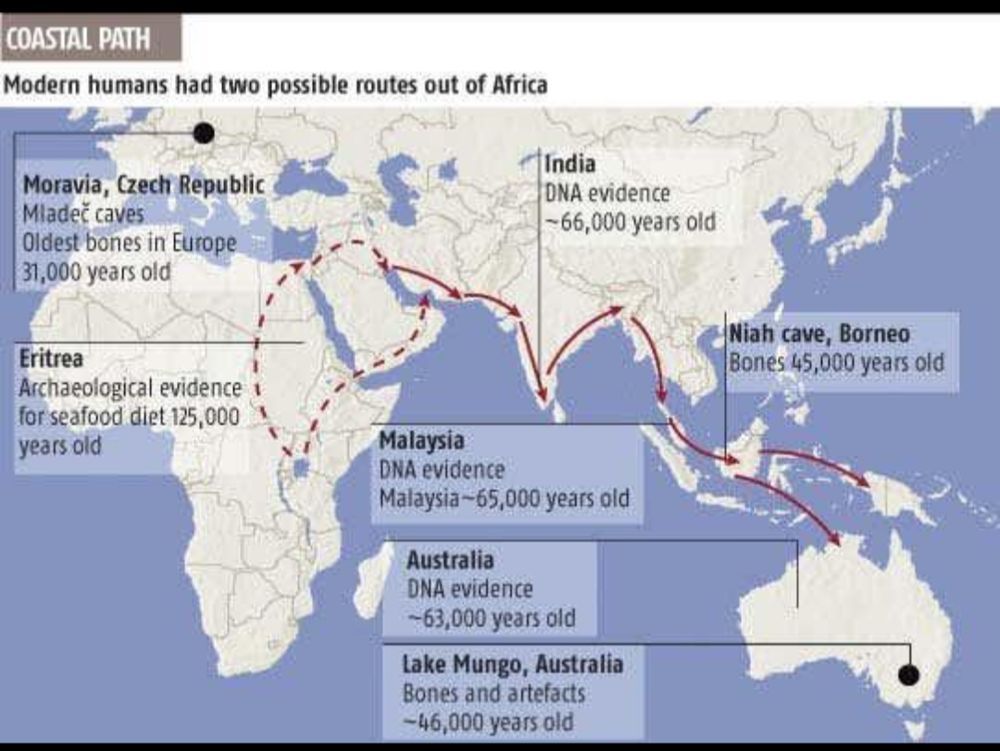
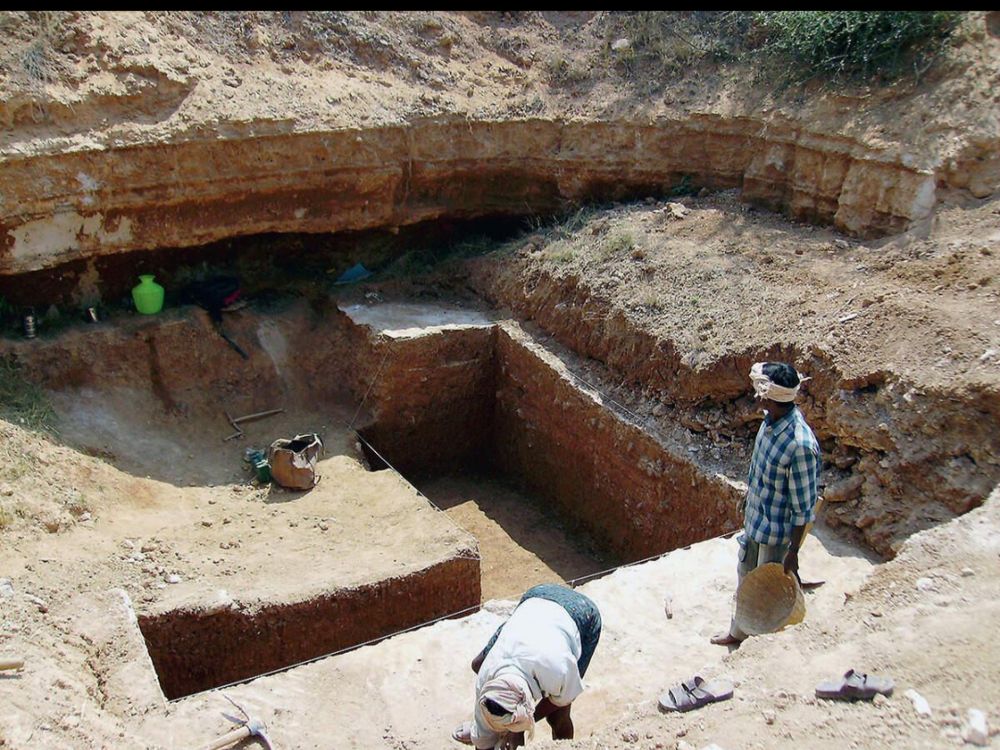
Archaeology and genetics give slightly different answers here. At Jwalapuram in Andhra Pradesh, Michael Petraglia and his colleagues found stone tools both below and above the ash of the Toba super-eruption in Sumatra, which happened about 74,000 years ago [2]. At Dhaba in the Middle Son Valley, a later study found tools in layers running from about 80,000 to 24,000 years ago [3]. These sites show that someone was making tools in India before and after Toba. What we do not know is who they were. They may have been an early wave of modern humans, or an older human species.
Paul Mellars and his colleagues argued for a different picture: a single, fast movement of modern humans along the coast of the Indian Ocean after Toba, around 60,000 years ago [4]. The genetic evidence now leans towards this later date. In 2025, Elise Kerdoncuff and her colleagues published an analysis of 2,762 whole genomes from across India in the journal Cell. They found that most of the genetic variation in Indians today comes from a single major migration out of Africa about 50,000 years ago [1]. If earlier groups did live here, they left little or no trace in our DNA.
Like other people outside Africa, Indians also carry a small share of DNA from archaic humans, about 1 to 2 percent from Neanderthals and Denisovans, picked up when the ancestors of modern humans met them after leaving Africa [1]. Indians carry an unusually wide spread of these archaic fragments. By putting together the pieces found in different people, the Kerdoncuff team recovered a large part of the Neanderthal genome and a smaller part of the Denisovan one from Indian data alone [1].
The deepest layer: the first South Asians
The descendants of that first migration became the earliest hunter-gatherers of South Asia. Geneticists call their ancestry AASI, short for Ancient Ancestral South Indian. No ancient DNA from these people has yet been recovered, so scientists study them indirectly. The closest living relatives are the Andaman Islanders, who have been isolated for a very long time [5, 6].
This deep layer is present in every Indian population studied so far. Toomas Kivisild and his colleagues showed in 2003 that many of the oldest maternal lineages in India are shared by tribal and caste groups alike [7]. Today, AASI ancestry is highest in some tribal groups of southern and central India, but it is found in the north as well. In some groups it makes up as much as about 60 percent of their ancestry [8]. It is the foundation on which everything else was built.
Farmers and the Iranian-related ancestry
The second major ancestry in Indians is usually called Iranian-related, because its closest ancient matches are early hunters and herders from the Iranian plateau. The name causes a lot of confusion. It does not mean that Iranians migrated into India.
The best evidence comes from two studies published in 2019. Vagheesh Narasimhan and a large team analysed the DNA of 523 ancient individuals from Iran, Central Asia and northern Pakistan [8]. Among them were eleven unusual individuals at two sites in Iran and Turkmenistan that traded with the Harappan cities. They carried a mix of Iranian-related ancestry and AASI ancestry, and the authors argued that this was probably the typical ancestry of people in the Indus Valley Civilisation. They called it the Indus Periphery Cline.
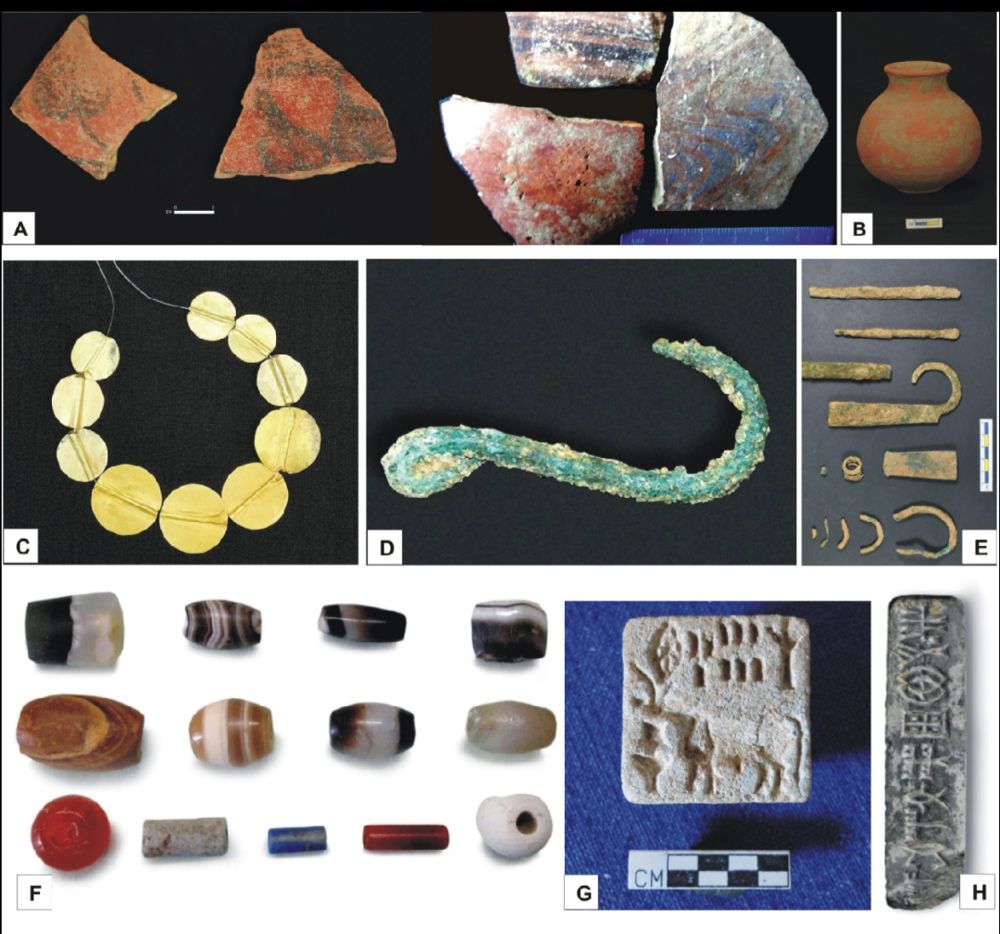
The same year, Vasant Shinde and colleagues published the first genome from inside the Indus Valley Civilisation, from a woman buried at Rakhigarhi in Haryana [9]. Her DNA fit the same pattern. The study also found that the Iranian-related part of her ancestry had separated from the line leading to the Iranian plateau farmers more than 12,000 years ago, before farming began anywhere in the region. In other words, this ancestry was probably already in South Asia or nearby before agriculture, and it does not record a large migration of farmers from the west.
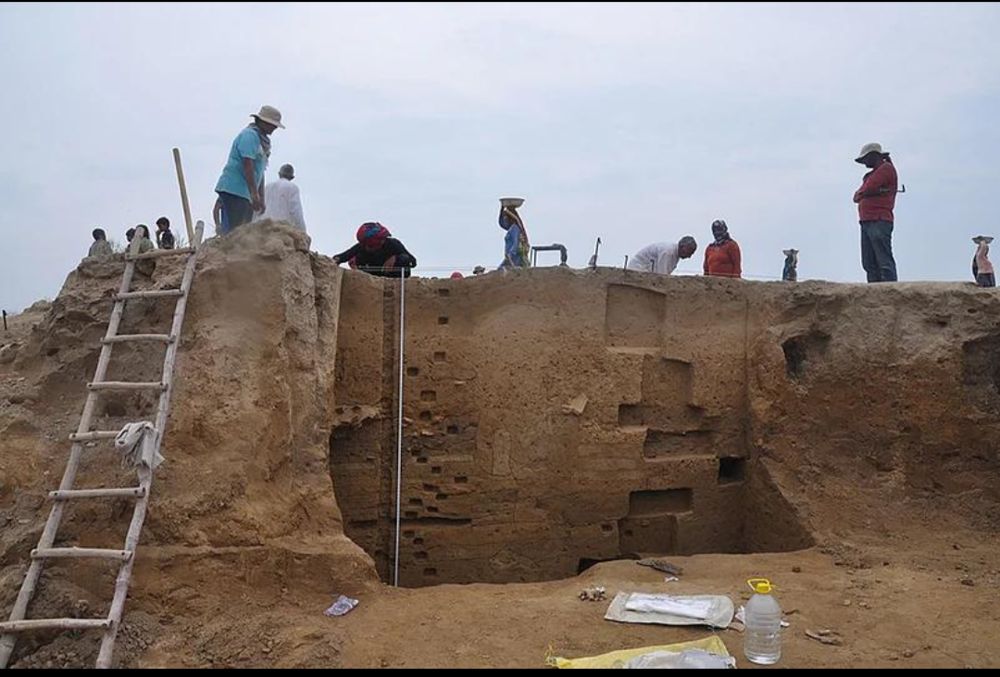
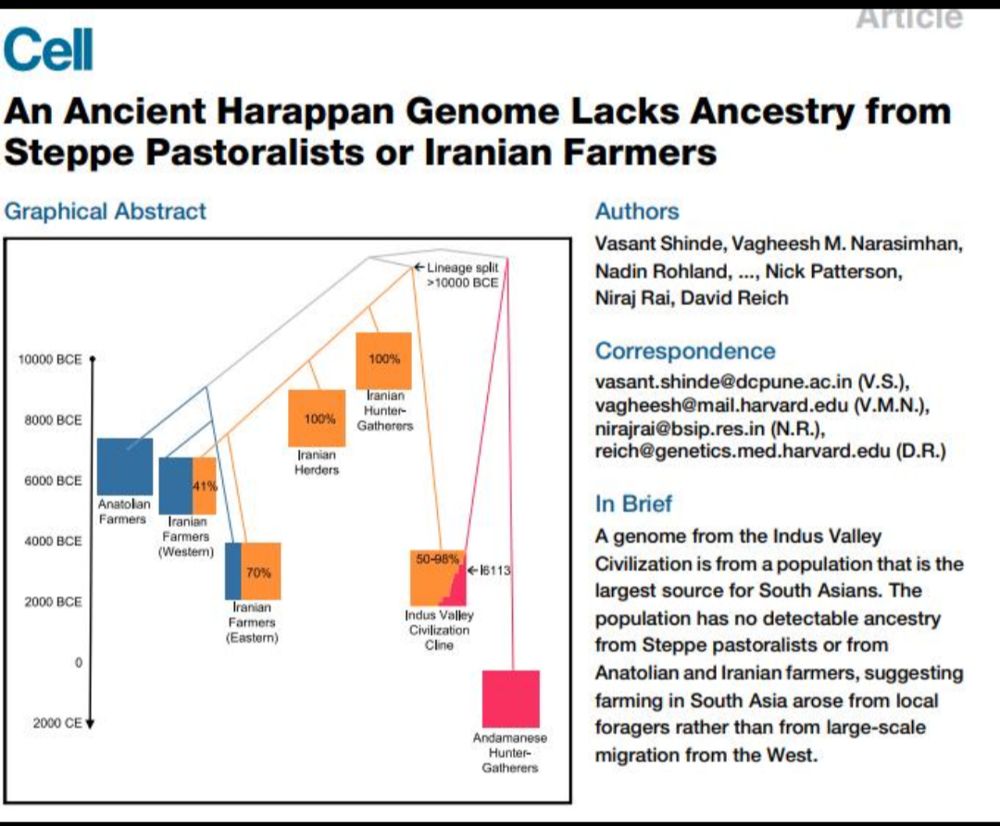
The Indus Valley Civilisation, in its mature phase from about 2600 to 1900 BCE, had cities such as Harappa, Mohenjo-daro, Dholavira and Rakhigarhi, spread over what is now Pakistan and the Indian states of Punjab, Haryana, Rajasthan and Gujarat [19]. Its people matter more for Indian ancestry than any other single group. Narasimhan's team found that people of the Indus Periphery Cline make up the majority of the ancestors of present-day South Asians [8]. The mixing of Iranian-related and AASI ancestry in their forebears happened between about 5400 and 3700 BCE, long before the first cities were built [8].
This matters for how we think about Mehrgarh in Balochistan, one of the oldest farming villages in South Asia, where wheat, barley, sheep and goats appear from around the seventh millennium BCE [19]. The genetic evidence suggests that the people who took up farming in this region were largely local, even if crops and animals came from further west.
The Steppe ancestry and the Indo-Aryan languages
The third major ancestry came later. It traces back to herders of the Eurasian steppe, north of the Black and Caspian Seas. Narasimhan's study found that this Steppe ancestry reached Central Asia by about 2100 BCE and mixed into people in the Swat Valley of northern Pakistan between about 1900 and 1500 BCE [8]. Today it makes up as much as 30 percent of the ancestry of some South Asian groups, and much less in others.
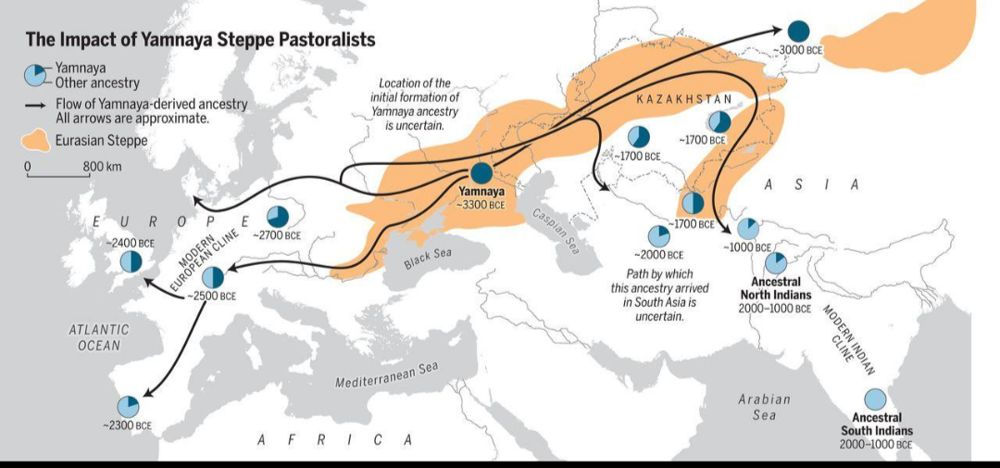
In 2025, Iosif Lazaridis and his colleagues traced these steppe herders further back, to a population living between the Caucasus and the lower Volga in the fifth millennium BCE [10]. Their descendants carried the Indo-European languages across Europe and Asia, including the branch that became Indo-Iranian. This makes the Steppe ancestry the most likely carrier of the Indo-Aryan languages, the family that includes Sanskrit, Hindi, Bengali and Marathi.
Two details here are often missed. First, the Steppe ancestry came into India mostly through men. Studies of the Y chromosome, which passes from father to son, show a strong Bronze Age input from Central Asia, while the maternal lines remain mostly old and local [11]. Second, Steppe ancestry is a minority share almost everywhere. Even in the groups that carry the most of it, the larger part of their DNA comes from the Iranian-related and AASI streams. The language spread much further than the genes did.
From the north-west to the south and east
After about 1900 BCE the Indus cities declined, and their people did not disappear. They moved and mixed. Narasimhan's team found that they became the largest source for both of the ancestral groups that later shaped most of India [8]. In the north-west they mixed with the newly arrived Steppe people. In the south and east they mixed with groups that carried more AASI ancestry. By the team's estimate, at least about 70 percent of the ancestry of the northern group and at least about 55 percent of the southern group came from the Indus Periphery people [8]. For one southern group, the Palliyar, they dated this mixing to between about 1700 and 400 BCE [8].
This is why ancestry in India changes gradually across the map. Steppe ancestry is highest in the north-west and among some groups of the Gangetic plain, and it falls towards the south and east. AASI ancestry rises towards the south and among tribal communities of central and eastern India. East Asian ancestry rises towards Bengal, the northeast and the Himalaya. Geography is only half the story, though. Because endogamy kept groups apart, two communities in the same state can differ as much as communities from distant states [14, 17].
Where do Dravidian languages fit?
If Indo-Aryan came with the Steppe herders, where did the Dravidian languages, such as Tamil, Telugu, Kannada and Malayalam, come from? Here the evidence is thinner.
A study of language change by Vishnupriya Kolipakam and her colleagues dated the Dravidian family to about 4,500 years ago [12]. That is the age of the shared ancestor of today's Dravidian languages, not the age of Dravidian-speaking people. Narasimhan's team suggested two possibilities. One is that an early form of Dravidian was spoken in the Indus Valley Civilisation and spread south with people carrying Indus Periphery ancestry. The other is that it came from peninsular India itself [8]. Neither has been proved. The Indus script is still undeciphered, and that leaves the question open.
Eastern streams: Austroasiatic and Tibeto-Burman
Two smaller ancestries came from the east. Speakers of Austroasiatic languages in India, such as the Santhal, Munda and Ho, carry ancestry linked to Southeast Asia. Gyaneshwer Chaubey and his colleagues found that this link is mostly on the paternal side, through the Y-chromosome lineage O2a, while their maternal lines are largely South Asian [13]. This again suggests that men moved in and married local women.
In the northeast and the Himalayan belt, many communities carry East Asian ancestry linked with Tibeto-Burman languages. Analabha Basu, Neeta Sarkar-Roy and Partha Majumder identified separate Austroasiatic and Tibeto-Burman components in mainland India, alongside the older ones [16]. For many Indians in the northeast, these eastern streams are the largest part of their ancestry.
How mixing became endogamy
The first genome-wide study of Indian populations, by David Reich, Kumarasamy Thangaraj and colleagues in 2009, found that most Indians could be described as a mix of two ancestral groups. They called them Ancestral North Indians (ANI) and Ancestral South Indians (ASI) [14]. Later work showed that both of these were themselves mixtures. The ASI formed when Indus Periphery people mixed with groups carrying more AASI ancestry, and the ANI formed when Indus Periphery people mixed with groups carrying Steppe ancestry [8].
Then something unusual happened. Priya Moorjani and her colleagues dated the mixing of ANI and ASI to between about 1,900 and 4,200 years ago [15]. After that, mixing slowed down sharply. Groups began to marry only within themselves. Basu and his colleagues estimated that this shift came about 70 generations ago in many upper-caste groups [16]. Endogamy, in other words, is genetically quite recent. Before it, people in India mixed widely.
Endogamy has left a strong mark. Nathan Nakatsuka and his colleagues studied more than 2,800 people from over 260 South Asian groups and found 81 groups with founder effects stronger than those seen in Finns or Ashkenazi Jews [17]. A founder effect happens when a community descends from a small number of ancestors and keeps marrying within itself. This raises the risk of certain inherited diseases within that community. It is one of the most practical reasons why Indian genetics matters for health.
Later arrivals: traders, refugees and rulers
The large ancestral streams were in place by about 2,000 years ago. After that, many smaller groups came to India by sea and over land. Their mark on India as a whole is small, but in some communities it is clear.
Kerala's ports traded with West Asia for more than two thousand years, and several communities trace their origins to that trade. Jews lived in Cochin for many centuries, and the Bene Israel lived on the Konkan coast of Maharashtra. Doron Behar and his colleagues found that the Indian Jewish communities they sampled are genetically close to their Indian neighbours [20]. A closer study of the Bene Israel by Yedael Waldman and colleagues found that they carry both Jewish and Indian ancestry, roughly half each in one model, from mixing about 650 to 1,050 years ago. The Jewish share came in mostly through men [21].
Kerala's Syrian Christians trace their church to the apostle Thomas. The Knanaya, an endogamous group among them, trace their descent to Syrian settlers who came with Thomas of Cana, by tradition in the fourth century CE. No peer-reviewed genome study of these communities has been published yet. Preliminary analyses shared outside journals suggest that the Knanaya carry more West Asian ancestry than other Syrian Christians, but this still needs proper study.
Arab traders married into families on the Malabar coast, and Hyderabad had communities of Arab soldiers in the service of the Nizams. Genetic studies of Indian Muslim communities find that most of their ancestry comes from neighbouring Indian populations, with small traces of West Asian, Arabian and African lineages. Muthukrishnan Eaaswarkhanth and his colleagues concluded that Islam spread in India mostly through conversion, with minor gene flow from outside, and that this gene flow came more from Iran and Central Asia than directly from Arabia [23].
This bears on a question people often ask: what was the genetic impact of the Turkish, Afghan and Mughal rulers? Soldiers, officials and families from Central Asia and Iran did settle in India between the twelfth and eighteenth centuries. On present evidence, their genetic contribution to the wider population is small and hard to separate from the older Iranian-related and Central Asian ancestry already present. The question is still debated, and larger studies of specific communities are needed.
The Parsis came from Iran after the Arab conquest. Gyaneshwer Chaubey and his colleagues found that they are genetically closer to Neolithic Iranians than to Iranians today, and that they mixed with Indians about 1,200 years ago. The Indian share came in mostly through women [22]. The Siddis of western and southern India descend from Africans, mostly Bantu speakers, brought across the Indian Ocean. Anish Shah and colleagues found African ancestry on both their father's and mother's lines, with Indian ancestry added in the last few hundred years [24]. Anglo-Indians, as the Constitution of India defines them, descend through the male line from Europeans, mostly British and Portuguese men who married Indian women in the colonial period.
These later histories repeat a pattern seen in the older migrations. Newcomers, often men, married local women, and within some generations most of the community's DNA was Indian.
A timeline
- About 50,000 years ago: modern humans reach South Asia. Their descendants carry the AASI ancestry [1].
- Before 10,000 BCE: the Iranian-related lineage later found in the Indus people separates from the line leading to the Iranian plateau groups [9].
- Seventh millennium BCE: farming begins at Mehrgarh in Balochistan [19].
- 5400 to 3700 BCE: Iranian-related and AASI ancestry mix in the forebears of the Indus people [8].
- 2600 to 1900 BCE: the mature phase of the Indus Valley Civilisation [19].
- About 2100 to 1500 BCE: Steppe ancestry reaches Central Asia and then the Swat Valley [8].
- From about 2000 BCE: Indus Periphery people mix with Steppe groups in the north-west and with AASI-rich groups in the south and east [8].
- About 4,200 to 1,900 years ago: these northern and southern groups mix widely across India [15].
- About 70 generations ago: strict endogamy sets in for many groups [16].
- Last 1,500 years: Parsis, Jews, Arabs, Central Asians, Africans and Europeans add smaller signals to particular communities [20 to 24].
Reading an ancient DNA report
GenoConnect's ancient DNA report models a person's genome against ancient populations from five periods: the Palaeolithic (50,000 to 10,000 BCE), the Neolithic (10,000 to 3300 BCE), the Early Bronze Age (3300 to 2100 BCE), the Middle Bronze Age (2100 to 1550 BCE) and the Late Bronze Age (1550 to 1200 BCE). Each period has its own qpAdm model, a standard method that tests whether a genome can be described as a mix of chosen source populations and estimates the share of each [8]. Read together, the five models show the layers described in this article.
The Palaeolithic model splits a genome into deep branches: Eastern Eurasian, Western Eurasian, Basal Eurasian and Ancient North Eurasian (ANE). Indians usually show a large Eastern Eurasian share, because the AASI ancestry comes from the eastern branch. The Western, Basal and ANE shares arrived later, inside the Iranian-related and Steppe ancestry.
The Neolithic model uses hunters and farmers from just before and during the spread of farming: the AASI, Iranian Zagros farmers, Caucasus and Eastern European hunter-gatherers, Anatolian farmers and others. Indians usually come out as mostly AASI plus Zagros-related ancestry, with smaller shares of the northern hunter-gatherer groups that reached India later as part of the Steppe ancestry.
The Bronze Age models come closest to the published three-way picture. They use an Indus Periphery source, an AASI source and a Steppe source from the right period: Yamnaya for the Early Bronze Age, Sintashta for the Middle Bronze Age and Central Steppe herders for the Late Bronze Age. Some models add a later West Asian source to test for the small medieval signals described above. In published studies, Steppe ancestry in Indian groups ranges from close to zero to about 30 percent, AASI up to about 60 percent, and the Indus Periphery source makes up most of the rest [8].
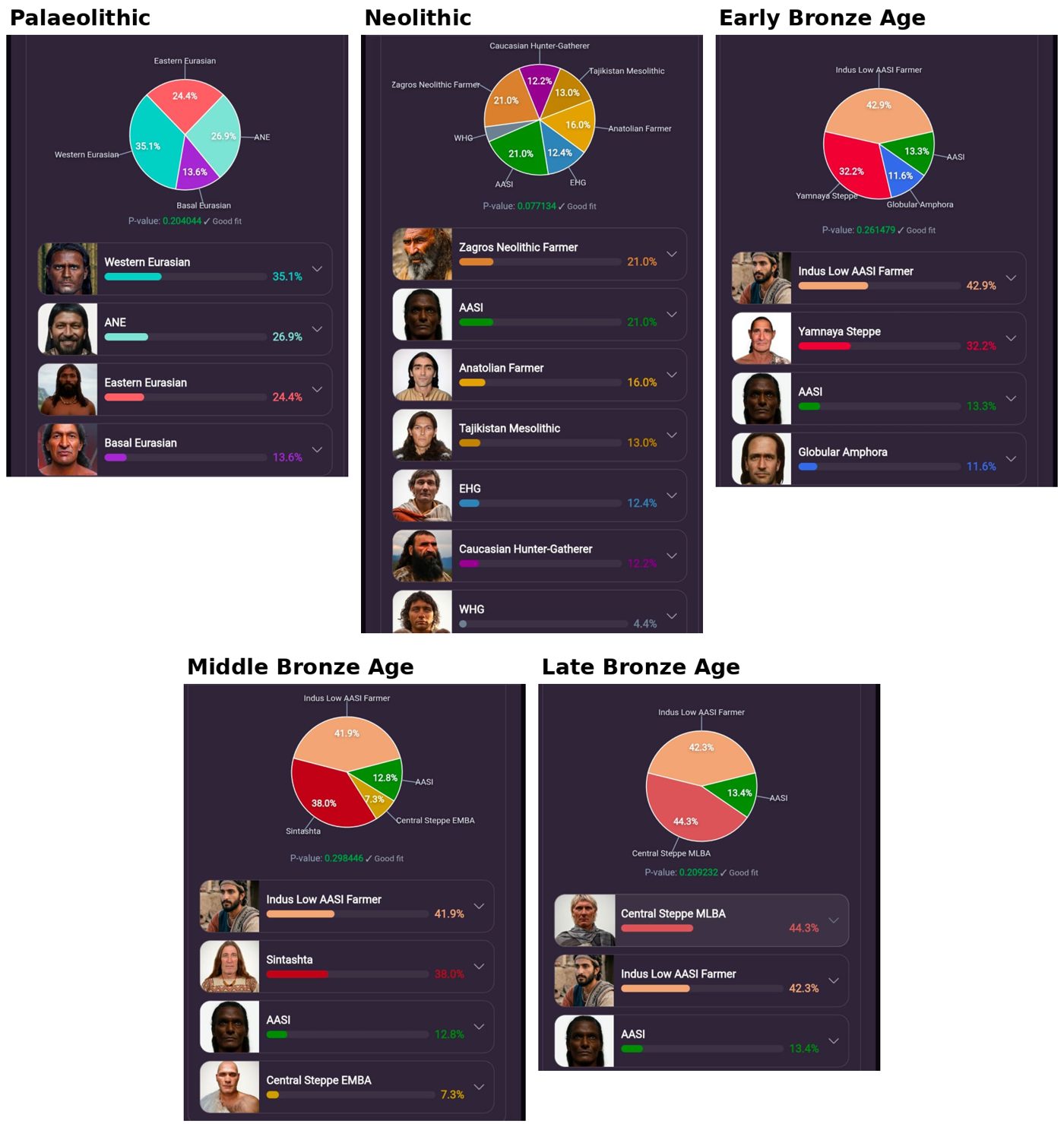
Two examples show the range. One report we looked at came out at about 50 percent Indus Periphery, 32 percent AASI and 12 to 15 percent Steppe in the Bronze Age models, with a small West Asian signal in some of them. The person in Figure 7 has much less AASI and much more Steppe ancestry. Each model also gives a p-value. A high p-value means the chosen sources describe the genome well. It does not prove that those sources were the person's actual ancestors, and a different set of sources may fit just as well.
The limits of the models
Terms like AASI, Iranian-related, Steppe, ANI and ASI are tools that geneticists use to describe patterns in DNA. They are not tribes that packed up and marched across the map. Each one is a statistical reconstruction, usually named after the ancient or modern population that best matches it. If scientists use different reference populations, the percentages change.
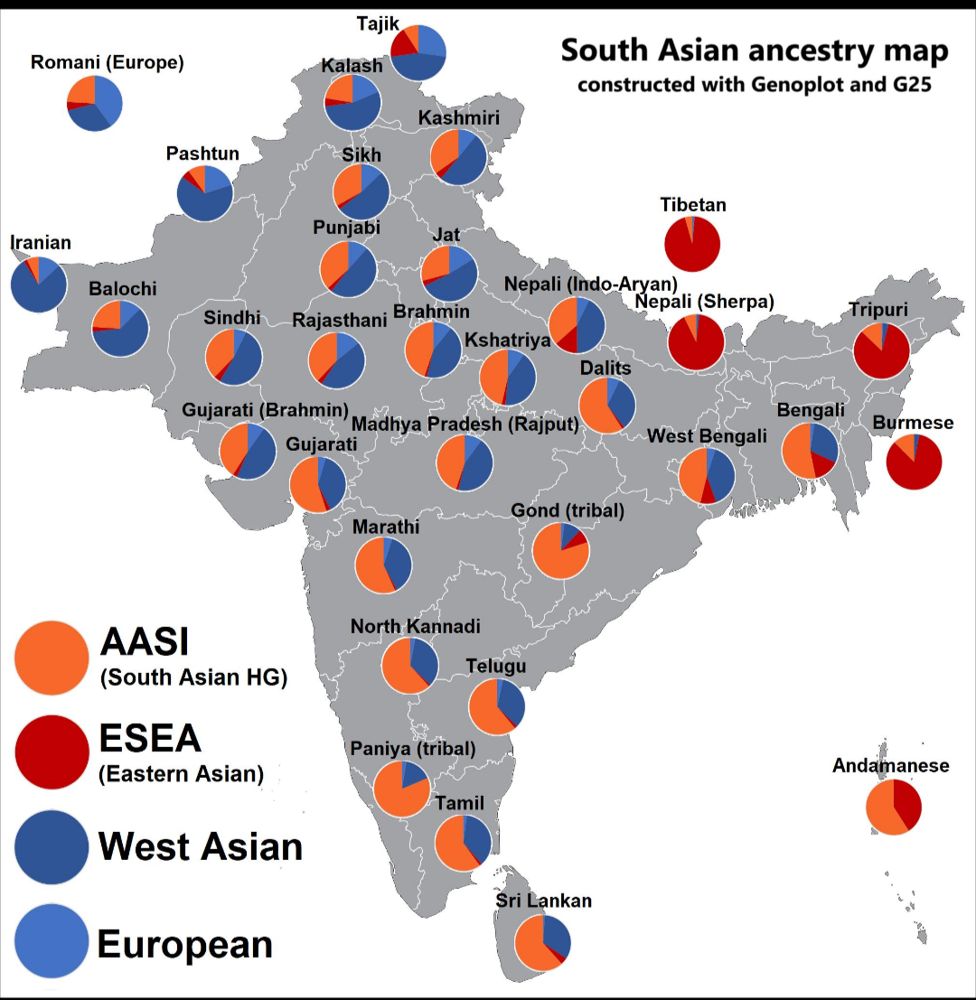
The data also has gaps. We have one ancient genome from inside the Indus Valley Civilisation, and none at all from the Ganga plain or from the Vedic period. Large new studies are filling in the modern picture. The GenomeIndia project, published in 2025, sequenced the whole genomes of 10,000 people from 83 populations [18], and the Kerdoncuff study drew its samples from across the country [1]. But for the ancient picture, much depends on what future excavations and laboratories produce.
What this means for identity
Some people use genetics to argue that their community is purely indigenous, and others that some communities are foreign. The evidence supports neither claim. Every Indian population studied so far is a mixture. Groups with the most AASI ancestry also carry Iranian-related ancestry, and northern groups that carry Steppe ancestry also carry a large share of AASI ancestry. The proportions differ, but the ingredients are mostly the same.
Genetics also cannot decide who is Aryan or Dravidian. Those are names for families of languages, and people have switched languages many times in history without their DNA changing much. And while caste groups do differ in their average ancestry, these differences are averages with a lot of overlap. Caste is a social system that froze existing mixtures in place. It did not create separate races.
So who are the ancestors of Indians? The first hunter-gatherers who arrived around 50,000 years ago. The people of the Indus region and their Iranian-related ancestors. Herders from the steppe who brought new languages. Communities from the east who settled in the forests and hills. Traders and refugees who came much later by sea and over land. Over thousands of years, all of them mixed, and only in the last two thousand years or so did that mixing slow down. Most Indians carry some part of each of these stories.
Finding your own mix
If you want to see where you fit in this story, a GenoConnect whole-genome test reports three kinds of result:
- Your Y-chromosome haplogroup, which traces your direct father's line. Common Indian lineages include H, L, R2, R1a, J2 and, among Austroasiatic speakers, O2a [11, 13]. Only men carry a Y chromosome, so a woman can learn her father's line from a test of her father or brother.
- Your mitochondrial haplogroup, which traces your direct mother's line. Most Indians carry old South Asian lineages from the M and R families, such as M2, M3, M5, R5 and U2 [7, 11].
- Your ancestry proportions, modelled with the three-way Indus Periphery, AASI and Steppe sources, together with the five period-by-period models described above.
Each result shows a different part of your ancestry. A haplogroup follows one line among thousands of ancestors, while the proportions summarise your whole genome.
References
- [1]Kerdoncuff, Elise, et al. "50,000 Years of Evolutionary History of India: Impact on Health and Disease Variation." Cell 188, no. 13 (2025): 3389–3404. doi:10.1016/j.cell.2025.04.027.
- [2]Petraglia, Michael, et al. "Middle Paleolithic Assemblages from the Indian Subcontinent Before and After the Toba Super-Eruption." Science 317, no. 5834 (2007): 114–116. doi:10.1126/science.1141564.
- [3]Clarkson, Chris, et al. "Human Occupation of Northern India Spans the Toba Super-Eruption ~74,000 Years Ago." Nature Communications 11 (2020): 961. doi:10.1038/s41467-020-14668-4.
- [4]Mellars, Paul, et al. "Genetic and Archaeological Perspectives on the Initial Modern Human Colonization of Southern Asia." Proceedings of the National Academy of Sciences 110, no. 26 (2013): 10699–10704. doi:10.1073/pnas.1306043110.
- [5]Thangaraj, Kumarasamy, et al. "Reconstructing the Origin of Andaman Islanders." Science 308, no. 5724 (2005): 996. doi:10.1126/science.1109987.
- [6]Mondal, Mayukh, et al. "Genomic Analysis of Andamanese Provides Insights into Ancient Human Migration into Asia and Adaptation." Nature Genetics 48, no. 9 (2016): 1066–1070. doi:10.1038/ng.3621.
- [7]Kivisild, Toomas, et al. "The Genetic Heritage of the Earliest Settlers Persists Both in Indian Tribal and Caste Populations." American Journal of Human Genetics 72, no. 2 (2003): 313–332. doi:10.1086/346068.
- [8]Narasimhan, Vagheesh M., et al. "The Formation of Human Populations in South and Central Asia." Science 365, no. 6457 (2019): eaat7487. doi:10.1126/science.aat7487.
- [9]Shinde, Vasant, et al. "An Ancient Harappan Genome Lacks Ancestry from Steppe Pastoralists or Iranian Farmers." Cell 179, no. 3 (2019): 729–735. doi:10.1016/j.cell.2019.08.048.
- [10]Lazaridis, Iosif, et al. "The Genetic Origin of the Indo-Europeans." Nature 639 (2025): 132–142. doi:10.1038/s41586-024-08531-5.
- [11]Silva, Marina, et al. "A Genetic Chronology for the Indian Subcontinent Points to Heavily Sex-Biased Dispersals." BMC Evolutionary Biology 17 (2017): 88. doi:10.1186/s12862-017-0936-9.
- [12]Kolipakam, Vishnupriya, et al. "A Bayesian Phylogenetic Study of the Dravidian Language Family." Royal Society Open Science 5, no. 3 (2018): 171504. doi:10.1098/rsos.171504.
- [13]Chaubey, Gyaneshwer, et al. "Population Genetic Structure in Indian Austroasiatic Speakers: The Role of Landscape Barriers and Sex-Specific Admixture." Molecular Biology and Evolution 28, no. 2 (2011): 1013–1024. doi:10.1093/molbev/msq288.
- [14]Reich, David, Kumarasamy Thangaraj, Nick Patterson, Alkes L. Price, and Lalji Singh. "Reconstructing Indian Population History." Nature 461 (2009): 489–494. doi:10.1038/nature08365.
- [15]Moorjani, Priya, et al. "Genetic Evidence for Recent Population Mixture in India." American Journal of Human Genetics 93, no. 3 (2013): 422–438. doi:10.1016/j.ajhg.2013.07.006.
- [16]Basu, Analabha, Neeta Sarkar-Roy, and Partha P. Majumder. "Genomic Reconstruction of the History of Extant Populations of India Reveals Five Distinct Ancestral Components and a Complex Structure." Proceedings of the National Academy of Sciences 113, no. 6 (2016): 1594–1599. doi:10.1073/pnas.1513197113.
- [17]Nakatsuka, Nathan, et al. "The Promise of Discovering Population-Specific Disease-Associated Genes in South Asia." Nature Genetics 49, no. 9 (2017): 1403–1407. doi:10.1038/ng.3917.
- [18]Bhattacharyya, Chandrika, et al. "Mapping Genetic Diversity with the GenomeIndia Project." Nature Genetics 57, no. 4 (2025): 767–773. doi:10.1038/s41588-025-02153-x.
- [19]Kenoyer, Jonathan Mark. Ancient Cities of the Indus Valley Civilization. Karachi: Oxford University Press, 1998.
- [20]Behar, Doron M., et al. "The Genome-Wide Structure of the Jewish People." Nature 466 (2010): 238–242. doi:10.1038/nature09103.
- [21]Waldman, Yedael Y., et al. "The Genetics of Bene Israel from India Reveals Both Substantial Jewish and Indian Ancestry." PLoS ONE 11, no. 3 (2016): e0152056. doi:10.1371/journal.pone.0152056.
- [22]Chaubey, Gyaneshwer, et al. "'Like Sugar in Milk': Reconstructing the Genetic History of the Parsi Population." Genome Biology 18 (2017): 110. doi:10.1186/s13059-017-1244-9.
- [23]Eaaswarkhanth, Muthukrishnan, et al. "Traces of Sub-Saharan and Middle Eastern Lineages in Indian Muslim Populations." European Journal of Human Genetics 18 (2010): 354–363. doi:10.1038/ejhg.2009.168.
- [24]Shah, Anish M., et al. "Indian Siddis: African Descendants with Indian Admixture." American Journal of Human Genetics 89, no. 1 (2011): 154–161. doi:10.1016/j.ajhg.2011.05.030.
Further reading
- [25]Joseph, Tony. Early Indians: The Story of Our Ancestors and Where We Came From. New Delhi: Juggernaut, 2018.
- [26]Reich, David. Who We Are and How We Got Here: Ancient DNA and the New Science of the Human Past. New York: Pantheon, 2018.
- [27]Singh, Upinder. A History of Ancient and Early Medieval India: From the Stone Age to the 12th Century. New Delhi: Pearson Longman, 2008.
- [28]Thapar, Romila, Michael Witzel, Jaya Menon, Kai Friese, and Razib Khan. Which of Us Are Aryans? Rethinking the Concept of Our Origins. New Delhi: Aleph, 2019.