Yamnaya ancestry: origins, migrations and genetic legacy
· By Himanshu Pandey
Explore the genetic journey of the Yamnaya people, their distinctive burial customs, and their profound impact on South Asian ancestry and global populations.
A camp on the Sok River
The wind on the steppe hardly ever stops. Some time around 3000 BCE, it blows across a herders’ camp near the Sok River, in what is now the Samara region of Russia.
A wagon stands beside a tent of felt and hide. Its wheels are solid wood, each cut from planks and pinned together, and it is heavy enough to need a pair of oxen. A woman milks the cows while a boy drives the sheep and goats down to the water. In a pot by the fire, yesterday’s milk is turning sour and thick. In a few days, when the grass near the river is eaten down, the family will load the wagon with the tent, water and food, and follow their herds out across the open grass [1, 5].
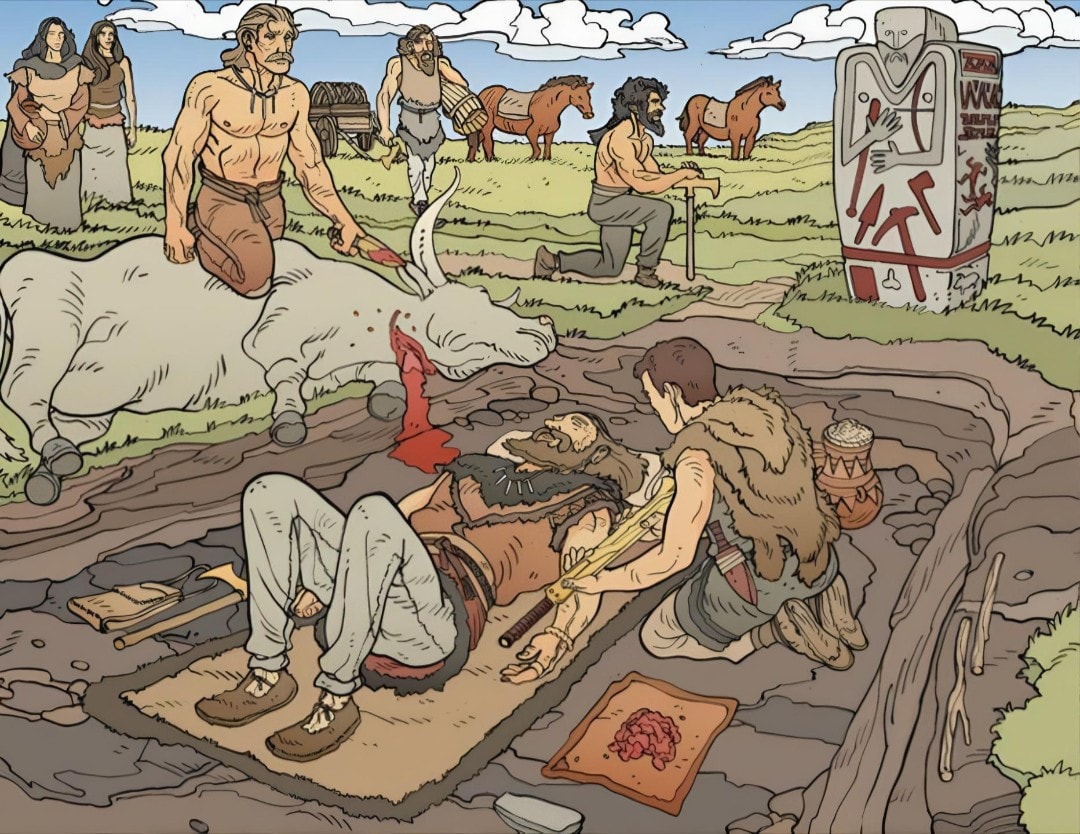
Figure 1. An artist’s reconstruction of a steppe funeral: the body lies in a pit with ochre and grave goods, a sacrificed ox lies at the edge, and a carved stone stela stands behind.
This family is imagined. Their way of life is not. Archaeologists have found the wagons and wheels these people built, and chemists have found milk proteins from cattle, sheep and goats in the tartar on their teeth [1, 5]. They have even read the DNA of a man who lived beside this river at this time. Geneticists call him SVP38. His father’s line belonged to a branch of the Y chromosome called R1b-M269, and his mother’s line was T2c1a2 [2]. We do not know his name or his language. We know his genome, and we know how his people lived.
Archaeologists call them the Yamnaya. Within a few centuries, people with their ancestry would be living in Germany, Britain and the Altai Mountains. Much later, and by a long and mixed road, a share of their ancestry would reach South Asia. If your DNA report shows “steppe” ancestry, part of it goes back to people like these.
So who were they?
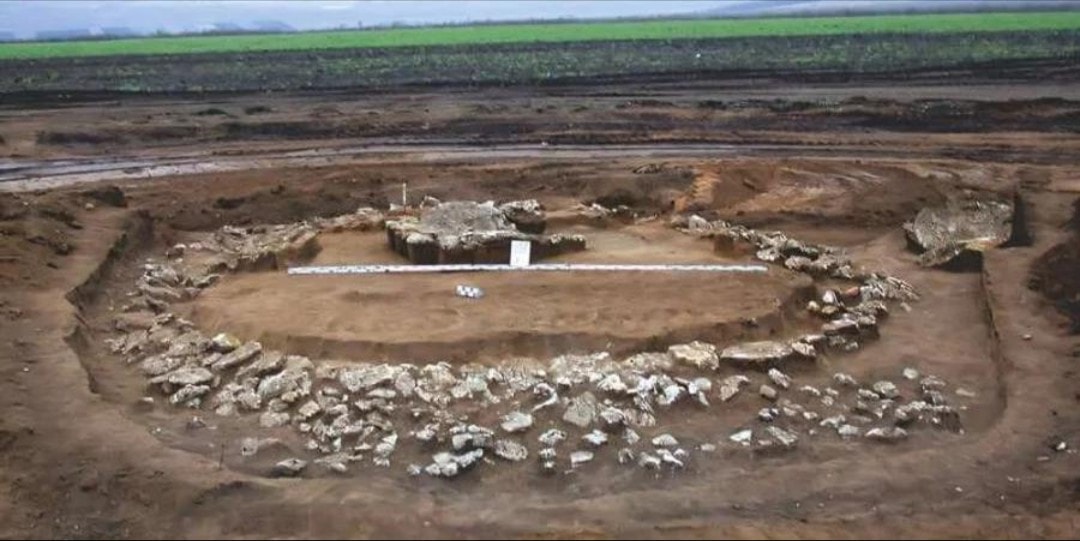
Figure 2. An excavated burial mound (kurgan). The mound has been removed to show the ring of stones around the central grave.
A name taken from a hole in the ground
Archaeologists call them the Yamnaya, from the Russian word yama, a pit. The name describes the graves. Nobody knows what these people called themselves, or whether they thought of themselves as one people at all. In this article “the Yamnaya” means people buried in this way on the grasslands north of the Black Sea and the Caspian Sea.
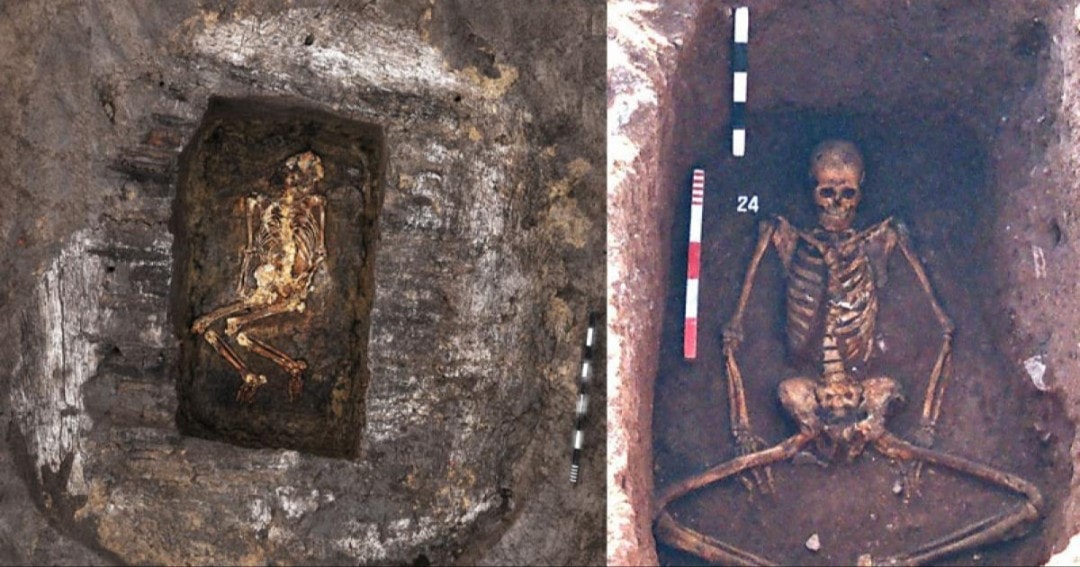
Figure 3. Pit burials of the kind that gave the Yamnaya their name. The dead were usually laid on the back with the knees drawn up; over time the knees often fell to one side.
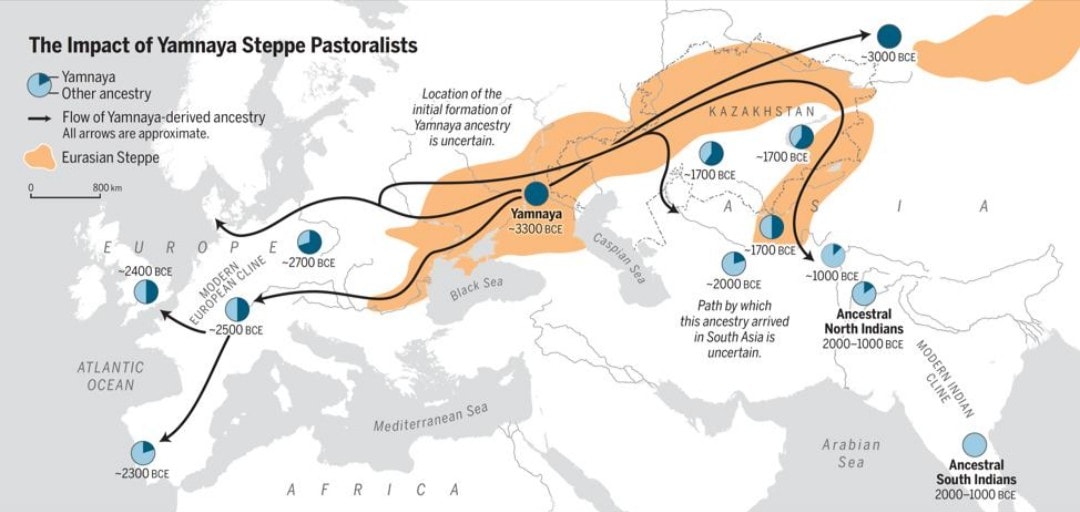
Their graves appear around 3300 BCE. By about 3000 BCE they stretch from Hungary in the west to Kazakhstan in the east [3]. Within a few centuries, people with their ancestry would be living in Germany, Britain, the Altai Mountains and, much later and in a mixed form, South Asia.
For most of the twentieth century, all we had were the graves. Archaeologists argued over whether the spread of this burial style meant people moving or ideas moving. Ancient DNA has now answered a large part of that question. To understand it, we have to go back a thousand years before the man at Lopatino.
Before the Yamnaya: two worlds meet on the Dnipro
Around 4500 BCE, the land between the Caucasus Mountains and the lower Volga River was home to a population that geneticists call the Caucasus–Lower Volga people, or CLV for short. At their southern end they were closely related to the farmers of the Caucasus. At their northern end, at a site called Berezhnovka on the lower Volga, they looked more like the hunters of the steppe [3]. They were not one tribe. They were a chain of related communities, each mixed with its neighbours.
Some CLV people moved west. On the Dnipro and Don rivers, in what is now Ukraine and southern Russia, they met people descended from the old hunter-gatherers of the region. The newcomers and the locals mixed. Archaeologists call the culture that came out of this the Serednii Stih [3, 4].
There were other branches of the same story. One wave of CLV migrants went further west and mixed in equal parts with the farmers of the Trypillia culture, forming a people archaeologists call the Usatove, around 4500 BCE [4]. The Usatove were cousins of the Yamnaya’s ancestors. They took a different road.
Then, around 4000 BCE, one group of Serednii Stih people mixed again. Their descendants are the Yamnaya. Iosif Lazaridis and colleagues date this final mixture to about 4038 BCE, give or take a few decades [3]. They estimate that about four-fifths of Yamnaya ancestry came from CLV people and about one-fifth from the hunter-gatherers of the Dnipro and Don [3].
The place where this happened may have been found. At Mykhailivka, a settlement on the lower Dnipro in southern Ukraine, people lived through the whole change from the older culture to the Yamnaya one. One man buried there, dated to between 3635 and 3383 BCE, is already genetically Yamnaya [4]. Alexey Nikitin and colleagues call Mykhailivka a likely centre of Yamnaya formation.
The first ancient DNA studies, in 2015, saw this picture only roughly. Wolfgang Haak and colleagues found that the Yamnaya were about half eastern European hunter-gatherer and half something related to the Near East, for which present-day Armenians were the best stand-in they had [2]. Ten years and hundreds of new genomes later, that “something” has a place and a name.
How do we know when two groups mixed? When two populations mix, the children inherit long unbroken stretches of DNA from each side. In every later generation those stretches are cut into shorter pieces. By measuring how long the pieces are in a person’s genome, geneticists can count back roughly how many generations ago the mixing happened.
A small people that grew fast
For several centuries after they formed, the Yamnaya’s ancestors kept mostly to themselves. Lazaridis and colleagues estimate that their breeding population was only a few thousand people [3]. Then, after about 3600 to 3400 BCE, their numbers grew very fast, by up to ten times [3]. A small community became the founders of a huge one.
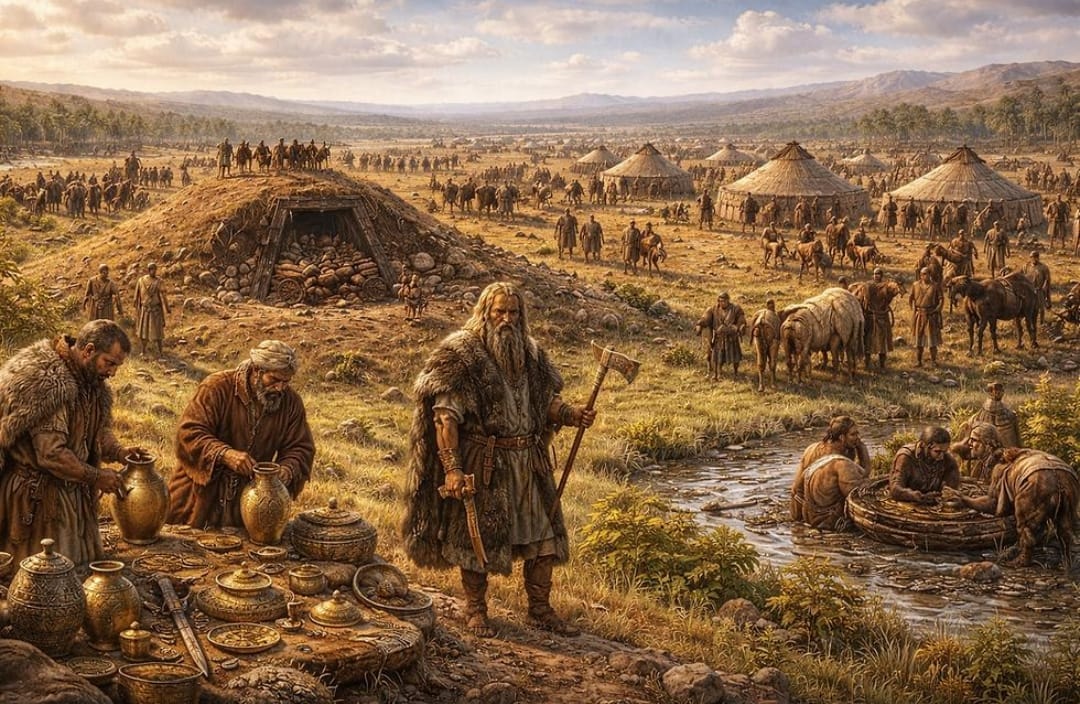
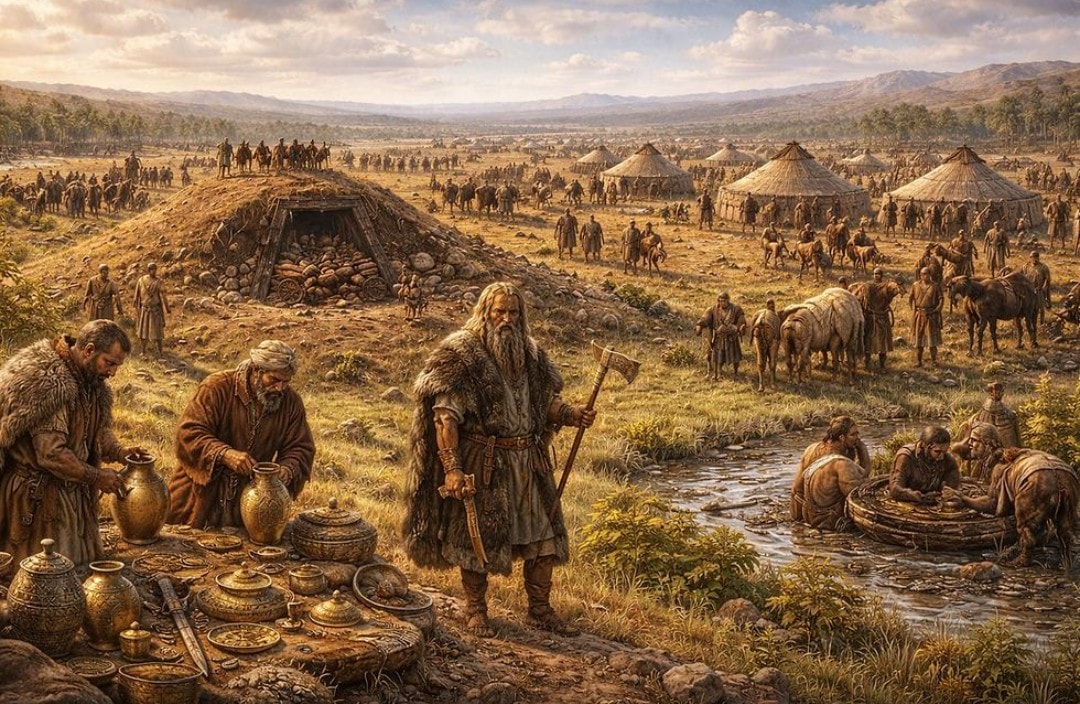
Figure 4. An artist’s impression of a steppe herders’ camp. Some details, such as the gold vessels and mounted riders, go beyond what the archaeological evidence shows.
Their father lines tell the same story. Among the men of the core Yamnaya population, 49 out of 51 carried the Y-chromosome branch R1b-M269, and 41 of those 51 carried one particular sub-branch, R1b-Z2103 [3]. The authors write of “the homogeneity of the Yamnaya patrilineal community”: a society in which descent and belonging passed from father to son [3].
Not every Yamnaya group was the same. On the Don River, 17 out of 20 Yamnaya men carried a different father line, I-L699, and these Don Yamnaya also carried about one-fifth of their ancestry from local hunter-gatherers [3]. Here the Yamnaya had married into the families already living on the river.
Their mother lines were far more varied. The nine Yamnaya individuals from the Samara region studied in 2015 carried the mitochondrial lines U4a1, U5a1a1 (twice), W6, W3a1a, H13a1a1a, H2b, H6a1b and T2c1a2 [2]. U4 and U5 were common among the old hunter-gatherers of Europe. H, T and W lines were widespread among farming populations and peoples related to the Near East. Women seem to have come into these communities from many different families.
How do we know about fathers and mothers separately? The Y chromosome passes only from father to son, almost unchanged. Mitochondrial DNA passes only from a mother to all her children. Comparing the two in the same cemetery shows whether men or women were more likely to stay in the community where they were born.
Where the bones were found
The Yamnaya story is pieced together from graves and settlements spread across Europe and Asia. These are the places mentioned in this article.
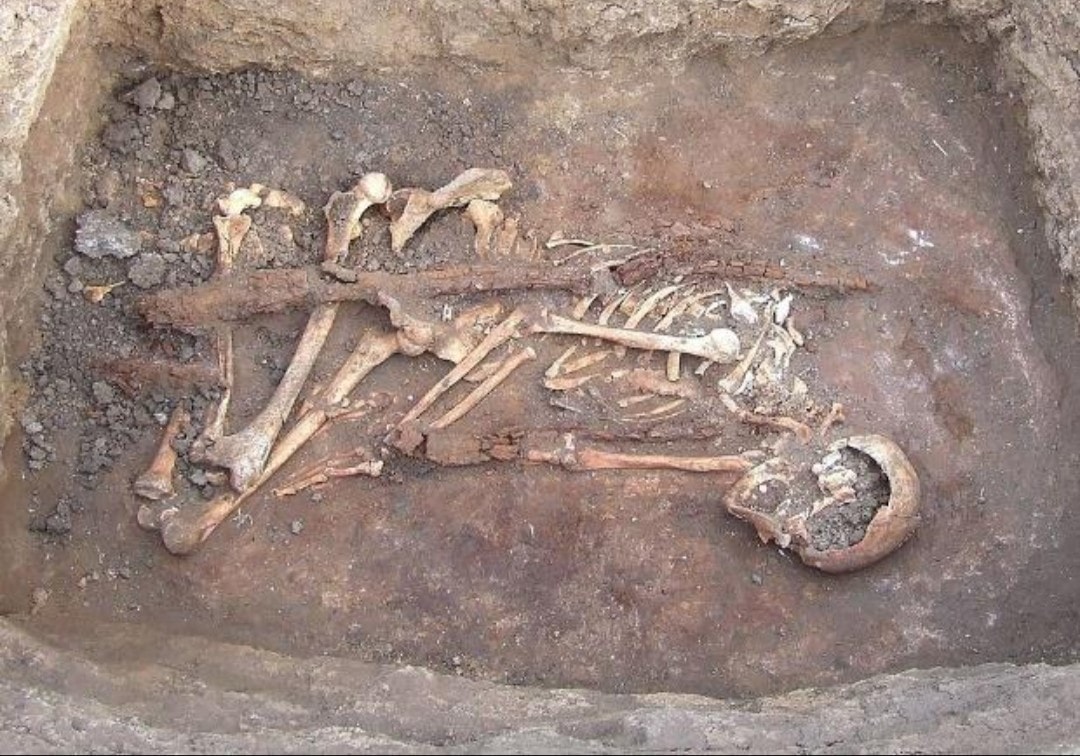
Figure 5. A skeleton in a rectangular grave pit. The reddish colour on the grave floor may come from ochre scattered at burial.
Site
Where it is today
What was found
Source
Berezhnovka
Lower Volga, Russia
Northern end of the CLV population, ancestors of the Yamnaya
[3]
Mykhailivka
Lower Dnipro, southern Ukraine
Settlement used across the change to Yamnaya; a genetically Yamnaya man, 3635–3383 BCE
[4]
Lopatino I and II
Sok River, Samara region, Russia
Yamnaya burials, including SVP38
[2]
Ekaterinovka, Luzhki I, Kurmanaevka III, Kutuluk I
Samara region, Russia
More Yamnaya genomes, about 3300–2700 BCE; with Lopatino, seven men in all, every one R1b-M269
[2]
Ishkinovka I
Orenburg region, Russia
Yamnaya burial in the steppe near the Urals
[2]
Krivyanskiy 9
Lower Don, Russia
The oldest horse milk proteins yet found, in the teeth of two people
[5]
Strejnicu
Romania
A Yamnaya skeleton with all six skeletal signs linked to riding
[6]
Malomirovo
Bulgaria
Yamnaya skeletons studied for signs of riding
[6]
Milk, wagons and horses
What did the Yamnaya eat? For a long time the answer came only from animal bones in their graves. Then scientists began to study something less obvious: the hard plaque, or tartar, on their teeth. Tartar traps tiny bits of food and keeps them for thousands of years.
Shevan Wilkin and colleagues looked for milk proteins in the tartar of people from the western steppe [5]. In the centuries before the Yamnaya, 10 out of 11 people showed no sign of drinking milk at all. In the Early Bronze Age, the time of the Yamnaya, 15 out of 16 people had milk proteins in their teeth [5]. The milk came from cattle, sheep and goats. Two people at Krivyanskiy 9 on the lower Don also had horse milk proteins, the oldest yet found [5].
That change matters for the story. A herding family that can live on milk from its animals does not need to grow crops or stay near one patch of land. With milk and a wagon, people could move with their herds across hundreds of kilometres of grass [1, 5].
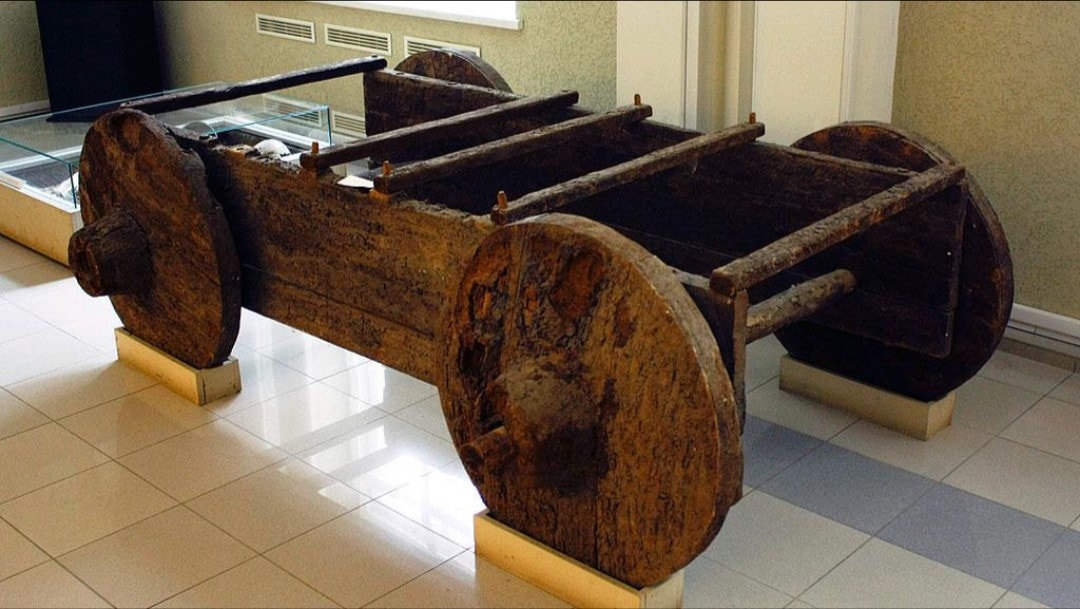
Figure 6. A wooden wagon with solid wheels from a steppe burial, now in a museum. Wagons like this, pulled by oxen, carried herding families across the grassland.
There is a puzzle here. The gene variant that lets adults digest fresh milk easily was still rare in the Bronze Age [7]. Most Yamnaya adults probably could not drink large amounts of fresh milk without discomfort. Herders in many parts of the world solve this by fermenting milk into yogurt, cheese or soured drinks, which contain less lactose. The Yamnaya may have done the same, though no one has yet found direct proof.
Did they ride?
This is one of the fiercest arguments in the field. In 2023, Martin Trautmann and colleagues examined skeletons from kurgans in Romania, Bulgaria and Hungary. They reported five Yamnaya individuals, dated between 3021 and 2501 BCE, whose hips, thigh bones and spines showed changes that habitual horse riders often develop [6]. One skeleton from Strejnicu in Romania showed all six of the signs they looked for. They called these people the oldest known riders.
Other scholars are not convinced. Hosek, James and Taylor argue that the same bone changes can come from other kinds of hard physical work, and that there is not yet a reliable comparison set to tell them apart [8]. Horse genetics adds another doubt. Pablo Librado and colleagues studied 475 ancient horse genomes and found that people began tightly controlling horse breeding only around 2200 BCE, centuries after the Yamnaya expansion [9]. In their view, the Yamnaya did not move west with big herds of domestic horses.
In 2026, David Anthony, Martin Trautmann and Volker Heyd replied. They argue that horses were milked, managed and ridden long before 2200 BCE, and that Yamnaya groups rode horses of the same lineage as today’s domestic horses [10]. The argument is still open. The wagon pulled by oxen is the Yamnaya vehicle that the evidence firmly supports.
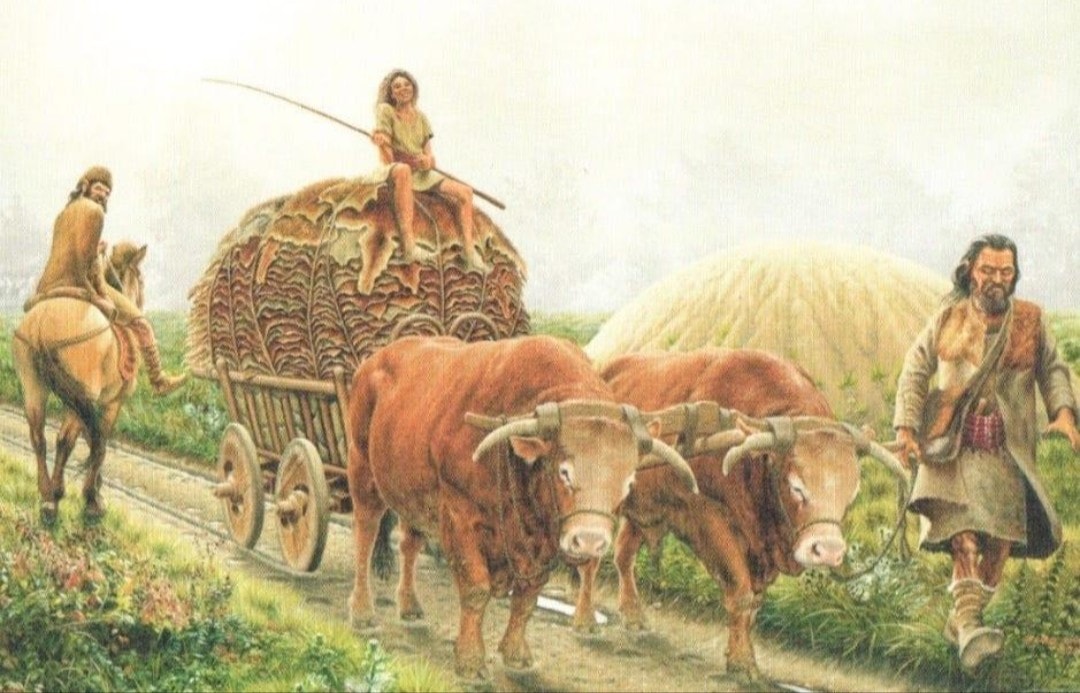
Figure 7. An artist’s reconstruction of an ox-drawn wagon. The rider on the left shows one side of the debate over whether the Yamnaya rode horses.
What made them sick
Life on the steppe had its dangers. Simon Rasmussen and colleagues found the DNA of the plague bacterium in human teeth from Asia and Europe, dating from 5,000 to 2,800 years ago [11]. These were early forms of plague, older than any that caused the great historical pandemics. Bronze Age people across Eurasia, including herders of the steppe, lived with this disease.
Their immune systems carry traces of that history. William Barrie and colleagues found that genetic variants that raise the risk of multiple sclerosis today became more common among steppe herders and were favoured by natural selection, probably because they helped fight infections [12]. The same variants travelled into Europe with Yamnaya-related ancestry about 5,000 years ago [12]. A defence that helped Bronze Age herders survive their diseases has a cost for some of their descendants today.
The great spread
Around 3300 BCE, the Yamnaya began to move. Over the next three centuries their graves spread across the steppe in both directions [3].
On the Volga and further east, the groups who had lived there before the Yamnaya seem to disappear from the record. Lazaridis and colleagues describe them vanishing “in the face of the Yamnaya juggernaut” [3]. In the west, the story was different. In the Danube lands and Hungary, Yamnaya people lived alongside farming communities, and many western Yamnaya carried farmer ancestry mixed into their own [3]. On the Don they mixed with local hunters. Each frontier produced its own blend.
Far to the east, some Yamnaya people crossed the steppe to the Altai Mountains, on the borders of present-day Russia, Kazakhstan, Mongolia and China. Archaeologists call their culture there the Afanasievo. Genetically, the Afanasievo were Yamnaya [3, 7]. People with almost the same ancestry now lived thousands of kilometres apart.
Figure 8. Approximate routes of Yamnaya-derived ancestry. Each pie chart shows the share of Yamnaya ancestry (dark) in a population at the date given
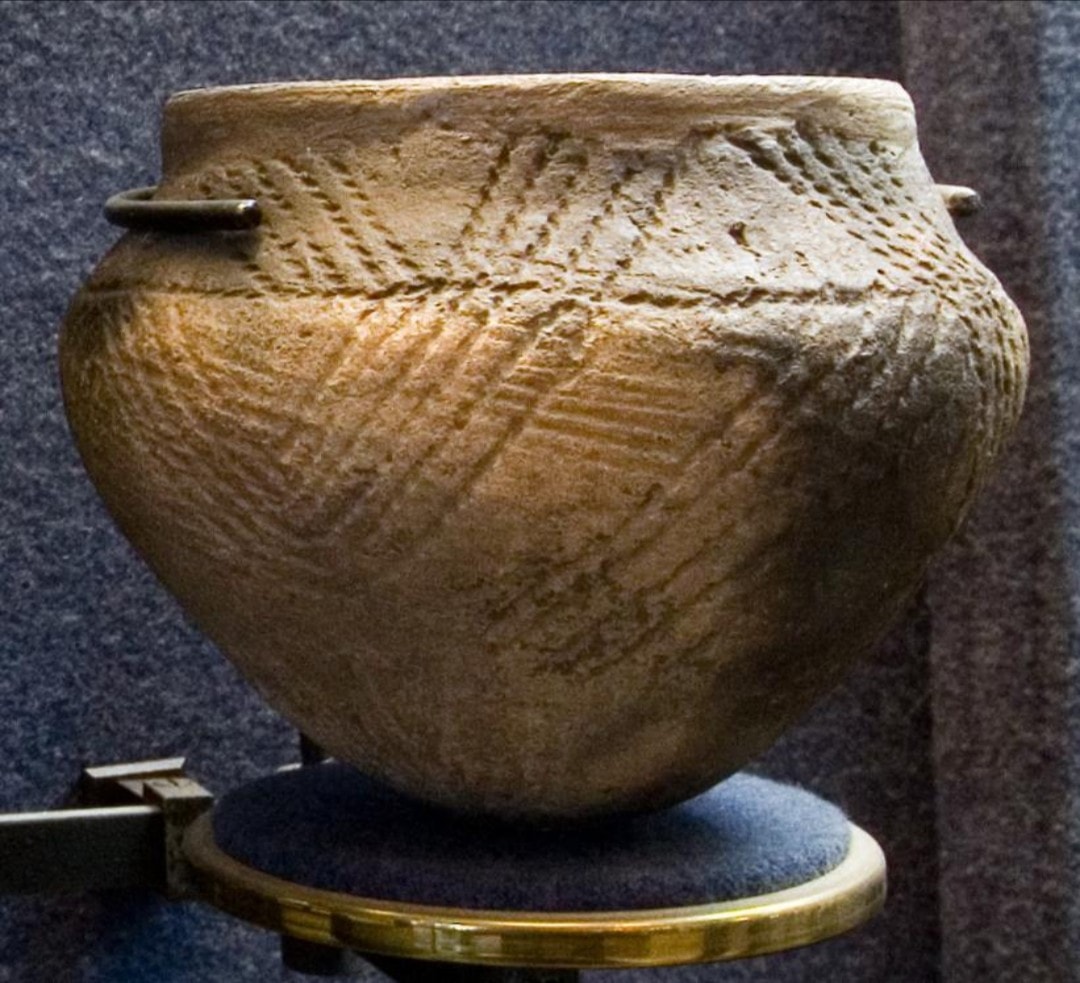
What happened next shaped much of Europe. Haak and colleagues found that people of the Corded Ware culture in Germany, from about 2900 BCE, traced about three-quarters of their ancestry to Yamnaya-like people [2]. Steppe ancestry then spread across central and northern Europe. In Britain, people of the Bell Beaker culture arrived after about 2500 BCE, and within a few hundred years about 90 percent of Britain’s gene pool had been replaced [13]. A 2024 preprint, not yet peer-reviewed, suggests that the ancestors of Greeks and Armenians received their steppe ancestry more directly from Yamnaya groups of eastern Europe [14].
Figure 9. A pot decorated with cord impressions, the style that gave the Corded Ware culture its name.
Yamnaya ancestry also travelled east and south by a longer road. Corded Ware-related people moved back east to the Urals, where their descendants built the Sintashta culture around 2000 BCE [7, 15]. From there, people of the Andronovo cultures spread across Kazakhstan. Their ancestry, about two-thirds Yamnaya-like and one-third European farmer-related, reached South Asia in the second millennium BCE [15].
Did the Yamnaya speak an early form of the Indo-European languages, the family that includes Sanskrit, Persian, Greek and English? Many geneticists and archaeologists think so. Lazaridis and colleagues place the last common ancestor of these languages among the CLV people between 4400 and 4000 BCE [3]. Others, including Paul Heggarty and colleagues, argue for an earlier origin south of the Caucasus [16]. DNA can tell us who people’s ancestors were. It cannot tell us what language they spoke.
Where their ancestry lives today
Yamnaya-related ancestry is found in almost every person in Europe today [2]. It is highest in the north and lower in the south. Evan Irving-Pease and colleagues found that it peaks in Ireland, Iceland, Norway and Sweden [17]. Within the United Kingdom it is highest in the Outer Hebrides and in Ireland, though the differences between regions there are only a few percentage points [17]. The same team found that the difference in average height between northern and southern Europeans is linked to differences in steppe ancestry [17].
In South Asia the ancestry arrived late and already mixed. It came through the Sintashta and Andronovo groups, so only about two-thirds of the “steppe” ancestry in South Asians is Yamnaya-like. Steppe ancestry makes up as much as 30 percent of the ancestry of some South Asian groups, and is generally higher in the north-west of the subcontinent [15]. Every South Asian group also carries large shares of two older streams: the ancient hunter-gatherers of South Asia and an Iranian-related stream of farmers and herders.
What about haplogroups?
Many readers want to know whether their father line goes back to the Yamnaya. The answer is less simple than it looks.
R1b-M269, the branch carried by almost all core Yamnaya men, is today the most common male line in western Europe. But most western European men carry a sister branch, R1b-L51, while most Yamnaya men carried R1b-Z2103 [3]. Morten Allentoft and colleagues point out that the Yamnaya father lines do not match those found in Europeans after about 3000 BCE [18]. The western European R1b lines are relatives of the Yamnaya ones, and their exact route is still being worked out.
R1a, the steppe-related male line most common in South Asia and eastern Europe, is almost absent from the Yamnaya graves sampled so far [2, 3]. It became common among the later Corded Ware and Sintashta men [15]. An Indian man with R1a-Z93 shares distant steppe ancestry with the Yamnaya, but his father line runs through those later groups.
Back to the mound
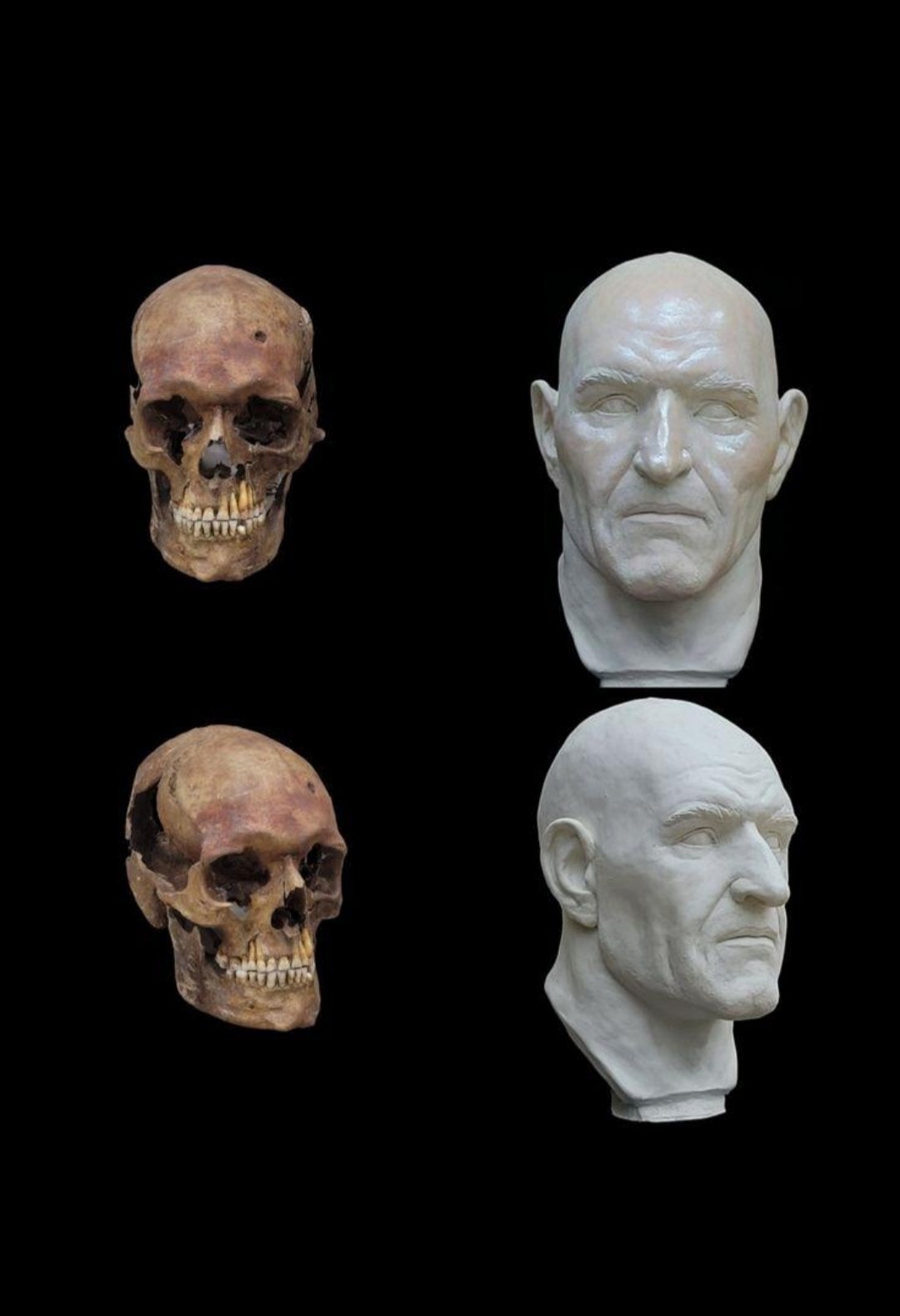
Return to the grave on the Sok River, and to the man the scientists call SVP38. His ancestors had come together only a few centuries before he was born, from Caucasus-related herders and the hunters of the Dnipro. His people were few for a long time and then, quite suddenly, many. They drank milk, travelled with wagons and buried their dead under mounds with neighbours who were not always kin.
Figure 10. A Bronze Age steppe skull and a facial reconstruction based on it. A reconstruction shows the shape of the face but cannot show skin, hair or eye colour.
Within a few generations of his death, people with his ancestry lived from Hungary to the Altai. Within a thousand years their descendants had mixed with farmers in Germany, settled Britain, and set out on the long road that would bring a share of their ancestry to the plains of India. Today a part of his story sits in the genomes of hundreds of millions of people, almost always blended with the stories of other ancient peoples.
References
[1]
Anthony, D. W. 2007. The Horse, the Wheel, and Language: How Bronze-Age Riders from the Eurasian Steppes Shaped the Modern World. Princeton University Press.