About 10,000 years ago, hunters in central Anatolia started farming, and their descendants carried farming all the way across Europe. South Asians carry very little of their ancestry, because here farming seems to have started among people who were already living in the region.
— Himanshu Pandey
A town with no streets
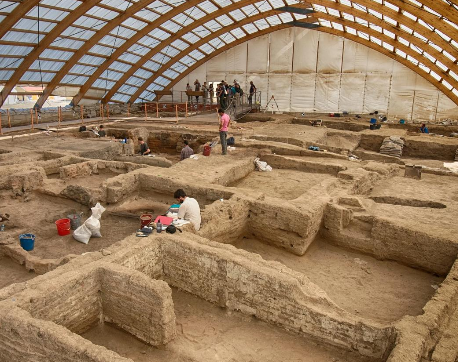
Picture a family on the Konya plain, in what is now south-central Turkey, about 6600 BCE. It is early morning. A girl climbs up a wooden ladder, out through a hole in the ceiling, and onto the roof. Her town has no streets. The mud-brick houses are built wall to wall, so the roofs are the streets, and people walk across them to visit their neighbours [1, 2].
Figure 1. Excavated houses at Çatalhöyük. The buildings stood wall to wall, with no streets between them. Image source: Çatalhöyük Research Project.
This family is imagined. Everything around them is real. The town is Çatalhöyük. It began about 7100 BCE, and at its height it may have held between 3,500 and 8,000 people, which makes it one of the largest settlements of its time anywhere in the world [1, 3]. People rebuilt their houses on the same spot, one on top of the other, for well over a thousand years.
The story of these villagers did not stay on the Konya plain. People from the same population became the first farmers of Europe. Their descendants walked up the valley of the Danube and sailed along the Mediterranean coast, and within a few thousand years farming families had reached Spain, Germany and Britain [5, 6].
Geneticists call their ancestry “Anatolian farmer” ancestry. Treat the phrase as a label, like “Darjeeling” on a packet of tea. It tells you where something began. It tells you nothing about who drinks the tea today. And these farmers were not Turks. Turkic speakers reached Anatolia only about a thousand years ago [7], and the people of modern Turkey, like all of us, come from many mixtures.
So the relatives of these villagers reached as far as Britain. Did any of them reach India? And if farming in South Asia did not come with them, how did it begin? That is where this story is heading.
The hunters who started farming
Go back about 15,000 years. A man dies at Pınarbaşı, on the southern side of the Konya plain. Nobody around him farms. Nobody anywhere does. Thousands of years later, a small bone from his hand or foot gives scientists the first genome of an Anatolian hunter-gatherer [8].
That one genome helped settle an old argument. Farming first appeared in the Fertile Crescent, the arc of land that runs through the Levant, northern Mesopotamia and the Zagros Mountains. So did farmers from there walk into central Anatolia and bring farming with them? Or did the people already living in Anatolia start farming themselves?
In 2019 Michal Feldman and her colleagues compared the Pınarbaşı man with farmers from Boncuklu, a village about 10,000 years old. Their answer was clear. About 90 percent of the farmers' ancestry came from people related to the local hunter [8]. The farmers were the hunter's own people, thousands of years on.
One thing to remember about such numbers: an ancestry percentage is the estimate of a statistical model. It is different from measuring someone's height, because if you change the groups you compare with, the number can move. The other 10 percent or so at Boncuklu came from people related to those of Iran and the Caucasus. About 2,000 years later, Feldman's model adds about 20 percent from the Levant, the lands of today's Israel, Jordan and their neighbours [8]. Yaka's team, using different data, put the Levant share at about 10 percent [3].
The digging tells the same story. Archaeologists use the word Neolithic for the time when people in a region began to farm. Domestication is the slow change of a wild plant or animal into a form that lives with people, the way a dog differs from a wolf. Douglas Baird's team dug at Boncuklu and found people who mostly hunted and gathered around the wetlands. They also grew small plots of wheat, lentils and peas, and these plants were not yet fully domesticated. They kept a few sheep and goats as well, as a small experiment [9, 10].
They carried on like this for at least five hundred years. Meanwhile at Pınarbaşı, about 30 kilometres away, people of the same time stayed with hunting and gathering [10]. So two communities close to each other could live in different ways. One tried farming and the other did not.
Far to the south-east, near today's Şanlıurfa, people had already done something surprising. At Göbekli Tepe they built round enclosures with carved T-shaped limestone pillars. The excavators date the oldest tested enclosure to about 11,500 years ago, and the site went out of use about 10,000 years ago. They have found no domesticated plants or animals there [11]. So people who lived by hunting and gathering could also build on a large scale.
How much of Anatolian farming was invented locally, and how much was borrowed? The crops seem to have come through exchange with areas to the south and east, while herding may have started with local animals [9, 10]. Feldman's team says local hunters picked up ideas, plants and techniques, and some people from neighbouring regions joined them over time [8]. Baird's team warns against turning this into a simple either-or question [9]. Both things happened, and we still cannot say in what measure.
A day in the first villages
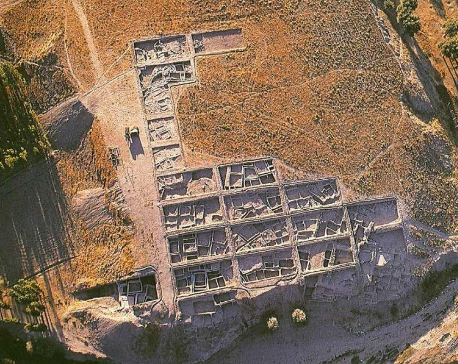
What was daily life like? About 10,000 years ago, the houses at Boncuklu and Aşıklı Höyük were small and curved, and much of the work was done outdoors. At Aşıklı, in Cappadocia, people kept sheep inside the settlement and grew cereals. They went on hunting many kinds of animals too [3].
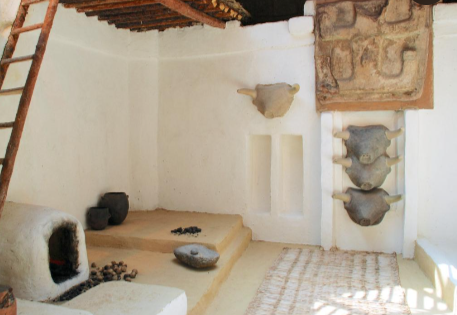
Figure 2. Aerial view of the excavations at Aşıklı Höyük, one of the earliest settled villages in central Anatolia.Figure 3. A modern reconstruction of a Çatalhöyük house, with a roof ladder, an oven and plastered bull heads. Image source: Çatalhöyük Research Project.
People kept building on the same spot. A new house went up on top of the old one, with the hearth in about the same place, and this went on for centuries. Human skulls seem to have been handed down inside houses from one generation to the next. The excavators have found no big public buildings and no separate cemeteries, and the houses are about the same size. Many researchers read this as a sign of a fairly equal society [1]. Seeds, bones and walls show us the farming, the feasts and the floor plans. The equal society is a reading of those remains, and we should keep that difference in mind.
The DNA brings individual people into view. At Aşıklı, five women and girls were buried in two buildings that shared a work area. Their genomes point to two pairs of sisters, though a parent and child cannot be ruled out [3]. At Boncuklu, a woman and her probable adult son lay in one building, and a man and woman who were probably brother and sister lay in two neighbouring buildings [3].
One grave at Boncuklu is a small puzzle. A newborn baby lay with an adult woman. Both had the same mitochondrial type, a stretch of DNA that passes from mother to child. Anyone would guess mother and baby. But the rest of the genome showed they were not close relatives [3]. We can only wonder who that baby was to her.
It is tempting to say that people first lived in villages of relatives and later moved to something else at Çatalhöyük. The evidence does not let us say this with confidence. Only 14 of the 60 skeletons tried at Çatalhöyük gave usable DNA, and almost all of those were children. We cannot even be sure that the people buried in a house lived in it, since Aşıklı has only about 90 burials from more than 400 excavated rooms [3]. Yaka's team leaves the question open. This may be a change over time, or children and adults may simply have been treated differently.
Other farmers, other families
Now walk east across Anatolia and into the Zagros Mountains of western Iran. About 10,000 years ago, people at Ganj Dareh in the Zagros were herding goats [13]. Like the villagers of Boncuklu, they were trying something new with animals. By their DNA, though, they were a different people.
Iosif Lazaridis and his colleagues showed in 2016 that the first farmers of the Levant and of the Zagros were very different from each other, and that each group came from its own local hunter-gatherers [12]. Anatolia's farmers had their own profile as well [8]. So farming began among several separate peoples who had lived apart for a long time.
Over the next few thousand years these peoples met and had children together. Geneticists call this admixture. Think of two rivers joining, with the water of both still there downstream. By the Bronze Age this mixing had produced a gradient across south-west Asia, with more Anatolian-related ancestry in the west and more Iranian-related ancestry in the east [14]. Remember this gradient. It comes back when we reach India.
There is another clue in our DNA. The Y chromosome passes from father to son, like a surname. Mitochondrial DNA passes from mother to child. A haplogroup is one branch on the family tree of such a line, so it follows just one thread among thousands of ancestors.
The Konya plain has a surprise here. The Pınarbaşı hunter carried the Y-chromosome branch C1a2 and the maternal branch K2b [8]. Thousands of years later, two babies buried at Çatalhöyük also carried C1a2 [3]. It is as if one surname had stayed in the same district for six thousand years. Other boys in these villages carried branches of G2a, and the mothers' lines at Aşıklı and Çatalhöyük include K1a, N1a, T2 and U3 [3]. Feldman's team lists G2a and C among the common Y-chromosome types of early farmers, with N1a, U3 and K1a among the maternal ones [8]. N1a also turned up often among central Europe's early farmers, though it is rare today [15].
A word of caution. These findings come from the few people sampled so far, and many of the genomes are thin. If you carry G2a or K1a today, that does not place your family at Çatalhöyük. These branches are far older than any one village, and they are scattered far more widely.
The long walk west
Stand on the Aegean coast about 6500 BCE. Across a sea full of islands lies Greece, and its plains would suit wheat and sheep very well. Between about 7000 and 6500 BCE, farming families began to settle there [16, 13].
How do we know they were the same people? In 2016 Zuzana Hofmanová, Joachim Burger and their colleagues read genomes from early farmers of northern Greece and north-western Turkey. These people closely resembled one another across the water, and they also resembled early farmers from much deeper inside Europe [17]. Gülşah Merve Kılınç's team took the line one step further back and showed that central Anatolia's earliest farmers belonged to the same gene pool [6].
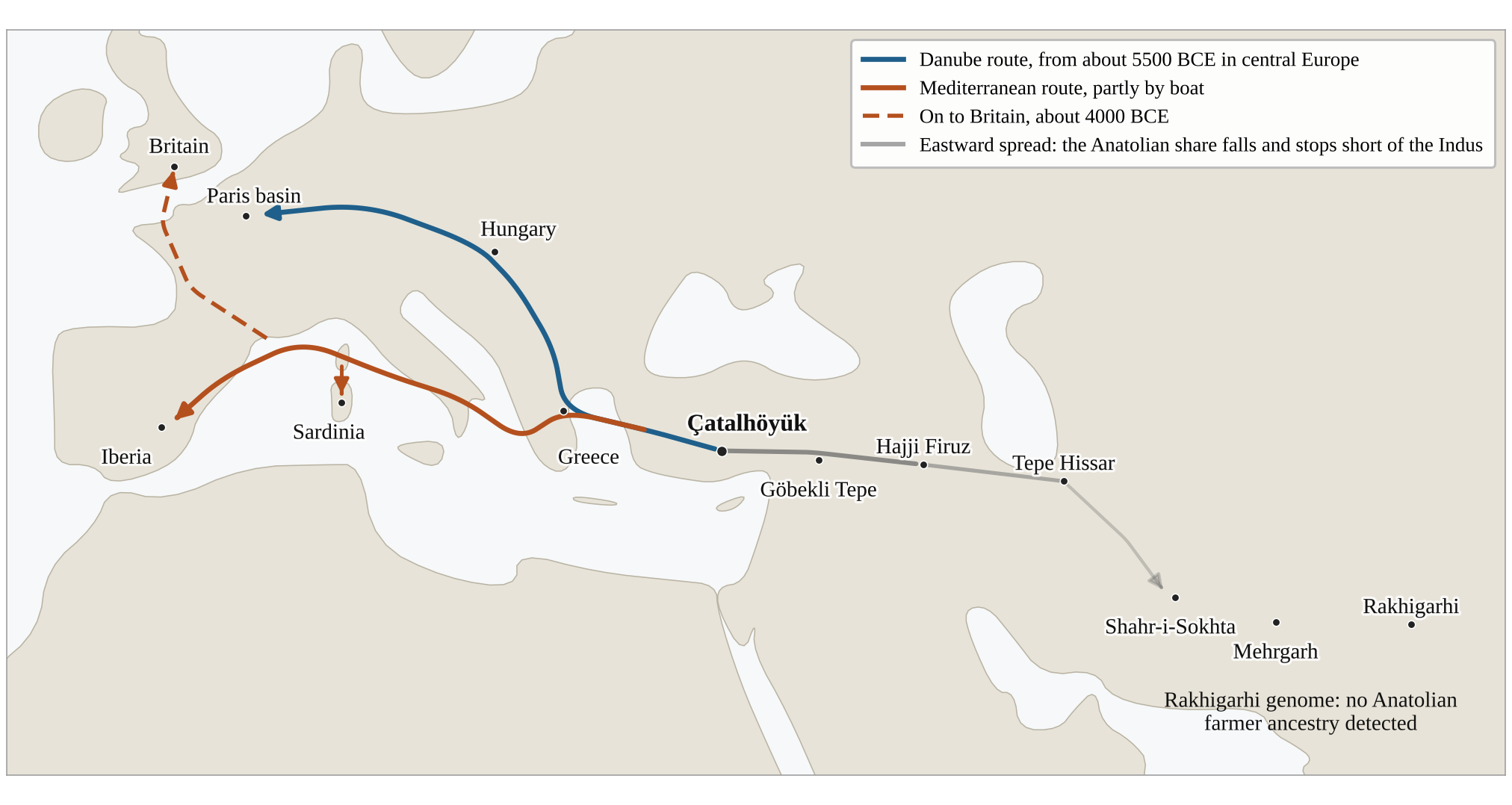
From the Balkans the movement split in two. One stream went up the Danube. These people made the Linear Pottery culture, named after the lines cut into their pots. It took root in today's Hungary and, from about 5500 BCE, spread across central Europe within about five centuries, as far as the Paris basin [15]. The other stream followed the Mediterranean coast to Italy, France and Iberia. Some of them must have come by boat, because farming reached the island of Sardinia about 5500 BCE [18].
Figure 4. Two routes into Europe, and the eastward spread that stops short of the Indus. Map drawn for this article from the studies cited here [13, 14, 15, 17, 20]; routes and coastlines are simplified.
Europe was not empty. Western hunter-gatherers, or WHG, had lived there for thousands of years. Picture a farming hamlet in a forest clearing, with a fishing camp a few days' walk away. The DNA shows the farmers arriving as a separate population [19]. Over the next two thousand years the two peoples met and had children. Wolfgang Haak and his colleagues found that by about 4000 to 3000 BCE, farmers across much of Europe had more hunter-gatherer ancestry than their ancestors had [19]. So hunter communities seem to have lived beside farmers for a very long time.
It went differently from place to place. South of the Alps, the genome of one man suggests that hunter ancestry entered his family line around 4900 BCE, give or take about 600 years, long after farming had begun there [16]. That date comes from a model and from just one person, so we should hold it lightly.
Then the story reaches the edge of the map. Farming came to Britain about 4000 BCE, nearly a thousand years after it had reached the coasts facing the island. In 2019 Selina Brace and her colleagues compared 6 hunter-gatherers and 67 farmers from Britain [20]. They found that the population changed. The newcomers brought farming with them. Their ancestry went back mostly to Aegean farmers who had taken the Mediterranean route, with close links to the farmers of Iberia. They carried only a small share of British hunter ancestry, and unlike in the rest of Europe, that share did not rise later [20]. The DNA tells us who had children. It does not tell us how the two peoples met.
Meeting Europe's first farmers
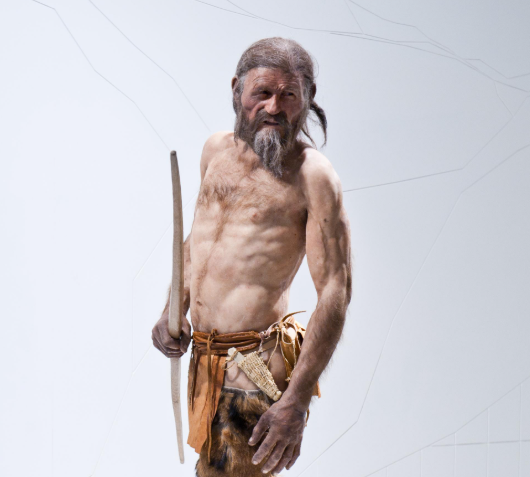
In 1991 a body was found in the ice of the Alps. He is now known as Ötzi, or the Iceman, and he died between 3350 and 3120 BCE [16]. He is probably the most famous descendant of these farmers.
His first genome, published in 2012, had modern DNA mixed into it. In 2023 Ke Wang, Johannes Krause and their colleagues produced a much cleaner one from the same bone. Their model gives him about 90 percent Anatolian farmer ancestry, plus or minus 2.5 points, and the rest from western hunter-gatherers. A small Steppe share reported earlier turned out to be contamination [16]. Among the tested Europeans of his time, he and a person from Broion, also in northern Italy, carry the most farmer ancestry. The team thinks Alpine valleys may have kept their people fairly isolated, but they also caution that one person cannot speak for a whole population [16].
Stonehenge has a connection too. Its builders worked about 5,000 years ago, in the same Britain that Brace's team studied. Their 2019 paper does not discuss the monument, but Brace told NBC News that the builders were descendants of those first farmers, people of the same period living later [21]. Since the DNA comes from Neolithic people in Britain generally, this is a sensible inference.
And the connection is still alive in Sardinia. Farmers reached the island early, and it stayed apart from much of what happened on the mainland. Early European farmers show a strong genetic resemblance to Sardinians today. In 2020 Joseph Marcus and his colleagues studied 70 ancient Sardinians. They found long continuity on the island through the second millennium BCE, and then fresh mixing from the eastern and northern Mediterranean from Phoenician and Punic times onward [18]. So Sardinians too come from several later arrivals.
Why did mainland Europe change so much more? Around 2900 BCE, herders from the steppe, the grasslands north of the Black and Caspian Seas, began moving into Europe [16]. Their ancestry is called Steppe ancestry. Haak's team found that the Corded Ware people of Germany, about 2500 BCE, got about 75 percent of their ancestry from the Yamnaya herders of the steppe [19]. These people went on mixing with locals, and the farmer share fell across much of the continent. The Mediterranean received less Steppe ancestry than northern and central Europe did [14].
Why India's story is different
Now we turn east, towards home. About 6000 BCE, farmers at Hajji Firuz in the Zagros carried about 59 percent Anatolian farmer-related ancestry. About 4000 BCE, farmers at Tepe Hissar in central Iran carried about 30 percent [13]. In 2019 Vagheesh Narasimhan, David Reich and their colleagues followed this fading line through hundreds of ancient genomes. In the Copper and Bronze Ages it ran from about 70 percent in Anatolia to about 31 percent in eastern Iran and about 7 percent in the far east of southern Central Asia [14]. In this part of the world, the ancestry did travel along with farming.
Then we come to a town that tells the whole story. Shahr-i-Sokhta was a Bronze Age town in far-eastern Iran that traded with the Indus world. Most people sampled there carried about 16 to 21 percent Anatolian-related ancestry. But eight people buried in the same town carried none that could be detected, and they had much more ancestry related to South Asia [14]. Three people with a similar profile turned up at Gonur in Turkmenistan. Several of those at Shahr-i-Sokhta were buried with objects linked to Baluchistan. The researchers think these eleven were probably migrants from the Indus world, or from people close to it.
The same year, this idea got support from India itself. Vasant Shinde, Niraj Rai, Reich and their colleagues tried to get DNA from 61 skeletons at Rakhigarhi in Haryana, one of the largest Indus cities. Only one woman's bones gave enough to study. Her ancestry matched the eleven migrants, and she too had no sign of Anatolian farmer ancestry [13]. The Iranian-related part of her ancestry came from a line that had split off before farming began in Iran. She shared a very old ancestor with the Zagros herders, but she did not descend from them.
So what is the answer to our question? South Asians today do carry a small amount of Anatolian farmer-related ancestry. Shinde's team says this fits a route through Steppe herders who arrived from about 2000 to 1500 BCE [13]. Narasimhan's team found that the ancestors of those herders got about a third of their ancestry from the European mix of farmers and hunters [14]. So the little trace we carry may have come the long way round: from Anatolia to Europe, then north to the steppe, then east and south over thousands of years. The direct road east seems to have ended before the Indus.
Then how did farming begin here? Wheat, barley, goats and sheep reached the hills of Mehrgarh, in today's Pakistan, as early as the seventh millennium BCE. Did people from the Iranian plateau come with them? Narasimhan's team looked at this, and the lack of Anatolian ancestry counts against any large movement from the Near East after about 6000 BCE [14]. Shinde's team goes further. They propose that hunter-gatherers in South Asia and on the Iranian plateau each took up farming, without much movement of people between them [13]. This rests on very few genomes. Neither study had DNA from Mehrgarh or from South Asia's first farmers, and Shinde's team says such DNA is what could test the idea.
All this also touches on language. The "Anatolian hypothesis" says that Indo-European languages, the family of Sanskrit, Hindi, Greek and Latin, spread with early farmers from Anatolia. Shinde's team argues that ancient DNA goes against this route for South Asia, and both 2019 studies favour a spread through the Steppe in the first half of the second millennium BCE [13, 14]. In 2022 Lazaridis's team separately proposed that the older ancestor of Indo-European and of extinct languages like Hittite was spoken in the highlands of West Asia [22]. That debate is still going on.
Here the two stories part. Central Anatolia and South Asia made a similar first move, because in both places people already living there took up farming. The difference is in what came next. Western Anatolia's farmers moved into a Europe of hunter-gatherers, while the evidence so far shows no large movement of farmers from the west into South Asia. Shinde's team notes that a farming population may later have spread within South Asia itself, and ancient DNA could still show this [13].
Where this ancestry is today
Imagine asking the same question in Cagliari, in Athens and in Oslo: how much of the Konya plain is here? Ancient DNA suggests you would get a different answer in each city.
Feldman's team calls this ancestry the largest part of the ancestry of present-day Europeans [8]. That is true of Europe as a whole, but it changes as you travel. Sardinians are at the farmer-rich end [18]. Mediterranean Europe generally has less Steppe ancestry than northern and central Europe, which leaves more room for the farmers' share [14]. Every such number depends on the model used, so one figure for a whole nation would mislead you.
Anatolia has its own long story. Lazaridis's team found that its people changed through gene flow within West Asia and took in very little from the Yamnaya migrations [22]. They report strong continuity there down to Roman and Byzantine times. Then came medieval migrations linked with Turkic and Slavic speakers, which changed the region a great deal [7]. People in Turkey and the wider Near East today carry the old farmers' ancestry inside these later mixtures.
Farther east the share keeps getting thinner. Bronze Age people of southern Central Asia carried some of it, down to the 7 percent at the far end of the gradient [14]. In South Asia it is small, and it may have come in with Steppe ancestry [13].
So the Konya villagers have no single set of heirs. People in Sardinia, Greece and eastern Turkey may each carry some of their ancestry, along with many other lines. A family in Punjab or Tamil Nadu may carry almost none, and that family has deep roots of its own, in the people of the Indus world and in the hunter-gatherers of South Asia [14].
What your own DNA can show
Suppose you open your ancestry report and see a very low figure beside "Anatolian farmer", or nothing at all. If your family is from South Asia, that is the usual result. Nothing has gone wrong with the test.
A GenoConnect report estimates how much of your ancestry is best explained by reference groups built from ancient genomes, including Anatolian farmer, Iranian-related and Steppe ancestry. It compares many positions in your DNA with these groups and looks for the mixture that fits best. These are a model's estimates, so a very small percentage may be close to the limit of what the method can detect.
For most South Asian readers, the Iranian-related share and the share from South Asia's own early hunter-gatherers will be much larger. The Steppe share will vary from family to family and community to community [14]. Any trace of Anatolian farmer ancestry may have come along with that Steppe line, so the two figures can be connected [13].
Research has so far sampled only some communities in South Asia, and many have never been studied directly. If you want to see where your own family fits among these old lines, you can test with GenoConnect at genoconnect.co.
What we still do not know
A lot is still open. How much of Anatolian farming was invented locally, and how much was borrowed? The crops at Boncuklu were not yet fully domesticated [10]. Genomes from eastern Anatolia and greater Mesopotamia, the gap between central Anatolia and the older farming regions, could show how the newcomers arrived [8].
Why did burial patterns differ between villages? Adult genomes from Çatalhöyük and Barcın would help most. They could tell us whether the pattern among the young holds for grown men and women too [3].
How did farmers and hunters meet in each part of Europe? The rising hunter ancestry shows that they did [19], but the timing differs from region to region [16]. Close sampling from one valley over many generations, which is still missing for the southern Alps, would bring us nearer to the lives behind the percentages [16].
Did any Anatolian-related ancestry reach South Asia before the Steppe period? So far, the twelve people on the Indus gradient show negligible amounts, and only one of them comes from an Indus city [13]. More genomes from Indus sites, and from the first farmers of the region, would test this directly [13].
Some of the answers may stay in the ground for a long time. Less than a tenth of Çatalhöyük's two mounds has been excavated [1]. Under the houses nobody has dug, there must be more floors, and under those floors more children. Perhaps two more sisters lie there, with a neighbour's child beside them, and nothing in the DNA to say who brought that child home.
FAQs
Do Indians have Anatolian farmer ancestry?
Very little. Shinde and colleagues report a small proportion in South Asians today, and they say it fits arrival with Steppe herders from about 2000 to 1500 BCE [13]. The one Rakhigarhi genome and the eleven related people sampled outside the Indus region show no detectable Anatolian farmer ancestry [13, 14].
Did farming come to India from Turkey?
The evidence so far points away from any large movement of Anatolian farmers into South Asia [13, 14]. Wheat, barley, sheep and goats did spread eastward to places like Mehrgarh [14]. Shinde's team proposes that local hunter-gatherers took up farming [13]. DNA from South Asia's first farmers would test this.
Were the Anatolian farmers Turks?
No. "Anatolian farmer" is a geneticists' label for the ancestry of people who lived about 9,000 to 10,000 years ago. Turkic speakers reached Anatolia in medieval times, about a thousand years ago [7]. People in Turkey today descend from both of these and from many others.
Who built Göbekli Tepe?
People who lived by hunting and gathering. The excavators date its oldest tested enclosure to about 11,500 years ago and have found no domesticated plants or animals at the site [11]. How they were related to the villagers of the Konya plain is an open question.
Why do Europeans have so much farmer ancestry?
Farmers from Anatolia and the Aegean moved into Europe in large numbers from about 7000 to 6500 BCE and mixed with the hunter-gatherers already there [13, 16, 17]. Herders from the steppe later reduced the farmer share, especially in the north [14, 19]. Across Europe as a whole, Feldman's team calls farmer ancestry the largest single part [8].
What is the Anatolian hypothesis?
It is the idea that Indo-European languages, the family of Sanskrit, Hindi, Greek and Latin, spread with early farmers from Anatolia. Shinde's team argues that ancient DNA goes against this route for South Asia [13]. The two 2019 studies favour a spread with Steppe ancestry in the second millennium BCE [13, 14].
Further reading: "Where did the Indus Valley people go?