Caucasus hunter-gatherers: the mountain ancestry carried to Europe and India
Thousands of years ago, a small group of hunters lived in the valleys of western Georgia, and when scientists read their DNA in 2015 they found a strand of human ancestry nobody had described before. Much later, people carrying this ancestry moved north onto the grasslands, mixed with the hunters there, and a part of it travelled with herders to Europe and, as a small share, to South Asia.— Himanshu Pandey
A thread in a cave
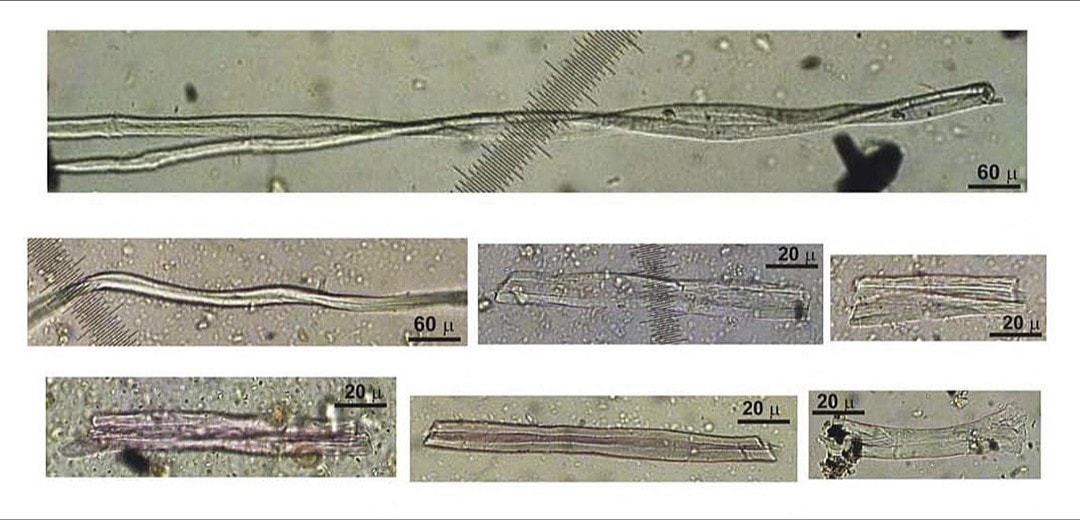
Imagine a cave in the hills of western Georgia, more than 30,000 years ago. Someone is twisting wild flax into thread. Some of this thread goes into a dye and comes out black, grey or turquoise. Hair from the tur, the wild mountain goat, is lying around too, and some of that has also been coloured and twisted [1].
How can we know something so small about people so far back? Mostly by luck. In 2009 Eliso Kvavadze and her team were looking at clay from this cave, called Dzudzuana, under a microscope. They were searching for pollen, and they kept finding flax [1]. In the oldest layer alone they counted 488 fibres. Of these, 58 were dyed and 13 were spun. No cloth has survived, so we can only guess what the thread was for. The team's guess was cords for tools, baskets or clothes.
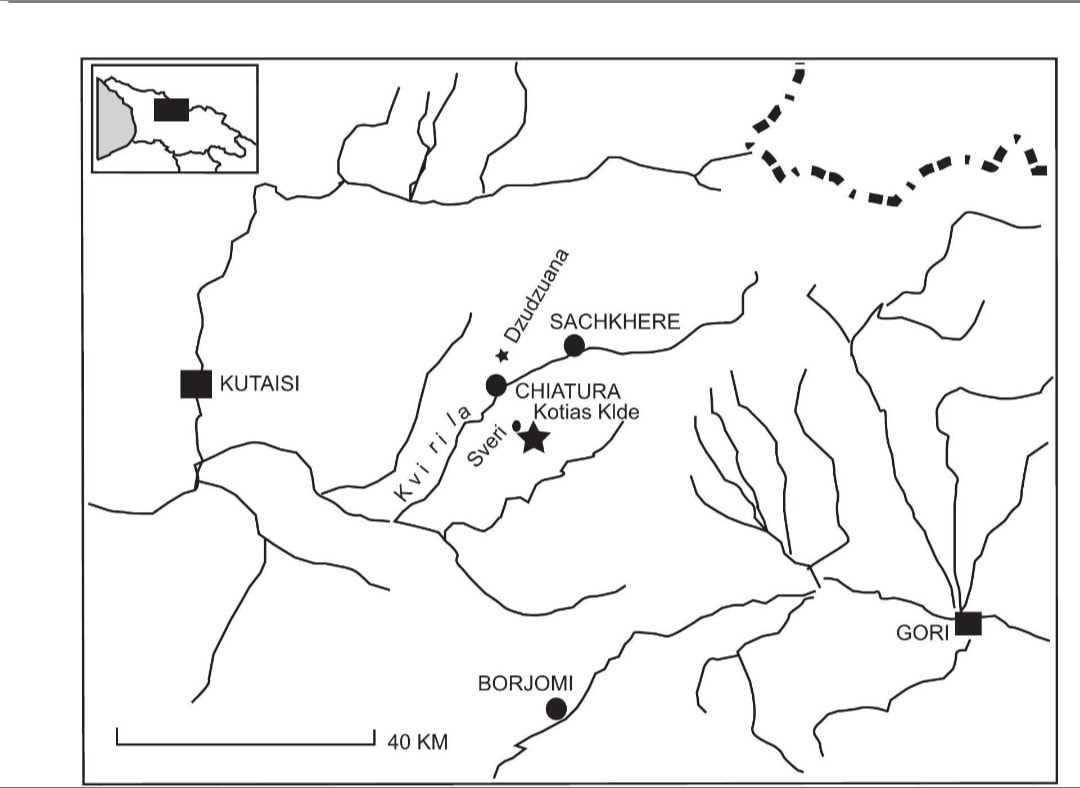
People kept coming back to this cave. In a later layer, about 26,000 years old, there were teeth from two people. In a study posted in 2018, Iosif Lazaridis and his team at Harvard read the DNA in those teeth. Then they compared it with DNA from hunters found in two other caves nearby, less than 50 kilometres away and about 13,000 years younger [2].
You would expect the older people to be the ancestors of the younger ones. Same hills, nearly the same caves. The DNA said something else. The two Dzudzuana people were closer to farmers who lived in Anatolia, today's Turkey, about 18,000 years after them than they were to the hunters next door [2]. Even in this small corner of the world, people came and went.
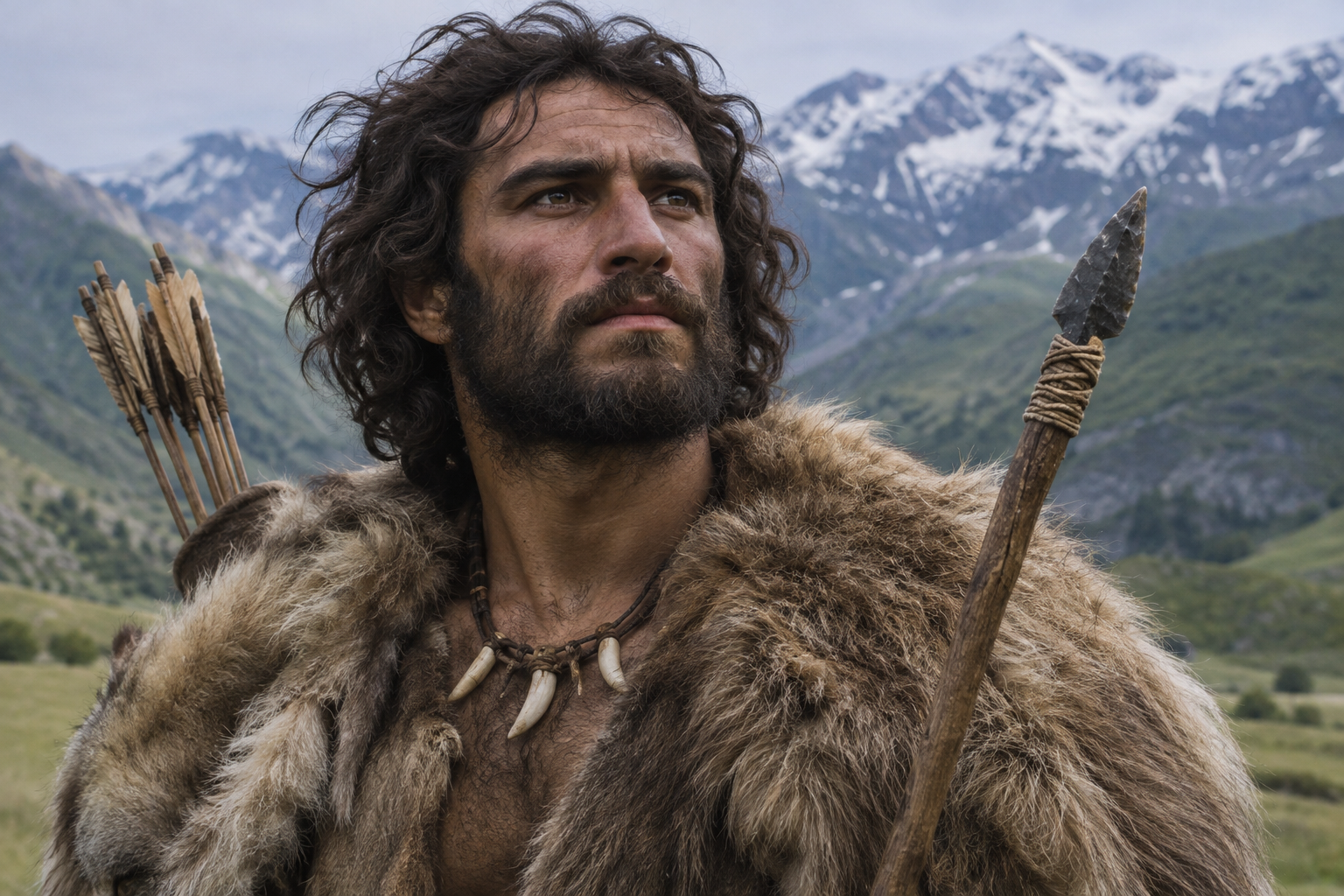
This article is about those later hunters. Geneticists call them Caucasus hunter-gatherers, or CHG for short. It is only a label for a strand of ancestry, named after the place where the first genomes were found, and the hunters themselves never heard it. (A genome is the full text of a person's DNA, like an instruction book copied into nearly every cell.) Their story starts in a few caves and ends inside people living from Ireland to India. How did that happen?
A refuge in the mountains
To follow these hunters we have to start with the cold. The coldest part of the last Ice Age, called the Last Glacial Maximum, lasted from about 24,000 to 18,000 years ago [3]. Ice sheets covered northern Europe, and people across Eurasia were pushed into small pockets of land, cut off from one another. Western Georgia lies between the Black Sea and high mountains, and it kept enough moisture for plants like flax to keep growing [1]. Alexander Gavashelishvili and his team think these caves lay inside a refuge where people could wait out the cold [4].
It is a neat story, but the caves make it harder. At Satsurblia, Ron Pinhasi's team found signs of people from about 25,500 to 24,400 years ago, and then again from about 17,900 to 16,200 years ago. In between they found nothing [3]. Dzudzuana has a similar gap. So Pinhasi's team thinks this part of Georgia was probably empty when the cold was at its worst. Maybe the real refuge was somewhere close by that nobody has dug yet. Maybe people simply walked back when the weather got better. We do not know.
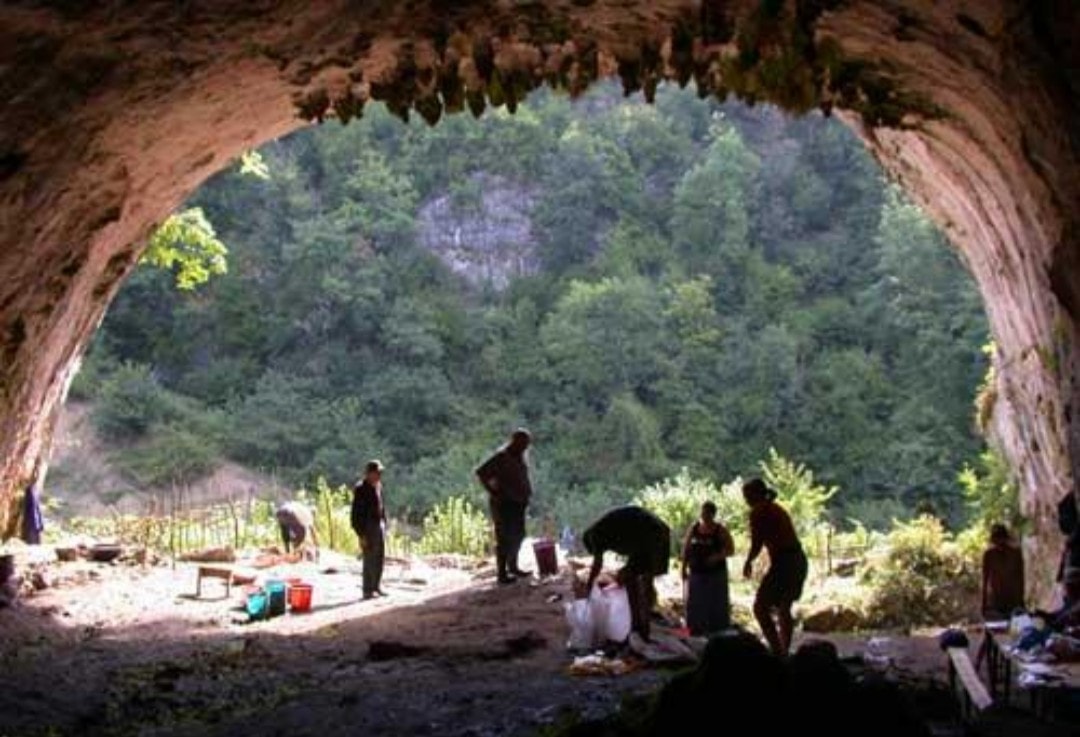
When they did come back, they left behind a good record of what they ate. At Satsurblia most of the bones are from wild boar and red deer. There are some from the tur, roe deer and brown bear, and even a few from beaver [3]. Nearly every long bone was broken open for the marrow inside. Bones of very young boar tell us hunters were there in late spring or early summer. They ate wild cereals too, and they were still working with flax, now dyed blue and pink. They also left stone tools, bone points and small pendants made from stalagmite [3].
At Kotias Klde, a rock shelter in the same region, later hunters went after something more dangerous. Guy Bar-Oz and his team found brown bear bones with butchery marks all through the rubbish, and they believe these people hunted bears on purpose [5].
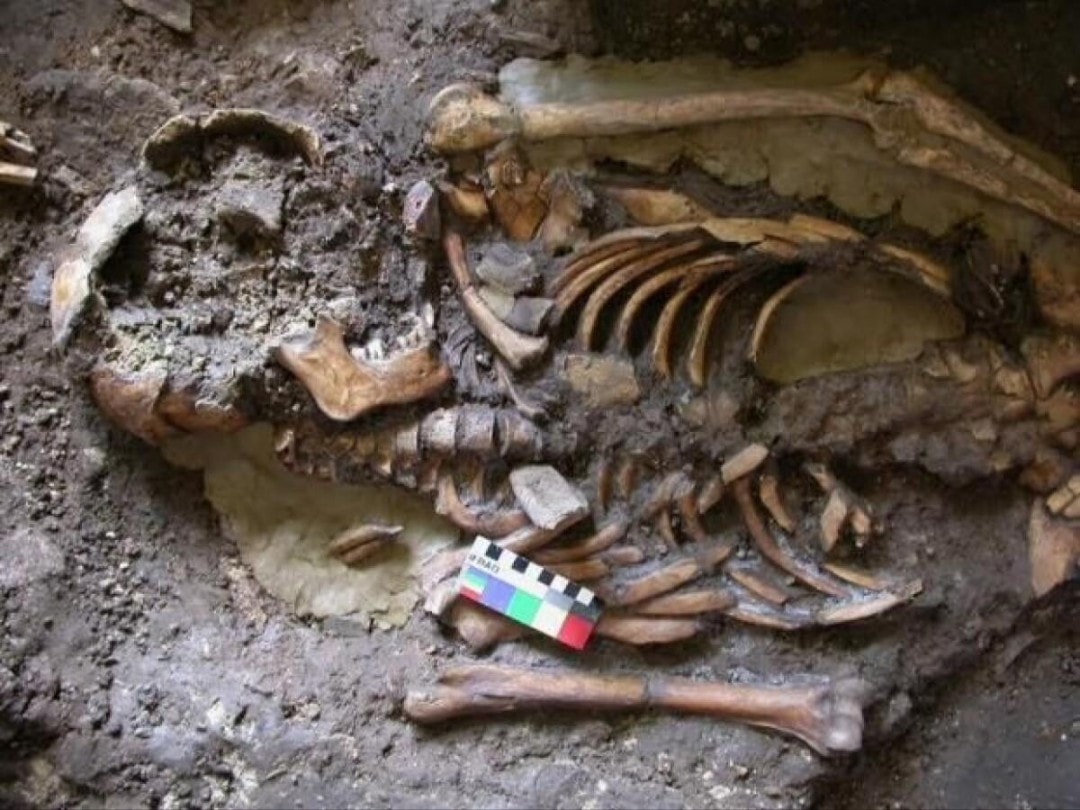
The first two CHG genomes came from these two places. The Satsurblia man lived about 13,300 years ago, and his DNA was read from a single ear bone. The Kotias man lived about 9,700 years ago, and his DNA came from a tooth in a burial [6]. That is 3,600 years between them, and yet their DNA is close enough to count as one line of people. Their genomes also have long identical stretches, which usually means small groups marrying among themselves for many generations [6].
A strand of its own
So who were these hunters related to? In 2015 Eppie Jones and her colleagues in Dublin and Cambridge compared the two men with ancient hunters and farmers from Europe and the Near East [6]. The two men did not fit any known group. Their line had separated from the ancestors of western European hunters about 45,000 years ago, and from the ancestors of the first farmers about 25,000 years ago.
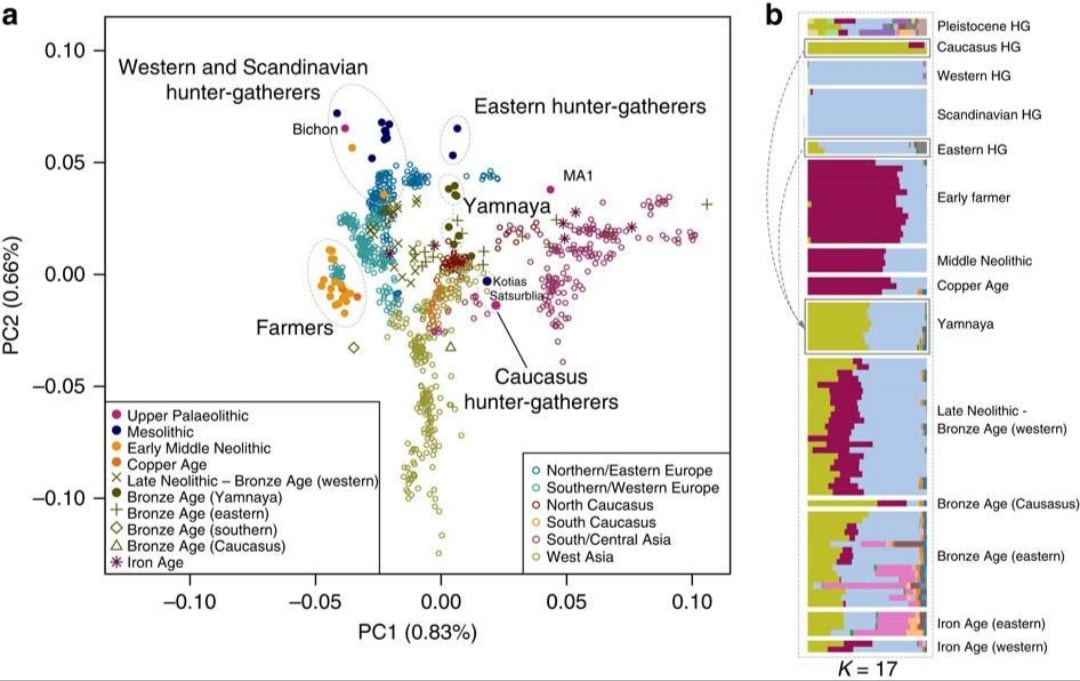
Please read those dates the way you would read an old family memory of when two branches of the family separated. They are estimates from a model. The study's own best estimates run from 40,000 to 50,000 years for the first split, and from 20,000 to 30,000 years for the second [6].
The Dzudzuana study added a twist. Lazaridis's team explained both groups with the help of two very old populations that we know mainly from the DNA they left in later people [2]. Basal Eurasians were a branch that split away before the other people outside Africa divided among themselves. Ancient North Eurasians were hunters related to people who once lived in Siberia. In the team's model, the Dzudzuana people had about 28 percent Basal Eurasian ancestry. In one of its models, CHG got about 58 to 64 percent from a Dzudzuana-like population, and the rest from very deep lines and from Ancient North Eurasians [2].
A word about percentages, since this article has many of them. An ancestry percentage is a model's estimate. Your height stays the same whoever measures it, but change the model and this number can change. The big picture still holds, though. At some point admixture happened, which simply means two groups who had lived apart for a long time started having children together. Think of the Ganga and the Yamuna at Prayagraj: two rivers with their own long journeys, and after the meeting, one river.
The hunters also had close relatives in the south. About 10,000 years ago a woman was buried at Ganj Dareh in the Zagros Mountains of Iran, where people herded goats. Her DNA turned out to be closest to the Caucasus hunters [7]. Farnaz Broushaki's team read more genomes from the Zagros in 2016 and described the same distinct population [8]. The hunters in Georgia and the herders in Iran were two branches of one wide family.
Two other kinds of DNA add some detail. Mitochondrial DNA passes from mother to child. The Y chromosome passes from father to son, much like a surname. Each one places a person in a haplogroup, which is a family line on that tree. The Satsurblia man had Y line J and maternal line K3. The Kotias man had Y line J2a and maternal line H13c, and all of these are common in Georgia today [6]. Remember that this is what we know from two men. J2 is also common in many other places, India included, and nobody can say for sure that a modern J2 line goes back to these hunters.
When farming reached the mountains
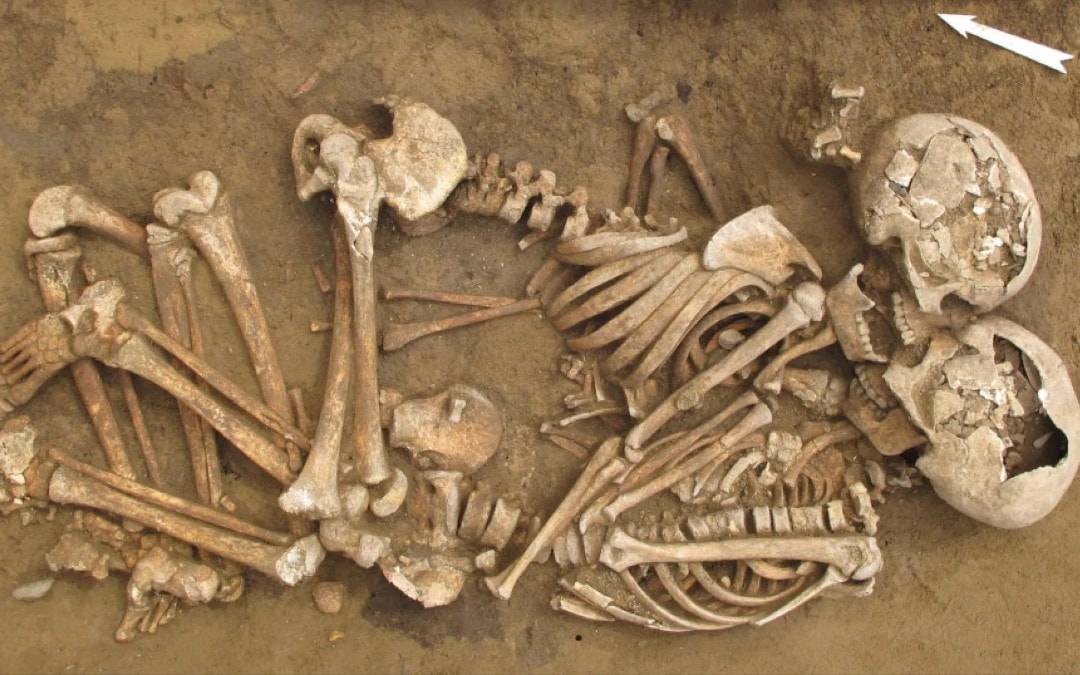
Nearly 8,000 years ago, at a village called Mentesh Tepe in what is now western Azerbaijan, about 30 people were laid together in one pit. Among them were two young people placed with their arms around each other. Their DNA shows they were brothers [9]. Nobody knows what killed so many people at once. The bones show no sign of violence.
The people of this village lived very differently from the cave hunters. They built round houses of mud brick. They grew barley and wheat, and they kept sheep, goats, cattle, pigs and dogs [9]. Archaeologists call this the Shulaveri-Shomu culture, the oldest in the Caucasus with the full set of crops and animals. Most of those crops and animals had first been domesticated somewhere else.
So did the hunters learn farming, or did farmers walk in from outside? It seems both groups were part of it. Perle Guarino-Vignon's team found that the Mentesh Tepe people were a recent mix of Anatolian farmers and a local line related to CHG or to Iranian farmers. In those models, 36 to 49 percent came from the CHG side [9]. At Aknashen in Armenia, about 8,000 years ago, the CHG-related share was about 42 percent, while at nearby Masis Blur it was about 14 percent [10]. Eirini Skourtanioti's team found that these farmers sat on a long slope of ancestry running between western Anatolia and the Zagros [11].
With time, the mountains stopped keeping people apart. Chuan-Chao Wang's team found that Bronze Age people in the North Caucasus were genetically much like people to the south, and they called the range a bridge [12]. Among these people were the Maikop, about 5,900 to 4,900 years ago, known for their burial mounds and mostly descended from people like those at Aknashen [10]. Later, in the Kura-Araxes culture that spread after about 5,000 years ago, ancestry close to CHG rose again in the South Caucasus. It probably came from a group nobody has sampled yet [9].
North onto the grasslands
North of the Caucasus the land goes flat. This is the Steppe, the grasslands that run from Ukraine to Kazakhstan, and here our story changes. Before 6000 BCE the two sides of the mountains held very different people. Ayshin Ghalichi's team found hunters with Eastern European ancestry in the north and CHG ancestry in the south [13]. Then they began to meet. Around the mouth of the Volga, from about 6200 BCE, foragers were making pottery and stone tools like those of the Caucasus. By 5000 BCE, hunters further up the river were carrying southern ancestry too [10].
For some years the story was told simply. In 2015 Wolfgang Haak's team showed that the Yamnaya, the herders of about 3300 to 2600 BCE, came from Eastern European hunters and a Near Eastern source [14]. The same year, Jones's team named that source as CHG or people close to them, and said it gave the Yamnaya about half of their ancestry [6].
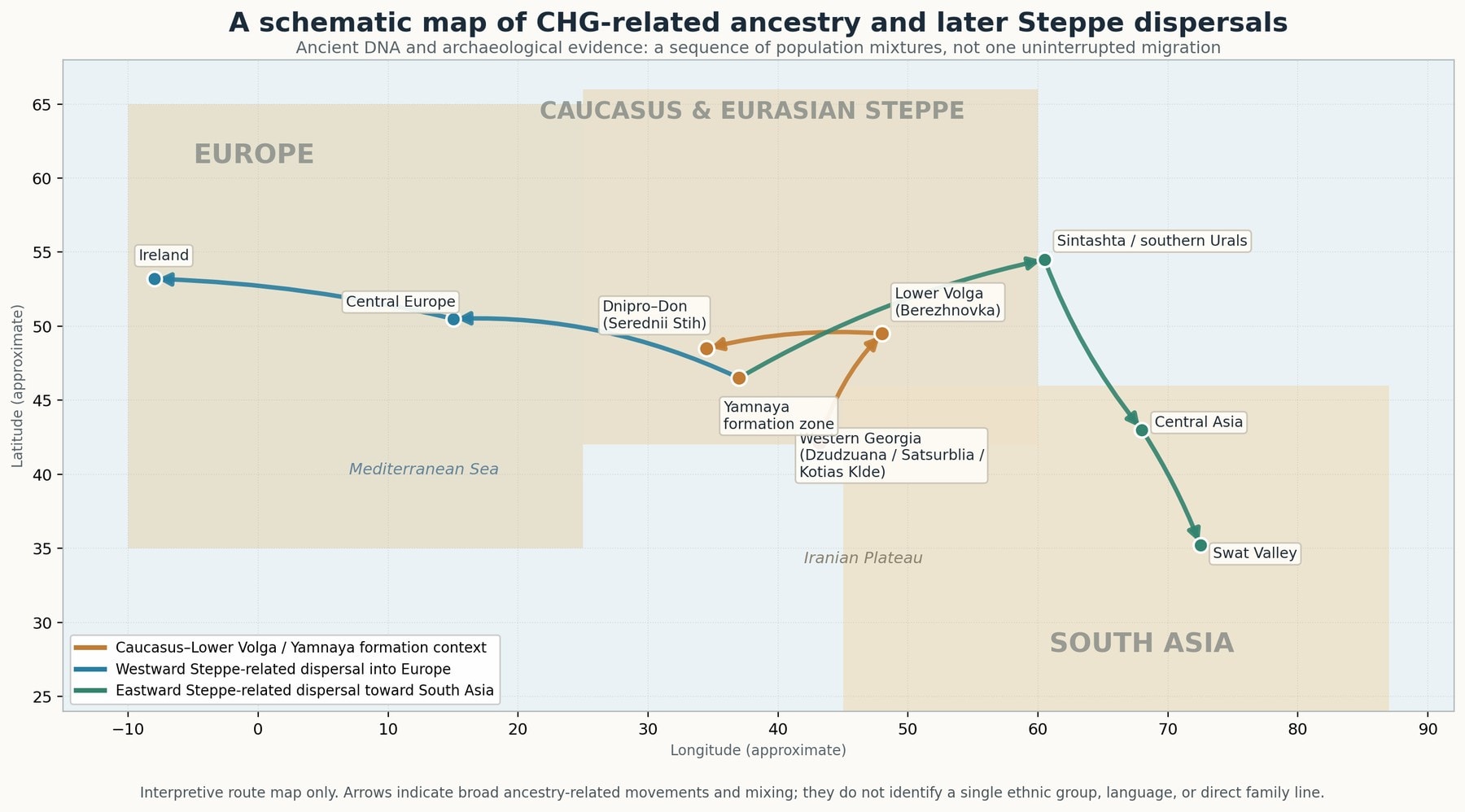
Then in 2025 a much bigger study came out in Nature. Lazaridis and his colleagues looked at ancient DNA from 435 people and described what they called the Caucasus-Lower Volga people [10]. Imagine a long road. At the southern end live farmers of the Caucasus. At the northern end, around 4450 to 3960 BCE, live people at Berezhnovka on the Lower Volga. In the villages between, you find every kind of mix, because people moved both ways along this road and married each other.
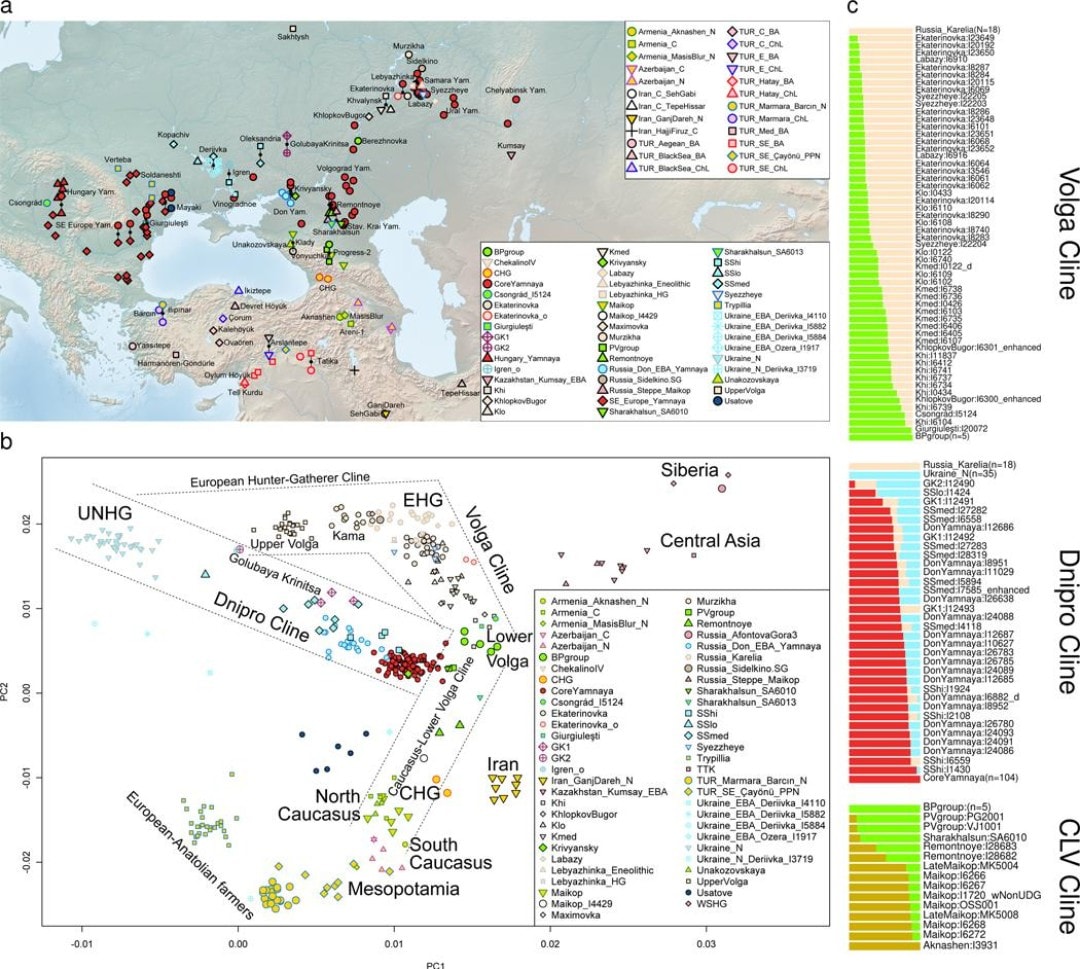
Some of them went west to the Dnipro and Don rivers, in today's Ukraine and southern Russia, and mixed with the hunters living there. According to this study, the ancestors of the Yamnaya formed in that area around 4000 BCE. For a long time they were a small group of only a few thousand breeding adults. They started growing fast after about 3750 to 3350 BCE, and by 3000 BCE their culture stretched from Hungary to Kazakhstan [10].
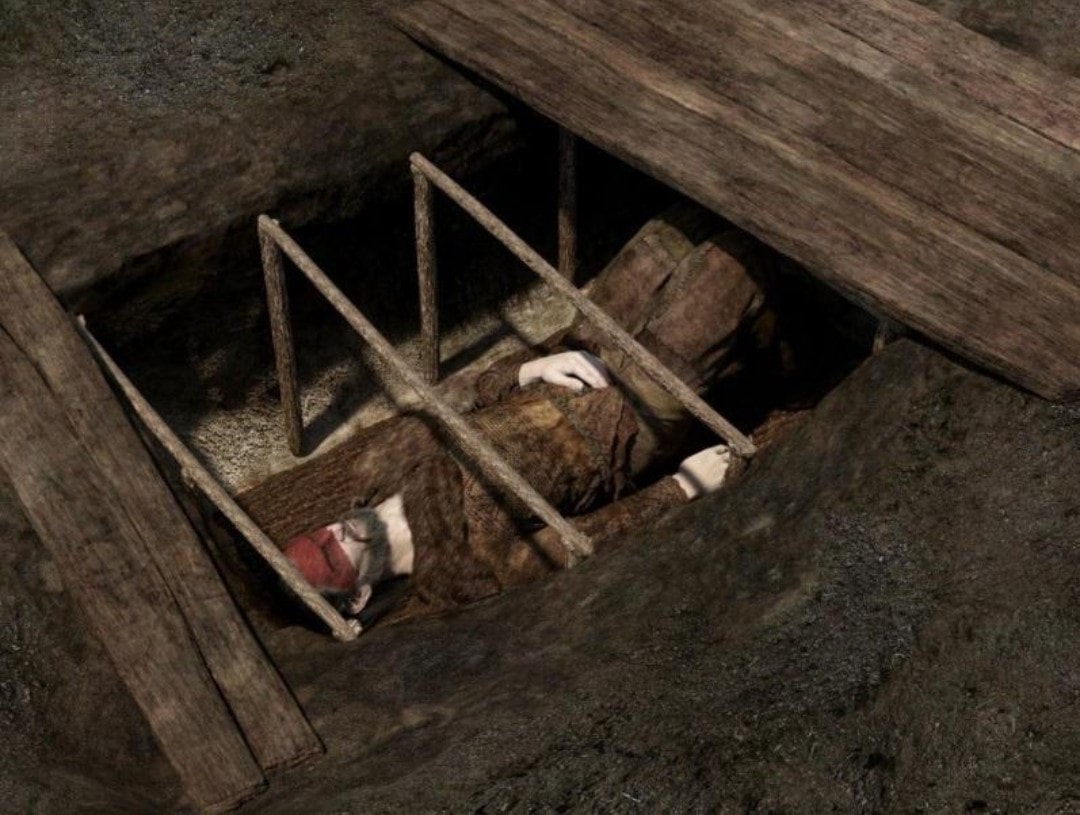
One number from this study gets misquoted, so let us be careful with it. The Caucasus-Lower Volga people gave the Yamnaya about four-fifths of their ancestry, and the Dnipro and Don hunters gave about one-fifth [10]. But that four-fifths does not mean four-fifths CHG. It already includes Caucasus farmers with Anatolian ancestry, and Lower Volga people with hunter ancestry of their own. CHG is one old strand inside it.
This model is new and people are still arguing over it. The authors also suggest that Proto-Indo-Anatolian, the language behind Hittite and all other Indo-European languages, was spoken among these people between 4400 and 4000 BCE. They admit that genetics cannot tell us who first spoke it [10]. Paul Heggarty's team, working from language trees, puts the root of the family near 6100 BCE and south of the Caucasus [15]. Bones and teeth do not tell us what language a person spoke, so this fight is not over.
West into Europe and Anatolia
Around 2500 BCE, in what is now Germany, people of the Corded Ware culture were being buried with their pots. Haak's team found that about 75 percent of their ancestry came from people related to the Yamnaya [14]. In a few centuries, people from the Steppe had reached the middle of Europe, and the CHG-related share came with them.
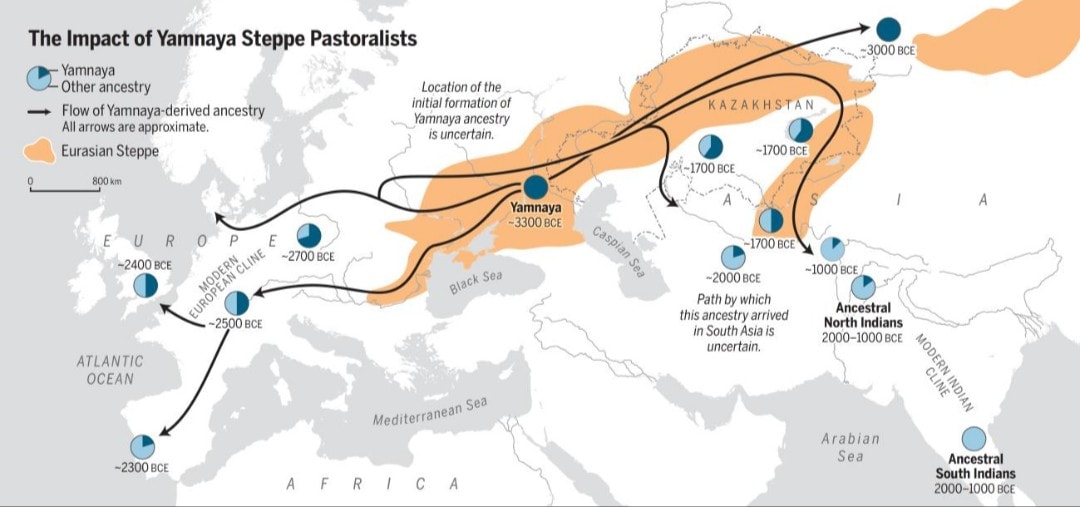
It went further. In Britain, people connected with Beaker pottery arrived from the continent, and Iñigo Olalde's team estimates that about 90 percent of the island's gene pool was replaced within a few hundred years [16]. In Ireland, three people buried on Rathlin Island between 2026 and 1534 BCE had a large share of Steppe ancestry, and Lara Cassidy's team found their DNA closest to people living in Ireland, Scotland and Wales today [17]. These studies can measure the change in population. They cannot tell us how these people met each other, and the graves do not say.
The farmers and hunters already living in Europe stayed in the mix. Jones's team found the CHG signal stronger in northern Europe than in the south [6]. A person in Ireland and a person in Greece may both carry this strand, in different amounts, and with very different family histories around it.
Anatolia has a different story. Lazaridis's 2022 study found that the later Yamnaya movements left almost no mark there, even though they reached the Balkans and Armenia [18]. Yet people in central Anatolia in the Bronze Age, between about 2750 and 1500 BCE, had at least a tenth of their ancestry from the Caucasus-Lower Volga people, who probably came in from the east [10]. This is where Hittite was spoken, the oldest Indo-European language we know from writing. Did the people in these graves speak it? Even the authors say that cannot be known.
East to Central and South Asia
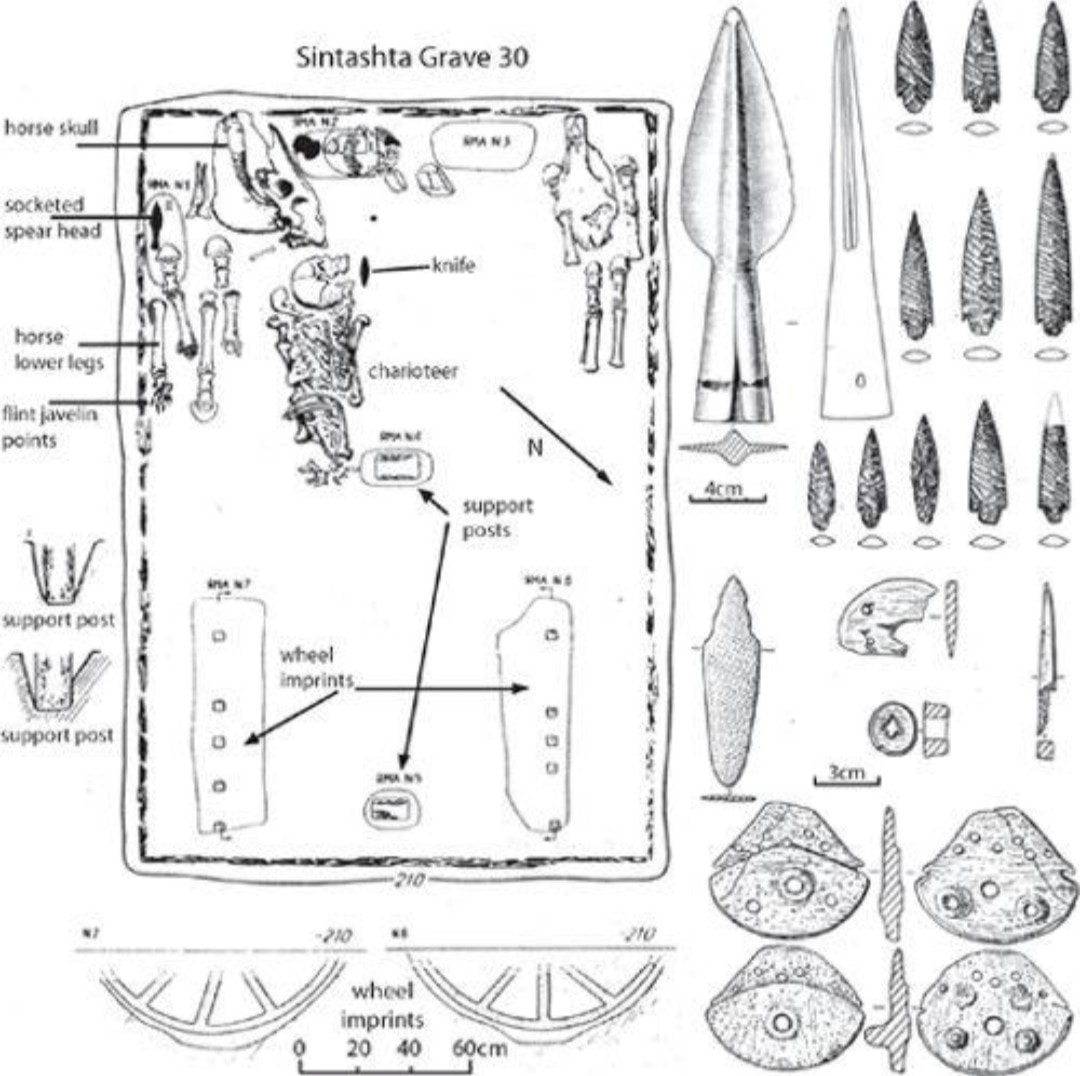
Now let us go east. Around 2000 BCE, at Kamennyi Ambar in the southern Urals, a community of the Sintashta culture was burying its dead. Vagheesh Narasimhan and his colleagues studied 50 of these people in 2019 [19]. Most of them had about two-thirds Yamnaya ancestry and one-third from European farmers. People with this mix spread over a huge area, from eastern Europe into Kazakhstan, and later herders of the Andronovo world carried the movement further east across the same grasslands.
From there the trail turns south. Between about 2100 and 1700 BCE, Narasimhan's team found a few people with this Steppe ancestry at sites in Central Asia, living among a much larger local population [19]. In the Swat Valley of northern Pakistan, graves from about 1200 BCE onward show Steppe ancestry that had entered local families around 1900 to 1500 BCE [19]. So the first half of the second millennium BCE is when it arrived.
These herders did not walk into an empty land. South Asia already had the people of the Indus world, with their old Iranian-related ancestry, and they had mixed with the Ancient Ancestral South Indians, the old hunter-gatherers of the subcontinent. Most South Asians today get the largest part of their ancestry from this older world. A woman from Rakhigarhi, whose genome was published by Vasant Shinde's team, had no Steppe ancestry that they could detect [20]. After the Indus cities declined, people of Indus-related ancestry mixed with newcomers in the north-west and became the Ancestral North Indians. Others mixed with people to the south and east and became the Ancestral South Indians [19]. Marriages between these two groups, over many centuries, gave us the main pattern of ancestry we see in South Asia today.
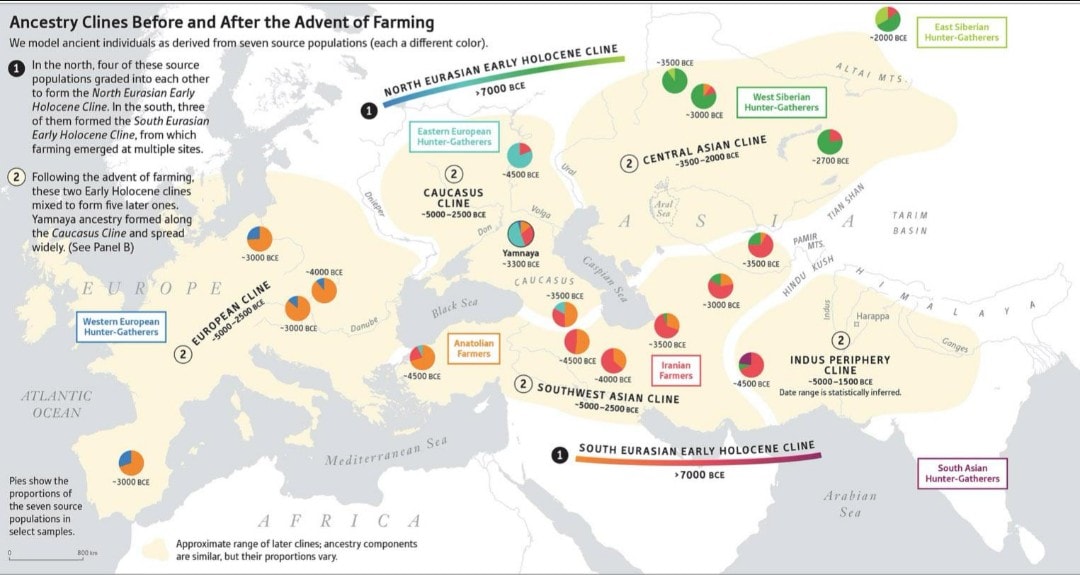
Where does CHG fit in all this? In 2015 Jones's team saw a CHG imprint in Central and South Asia and said it may have come with Indo-Aryan languages, though earlier movements with farming and herding were also possible [6]. Narasimhan's team reports Steppe ancestry of up to about 30 percent in some South Asian groups and much less in many others [19]. CHG-related ancestry is only one part of that Steppe share. So for most South Asians it is a small strand, and the amount changes from group to group.
There is one more thing to keep in mind. Shinde's team found that the Iranian-related ancestry of the Rakhigarhi woman split off before the ancestors of Iran's early farmers, herders and hunters separated from one another [20]. CHG is a distant cousin of that old line. Because they are cousins, the two can look alike in a model, and part of what Jones's team saw in 2015 may come from this older relationship. That is why I am not giving you one CHG figure for Indians here. The answer depends on the model.
Where this ancestry is today
Let us go back to western Georgia, to the Imereti hills where the caves are. In 2021 Gavashelishvili's team collected DNA from 77 men across the Caucasus and compared it with ancient genomes [4]. Ancient Caucasus ancestry was highest among Imeretians, Svans and Megrelians of western Georgia, the people living closest to the caves. Jones's team had already found that people of the southern Caucasus are the closest living match to CHG [6].
As you move away from the caves, other strands get stronger. In the same study, Laz, Meskhetian Georgians and Armenians had more ancient Anatolian ancestry. Chechens, Balkars and the Tush of north-eastern Georgia had more ancestry related to ancient people from the Balkans and Siberia [4]. Azerbaijanis were not in that sample, so we have no figure for them from this study, though the ancient farmers of Azerbaijan fit the same slope [9]. All of these communities also carry the traces of people who came later.
Further south the old family continues through Iran and Anatolia. Broushaki's team found that the Zagros farmers are closest to Iranian Zoroastrians, Pakistanis and Afghans today [8]. Skourtanioti's team placed Anatolia's ancient farmers on a slope running toward the Caucasus and the Zagros, with continuity into the Bronze Age [11]. This is mostly the wide family that includes CHG, and it reached these places without going through the Steppe.
In Europe the strand came mainly through Steppe ancestry, more in the north than in the south [6]. In Central and South Asia it is there at lower levels. Wherever you find it today, it is one thread among many others.
Words that mislead
In 1795 a German doctor named Johann Friedrich Blumenbach divided humankind into five varieties. He had a collection of skulls, and his favourite came from a Georgian woman. He called it the most handsome of all, and he said the most beautiful people lived on the southern slopes of the Caucasus [21, 22]. So "Caucasian" became his name for the variety that included Europeans.
That is the whole connection. The racial word "Caucasian" came from one skull and one man's idea of beauty, and later it travelled far away from the mountains [21]. It has nothing to do with Caucasus hunter-gatherers, whose ancestry was found in 2015. Blumenbach knew nothing about DNA.
In India the same confusion takes a local form. People sometimes link Steppe or "Caucasian" ancestry with fair skin, caste rank or the word "Aryan". The evidence does not support these links. An ancestry percentage tells you something about some of your distant ancestors. It cannot tell you what you look like, and it says nothing about anyone's worth, ability or rank.
Caste comes up because Narasimhan's team reported that several groups with priestly traditions have somewhat more Steppe ancestry than a simple model predicts [19]. The team explains this through long marriage within groups, which keeps old differences alive. That is a finding about who married whom over time. It gives nobody a reason to rank anyone, because rank is something people made in society.
"Aryan" is also a word from old texts. Speakers of Vedic Sanskrit and Old Iranian used it for themselves and their language, as Michael Witzel shows [23]. The idea of an Aryan race was built in nineteenth-century Europe, as Romila Thapar has explained [24]. No DNA test can find an Aryan, because the word was never a genetic category.
What your own DNA can show
Suppose your report shows a Steppe or CHG-related percentage. Where does that number come from? A testing company reads several hundred thousand points on your genome and compares them with reference samples, ancient and modern. A statistical model then asks which mix of those references best fits your DNA.
The answer is an estimate, and it can change when the references or the model change. Two honest tests can give two different answers. A very small number, say a few percent, may be inside the model's margin of error. So take your percentage seriously, but hold it loosely.
It has limits too. A CHG-related share in an Indian report may come through the Steppe, or through the older Iranian-related cousins, or through both, and a model can struggle to separate them. It cannot name one ancestor, one village or one family story. Your number will even differ from your brother's, because each child inherits a different selection of the same parents' DNA.
What a test can do is show where you sit on the map of human mixing. Many Indian communities have very little published data so far. If you test with GenoConnect, you can see how your results compare with others from your community, and each new result fills in a little more of that map.
What we still do not know
A lot, to be honest. Where did these people go during the worst of the cold? The caves of western Georgia are silent between about 24,000 and 18,000 years ago. Sites of that age, lower down or nearer the Black Sea coast, could answer this if they hold human remains with DNA.
What happened between Dzudzuana and Satsurblia? We have genomes from about 26,000 years ago and about 13,300 years ago, and very little in between. Even soil can help here. In 2021 Pere Gelabert's team read human DNA from 25,000-year-old cave sediment at Satsurblia, without a single bone [25]. More results like this could show when and where Ancient North Eurasian ancestry arrived.
How did Caucasus ancestry reach the Steppe, and when? Hunters with this ancestry were on the move perhaps 8,000 years ago, but the source is still missing. The 2025 study itself points to a CHG-related group somewhere between Georgia and the Lower Volga that nobody has found [10]. Graves of that age from the North Caucasus and the Caspian shore would help the most.
Where was Proto-Indo-European spoken? The steppe north of the Caucasus and the lands south of it both have their defenders [10, 15]. Better dated language trees and more DNA from eastern Anatolia could narrow it down, but genes alone will never tell us what people spoke.
All of this rests on a small number of genomes from a few caves, and the next tooth from Georgia may change parts of the story. I like to go back to where we began, to that clay at Dzudzuana and the thread in it. Someone sat in that cave and twisted it. We will never know their name or their language, only that the thread was dyed turquoise, and that it lasted.
Frequently asked questions
What is CHG ancestry?
CHG stands for Caucasus hunter-gatherer. It is a label for a strand of ancestry first found in two men from western Georgia, who lived about 13,300 and 9,700 years ago [6].
Do Indians have Caucasus ancestry?
Many do, as a small share that changes from group to group. It came mainly through Steppe ancestry, which Narasimhan's 2019 study puts at up to about 30 percent in some groups, and CHG-related ancestry is only a part of that [19]. The largest part of most South Asians' ancestry is a different and older Iranian-related line, a distant cousin of CHG [20].
Is CHG the same as Steppe ancestry?
No. Steppe ancestry formed later, when people with Caucasus ancestry mixed with hunters on the grasslands. CHG-related ancestry is one part of it [6, 10].
Are Caucasians and Caucasus hunter-gatherers the same?
No. "Caucasian" is a racial label made popular in 1795 by Johann Friedrich Blumenbach, based on a skull from Georgia and his ideas about beauty [21, 22]. Caucasus hunter-gatherer is the name of an ancient ancestry. The two are unrelated.
Did Indo-European languages come from the Caucasus?
Nobody knows yet. Lazaridis's 2025 study suggests the ancestor of these languages was spoken between the Caucasus and the Lower Volga. Heggarty's 2023 study places it south of the Caucasus. Both ideas are disputed [10, 15].
Is CHG related to Iranian farmers?
Yes. An early herder from the Zagros Mountains of Iran was genetically closest to the Caucasus hunters [7]. They were branches of one wide family, each with its own history.
Further reading on GenoConnect: Where did the Indus Valley people go?
References
- [1]Kvavadze, Eliso, Ofer Bar-Yosef, Anna Belfer-Cohen, Elisabetta Boaretto, Nino Jakeli, Zinovi Matskevich, and Tengiz Meshveliani. "30,000-Year-Old Wild Flax Fibers." Science 325, no. 5946 (2009): 1359. https://doi.org/10.1126/science.1175404.
- [2]Lazaridis, Iosif, Anna Belfer-Cohen, Swapan Mallick, Nick Patterson, Olivia Cheronet, Nadin Rohland, Guy Bar-Oz, et al. "Paleolithic DNA from the Caucasus Reveals Core of West Eurasian Ancestry." bioRxiv (2018). Preprint. https://doi.org/10.1101/423079.
- [3]Pinhasi, Ron, Tengiz Meshveliani, Zinovi Matskevich, Guy Bar-Oz, Lior Weissbrod, Christopher E. Miller, Keith Wilkinson, et al. "Satsurblia: New Insights of Human Response and Survival across the Last Glacial Maximum in the Southern Caucasus." PLoS ONE 9, no. 10 (2014): e111271. https://doi.org/10.1371/journal.pone.0111271.
- [4]Gavashelishvili, Alexander, Alexey Yanchukov, David Tarkhnishvili, et al. "Landscape Genetics and the Genetic Legacy of Upper Paleolithic and Mesolithic Hunter-Gatherers in the Modern Caucasus." Scientific Reports 11 (2021): 17985. https://doi.org/10.1038/s41598-021-97519-6.
- [5]Bar-Oz, Guy, Anna Belfer-Cohen, Tengiz Meshveliani, Nino Jakeli, Zinovi Matskevich, and Ofer Bar-Yosef. "Bear in Mind: Bear Hunting in the Mesolithic of the Southern Caucasus." Archaeology, Ethnology and Anthropology of Eurasia 37, no. 1 (2009): 15-24. https://doi.org/10.1016/j.aeae.2009.05.002.
- [6]Jones, Eppie R., Gloria Gonzalez-Fortes, Sarah Connell, Veronika Siska, Anders Eriksson, Rui Martiniano, Russell L. McLaughlin, et al. "Upper Palaeolithic Genomes Reveal Deep Roots of Modern Eurasians." Nature Communications 6 (2015): 8912. https://doi.org/10.1038/ncomms9912.
- [7]Gallego-Llorente, M., S. Connell, E. R. Jones, D. C. Merrett, Y. Jeon, A. Eriksson, V. Siska, et al. "The Genetics of an Early Neolithic Pastoralist from the Zagros, Iran." Scientific Reports 6 (2016): 31326. https://doi.org/10.1038/srep31326.
- [8]Broushaki, Farnaz, Mark G. Thomas, Vivian Link, Saioa López, Lucy van Dorp, Karola Kirsanow, Zuzana Hofmanová, et al. "Early Neolithic Genomes from the Eastern Fertile Crescent." Science 353, no. 6298 (2016): 499-503. https://doi.org/10.1126/science.aaf7943.
- [9]Guarino-Vignon, Perle, M. Lefeuvre, A. Chimènes, et al. "Genome-Wide Analysis of a Collective Grave from Mentesh Tepe Provides Insight into the Population Structure of Early Neolithic Population in the South Caucasus." Communications Biology 6 (2023): 319. https://doi.org/10.1038/s42003-023-04681-w.
- [10]Lazaridis, Iosif, Nick Patterson, David Anthony, Leonid Vyazov, Romain Fournier, Harald Ringbauer, Iñigo Olalde, et al. "The Genetic Origin of the Indo-Europeans." Nature 639, no. 8053 (2025): 132-42. https://doi.org/10.1038/s41586-024-08531-5.
- [11]Skourtanioti, Eirini, Yilmaz S. Erdal, Marcella Frangipane, Francesca Balossi Restelli, K. Aslıhan Yener, Frances Pinnock, Paolo Matthiae, et al. "Genomic History of Neolithic to Bronze Age Anatolia, Northern Levant, and Southern Caucasus." Cell 181, no. 5 (2020): 1158-75. https://doi.org/10.1016/j.cell.2020.04.044.
- [12]Wang, Chuan-Chao, Sabine Reinhold, Alexey Kalmykov, Antje Wissgott, Guido Brandt, Choongwon Jeong, Olivia Cheronet, et al. "Ancient Human Genome-Wide Data from a 3000-Year Interval in the Caucasus Corresponds with Eco-Geographic Regions." Nature Communications 10 (2019): 590. https://doi.org/10.1038/s41467-018-08220-8.
- [13]Ghalichi, Ayshin, Sabine Reinhold, Adam B. Rohrlach, Alexey A. Kalmykov, Ainash Childebayeva, He Yu, Franziska Aron, et al. "The Rise and Transformation of Bronze Age Pastoralists in the Caucasus." Nature 635, no. 8040 (2024): 917-25. https://doi.org/10.1038/s41586-024-08113-5.
- [14]Haak, Wolfgang, Iosif Lazaridis, Nick Patterson, Nadin Rohland, Swapan Mallick, Bastien Llamas, Guido Brandt, et al. "Massive Migration from the Steppe Was a Source for Indo-European Languages in Europe." Nature 522, no. 7555 (2015): 207-11. https://doi.org/10.1038/nature14317.
- [15]Heggarty, Paul, Cormac Anderson, Matthew Scarborough, Benedict King, Remco Bouckaert, Lechosław Jocz, Martin Joachim Kümmel, et al. "Language Trees with Sampled Ancestors Support a Hybrid Model for the Origin of Indo-European Languages." Science 381, no. 6656 (2023): eabg0818. https://doi.org/10.1126/science.abg0818.
- [16]Olalde, Iñigo, Selina Brace, Morten E. Allentoft, Ian Armit, Kristian Kristiansen, Thomas Booth, Nadin Rohland, et al. "The Beaker Phenomenon and the Genomic Transformation of Northwest Europe." Nature 555, no. 7695 (2018): 190-96. https://doi.org/10.1038/nature25738.
- [17]Cassidy, Lara M., et al. "Neolithic and Bronze Age Migration to Ireland and Establishment of the Insular Atlantic Genome." Proceedings of the National Academy of Sciences 113, no. 2 (2016): 368-73. https://doi.org/10.1073/pnas.1518445113.
- [18]Lazaridis, Iosif, Songül Alpaslan-Roodenberg, Ayşe Acar, Ayşen Açıkkol, Anagnostis Agelarakis, Levon Aghikyan, Uğur Akyüz, et al. "The Genetic History of the Southern Arc: A Bridge between West Asia and Europe." Science 377, no. 6609 (2022): eabm4247. https://doi.org/10.1126/science.abm4247.
- [19]Narasimhan, Vagheesh M., Nick Patterson, Priya Moorjani, Nadin Rohland, Rebecca Bernardos, Swapan Mallick, Iosif Lazaridis, et al. "The Formation of Human Populations in South and Central Asia." Science 365, no. 6457 (2019): eaat7487. https://doi.org/10.1126/science.aat7487.
- [20]Shinde, Vasant, Vagheesh M. Narasimhan, Nadin Rohland, Swapan Mallick, Matthew Mah, Mark Lipson, Nathan Nakatsuka, et al. "An Ancient Harappan Genome Lacks Ancestry from Steppe Pastoralists or Iranian Farmers." Cell 179, no. 3 (2019): 729-35. https://doi.org/10.1016/j.cell.2019.08.048.
- [21]Painter, Nell Irvin. The History of White People. New York: W. W. Norton, 2010.
- [22]Bhopal, Raj. "The Beautiful Skull and Blumenbach's Errors: The Birth of the Scientific Concept of Race." BMJ 335, no. 7633 (2007): 1308-9. https://doi.org/10.1136/bmj.39413.463958.80.
- [23]Witzel, Michael. "Autochthonous Aryans? The Evidence from Old Indian and Iranian Texts." Electronic Journal of Vedic Studies 7, no. 3 (2001). https://hasp.ub.uni-heidelberg.de/journals/ejvs/article/download/830/808/1652.
- [24]Thapar, Romila. "The Theory of Aryan Race and India: History and Politics." Social Scientist 24, no. 1/3 (1996): 3-29.
- [25]Gelabert, Pere, Susanna Sawyer, Anders Bergström, Ashot Margaryan, Thomas C. Collin, Tengiz Meshveliani, Anna Belfer-Cohen, et al. "Genome-Scale Sequencing and Analysis of Human, Wolf, and Bison DNA from 25,000-Year-Old Sediment." Current Biology 31, no. 16 (2021): 3564-74. https://doi.org/10.1016/j.cub.2021.06.023.