

Iyengar - Bharathwaja Gothra Community
Explore the Iyengar Community: a deep dive into Tamil Sri Vaishnava Brahmins, their Visishtadvaita philosophy, historical origins, customs, and global.
Iyengar Community & Ancestry
History, Gothras & Sri Vaishnava Heritage
Iyengar Brahmins: History, Bharathwaja Gothra, & DNA Ancestry Insights
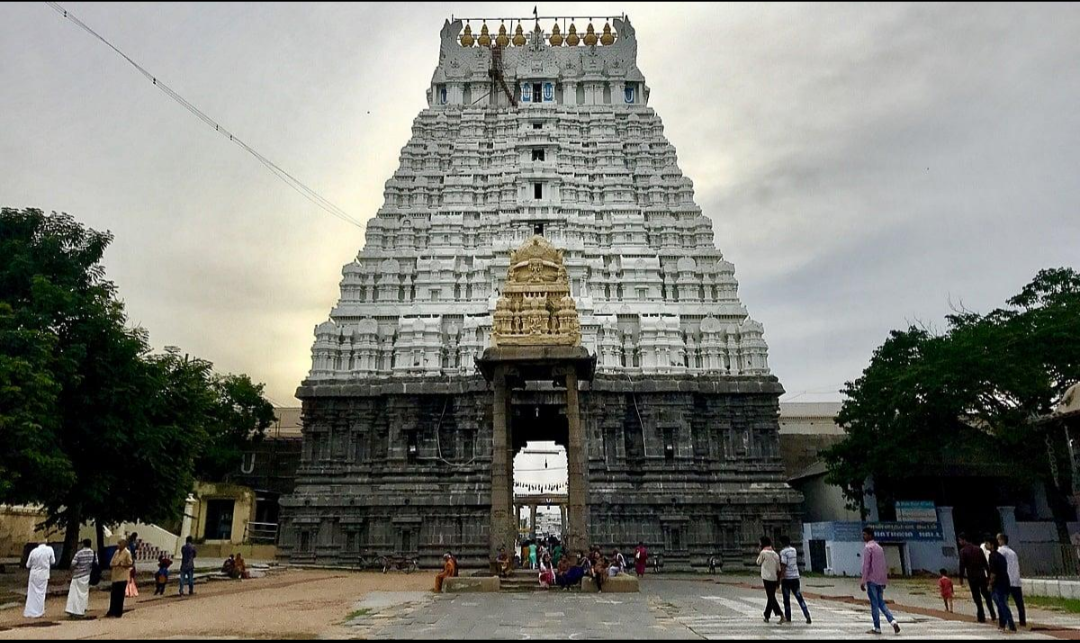
1. Introduction: Who Are the Iyengars?
The Iyengars (also spelt Ayyangar, Aiyengar, or Aiyangar) are an ethnoreligious community of Tamil-speaking Hindu Brahmins whose members follow Sri Vaishnavism and the Visishtadvaita (“qualified non-dualism”) philosophy propounded by the eleventh-century theologian Ramanuja. They are found mostly in the southern Indian states of Tamil Nadu, Karnataka, and Andhra Pradesh, with smaller historical settlements as far afield as the Purulia district of West Bengal. Alongside the Iyers — who follow the Advaita philosophy of Adi Shankara — the Iyengars form one of the two principal branches of the Tamil Brahmin community, and searches comparing “Sri Vaishnava Brahmin vs Iyengar” often arrive at the same answer: Sri Vaishnava is the religious tradition, and Iyengar is the community name most commonly used for its hereditary Tamil Brahmin followers.
Traditionally associated with temple scholarship, Vedic and Tamil liturgy, and priestly and administrative service, Iyengars belong to the Pancha Dravida Brahmana classification of Brahmins in India. Over the past century the community has diversified well beyond its priestly and scholarly roots into law, medicine, engineering, science, cinema, and a substantial global diaspora, while continuing to define itself, above all, through its distinctive theology, gothra lineage, and devotion to Vishnu.
This profile draws on encyclopaedic sources, community and temple histories, and contemporary journalism to summarise the Iyengar community's philosophical origins, historical development, internal sub-divisions, gothras, customs, and modern presence — including how many Iyengars today are using DNA ancestry testing to trace their lineage and reconnect with relatives across the globe. As with most Indian caste and community histories, the earliest chapters rest on a mixture of inscriptional evidence, hagiography, and oral tradition rather than continuous documentary record, and are presented here accordingly.
2. Etymology and Origins
The word “Iyengar” is the anglicised form of the Dravidian word Aiyangār (Tamil: ஐயங்கார்). Several explanations of its origin circulate within the community and in scholarship, none universally settled:
- Ayya + honorific theory: One view holds that the term derives from the Proto-Dravidian ayya-gāru, in which ayya is the Tamil equivalent of the Sanskrit ārya (“noble”), later rendered Ayyangāru and then Iyengar as a mark of respect.
- Pancha Samskara theory: A widely cited explanation within the Sri Vaishnava tradition itself connects the name to Iyndu Angam Udaiyavar or Iyndu Kāryangal Udaiyavar — “one possessing the five (limbs/rites)” — a reference to the Pancha Samskara, the five sacraments of initiation into Sri Vaishnavism. On this reading, “Iyengar” was originally a title conferred on anyone formally initiated into the faith, only later narrowing to denote a specific hereditary Brahmin community.
- Absence from early scripture: Scholars note that the term “Iyengar” itself does not appear in medieval Sri Vaishnava works; the more precise and older term for the tradition's followers is “Sri Vaishnava,” and some community writers argue that Iyengar identity is, in principle, a matter of religious initiation rather than birth alone — even though, in social practice, the name has long been used specifically for Sri Vaishnava Brahmin families.
Because the surviving evidence is fragmentary and largely theological rather than documentary, the exact process by which “Iyengar” evolved from a devotional title into a hereditary community name remains a subject that historians and community scholars continue to discuss rather than a settled fact.
3. Historical Development
3.1 Nathamuni and the Recovery of the Divya Prabandham
The Iyengar community traces its philosophical origins to Nathamuni, the first Sri Vaishnava āchārya, who lived around 900 CE. Nathamuni is traditionally credited with collecting the 4,000 devotional verses of Nammalvar and the other Alvars — the Tamil poet-saints intensely devoted to Vishnu — into the collection known as the Divya Prabandham, or Tamil Veda. He is believed to have set these hymns to music and introduced them into temple worship, placing them alongside the Sanskrit Vedas as a body of equally authoritative scripture: the Sanskrit texts understood as metaphysical truth, and the Tamil hymns as the lived, emotional experience of the same truth.
3.2 Ramanuja and the Formalisation of Sri Vaishnavism
A century or so after Nathamuni, Ramanuja (traditionally dated c. 1017–1137 CE) became the principal figure among Sri Vaishnava religious leaders to formalise this devotional inheritance into a systematic theology, Visishtadvaita Vedanta. Scholars describe Ramanuja variously as the founding interpreter of Sri Vaishnava scripture and as a collator and synthesiser of the tradition's Tamil and Sanskrit strands rather than a wholly original thinker. Notably, while Nathamuni and Ramanuja were both Brahmins, Nammalvar — whose hymns Nathamuni preserved — belonged to the Vellala community; all three were Tamils, though Ramanuja wrote chiefly in Sanskrit. This layered inheritance, spanning caste and language, remains central to how the community understands its own scriptural tradition, and our community traces its philosophical origins directly back to this thousand-year-old synthesis.
3.3 Consolidation, Temple Life, and Regional Spread
In the centuries following Ramanuja, Sri Vaishnava institutional life became closely associated with major temple centres such as Srirangam (the Sri Ranganathaswamy Temple) and Kanchipuram, as well as with the hill shrine of Venkateswara at Tirumala. Iyengar scholars, preceptors, and temple functionaries served across the Chola, Pandya, and later Vijayanagara-era Deccan, and the community's historical presence grew alongside these temple institutions and their associated centres of Vedic and Tamil learning. A distinct and long-standing diaspora also formed in the Purulia district of present-day West Bengal, whose Iyengar community is traditionally said to have migrated from Tamil Nadu at the invitation of a local king around 1100 CE.
3.4 Modern Period
From the nineteenth century, colonial-era education, the growth of the Madras Presidency's administrative and legal institutions, and later India's independence and the expansion of scientific and technical education, drew Iyengar families increasingly into government service, law, teaching, science, and eventually engineering, medicine, and business, alongside the community's continuing role in temple scholarship and Vedic learning. From the mid-twentieth century onward, Iyengars became especially prominent in Tamil cinema, English-language and Tamil literature, and, from the later twentieth century, in global professional and technology migration.
4. Iyengar Sub-Castes and Origins: Social Structure & Distribution
Iyengars are today divided into two principal denominations, or sampradayas: the Vadakalai (“northern culture,” associated with an emphasis on Sanskrit tradition) and the Tenkalai (“southern culture,” associated with an emphasis on the Tamil Prabandham). Scholars such as S. M. Srinivasa Chari caution that this linguistic characterisation is somewhat overstated; both sects hold Nammalvar and Ramanuja in common reverence, but the Vadakalai favour the theologian Vedanta Desika as their principal āchārya, while the Tenkalai look instead to Manavala Mamuni. Roughly eighteen points of doctrinal difference between the two, known as the ashtadasa bhedas, are traditionally recognised, though most are minor; the most frequently cited concerns the nature of divine grace, sometimes summarised as the difference between the “monkey school” (Vadakalai, holding that the soul must cling to God's grace through its own effort, as an infant monkey clings to its mother) and the “cat school” (Tenkalai, holding that grace is bestowed unconditionally, as a mother cat carries her kitten).
Beyond this central division, several regional sub-groups exist:
- Hebbar Iyengars: Found mainly in the southern districts of Karnataka (including Bangalore, Mysore, Mandya, Tumkur, Hassan, Kolar, and Chamarajanagar), traditionally said to have settled there on Ramanuja's own instruction during his time in the Hoysala kingdom. Their mother tongue historically was Kannada, though the community also learned Tamil to study the Divya Prabandham.
- Mandyam Iyengars: Settled predominantly around Melkote in Karnataka and speakers of a distinct Tamil dialect known as Mandyam Tamil. The community traditionally does not celebrate Diwali, in memory of a massacre of around 1,500 Mandyam Iyengar men, women, and children by the forces of Tipu Sultan at Srirangapatna on Diwali in 1773.
- Chelluru (Selvanallur) Iyengars: A Tenkalai sub-group believed to have migrated from a village on the banks of the Godavari and settled in and around Madurai as early as the ninth century.
Iyengars are concentrated in Tamil Nadu, with significant populations in Karnataka, Andhra Pradesh, and Telangana; Tamil (in regional and community-specific dialects, including Iyengar Tamil, Hebbar Tamil, and Mandyam Tamil) remains the primary mother tongue, alongside fluency in Kannada or Telugu among Iyengars long settled in those states.
5. Iyengar Gothras: Bharathwaja and Beyond
As with other Brahmin communities, Iyengar family lineage is organised through the gothra system — a patrilineal descent grouping traced to a founding Vedic sage (rishi) — which governs exogamous marriage rules (a bride and groom are not traditionally matched within the same gothra) and is recorded, along with nakshatra (birth star) details, on the horoscope (jathakam) used in matchmaking.
Sri Vaishnava tradition recognises twenty principal gothras, each linked to a specific set of rishi pravaras. The Bharathwaja Gothra — tracing descent to the sage Bharadwaja — is among the most numerous and widely searched-for lineages among Iyengar families today, and Bharadwaja is also one of the most common gothras across Brahmin communities in India more broadly. Other commonly encountered Iyengar gothras include:
- Bharathwaja (Bharadwaja) — among the most common Iyengar gothras
- Kaushika (Kowsika) — traced to sage Vishvamitra
- Vishvamitra (Viswamitra)
- Atreya
- Srivatsa (associated with the Oppiliappan lineage)
- Kaundinya (Kowndinya)
- Harita
- Shandilya (Sandilya)
- Moudgalya (Mowdgalya)
Families typically know their specific gothra and pravara through oral family tradition, temple records, or the family priest (purohit), and it remains one of the first details exchanged in matchmaking and ritual contexts even today.
Uncovering Your Iyengar Roots with DNA Ancestry Testing
Many Iyengars today look for their roots beyond what family memory and gothra records can tell them. DNA ancestry testing can help confirm a stated gothra lineage against genetic patrilineal markers, trace regional migration — such as the historic movement of Hebbar and Mandyam Iyengar families into Karnataka, or Iyengar settlement in Purulia, West Bengal — and identify shared genetic markers with extended family branches long since dispersed. For NRI Iyengars and diaspora families in particular, a DNA test can be a starting point for reconnecting with distant relatives across India, the US, the UK, and the Gulf, and for placing family oral history within a broader genetic and historical picture.
6. Religion, Philosophy, and the Namam
Iyengars are Sri Vaishnavas: devotees of Vishnu and his consort Lakshmi, worshipped together as Sriman Narayana, with particular reverence for forms such as Venkateswara of Tirumala, Ranganatha of Srirangam, and Varadaraja of Kanchipuram. Doctrinally, the community follows Visishtadvaita (“qualified non-dualism”), which holds that the individual soul and the material world are real and are integrally related to, but distinct from, the Supreme Being — a position framed in contrast to the strict non-dualism (Advaita) of the Iyer community's Smarta tradition. This theological distinction is the clearest answer to the common question of Sri Vaishnava Brahmin vs Iyengar: the two terms describe the same community from two angles, religious affiliation and hereditary identity.
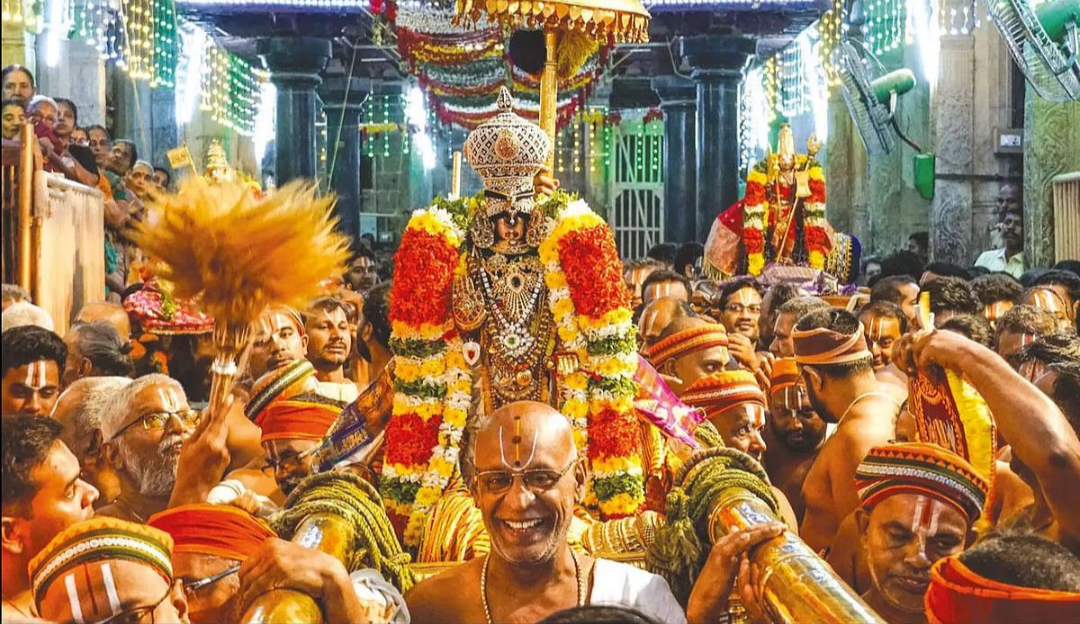
A visible marker of Iyengar identity is the namam (also called thirunamam or thiruman), a U- or Y-shaped tilak applied to the forehead and, traditionally, to eleven other points of the body. The mark is understood to represent the feet of Vishnu, with a central red or yellow line (srichurnam) representing the goddess Lakshmi. Vadakalai Iyengars wear the mark in a U shape confined to the forehead; Tenkalai Iyengars wear a Y shape that extends down to the bridge of the nose. In everyday life, many Iyengars wear an abbreviated version consisting of a single vertical line.
The community's scriptural inheritance is understood as twofold: the Sanskrit Vedas and Upanishads on one hand, and the Tamil Divya Prabandham — the collected hymns of the twelve Alvar poet-saints — on the other, recited together in temple worship.
7. Iyengar Festivals and Cultural Practices
Iyengar religious life follows a temple-centred festival calendar that blends the pan-Hindu and broader Tamil calendar with Sri Vaishnava-specific observances:
- Vaikunta Ekadashi: Considered the most significant Sri Vaishnava festival of the year, marked by an all-night vigil and passage through the temple's “Gate to Heaven” (Paramapada Vasal), observed with particular grandeur at Srirangam.
- Panguni Uthiram: A spring festival marking the celestial wedding of Vishnu, celebrated with temple processions across major Sri Vaishnava shrines.
- Adyayanotsavam: The twenty-one-day festival at Srirangam and other temples devoted to the recitation of the entire Divya Prabandham.
- Puthandu (Tamil New Year) and Deepavali: Observed by most Iyengar families as part of the wider Tamil and Hindu calendar — with the notable exception of Mandyam Iyengars, who abstain from Deepavali in memory of the 1773 Srirangapatna massacre.
- Upakarmam / Avani Avittam: The annual renewal of the sacred thread (poonal), observed by initiated men on the full moon of the Tamil month of Avani.
Temple-specific utsavams (festivals) at Srirangam, Tirumala, and Kanchipuram remain central to community and family life, drawing Iyengar families back to ancestral temple towns from across India and the diaspora each year.
8. Culture, Customs, and Social Life
Traditional Iyengar life centred on the extended family, temple service, and Vedic and Tamil scriptural learning; many families historically maintained close ties to a particular temple or matha (monastic institution) and its presiding āchārya. Rites of passage — including Namakaranam (naming), Annaprasanam (first solid food), Upanayanam (sacred-thread investiture, typically around age seven or later, which formally inducts a boy into daily ritual observance including sandhyavandanam, thrice-daily prayer), and Vivaham (marriage) — follow the broader Brahminical life-cycle pattern, with Sri Vaishnava-specific liturgical elements.
Respect for elders, hospitality, and strong extended-kin networks remain valued norms, and many families — including those long settled in cities or abroad — maintain ties to ancestral temples and villages, returning for festivals, weddings, and the death anniversaries of family elders (shraddha).
9. Iyengar Matrimonial Traditions & Family Life
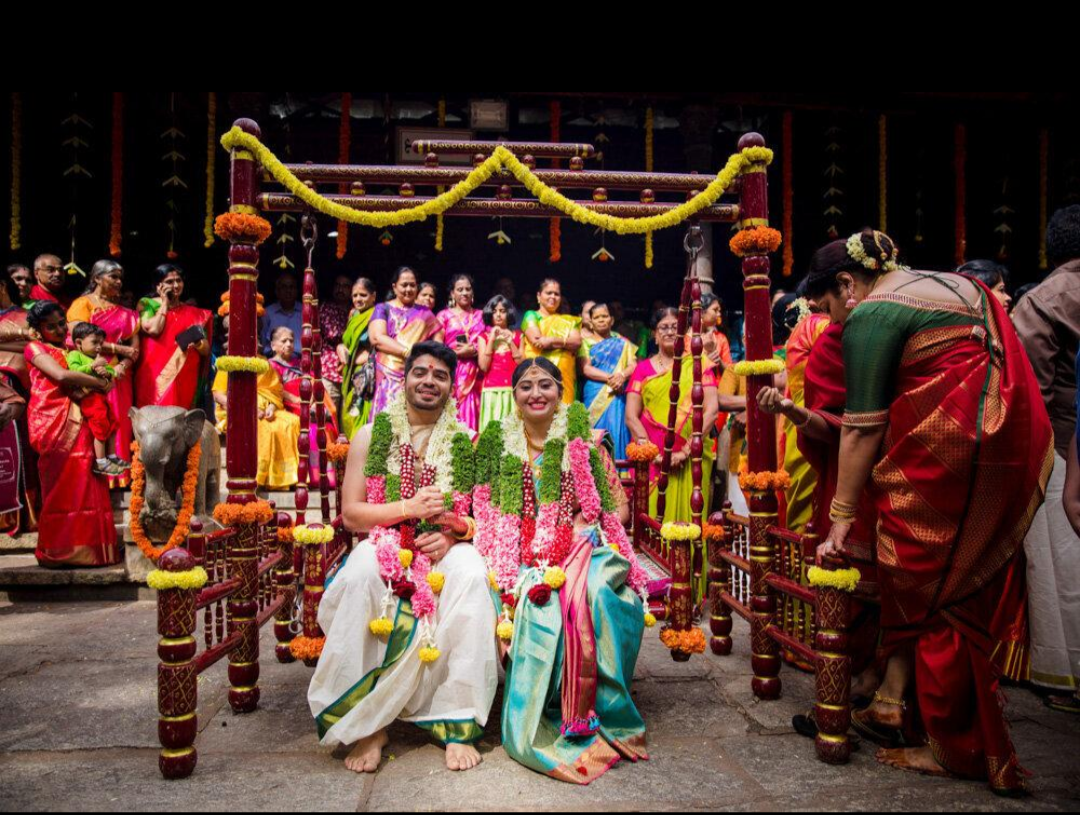
Iyengar weddings follow the broader Tamil Brahmin pattern shared with the Iyer community — the two traditions are said to overlap in roughly four-fifths of their rituals — while differing in theology, specific mantras, and some customary detail. Marriage has traditionally been arranged within the community and outside one's own gothra, consistent with wider Hindu Brahmin practice, with horoscope (jathakam) and gothra compatibility checked before a match proceeds.
A typical multi-day Tamil Brahmin wedding, as observed among Iyengars, includes:
- Nichayathartham: The formal engagement, at which the match and wedding date are announced and gifts exchanged between families.
- Naandi Shraardham: A ritual in which the groom's family is welcomed to the bride's home and blessings are sought from the couple's ancestors.
- Kasi Yatra: A playful enactment in which the groom mock-departs on a pilgrimage to Kashi (Varanasi) in renunciation, before being persuaded by the bride's father to accept marriage instead.
- Oonjal: A ceremony in which the bride and groom are seated on a decorated swing and sung to by assembled women, a custom particular to Tamil Brahmin weddings.
- Mangalyadharanam and Saptapadi: The groom ties the sacred thread (mangalsutra/thali) around the bride's neck, and the couple take seven steps together around the sacred fire, the ritual core of the marriage.
- Nalangu: A lighthearted post-wedding ritual, often involving playful games between the bride and groom, intended to help the couple relax and bond.
Matchmaking today runs alongside these traditions rather than replacing them: alongside family and community networks, dedicated Iyengar and Brahmin matrimonial platforms in Tamil Nadu and beyond now handle gothra, nakshatra, and sub-sect (Vadakalai/Tenkalai) filtering for prospective families, and “America varan” (US-based groom) matches have become a well-studied pattern of diaspora matrimonial arrangement among Tamil Brahmans more broadly. Intercaste and inter-regional marriages, including between Iyers and Iyengars, have also become more common among urban and diaspora families.
10. Cuisine
Iyengar cuisine belongs to the wider tradition of Tamil Brahmin vegetarian cooking, and is traditionally prepared without onion or garlic, in keeping with satvik dietary principles. It is rice-centric, making extensive use of lentils (paruppu), legumes such as black gram (ulundu) and split chickpeas (kadalai paruppu), and coconut.
- Rice preparations: A traditional Iyengar meal may include two or three rice varieties — such as coconut rice, tomato rice, or curd (yogurt) rice — eaten alongside a lentil-and-vegetable stew (kuzhambu) and a tangy, spiced soup (rasam).
- Vegetable and lentil dishes: Preparations such as paruppu usili (lentil-studded vegetables, typically French beans), vegetables in coconut gravy, and small roasted potatoes are common accompaniments.
- Tiffin and breakfast items: As with South Indian cuisine generally, dishes such as idli, dosa, and appam (a fermented rice pancake) feature at breakfast, often served with chutneys.
- Festive and ceremonial dishes: Sweet preparations such as payasam (a milk-and-rice or lentil pudding) and akkaravadisal (a rich rice-and-lentil pudding cooked in milk) are traditionally served at festivals and family celebrations, including weddings.
Meals are traditionally served on a fresh banana leaf, with dishes arranged in a customary order and eaten in a particular sequence, a practice still followed at many family and temple functions.
11. Traditional Dress and Ornaments
Traditional Iyengar dress follows the broader conventions of Tamil Brahmin and South Indian Hindu society. Women traditionally wear silk sarees on formal and ceremonial occasions, with Kanchipuram (Kanjeevaram) silk especially favoured for weddings, along with gold jewellery, including the mangalsutra/thali, worn as a mark of married status. Men traditionally wear a dhoti (veshti) with an angavastram (an upper cloth draped over the shoulder) for religious and formal occasions, along with the community's characteristic namam marking on the forehead and, for the initiated, the sacred thread (poonal). Everyday dress today largely follows contemporary fashion, with traditional attire reserved mainly for weddings, festivals, and temple visits.
12. Connecting the Global Iyengar Diaspora
From the later twentieth century, and accelerating from the 1990s with the growth of engineering, medicine, and information technology as career paths, Iyengar families have emigrated from Tamil Nadu, Karnataka, and Andhra Pradesh to other parts of India and abroad. Significant diaspora communities exist in the United States, the United Kingdom, Canada, Australia, and the Gulf countries. Diaspora Iyengar and broader Sri Vaishnava associations maintain temples, cultural centres, and religious classes abroad, and Iyengar families are also active participants in wider Tamil and Sri Vaishnava cultural organisations.
One of the community's most globally recognised contributions is indirect but far-reaching: B. K. S. Iyengar, born into an Iyengar family in Karnataka, is widely credited with popularising yoga as a disciplined system of physical and therapeutic practice in the West from the 1950s onward, a development that a recent Indian-American advocacy compilation credited with helping make yoga practice widespread in the United States today.
For today's NRI Iyengars — often several generations removed from an ancestral agraharam (Brahmin temple street) in Tamil Nadu or Karnataka — diaspora associations, temple networks, and family reunions remain the main channels for staying connected to community and heritage, alongside a growing interest in documenting family trees and gothra history before it is lost to memory.
Bridging the Iyengar Diaspora Through DNA
Whether you're an NRI Iyengar in the United States, the UK, or the Gulf, or a family still rooted in Tamil Nadu or Karnataka, DNA ancestry testing offers a practical way to bridge the distance. It can help verify oral accounts of gothra and sub-sect origin, surface genetic cousins descended from the same ancestral village or temple lineage, and give diaspora families a documented starting point for reconnecting with relatives they have lost touch with across generations and continents.
13. Education, Livelihoods, and Socioeconomic Profile
Historically a community whose status and livelihood were closely tied to temple service, Vedic scholarship, and administrative or legal roles under colonial and princely governments, Iyengars invested heavily in modern English-medium and technical education from the late nineteenth century onward. This early emphasis on education is widely credited with enabling the community's subsequent presence across law, the civil services, teaching, science, engineering, and medicine through the twentieth century.
Today, Iyengars have a significant presence in academia and scientific research, information technology and engineering, medicine, law, public administration, classical music and dance, and cinema, alongside a continuing core of families engaged in temple priesthood, Vedic teaching, and religious scholarship. The community is frequently noted in journalistic and sociological accounts of South Indian Brahmin communities for its historical emphasis on formal education and professional migration, both within India and abroad.
14. Notable Iyengars in Modern India and Abroad
14.1 Religion, Philosophy, and Yoga
- Ramanuja (c. 1017–1137): Formalised Visishtadvaita Vedanta and is regarded as the community's foundational āchārya.
- B. K. S. Iyengar (1918–2014): Internationally influential yoga teacher and founder of Iyengar Yoga, credited with popularising yoga as a therapeutic discipline in the West.
14.2 Politics and Public Life
- M. A. Ayyangar (1891–1978): First Deputy Speaker of the Lok Sabha and later Speaker of the Lok Sabha.
14.3 Science and Academia
- M. O. P. Iyengar (1886–1963): Botanist and phycologist, regarded as the father of Indian phycology and first president of the Phycological Society of India.
- K. R. Srinivasa Iyengar (1908–1999): Scholar of Indian writing in English, former vice-chancellor of Andhra University, and recipient of the Sahitya Akademi Fellowship.
- Sundaraja Sitharama Iyengar (b. 1947): Indian-American computer scientist known for co-developing the Brooks–Iyengar algorithm in fault-tolerant sensor fusion, and a widely published researcher in AI and digital forensics.
14.4 Cinema and the Arts
- Hema Malini (b. 1948): Actress and Bharatanatyam exponent.
- Kamal Haasan (b. 1954) and the Haasan family: Actor, filmmaker, and one of Indian cinema's most versatile performers, along with actress relatives Anu Hasan, Shruti Haasan, and Akshara Haasan.
- R. Madhavan (b. 1970): Actor prominent across Tamil and Hindi cinema.
- Vyjayanthimala (b. 1936): Actress and classical dancer of the 1950s–60s Hindi and Tamil film era.
This list is illustrative of individuals whose Iyengar community background is documented in published biographical or journalistic sources; it is not exhaustive, and the community has produced many further figures across public life, scholarship, and the professions.
15. Contemporary Reflections
Contemporary discussion of the Iyengar community in journalism and scholarship most often centres on two themes. The first is the community's continuing internal sectarian distinction between Vadakalai and Tenkalai, which occasionally surfaces in public disputes over temple ritual practice — including, in recent years, litigation and even physical altercations over whether Tamil or Sanskrit hymns should be recited during processions at temples such as the Varadaraja Perumal temple in Kanchipuram, and disputes over the shape of the namam applied to temple deities at Tirumala. Observers, including judges hearing such disputes, have periodically remarked on the persistence of this centuries-old rivalry even as both sects share a common theological and devotional inheritance.
The second theme is the community's transformation, over roughly a century, from a priestly and temple-centred identity into a highly educated, professionally diversified, and globally dispersed one — a trajectory shared, in broad outline, with other traditionally learned South Asian communities that invested early in formal education. As with other caste communities in modern India, questions of caste identity, endogamy, and changing social norms continue to be discussed within the community and in wider South Indian public life, particularly among younger and diaspora generations navigating gothra-based matchmaking, intercommunity marriage, and life far from ancestral temple towns.
16. Conclusion
The Iyengar community's documented history reflects a trajectory that begins not with a place or a lineage of kings, but with a body of devotional and philosophical scholarship: Nathamuni's recovery of the Divya Prabandham, Ramanuja's formalisation of Visishtadvaita Vedanta, and centuries of temple-centred learning at Srirangam, Kanchipuram, and Tirumala. From this theological foundation grew a distinct Tamil Brahmin community, internally divided between Vadakalai and Tenkalai schools of thought and organised through gothras such as Bharathwaja, yet unified by devotion to Vishnu, the namam mark, and a shared scriptural inheritance spanning Sanskrit and Tamil. In the modern era, the community has moved decisively beyond its priestly origins into education, science, law, cinema, and a substantial global diaspora, while continuing — through temple worship, ceremonial cuisine, gothra-based matchmaking, and life-cycle ritual, and increasingly through DNA ancestry research — to preserve and rediscover the theological and cultural distinctiveness first shaped a thousand years ago.
Trace Your Iyengar Heritage Today
From the Bharathwaja Gothra to the Vadakalai–Tenkalai divide, Iyengar identity is rich with lineage, ritual, and story. Curious how your own family's gothra, migration history, and DNA connect to this thousand-year-old Sri Vaishnava tradition? Explore ancestry testing to uncover your family's documented and genetic roots.
References
- [1]
- [2]
- [3]
- [4]
- [5]
- [6]
- [7]
- [8]
- [9]
- [10]
- [11]
- [12]
- [13]
- [14]
- [15]