
Admixture: The Science of Finding Where You Come From
What If Your Family Story Goes Further Back Than You Think?
Imagine sitting with your grandparents and asking a simple question: “Where did our family originally come from?”
Perhaps they tell you about a village your family left generations ago. Maybe there is a story about a great-grandparent who travelled to another region, married someone from a different community, or settled somewhere new in search of a better life.
These stories are fascinating, but family memories usually have limits. Records get lost, names change, and some parts of our history disappear over time.
Now imagine discovering that your DNA holds additional clues about your ancestral origins.
This is where admixture analysis comes in.
Admixture is a scientific concept used to understand how genetic ancestry from different ancestral populations contributes to the genetic makeup of individuals and communities today. By comparing patterns in your DNA with those observed in reference populations, scientists can estimate aspects of your genetic ancestry that may complement your family history.
But what does admixture actually mean, and how can a DNA test help you explore where you come from?
What Is Admixture in Genetics?
In genetics, admixture refers to the mixing of genetic ancestry from populations that were previously more genetically distinct.

Throughout human history, people have migrated, traded, formed relationships, and built families across geographical and cultural boundaries. Over many generations, these movements have brought together genetic lineages from different populations.
For example, imagine a family whose ancestors lived in different parts of South Asia over several generations. As people moved between regions and formed families, their descendants inherited DNA from multiple ancestral lineages.
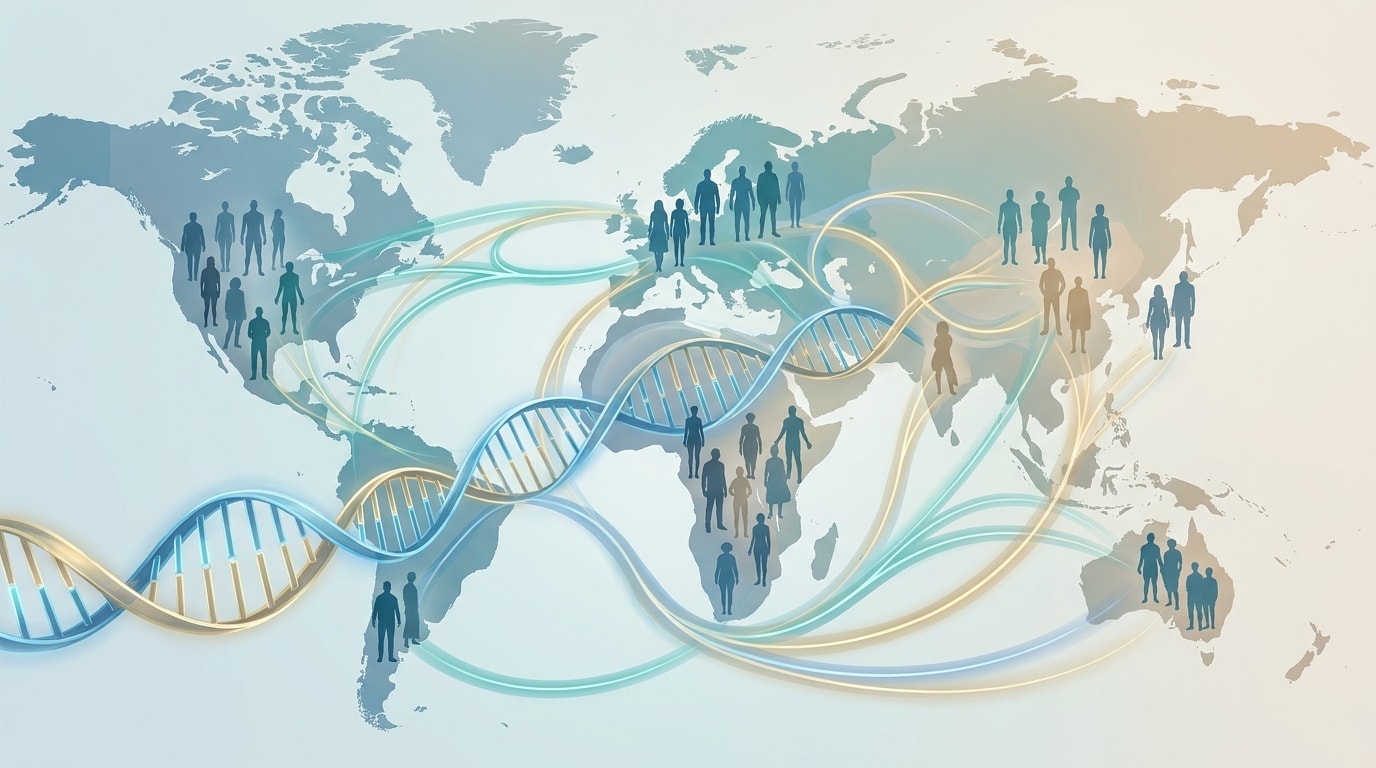
Admixture analysis uses genetic information to study these patterns.
In simple terms, it helps scientists investigate questions such as:
- Which ancestral populations may have contributed to a person's genetic ancestry?
- How does someone's genetic profile compare with different reference populations?
- What patterns of historical migration and population mixing are visible in DNA?
- How is an individual's genetic ancestry related to broader population history?
The important distinction: Admixture analysis estimates genetic ancestry. It does not define your nationality, culture, identity, or personal connection to a place.
Your identity is shaped by much more than your DNA.
How Can Your DNA Reveal Ancestral Connections?
A DNA sample is used to obtain genetic information. Depending on the testing method, this may involve analysing selected genetic markers or sequencing a much larger portion of the genome. For a consumer DNA test, the process begins with sample collection and laboratory analysis.
People share most of their DNA, but small variations distinguish one person's genetic profile from another's. These variations can include single-nucleotide polymorphisms, commonly called SNPs. When considered across many locations in the genome, they can help researchers identify patterns of genetic similarity.
Scientists compare your genetic patterns with reference datasets representing people from different geographical regions or ancestral backgrounds. Statistical models estimate how well your genetic profile fits these reference groups. The results depend partly on which populations are represented in the reference dataset and how the analysis is performed.
The analysis may produce estimates showing genetic affinities with particular regions or population groups. These estimates are not necessarily a literal record of your recent family tree. They reflect patterns in your DNA and the reference populations used by the analytical method.
Think of admixture analysis as a scientific clue to your ancestry, rather than a complete historical record of your family.
What Does an Admixture Percentage Actually Mean?
You may have seen ancestry reports showing percentages associated with different regions. These results often raise an immediate question: What do those numbers really tell us?
Imagine an illustrative report showing:
- 60% estimated ancestry associated with Reference Population A
- 25% estimated ancestry associated with Reference Population B
- 15% estimated ancestry associated with Reference Population C
These numbers are hypothetical and do not represent actual GenoConnect results. They illustrate how an ancestry model might summarise genetic similarities to different reference populations.
However, a result of 25% does not automatically mean that exactly 25% of your family came from a particular modern country, nor does it identify a specific ancestor.
Why? Because genetic populations do not always align neatly with present-day national borders. Neighbouring populations may share substantial genetic history, and different analysis methods may produce different estimates. Reference datasets also vary in their size, diversity, and geographical representation.
As a result, ancestry percentages are best understood as estimates based on a particular model and reference dataset, not as exact measurements of national or cultural identity.
Admixture and Human Migration: A Story Written Across Generations
Human history is a history of movement.
People have migrated because of climate changes, food availability, trade, conflict, exploration, employment, marriage, and many other reasons. Over thousands of years, these movements have shaped the genetic diversity observed in populations around the world.
Admixture analysis can help scientists investigate some of these historical patterns.
For example, genetic research has revealed complex histories of population movement and mixing across South Asia, Europe, Africa, the Americas, and other regions.
These histories are rarely simple stories of one population replacing another. They often involve repeated migration, interaction, and mixing across different periods.
Your DNA may contain traces of this wider history, although identifying the exact historical event or location responsible for a particular genetic pattern is not always possible.
This is what makes admixture interesting: it connects an individual's genetic profile to the broader story of human population history.
Admixture vs. Ancestry: Are They the Same Thing?
| Feature | Genetic ancestry | Admixture analysis |
|---|---|---|
| Main purpose | Explore ancestral connections reflected in DNA | Estimate genetic contributions from different reference populations |
| Typical results | Regional ancestry estimates, lineage information, population similarities | Model-based ancestry proportions or population contributions |
| Historical perspective | Can explore ancestral origins at different scales | Particularly useful for investigating population mixing |
| Key limitation | Does not reveal every ancestor or define identity | Results depend on reference populations and statistical assumptions |
Why Can Two People From the Same Family Receive Different Results?
Have you ever wondered why siblings might receive slightly different ancestry estimates, even though they have the same parents?
The answer lies in inheritance.
You inherit roughly half of your autosomal DNA from each parent, but you do not receive exactly the same combination of DNA as your siblings. During the formation of eggs and sperm, genetic material is reshuffled through a process called recombination.
As a result, siblings inherit different combinations of DNA from their shared ancestors.
Ancestry estimates can also differ because of analytical factors, including reference population selection, statistical methods, and how genetic similarities are assigned to particular groups.
Even when two people have similar family histories, their reports may therefore differ in some details. This does not automatically mean that one report is wrong. It highlights that genetic ancestry estimates are influenced by both biological inheritance and the methods used to interpret DNA.
Can Admixture Reveal Your Exact Ancestors?
This is one of the most common questions about genetic ancestry testing.
The short answer is: not by itself.
Admixture analysis can estimate genetic relationships with reference populations, but it generally cannot identify every individual ancestor or reconstruct a complete family tree.
For example, an ancestry estimate associated with a region does not necessarily establish that a particular great-grandparent was born there.
To investigate specific ancestors, DNA results may need to be combined with family documents, historical records, genealogy research, and, where available, DNA matching with biological relatives.
It is also important to distinguish between genetic ancestry and cultural heritage. A DNA test cannot determine which traditions you grew up with, which language you speak, or where you feel at home.
Your family story includes all these dimensions, not just the genetic one.
How Is Admixture Analysis Used in Genetic Research?
Admixture is not limited to consumer ancestry testing. It is also an important concept in population genetics and evolutionary research.
Human population history: Genetic data can help researchers examine how populations have moved, interacted, and mixed over time.
Population structure: Researchers can study patterns of genetic similarity and variation among groups.
Evolutionary history: Admixture can provide evidence of historical interactions between populations and, in some cases, ancient human lineages.
Medical and genetic research: Understanding population structure and ancestry can help researchers account for genetic differences when studying disease-associated variants. However, ancestry is not a diagnosis, and genetic background alone does not determine an individual's health.
These applications demonstrate how the same underlying scientific concept can help explore both personal ancestry and broader questions about human history.
Explore Your Genetic Ancestry With GenoConnect
Your family history may begin with the stories you have heard, but your DNA can offer another perspective on the journey of your ancestors.

With GenoConnect, you can explore DNA testing options designed to help you learn more about your genetic background through accessible reports and genetic insights.
Depending on the testing option and analysis available, genetic information can support exploration of ancestry and other aspects of your genetic profile.
Getting started is simple: choose a suitable DNA testing option, follow the sample collection instructions, and explore the insights available through your results.
A self-collected cheek swab can provide a convenient way to begin the process from home. The information available in your report depends on the selected test and the analyses performed.
Remember, no DNA test can tell your entire family story. But genetic insights, combined with family memories and historical research, may help you ask new questions about your past.
What Should You Remember About Admixture?
Admixture helps explain how genetic ancestry from different populations can come together over generations.
It offers a scientific way to investigate population history and explore patterns in your own DNA. However, ancestry percentages are estimates, reference populations influence the results, and genetic ancestry does not define your cultural or personal identity.
The most meaningful approach is to treat your DNA results as one part of a larger story—one that also includes family memories, traditions, migration, and the lives of the people who came before you.
Your DNA can offer clues. The story you build around those clues is uniquely yours.
Frequently Asked Questions
1. What is admixture in a DNA test?
Admixture is the mixing of genetic ancestry from populations that were previously more genetically distinct. In DNA testing, admixture analysis estimates contributions from reference populations using patterns of genetic variation.
2. Is admixture the same as ethnicity?
No. Admixture describes genetic ancestry and population mixing, whereas ethnicity can involve shared culture, language, history, traditions, and identity. Genetic ancestry estimates cannot determine a person's complete ethnic identity.
3. Are admixture percentages accurate?
They are estimates produced by statistical models. Their reliability depends on factors such as the reference populations, the genetic data available, and the analysis method. Estimates may change when datasets or analytical methods are updated.
4. Can admixture tell me where my ancestors lived?
It may suggest genetic connections with particular regions or populations, but it cannot reliably identify the exact location of every ancestor. Historical records and genealogy research can provide additional context.
5. Why do ancestry results sometimes change?
Results may change when testing companies update their reference datasets, add new populations, or improve their analytical methods. Small percentage estimates may be particularly sensitive to these changes.
6. Can people from the same region have different admixture results?
Yes. Individuals from the same geographical region can have different family histories and inherited genetic variations. Nearby populations may also share genetic similarities, making ancestry estimates complex.
7. How can I explore my own genetic ancestry?
You can begin by exploring a DNA testing option that provides ancestry-related insights. Review what the selected test includes, how its results are interpreted, and what limitations apply before making a purchase.
Ready to Explore Your DNA?
Every family has a story, and some chapters stretch back further than anyone remembers.
Discover another perspective on your genetic heritage with GenoConnect. Explore the available DNA testing options and begin learning more about the ancestral connections reflected in your DNA.
Explore GenoConnect: https://www.genoconnect.co/
Disclaimer: Genetic ancestry reports provide estimates based on available genetic data and reference populations. They do not establish nationality, cultural identity, or a complete family tree, and should be interpreted in the context of their stated limitations.