Explore the fascinating Andronovo culture, its origins in the Central Asian steppes, and its direct genetic legacy in modern-day India.
Rings in the wood
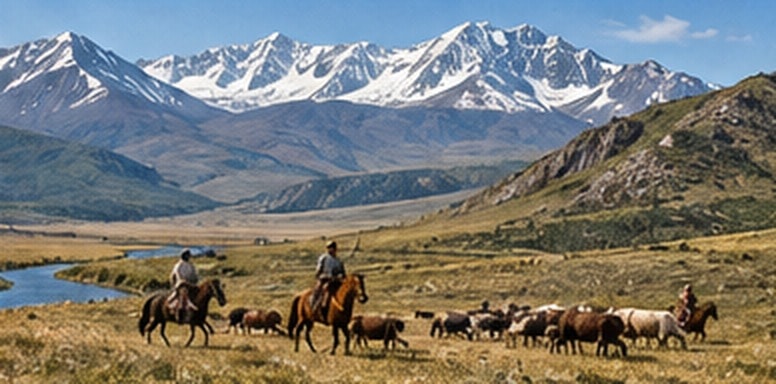
The Tobol River, around 1700 BCE. On the grassland of what is now northern Kazakhstan, two families live within sight of each other on the same bank.
Their days look much alike. At dawn the cattle and sheep go out to graze along the river, and the horses are brought in from the pasture. Both families cut pine from the woods nearby for timber. Both cook in clay pots and drink milk from their herds. When the grass runs thin, both move their animals to fresh pasture.
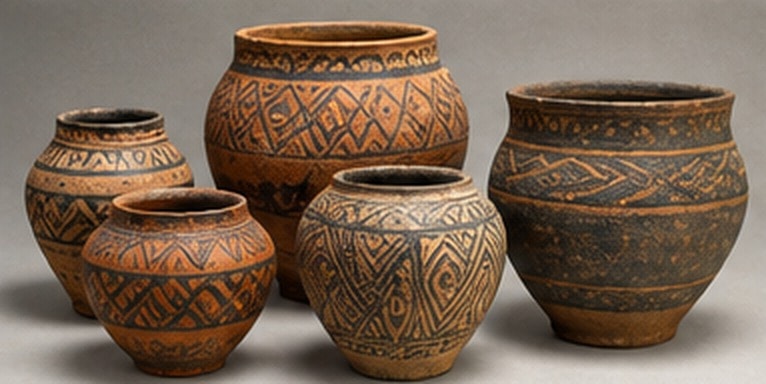
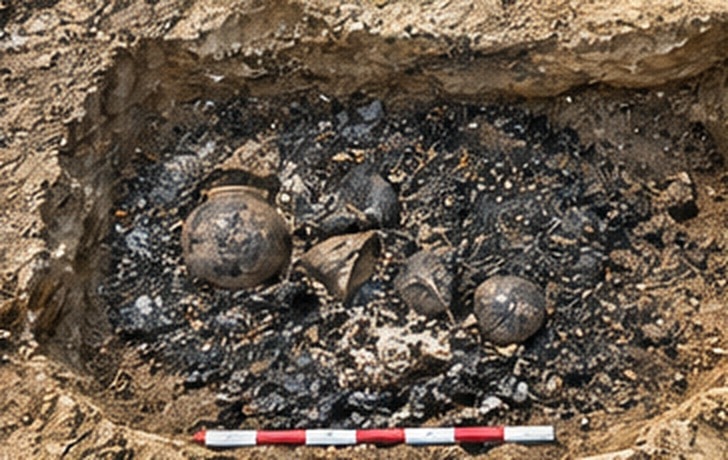
But look closely and the two households are not the same. They decorate their pots in different patterns. They follow different customs, and when someone dies, one family buries the body while the other cremates it first. Archaeologists would one day give their two ways of life different names, Alakul and Fedorovo, and for a long time they assumed the two must belong to different centuries.
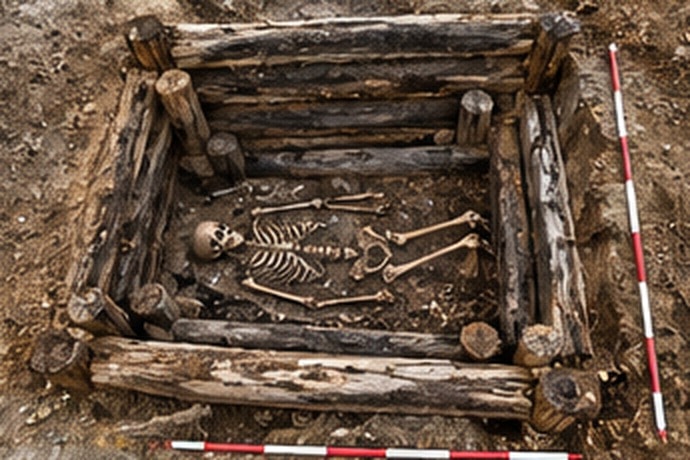
The pine proved them wrong. Some of the logs these families cut have survived, and wood keeps a record of its own: each ring in a tree trunk marks one year of growth. In 2008, Irina Panyushkina and colleagues matched the tree rings in these logs with radiocarbon dates. They found that the sites near the town of Lisakovsk were in use between about 1780 and 1660 BCE, and that Alakul and Fedorovo families lived here at the same time, within a few generations of each other [1].
Two customs, one riverbank, one community of neighbours. Within a few centuries, people of these traditions would live from the Ural Mountains to the edge of China, and from the Siberian forests to the mountains of Tajikistan. Some of their descendants would reach the north-west of the Indian subcontinent. When an Indian DNA report today shows “steppe” ancestry, these are the people the report is pointing to.
Who were they?
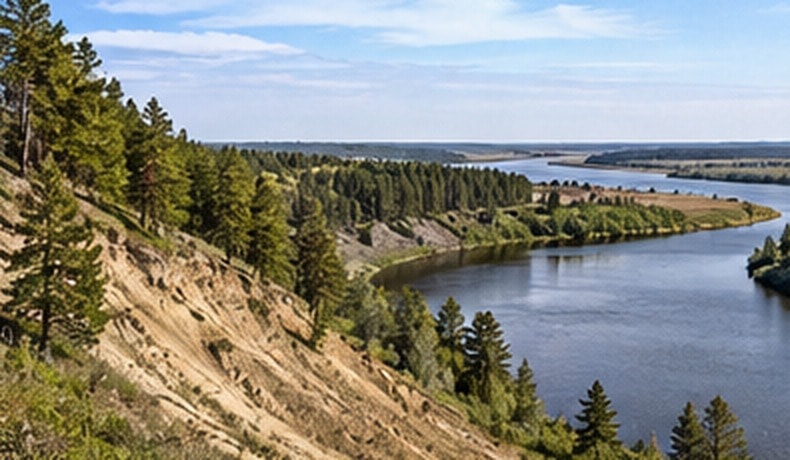
Figure 1. A river landscape like the Tobol valley in northern Kazakhstan, where the Lisakovsk cemeteries lie.Figure 3. Pots decorated with bands of geometric patterns, in the style of Andronovo pottery. Alakul and Fedorovo potters decorated their pots in different ways.
A name from a Siberian village
Southern Siberia, 1914. The Russian zoologist Arkady Tugarinov finds ancient graves near the village of Andronovo, in the Krasnoyarsk region. In the 1920s the archaeologist Sergei Teploukhov sees that they belong to a distinct culture and gives it the village’s name [2, 3]. Like most names for prehistoric peoples, it is an archaeologists’ label. What these people called themselves, nobody knows.
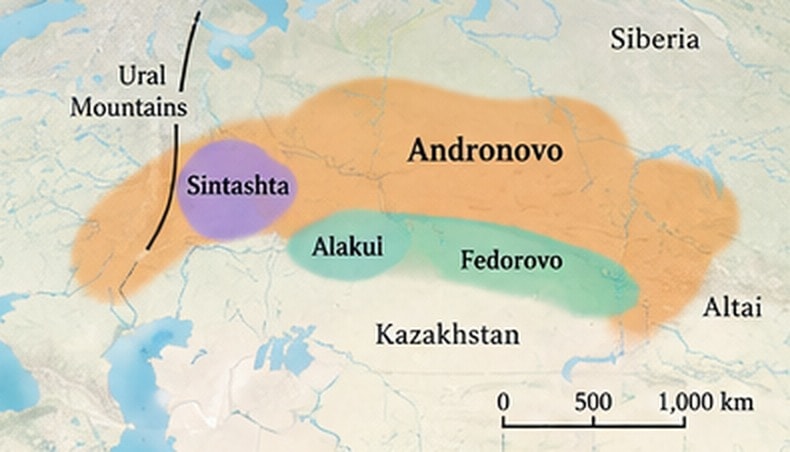
“Andronovo” is a family of related cultures that shared ways of making pots, building houses and burying the dead [2, 3]. Its two best-known branches are the ones that met at Lisakovsk. Alakul is found mostly in the west, in the southern Urals and northern Kazakhstan. Fedorovo stretches further east, into southern Siberia, the Altai and the mountains of Central Asia. Later local groups grew out of both. The dates differ by region, roughly from 2000 BCE to after 1200 BCE, and specialists still disagree on how to group them [2, 3].
Figure 4. A simplified map of the Andronovo world, with its two main branches, Alakul in the west and Fedorovo further east, and the earlier Sintashta in the southern Urals.
For Indian readers, there is a direct reason to know these people. When a DNA report shows “steppe” ancestry in an Indian person, the reference group behind it is usually called Central_Steppe_MLBA. Geneticists built that group from people of the Andronovo world [4].
To see where they came from, we have to go a few centuries further back, and a little further west.
Children of the Sintashta
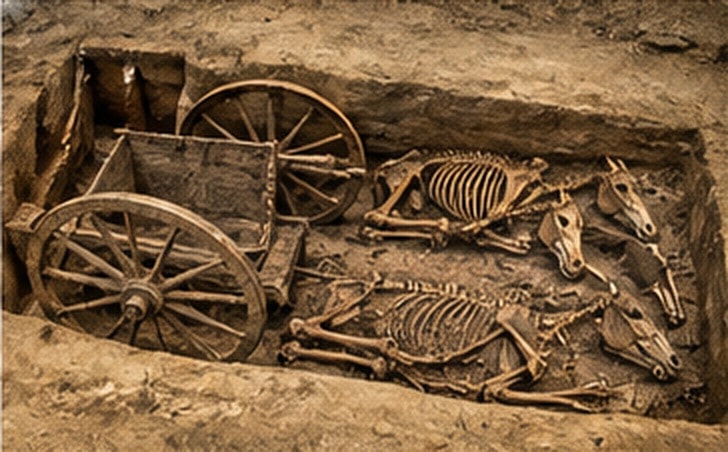
The southern Urals, 2100 BCE. A people archaeologists call the Sintashta live here in walled towns. They smelt copper in their homes, and they bury their dead with horses and the first known spoke-wheeled chariots. About two-thirds of their ancestry comes from the Yamnaya, the herders who spread across the steppe after 3300 BCE. The other third comes from Europe’s early farmers, picked up when steppe people moved into Europe and their descendants later turned back east [4, 5].
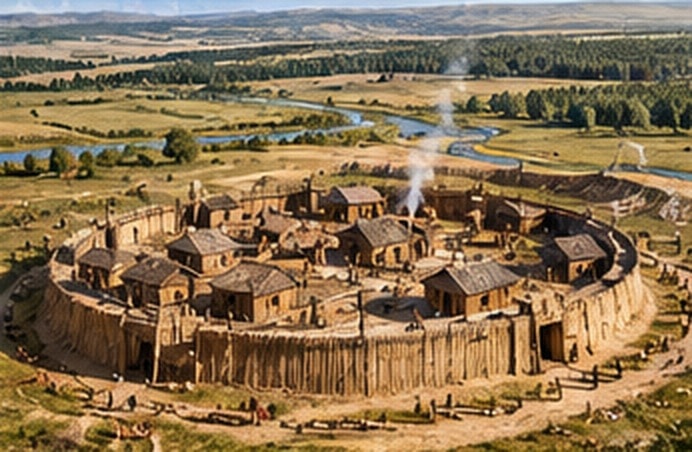
Figure 5. An artist’s impression of a Sintashta walled settlement in the southern Urals.Figure 6. An illustration of a Sintashta chariot burial with horses. In excavated graves the wood has rotted away, and the wheels usually survive only as traces in the soil.
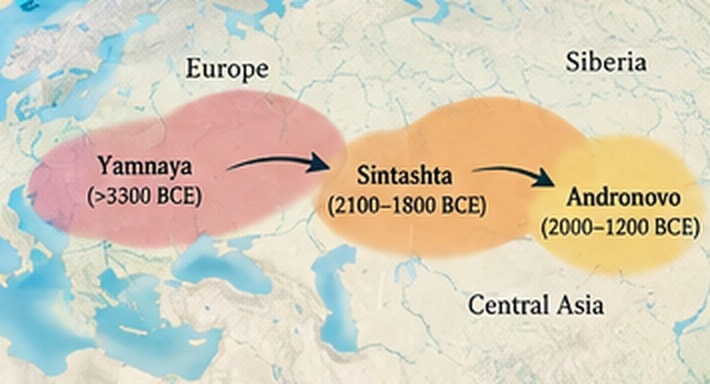
In 2015, Morten Allentoft and colleagues sequence the first Andronovo genomes. They are very close to the Sintashta [5]. The Andronovo are the Sintashta’s heirs.
Figure 7. A simplified map of the main line of descent, from the Yamnaya to the Sintashta and from the Sintashta to the Andronovo, who mixed with local peoples along the way.
As they spread east across Kazakhstan, they pick up something new. Vagheesh Narasimhan and colleagues find that the Andronovo-era people of the central steppe carry about 9 percent more ancestry from the older peoples of the region, mainly related to the hunter-gatherers of western Siberia [4]. That small difference is what separates Central_Steppe_MLBA from the Sintashta-like groups further west.
Northern Kazakhstan, 1780 BCE. According to Panyushkina’s team, Andronovo people have reached this part of the steppe by now, and Fedorovo-related groups are moving south into it from the northern steppe [1].
Wherever they go, they marry into the families already living there. Near Krasnoyarsk in Siberia, Andronovo-era people from about 1700 to 1500 BCE carry up to about a quarter of their ancestry from eastern Siberian hunter-gatherers [4]. At Koken, on the upper Irtysh River in eastern Kazakhstan, Haechan Gill and colleagues study 19 people of this period. Most are genetically like other steppe herders of the Middle to Late Bronze Age. A few outliers show two separate kinds of mixing with local hunter-gatherer families [6]. In the south, three sites in Kazakhstan dated to about 1600 to 1500 BCE show ancestry from the oasis towns of Central Asia [4]. Every frontier makes its own blend.
How do we know when and how people mixed? Geneticists compare millions of positions in each ancient genome with reference groups, and ask which mix of groups fits best. When two populations mix, children inherit long unbroken stretches of DNA from each side, and these stretches get shorter in every generation. Measuring their length gives a rough date for the mixing.
Their genomes hold one more story, written separately by fathers and by mothers.
Fathers and mothers
The Y chromosome passes from father to son. Mitochondrial DNA passes from a mother to all her children. Together they show the male and female lines of a community.
The men tell one story. The one Andronovo man in Allentoft’s 2015 study carries the father line R1a1a1b [5]. In Narasimhan’s larger sample, most Andronovo-related men carry branches of R1a, many of them under the sub-branch R1a-Z93 [4]. In southern Siberia, Christine Keyser and colleagues study 26 people from the Krasnoyarsk area, dating from the middle of the second millennium BCE to the fourth century CE. Nearly all the men carry R1a [7].
Yet one Andronovo man in Keyser’s study carries the father line C, a line common in Siberia and East Asia [7]. A local family has joined the community.
The women tell a more varied story. They carry mother lines such as U4, U5a1, U2e, T1, T4, H and K2b, most of them found among western Eurasian peoples [5, 7]. One individual in Keyser’s study carries Z1, a line found mainly in northern Asia [7]. Here again, local women married in.
Keyser’s team also predicted, from a small number of genetic markers, that many of these south Siberians had light eyes and hair [7]. Predictions from a few markers are uncertain, and these come from a small sample in one region. They cannot tell us what most Andronovo people looked like across their huge range.
What did these people do with their days? The answer lies in their houses, their fields and their furnaces.
Herders, farmers and miners
A river terrace on the steppe, the second millennium BCE. A few timber houses stand on the higher ground above the water. Some are large enough for an extended family. Most villages have only a few houses, though a few grow much larger [2, 3]. Wealth here is counted in animals: cattle, sheep, goats and horses.
The herds move with the seasons. In the western Tianshan mountains of Xinjiang, Peter Jia and colleagues map where Andronovo herders kept their animals in winter and in summer. The pattern closely matches where herders in the same valleys take their animals today [11]. High pastures in summer, sheltered valleys in winter: the same logic, four thousand years apart.
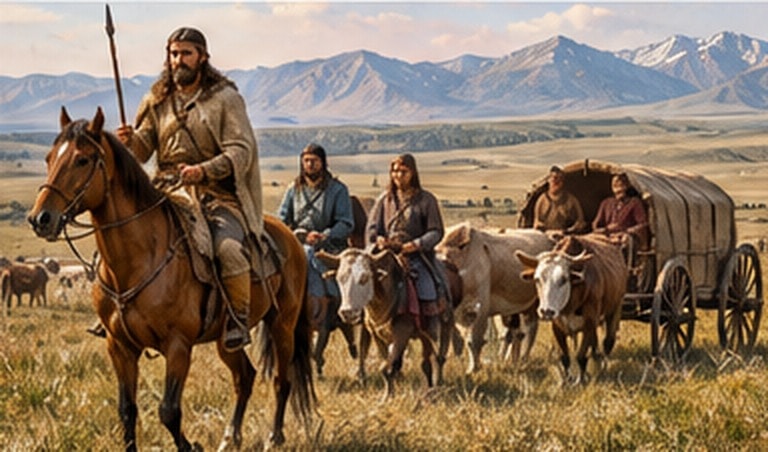
Figure 8. An artist’s impression of Andronovo herders on the move with cattle, horses and an ox-drawn wagon.
For a long time, scholars believed these herders grew no crops. Then Robert Spengler, Michael Frachetti and colleagues find carbonised grains at herders’ camps in the mountains of south-eastern Kazakhstan [9]. By the middle of the second millennium BCE, the people there grow millet, wheat, barley and legumes alongside their herds [9]. Millet came from East Asia; wheat and barley came from south-west Asia. These mountain herders carry crops between the two. Frachetti and colleagues later show that the routes herders used between pastures in Asia’s mountains match the locations of many later Silk Road sites [13].
Eastern Kazakhstan, 1600 BCE. At Semiyarka, a settlement that may cover about 140 hectares, furnaces are burning. Its people make bronze with up to 12 percent tin, probably from ores in the nearby Altai Mountains [8]. Miljana Radivojević and colleagues call it the first large steppe centre known to have produced tin bronze on site [8].
Horses are part of all this. Ancient horse genomes show that the lineage of modern domestic horses spread across Eurasia from about 2000 BCE, together with the chariots of the Sintashta, the Andronovo’s ancestors [14]. Further east, Choongwon Jeong and colleagues find that herders of this period in Mongolia lived on dairy products [10].
Some of their words may still be spoken. The linguist Rasmus Bjørn argues that words for “horse”, “honey”, “metal”, “seven”, “name” and “sister-in-law” passed from Indo-European languages spoken in the Afanasievo and Andronovo cultures into Uralic, Turkic and, in some cases, Old Chinese [15]. If he is right, the Andronovo left traces in languages across Asia.
And they keep moving.
To the edges of the world
The Andronovo world has no single centre, and its people move outward in every direction.
The Altai and western Mongolia. Jeong’s team finds Sintashta-related ancestry in seven Bronze Age herders here, mixed with the ancestry of local northern peoples. The mixing happened about ten generations, or roughly 290 years, before these people lived [10]. Further east, in eastern Mongolia, this ancestry never arrives [10]. The Andronovo world has a limit.
Figure 9. An artist’s impression of herders with horses and cattle in a mountain valley. Andronovo-related groups reached the Altai and the Tianshan.
Xinjiang. In a study of 201 ancient genomes from the region, Vikas Kumar and colleagues find that Middle and Late Bronze Age steppe groups kept mixing with other peoples there into the Iron Age [16]. In the western Tarim Basin, Bronze Age people draw most of their ancestry from early Andronovo-related herders, who had also mixed with people of the Central Asian oasis towns [12]. The famous Tarim mummies further east have a separate history. Their genomes show a local population with no Andronovo ancestry [17].
The road south. Some Andronovo-related people travel past the oasis towns of present-day Turkmenistan and Uzbekistan. Narasimhan’s team finds steppe ancestry in Central Asia by about 2100 BCE [4].
The Swat Valley, northern Pakistan, between 1900 and 1500 BCE. Here steppe ancestry mixes into the local population [4]. Only 2 of 44 men carry the steppe-linked father line R1a-Z93, yet about 20 percent of the people’s overall ancestry comes from the steppe [4]. In Swat, it came in mainly through women. In South Asians today, though, the Y chromosome carries more steppe ancestry than the rest of the genome, which points to a larger share through men over the long run [4]. People moved and married over many generations, and in more than one way.
The largest study of Indian genomes so far, by Elise Kerdoncuff and colleagues, analyses 2,762 genomes from 18 Indian states. It models most Indians as a mix of three streams: the ancient hunter-gatherers of South Asia, an Iranian-related stream of farmers and herders, and Central_Steppe_MLBA, the Andronovo-era stream [18].
Did the Andronovo people speak early Indo-Iranian languages, the branch that includes Sanskrit and Avestan? Elena Kuzmina, who spent her career studying Andronovo sites, argued that they did [2]. Bjørn’s loanwords point the same way [15]. Paul Heggarty and colleagues argue for a different origin of the wider Indo-European family [19]. DNA tells us about ancestry, not language, so this remains a hypothesis.
On the steppe itself, after about 1200 BCE, the Andronovo world gives way to the cultures of the Iron Age. Peter de Barros Damgaard and colleagues find that the Scythians, who dominated the steppe in the first millennium BCE, formed partly from Late Bronze Age herders, along with European farmers and Siberian hunter-gatherers [20].
Where their ancestry lives today
In Central Asia, the main ancestry of present-day Tajiks traces back to a mixture of Andronovo-related herders and the people of the Bronze Age oasis towns, according to a study by Dai and colleagues [21]. Highland Tajiks also carry some ancestry related to the Tarim mummies [21].
In South Asia, the steppe stream built from Andronovo-era people makes up as much as 30 percent of the ancestry of some groups, and it is generally higher in the north-west of the subcontinent [4]. Average levels differ between some Indian groups today. Every group also carries large shares of the two older streams, and the differences are between group averages. They say nothing about anyone’s worth or claim to India.
In north-western China, a study of more than 15,000 Y chromosomes by Mengge Wang and colleagues found that western Eurasian father lines first spread by Yamnaya-related steppe herders are still present, mainly in the north-west of the country [22].
Europeans do not descend from the Andronovo, but the two share ancestors. The steppe ancestry that peaks today in Ireland, Iceland, Norway and Sweden comes from the same Yamnaya and Corded Ware roots that the Sintashta and Andronovo carried east [23].
What about haplogroups?
R1a is one of the most widespread father lines in the world. Peter Underhill and colleagues showed that it splits into two main groups, one found mainly in Europe and one found mainly in Central and South Asia [24]. The Andronovo-related men belonged largely to the Asian group, the branch called R1a-Z93 [4]. A man in India, Pakistan, Tajikistan or Kyrgyzstan with R1a-Z93 may share a distant father line with the herders of the Andronovo world. A European man with R1a usually belongs to the European group, and shares a much older ancestor with them, from before the two branches split.
Back to the riverbank
Return to the Tobol River, around 1700 BCE, and to the two families lining their graves with pine. One burns its dead and one does not. They make their pots differently. They are neighbours all the same.
Figure 10. An illustration of a grave lined with timber logs, like the graves at Lisakovsk. Tree rings in logs like these gave the cemeteries their dates.Figure 11. An illustration of a cremation burial. Fedorovo-related families often burned their dead before burial.
They cannot know that their descendants will scatter across a quarter of Asia. Some will herd in the Altai. Some will grow millet in the mountains of Kazakhstan. Some will smelt tin bronze in the east of the steppe. Some will walk south through the oasis towns of Central Asia into the valleys of the north-west of the subcontinent.
Everywhere they go, they will marry into the families already living there. By the time any of their ancestry reached the plains of India, it was one thread among several, mixed many times over.
References
[1]
Panyushkina, I. P., Mills, B. J., Usmanova, E. R., Cheng, L. 2008. “Calendar age of Lisakovsky timbers attributed to Andronovo community of Bronze Age in Eurasia.” Radiocarbon 50(3).
[2]
Kuzmina, E. E. 2007. The Origin of the Indo-Iranians, ed. J. P. Mallory. Leiden: Brill.
[3]
Koryakova, L., Epimakhov, A. V. 2007. The Urals and Western Siberia in the Bronze and Iron Ages. Cambridge University Press.