The Sintashta: Who they were, how they lived, and how their ancestry reached India
Explore the Sintashta, a mixed community in the southern Urals who built the first chariots and spread steppe ancestry east, impacting modern Indian genetics.
How a mixed community in the southern Urals built the first known chariots and carried steppe ancestry east and south
A grave with wheels
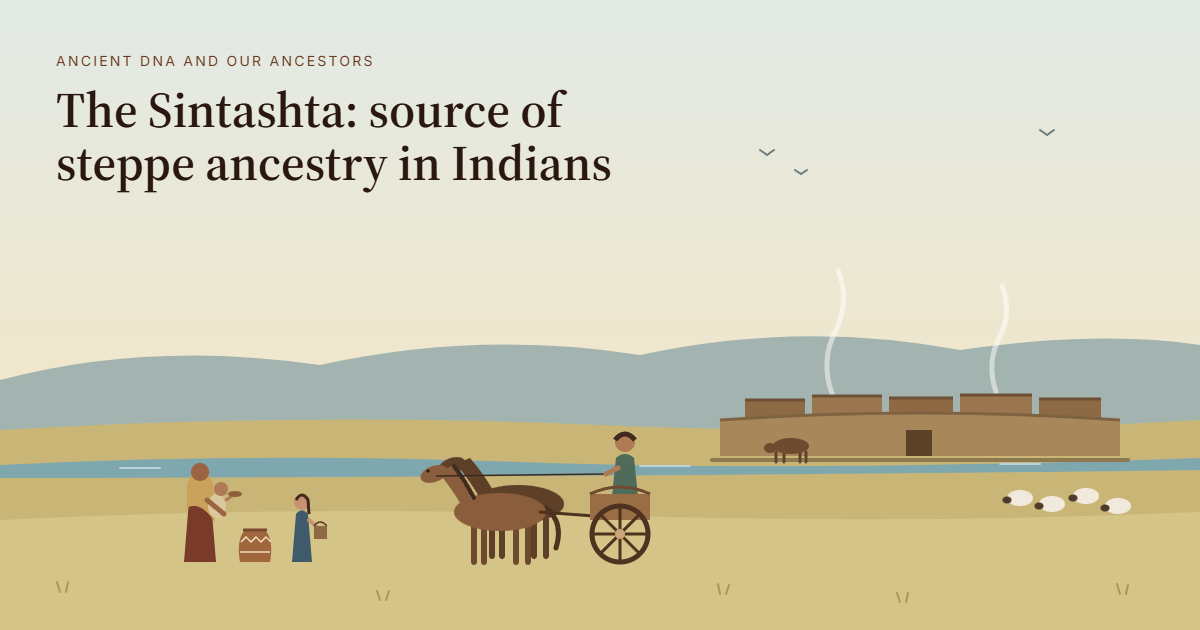
East of the southern Ural Mountains, around 1900 BCE. A community gathers beside a burial mound. The land is dry grassland cut by small rivers. A few hours’ walk away, the smoke of copper furnaces rises above a town with earth walls.
In the floor of a new grave, they dig two narrow parallel pits, each shaped to hold the lower part of a wheel. Into the grave go the skulls of horses and the pieces of a bridle, including cheekpieces of bone that once held a bit in a horse’s mouth. Four people, of different ages and sexes, are laid to rest here [1].
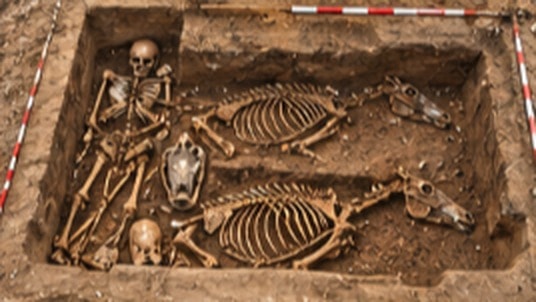
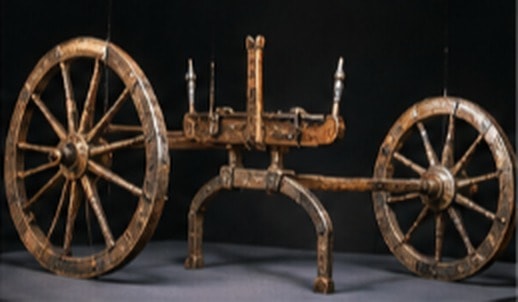
The wheels that fitted those pits may not stay. Stephan Lindner, who studied this grave, thinks the vehicle may have been taken out again as part of the funeral [1]. In other graves of the same people the wheels are left in place, and their spokes leave marks in the soil [1]. Together these graves record a new machine: a light cart on two spoked wheels, pulled by a pair of horses. Archaeologists call it a chariot.
Four thousand years later, this cemetery is known as Kamennyi Ambar 5, in the Chelyabinsk region of Russia. A radiocarbon date from the grave, set in a statistical model with other dates from the site, places the burial between about 1950 and 1880 BCE [1]. Geneticists have read the DNA of 50 people buried in this cemetery [2]. Skeletal biologists have studied about 100 of their skeletons [3]. Few places on earth let us follow one ancient community from its graves to its genes to its bodies.
Who were these people with horses, wheels and walled towns?
A name from a small river
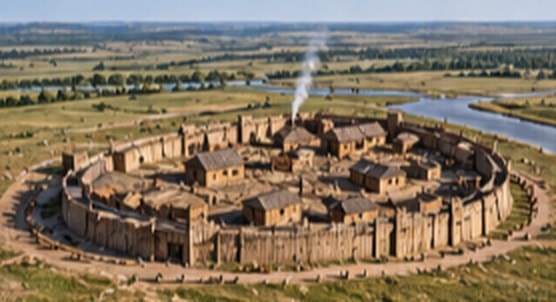
Archaeologists call them the Sintashta, after a small river in the southern Urals and the site on its bank where graves and a fortified settlement of this kind were first excavated. Like most names for prehistoric peoples, it is a label for customs found in the ground: the way they built towns, made pots, worked metal and buried their dead. What they called themselves, nobody knows.
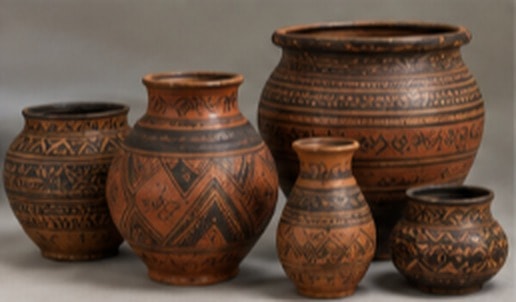
Figure 3. Pots with bands of geometric decoration, in the style of Sintashta pottery. Pottery is one of the customs archaeologists use to recognise the culture.
Their towns and cemeteries lie along the rivers of the southern Urals, in Russia and the north of present-day Kazakhstan. Radiocarbon dates place the Sintashta phase between about 2100 and 1700 BCE [4], and Lindner’s model for the region east of the Urals gives about 2040 to 1730 BCE [1]. Archaeologists know of more than twenty fortified Sintashta settlements in this small area, which Russian scholars sometimes call the “Country of Towns” [5].
For Indian readers, there is a special reason to know them. When a DNA report shows “steppe” ancestry in an Indian person, the reference group behind that word is built largely from people like those buried at Kamennyi Ambar [2].
To see how these people came to be here, we have to go back a thousand years, and far to the west.
A long road out and back
The grasslands north of the Black Sea and the Caspian, 3300 BCE. Herding people begin to spread out. Archaeologists call them the Yamnaya. They bury their dead in pits under mounds, keep cattle and sheep, and travel with heavy ox-drawn wagons. They are themselves a recent mixture: about four-fifths of their ancestry comes from herders of the Caucasus and the lower Volga, and the rest from the hunter-gatherers of the Dnipro and Don rivers [6].
Some of their descendants move west, into the forests and farmland of central and eastern Europe. There they marry into the families of Europe’s farmers, who have lived there for thousands of years. The people who come out of this mixture decorate their pots with cord marks, and archaeologists call them the Corded Ware people. In Germany, about three-quarters of Corded Ware ancestry comes from Yamnaya-like people and the rest from European farmers [7].
Then the story turns back east.
In 2015, Morten Allentoft and colleagues sequence the first Sintashta genomes. They expect them to look like the Yamnaya, who had lived on the same steppe a thousand years earlier. Instead, the Sintashta look most like the Corded Ware people of Europe [8]. People with this mixed European ancestry had moved east again, through the forest-steppe of the Volga, to the Urals.
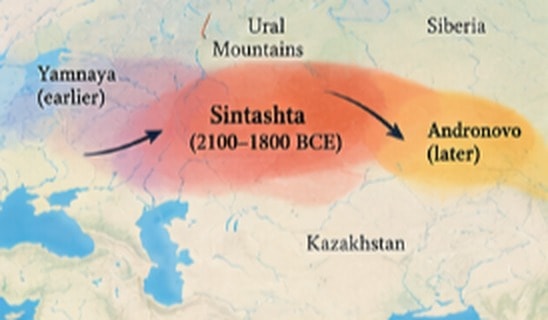
Vagheesh Narasimhan and colleagues put numbers on it. They model the Sintashta and related groups as about two-thirds Yamnaya-like and one-third European farmer-related [2]. About four in five of the people at Kamennyi Ambar fit this profile [2]. The rest do not. Three groups of outliers carry extra ancestry from three different directions: more from the central steppe of Kazakhstan, more of the old Yamnaya kind, or more from the hunter-gatherers of eastern Europe [2]. Narasimhan’s team calls Kamennyi Ambar 5 “a cosmopolitan site”. Families of different origins lived, married and were buried together.
Who were the newcomers from the west? Archaeologists think the forest-steppe people of the Abashevo culture, on the middle Volga and in the western Urals, were among the groups from which the Sintashta formed [9].
Two young men die violently, hundreds of kilometres apart. One, a bronze caster, is buried at Pepkino on the middle Volga, in an Abashevo grave. The other is buried at Maloyuldashevo in the southern Urals, in a Sintashta-related context. In 2024, Maria Mednikova and colleagues compare their DNA. Both men carry the same branch of the R1b Y chromosome, and the authors suggest they shared a paternal ancestor [10]. The sample is tiny. Still, it puts two real people on the road between the Volga and the Urals.
How do we know two groups are related? Every person’s genome holds millions of positions where people differ. Geneticists compare these positions between ancient individuals and reference groups. People who share more of the same variants share more recent ancestors. A model then asks which mix of reference groups best explains a person’s genome.
Inside the community, the fathers and the mothers tell two different stories.
Fathers and mothers
The Y chromosome passes from father to son, almost unchanged. Mitochondrial DNA passes from a mother to all her children. Together they let us follow the father lines and mother lines of a community.
The fathers first. At Kamennyi Ambar 5, the most common father line is R1a. In the data published by Narasimhan’s team, about 18 of the 30 men whose Y chromosome could be read carry R1a, and many of these belong to branches of R1a-Z93 such as Z2124. Five men carry R1b, two carry Q1a and one carries I2a [2]. The father lines are mixed, though R1a is the clear majority. A thousand years earlier, Yamnaya men had overwhelmingly carried R1b [6].
The mothers come from many more directions. The first four Sintashta genomes, published in 2015, carry the mother lines J1c1b1a, J2b1a2a, U2e1e and U2e1h [8]. Across the larger Kamennyi Ambar sample, most mother lines belong to branches of U, with W, J, T, H and K also present [2]. U lines are old in Europe and western Asia; J, T and H lines spread widely with farmers. The women of the Sintashta world came from many different family lines.
How did these mixed families live? The answer lies behind the walls.
Walls, copper and milk
The southern Urals, around 1900 BCE. A ditch and an earth wall ring the settlement. Inside, houses stand side by side in a ring or a block [5, 9]. The people of Kamennyi Ambar live in towns.
Arkaim is the best known of them. In 1987, archaeologists surveying a valley due to be flooded for a reservoir find its walls, about 160 metres across. The flooding plan is later dropped, and the site is now protected.
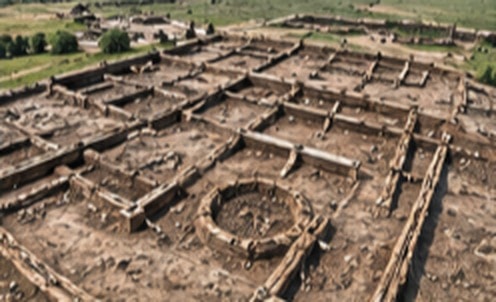
Inside the houses, excavators find furnaces, slag and moulds [5, 9]. The Sintashta smelt copper and make arsenical bronze on a scale not seen before in the region. Metalwork is household work, done in the same buildings where families eat and sleep.
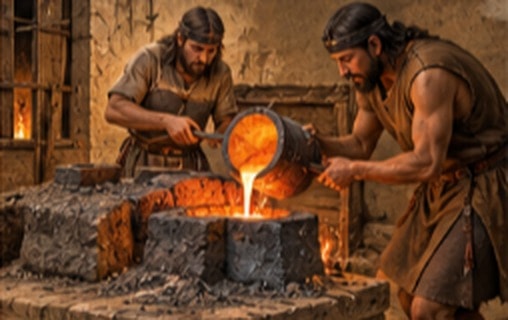
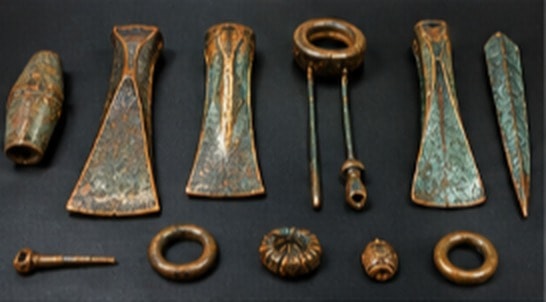
Why build walls? David Anthony has argued that the steppe became drier around this time, good river pastures became scarcer, and groups competed for them. Meanwhile, the growing towns of Central Asia wanted metal [11]. Walls protected herds and copper, and metal could be traded for alliances and prestige. Andrey Epimakhov, who has excavated in the region for decades, is more cautious [12]. He warns that we cannot simply read rank and power from the size of graves and walls. Some graves are richer than others, and some hold chariots and weapons, but whether this marks rulers, warriors or families honouring their dead in their own way is a matter of interpretation.
What do they eat? Chemical signatures in their bones show a diet of meat and milk from their herds, with wild plants, wild animals and some fish [13]. No trace of grown cereals has yet been found at Kamennyi Ambar [13]. These are herders who have settled behind walls.
The skeletons tell a hard story about childhood. Margaret Judd and colleagues find that three in four of the people buried at Kamennyi Ambar 5 were under 18 [3]. Few signs of hunger or disease marked their bones; most children probably died quickly from infections that leave no trace. Alicia Ventresca Miller and colleagues measure the bones of 41 children and 27 adults. Mothers began giving other food at about six months but kept nursing for years, until about age four [14]. Animal milk was probably the main extra food for small children.
Disease moves through the herds too. A team of geneticists finds the plague bacterium in the tooth of a sheep from Arkaim, dated between 1935 and 1772 BCE [15]. It belongs to a Bronze Age strain known from human remains across Eurasia, which suggests that livestock helped carry the disease between animals and people.
How were families organised? The Sintashta data have not yet answered this, but a cemetery a few generations later in the same region gives a glimpse. At Nepluyevsky, in the Srubnaya-Alakul tradition that followed Sintashta, Jens Blöcher and colleagues read 32 genomes and rebuild a family tree with six brothers at its centre [16]. Sons stayed; daughters married out; wives came in from other communities.
And then there are the horses.
Horses and chariots
The horse skulls in the Kamennyi Ambar grave belong to one of the biggest stories in this field. In 2021, Pablo Librado, Ludovic Orlando and a large team publish 273 ancient horse genomes [17]. Modern domestic horses, they find, descend from one population of the lower Volga and Don. From about 2000 BCE this lineage spreads fast across Eurasia and replaces almost every other horse population, at the same time as Sintashta chariots appear [17]. The authors write that in Asia, Indo-Iranian languages, chariots and horses spread together after the Sintashta.
A second study, with 475 horse genomes, finds that people began controlling horse breeding closely around 2200 BCE, mating related animals and breeding them younger [18]. That puts the rise of the modern horse in the Sintashta era.
The chariots are dated by their graves. Pavel Kuznetsov places steppe chariot burials in the 20th to 18th centuries BCE [19]. In the Near East, the earliest pictures of light horse-drawn vehicles appear on seals from Kültepe in Anatolia around 1900 BCE. Lindner concludes that the steppe chariots are no later than the first Near Eastern ones [1]. The steppe was one of the earliest places where chariots were used. Whether it was the first is still open.
One Sintashta-era horse from the southern Urals, about 3,900 years old, was badly infected with equine herpesvirus 4, a virus that still causes respiratory disease in horses today [20]. Herders then, as now, had to care for sick animals.
What were the chariots for? Igor Chechushkov and Andrey Epimakhov find that more than half of steppe chariot burials contain weapons, mostly arrowheads and other projectile points [21]. They argue that chariots carried passengers, were probably used in fighting, and gave prestige to the groups who owned them. Yet Judd’s team finds no injury on the Kamennyi Ambar skeletons that can clearly be put down to a weapon [3]. The chariot may have been a weapon, a racing vehicle or a mark of rank. The evidence has not yet settled it.
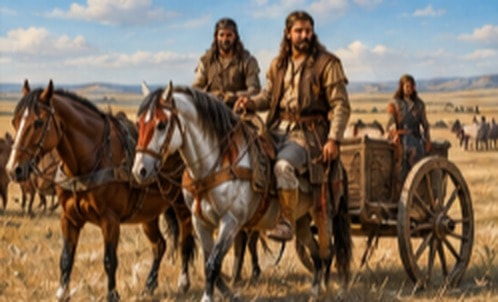
From the Urals, the horses, the wheels and the people keep moving.
The road east and south
After 1800 BCE. The customs and the ancestry of the Sintashta world spread far beyond the Urals. The Andronovo cultures that follow cover Kazakhstan and southern Siberia, and their people carry ancestry very like that of the Sintashta, with a little more from the older peoples of the central steppe [2].
Some go east into the Altai and western Mongolia. Choongwon Jeong and colleagues find Sintashta-related ancestry in Bronze Age herders there, mixed with local ancestry [22]. Others reach the western Tarim Basin in Xinjiang, where Bronze Age people draw most of their ancestry from early Andronovo-related herders [23].
Others go south, past the oasis towns of Central Asia. By 2100 BCE, a few people with steppe ancestry are already living in those towns [2]. In the Swat Valley of northern Pakistan, burials from about 1200 BCE onward show steppe ancestry mixed with the older ancestry of the region. Narasimhan’s team dates this mixing to between about 1900 and 1500 BCE [2].
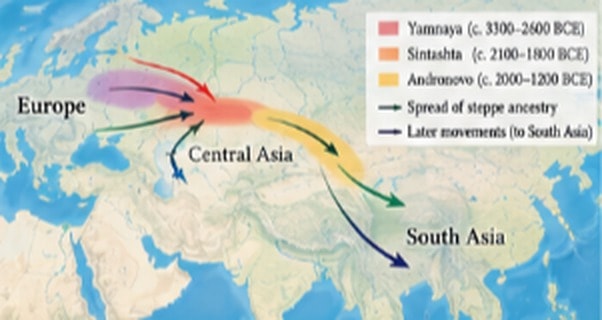
Here the fathers and mothers tell a surprising story. In the Swat Valley, only 2 of 44 men, about 5 percent, carry R1a-Z93, while about 20 percent of their overall ancestry comes from the steppe [2]. Steppe ancestry had come in mainly through women. In South Asians today the pattern is the reverse: the Y chromosome carries more steppe ancestry than the rest of the genome, which points to a larger share through men over the long run [2]. People moved and married over many generations, and in more than one way.
The largest study of Indian genomes so far, by Elise Kerdoncuff and colleagues, analyses 2,762 genomes from 18 Indian states. It models most Indians as a mix of three streams of ancestry: the ancient hunter-gatherers of South Asia, an Iranian-related stream of farmers and herders, and a steppe stream built from Sintashta and Andronovo-era people [24].
Did the Sintashta speak an early form of the Indo-Iranian languages, the branch that includes Sanskrit and Avestan? Many scholars think so. Elena Kuzmina and David Anthony point to Sintashta graves with sacrificed horses, and to the honoured place of the horse and chariot in the Rig Veda and the Avesta [9, 25]. Paul Heggarty and colleagues argue for a different origin of the wider Indo-European family [26]. Genes and graves cannot tell us what language anyone spoke, so this remains a strong hypothesis.
Arkaim has also attracted claims of a different kind. In Russia it has been called the “city of the Aryans”, an ancient observatory and the birthplace of Zoroaster. These ideas come from religious and nationalist movements. The archaeologists who study the site do not support them.
Where their ancestry lives today
In South Asia, Sintashta-related ancestry makes up as much as 30 percent of the ancestry of some groups, and it is generally higher in the north-west of the subcontinent [2]. Average levels differ between some Indian groups today. Every group also carries large shares of the two older streams, and the differences are between group averages. They say nothing about anyone’s worth or claim to India.
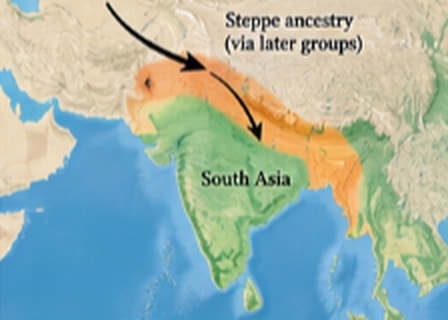
In Central Asia, the main ancestry of present-day Tajiks traces back to a mixture of Andronovo-related herders and the people of the Bronze Age oasis towns [27]. Europeans do not descend from the Sintashta, but they are close cousins. The Corded Ware ancestry that the Sintashta carried east is also part of the steppe ancestry that peaks today in Ireland, Iceland, Norway and Sweden [28].
What about haplogroups?
R1a is one of the most common father lines in the world today. A large study by Peter Underhill and colleagues found that it splits into two main groups. One, R1a-Z282, is found mainly in Europe. The other, R1a-Z93, is found mainly in Central and South Asia [29]. The Z93 branches carried by many Sintashta men at Kamennyi Ambar belong to the Asian group [2]. A man in India, Pakistan or Central Asia with R1a-Z93 may share a distant father line with the men of the Sintashta world. A Polish or Russian man with R1a-Z282 shares a much older ancestor with them, from before the two branches split.
Back to the wheel pits
Return to the grave at Kamennyi Ambar, around 1900 BCE, with its two wheel pits and its horse skulls. The four people buried there belong to a community of mixed origins. Most of their ancestry came from Yamnaya-like herders by way of Europe, and their neighbours in the same cemetery have roots on the central steppe and in the forests of eastern Europe. Most of their children die young. They live on milk and meat, smelt copper in their houses, and drive a new kind of horse in a new kind of vehicle.
Their descendants will move east into Kazakhstan, the Altai and Xinjiang, and south through Central Asia into the valleys of the north-west of the subcontinent.— the time any of their ancestry reached the plains of India, it was a small part of a much larger population, whose roots went back to the first hunter-gatherers of South Asia and the farmers and herders of the Indus world. That is the “steppe” line in an Indian DNA report: one thread among several, mixed many times over.
A note on method
The author writes for GenoConnect, which sells DNA tests and ancestry reports. Ancestry percentages in any such report, including GenoConnect’s, are estimates from statistical models. They depend on the reference groups used, and they change as more ancient genomes are sequenced. Statements in this article about language, warfare and social rank are interpretations by the scholars named. The opening scene follows Lindner’s description of the Kamennyi Ambar 5 chariot grave; the smoke of the furnaces and the walk to the town are the author’s reconstruction from the settlement evidence.
References
- [1]
- [2]
- [3]
- [4]Hanks, B. K., Epimakhov, A. V., Renfrew, A. C. 2007. “Towards a refined chronology for the Bronze Age of the southern Urals, Russia.” Antiquity 81: 353–367.
- [5]Koryakova, L., Epimakhov, A. V. 2007. The Urals and Western Siberia in the Bronze and Iron Ages. Cambridge University Press.
- [6]
- [7]
- [8]
- [9]Anthony, D. W. 2007. The Horse, the Wheel, and Language: How Bronze-Age Riders from the Eurasian Steppes Shaped the Modern World. Princeton University Press.
- [10]
- [11]Anthony, D. W. 2009. “The Sintashta genesis: the roles of climate change, warfare, and long-distance trade.” In B. K. Hanks and K. M. Linduff (eds), Social Complexity in Prehistoric Eurasia: Monuments, Metals, and Mobility, pp. 47–73. Cambridge University Press.
- [12]Epimakhov, A. V. 2009. “Settlements and cemeteries of the Bronze Age of the Urals: the potential for reconstructing early social dynamics.” In B. K. Hanks and K. M. Linduff (eds), Social Complexity in Prehistoric Eurasia, pp. 74–90. Cambridge University Press.
- [13]
- [14]
- [15]
- [16]
- [17]
- [18]
- [19]
- [20]
- [21]
- [22]
- [23]
- [24]
- [25]Kuzmina, E. E. 2007. The Origin of the Indo-Iranians, ed. J. P. Mallory. Leiden: Brill.
- [26]
- [27]
- [28]
- [29]