

Christian Orthodox Community
Discover your Orthodox Christian ancestry. Explore the history, geography, culture, and genetics of the Eastern Orthodox world, from Greece and the Balkans to Russia, Georgia, and the Middle East.
CHRISTIAN ORTHODOX
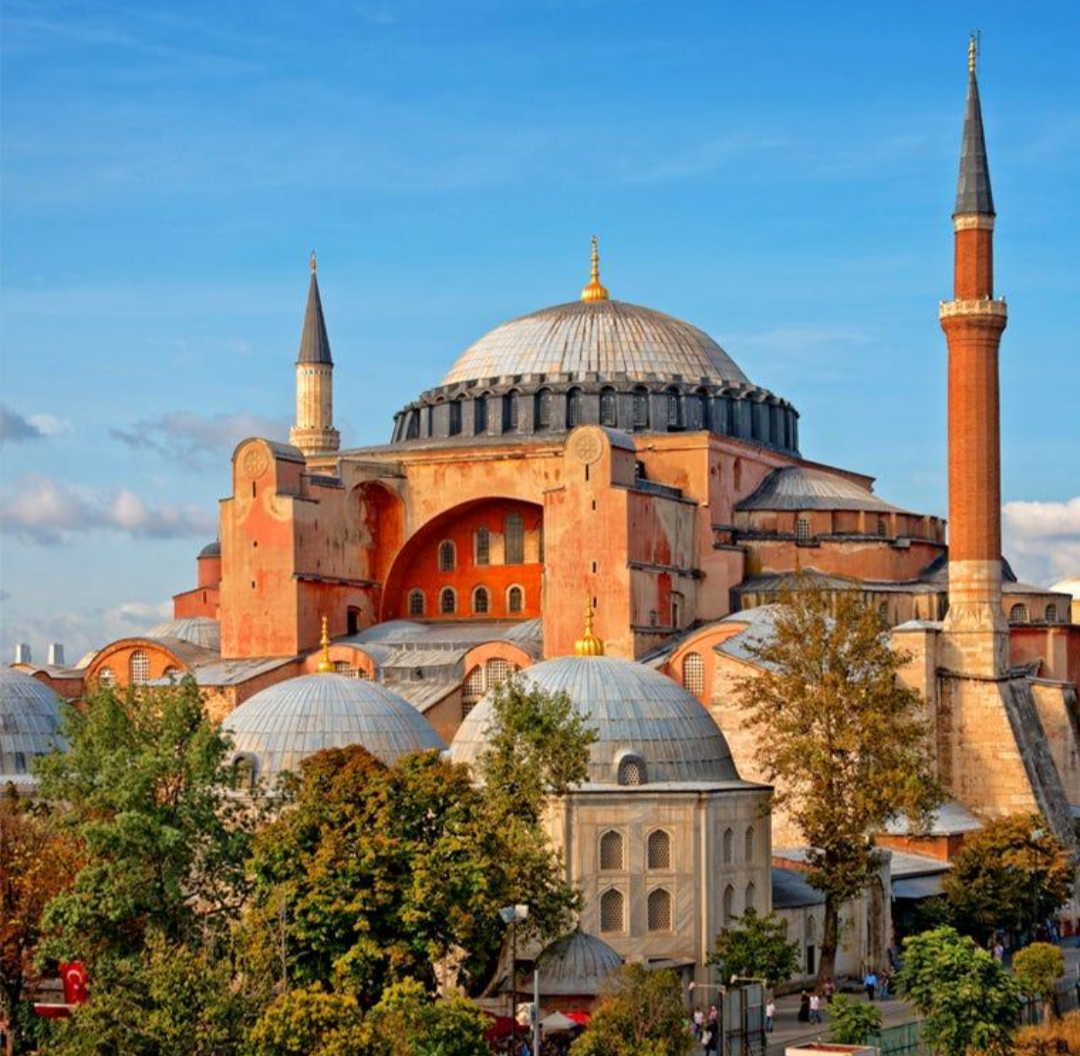
Geography, People, History, Culture, and Genetics of the Orthodox Christian World: from the Balkans and Greece to Russia, the Caucasus, and the Levant
1. Introduction: Who Are the Orthodox Christians?
“Orthodox Christian” is not one ethnic group like a caste, tribe, or clan. It is closer to a regional community: the peoples of a broad, contiguous region stretching from the Adriatic Sea and the Greek islands, across the Balkans and the plains of Eastern Europe, to the forests of Russia, the mountains of the Caucasus, and the ancient Christian towns of Syria, Lebanon, and Palestine. What binds these peoples together is a shared inheritance from the Eastern Roman (Byzantine) Empire: the Eastern Orthodox Church, its liturgy, its calendar, its icons, its alphabets, and a long common history shaped by Constantinople, the Ottoman Empire, and the Russian state.
Today there are roughly 220 to 260 million Eastern Orthodox Christians worldwide, making Orthodoxy the second-largest Christian communion after Roman Catholicism. The majority live in a handful of countries where Orthodoxy is the historic majority faith: Russia, Ukraine, Romania, Greece, Serbia, Bulgaria, Belarus, Georgia, Moldova, North Macedonia, Montenegro, and Cyprus. Significant Orthodox minorities live in Albania, Bosnia and Herzegovina, Kazakhstan, Estonia, Latvia, Syria, Lebanon, Jordan, Israel-Palestine, Egypt, and Turkey, and a large diaspora is spread across North America, Western Europe, and Australia.
This profile treats “Orthodox Christian” as a geography-of-origin community in the genealogical sense: the shared populations of a defined cultural region, encompassing many nations, languages, and ethnic groups (Greek, Slavic, Romance, Kartvelian, Arab, and others) whose ancestors have lived, farmed, traded, and migrated across the former Byzantine world and its northern and eastern extensions for more than a thousand years. A note on scope: the closely related but historically separate Oriental Orthodox churches (Armenian, Coptic, Ethiopian, Eritrean, Syriac, and the Malankara Orthodox of Kerala, India) are discussed briefly in Section 7 and in the FAQs, but the main focus here is the Eastern Orthodox world.
Discover Your Orthodox Roots!
The Orthodox world brings together Greek, Slavic, Romanian, Georgian, and Levantine peoples. Unravel your unique ancestral threads and see how your family connects to this Byzantine-rooted heritage with a GenoConnect DNA kit.
2. Geography
The Orthodox Christian world covers a vast, largely contiguous belt of Eurasia, from about 35°N in Cyprus and Crete to beyond the Arctic Circle in northern Russia, and from the Adriatic coast in the west to the Pacific shores of the Russian Far East. Its historical core, however, lies around three bodies of water: the Aegean Sea, the Black Sea, and the eastern Mediterranean, the maritime heartland of the Byzantine Empire, with Constantinople (modern Istanbul) standing at the strategic hinge between Europe and Asia on the Bosphorus.
The terrain is enormously varied. In the south lie the rugged, sun-dried peninsulas and islands of Greece and Cyprus, with an olive-and-vine Mediterranean economy. North of them rise the Balkan, Dinaric, Pindus, and Rhodope mountain systems, whose high valleys historically sheltered pastoral and village communities. Beyond the Danube open the fertile plains of Wallachia, Moldavia, and the Pontic-Caspian steppe, one of the great grain-growing regions of the world, and further north the mixed and boreal forests of Ukraine, Belarus, and Russia, crossed by the Dnieper, Volga, and Don rivers that carried early Slavic trade. In the east, the Greater and Lesser Caucasus ranges enclose Georgia, one of the oldest Christian kingdoms, while in the Levant, Orthodox Arab Christians live among the coastal ranges and cities of Syria, Lebanon, Palestine, and Jordan.
Cultural-Geographic Sub-Regions
Within this vast area, Orthodox peoples fall into several broad cultural-geographic blocs, each with its own language family, church tradition, cuisine, and historical character:
| Region | Approximate Location | Main Peoples / Churches | Character |
|---|---|---|---|
| Greek / Aegean | Greece, Cyprus, Aegean islands, historic Asia Minor coast | Greeks, Cypriots; Church of Greece, Ecumenical Patriarchate, Church of Cyprus | Direct heir of Byzantine Greek culture; Mediterranean maritime world |
| South Slavic / Balkan | Serbia, Montenegro, North Macedonia, Bulgaria, parts of Bosnia | Serbs, Bulgarians, Macedonians, Montenegrins | Mountain and village culture; long Ottoman period; strong national churches |
| Romanian / Danubian | Romania, Moldova | Romanians, Moldovans, Aromanians | Latin-speaking Orthodox people; Carpathian and Danubian plains |
| East Slavic | Russia, Ukraine, Belarus | Russians, Ukrainians, Belarusians | Heirs of Kyivan Rus'; largest Orthodox population in the world |
| Caucasian | Georgia (and Orthodox Ossetians) | Georgians, Ossetians, Abkhaz (partly) | Among the earliest Christian states (4th century); unique script |
| Levantine / Antiochian | Syria, Lebanon, Jordan, Palestine, Israel, southern Turkey | Arab Orthodox (Rum) Christians | Arabic-speaking; Patriarchates of Antioch and Jerusalem; Christianity's first homeland |
| Northern & Baltic fringe | Finland, Estonia, Latvia, northern Russia | Karelians, Setos, Finnish Orthodox, Russian-speaking minorities | Small, distinctive Orthodox communities on the Nordic-Baltic edge |
Are Your Roots Greek, Slavic, Romanian, or Levantine?
The Orthodox world spans the Aegean, the Balkans, the Russian plain, the Caucasus, and the Levant. Explore the Orthodox Christian Genome Project to see which of these historic regions your family’s heritage aligns with.
3. Origins and Early History
3.1 Apostolic Beginnings in the Eastern Mediterranean
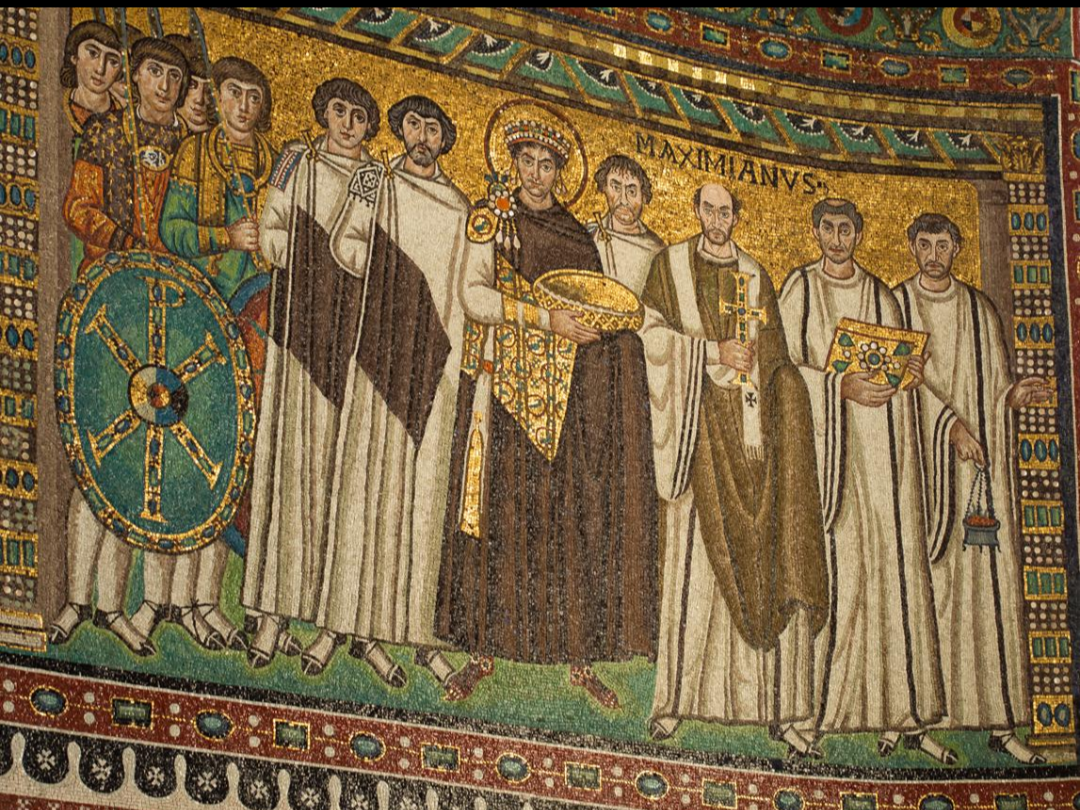
Orthodox Christians trace their church directly to the apostolic communities of the first century CE. Christianity began among Jewish followers of Jesus in Roman Judea and spread rapidly through the Greek-speaking cities of the eastern Mediterranean: Antioch (where, according to the Book of Acts, the disciples were first called “Christians”), Alexandria, Ephesus, Corinth, Thessaloniki, and Rome. Orthodox tradition credits specific apostles with founding local churches: St Paul in Greece and Asia Minor, St Mark in Alexandria, St Andrew along the Black Sea coast and (in later legend) as far as the future lands of Rus', and St Peter in Antioch before Rome. Greek, the common language of the eastern Roman world, became the language of the New Testament and of early Christian theology.
3.2 Constantine, Constantinople, and the Byzantine Empire
The decisive turning point came in the 4th century. Emperor Constantine the Great legalised Christianity in 313 CE, convened the First Ecumenical Council at Nicaea in 325, and in 330 founded a new imperial capital, Constantinople, on the site of the Greek town of Byzantium. For the next eleven centuries the Eastern Roman Empire, known to later historians as the Byzantine Empire, remained the political and cultural centre of Eastern Christianity. The seven Ecumenical Councils held between 325 and 787 defined the core doctrines that Orthodox Christians still profess, including the Nicene Creed, the doctrine of the Trinity, and the veneration of icons. Emperor Justinian’s great church of Hagia Sophia (537 CE) became the supreme architectural symbol of the Orthodox faith.
The Christian world was organised into five major patriarchates, the so-called Pentarchy: Rome, Constantinople, Alexandria, Antioch, and Jerusalem. The Council of Chalcedon (451) produced the first great split, when the churches that would become the Oriental Orthodox (Coptic, Armenian, Syriac, Ethiopian) rejected its definition of Christ’s nature.
3.3 The Conversion of the Slavs, Bulgarians, and Rus'
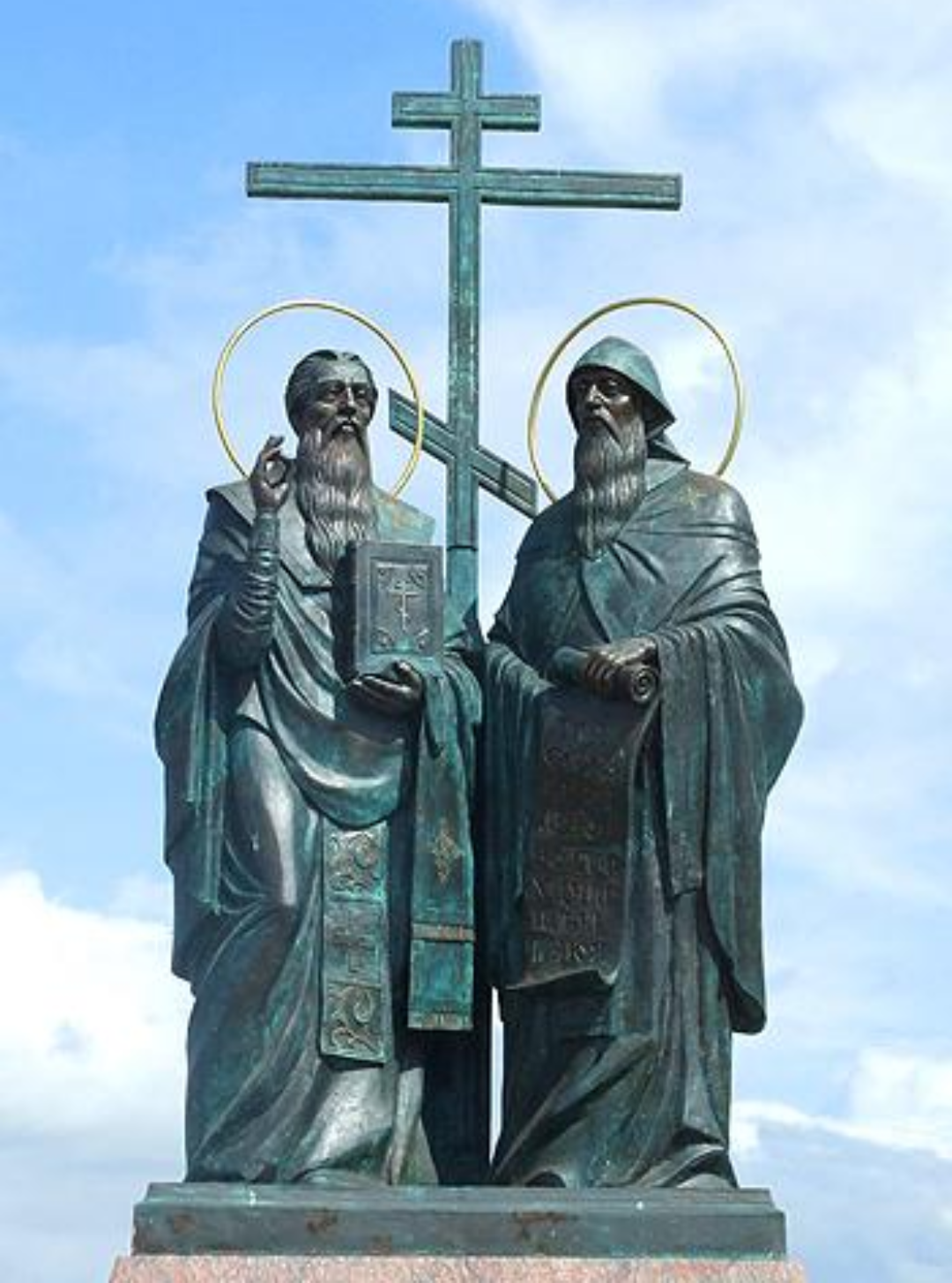
From the 9th century, Byzantine missionary activity carried Orthodoxy north into the Slavic world. The brothers Saints Cyril and Methodius, Greeks from Thessaloniki, created the Glagolitic alphabet and translated the liturgy into Old Church Slavonic around 863 for their mission to Great Moravia; their disciples, working in the First Bulgarian Empire, developed the Cyrillic alphabet, which is still used today by Russians, Ukrainians, Belarusians, Serbs, Bulgarians, and Macedonians. Bulgaria formally adopted Christianity under Khan Boris I in 864, and Serbia followed in the same period, gaining an independent (autocephalous) church under St Sava in 1219. The most consequential conversion came in 988, when Grand Prince Volodymyr (Vladimir) of Kyiv was baptised and ordered the baptism of his people in the Dnieper, bringing the vast lands of Kyivan Rus' into the Byzantine religious orbit.
Your Ancestors, from Byzantium to Kyivan Rus'?
From the apostolic churches of Antioch and Thessaloniki to the baptism of Rus' in 988, the Orthodox story spans two millennia. Trace your ancient migrations and discover how your lineage connects to this history with GenoConnect.
3.4 The Great Schism of 1054
Over centuries, the Latin-speaking West and the Greek-speaking East drifted apart in language, liturgy, church governance, and theology, above all over the authority of the Pope of Rome and the Western addition of the filioque clause to the Nicene Creed. In 1054, papal legates and the Patriarch of Constantinople excommunicated each other, an event conventionally dated as the Great Schism between Roman Catholicism and Eastern Orthodoxy. The split was sealed in popular memory by the Fourth Crusade’s sack of Constantinople in 1204. The mutual excommunications were formally lifted in 1965, but the two churches remain separate.
3.5 The Ottoman Period and the Rise of Moscow
Constantinople fell to the Ottoman Turks in 1453, ending the Byzantine Empire. Over the following two centuries, nearly all Orthodox Balkan, Greek, and Levantine peoples came under Ottoman rule. Under the millet system, Orthodox Christians were governed as a religious community (the Rum millet) headed by the Ecumenical Patriarch, which allowed them to keep their faith, church courts, and schools but placed them in a subordinate legal and tax position. The Church became the chief guardian of language, literacy, and communal identity for Greeks, Serbs, Bulgarians, and Romanians during these centuries. Meanwhile, the Grand Duchy of Moscow, freed from Mongol overlordship, emerged as the largest independent Orthodox state; its church became autocephalous in 1448 and gained its own patriarchate in 1589, and Russian thinkers developed the idea of Moscow as the “Third Rome,” successor to Rome and Constantinople.
3.6 National Revivals and Independent Churches (19th-20th Centuries)
The 19th century saw the Orthodox Balkan peoples win independence from the Ottoman Empire, beginning with the Serbian uprisings (1804-1817) and the Greek War of Independence (1821-1830), followed by Romania, Bulgaria, and Montenegro. Each new nation-state established its own self-governing national church, producing the modern pattern of autocephalous Orthodox churches organised largely along national lines. The 1923 Greek-Turkish population exchange uprooted over a million Orthodox Christians from Asia Minor, ending three thousand years of Greek presence there.
3.7 Communism, Revival, and the Present Day
After the 1917 Bolshevik Revolution, the Russian Orthodox Church suffered severe persecution: tens of thousands of clergy and believers were killed, and most churches and monasteries were closed or destroyed. After 1945, communist regimes across Eastern Europe (except Greece and Cyprus) imposed similar restrictions. The collapse of communism in 1989-1991 produced a dramatic religious revival, with thousands of churches rebuilt and religious identification rising sharply across Russia, Ukraine, Romania, Bulgaria, Georgia, and Serbia. The contemporary Orthodox world also faces internal divisions, most visibly the establishment of the Orthodox Church of Ukraine in 2019 and the resulting rift between the Moscow and Constantinople patriarchates.
4. Church Structure: A Family of Self-Governing Churches
Unlike Roman Catholicism, Orthodoxy has no single head with universal jurisdiction. It is a communion of self-governing (autocephalous) churches that share the same faith, sacraments, and liturgical tradition. The Ecumenical Patriarch of Constantinople holds a primacy of honour as “first among equals,” but does not govern other churches. The principal churches include:
| Church | Seat | Approx. Faithful | Notes |
|---|---|---|---|
| Ecumenical Patriarchate | Istanbul (Constantinople) | 3-5 million worldwide | Primacy of honour; oversees Mount Athos, parts of the diaspora |
| Patriarchate of Alexandria | Alexandria, Egypt | ~1.5 million | Greek-rooted; now largely African faithful |
| Patriarchate of Antioch | Damascus, Syria | ~1.5-2 million | Arabic-speaking Levantine Orthodox |
| Patriarchate of Jerusalem | Jerusalem | ~100,000+ | Custodian of Holy Sepulchre sites |
| Russian Orthodox Church | Moscow | ~100 million (identifying) | Largest Orthodox church in the world |
| Serbian Orthodox Church | Belgrade | ~8 million | Autocephalous since 1219 |
| Romanian Orthodox Church | Bucharest | ~16-17 million | Only large Latin-speaking Orthodox church |
| Bulgarian Orthodox Church | Sofia | ~6 million | One of the oldest Slavic churches |
| Georgian Orthodox Church | Tbilisi | ~3.5 million | Christian since the 4th century |
| Church of Greece / Cyprus | Athens / Nicosia | ~9-10 million | Greek-speaking churches |
| Others | Albania, Poland, Czech & Slovak lands, OCA (USA), Ukraine | Varies | Smaller autocephalous churches |
Note: membership figures vary widely depending on whether they measure baptism, self-identification, or regular practice; the numbers above are approximate.
5. Demographic Profile and Population Size
Estimates of the global Eastern Orthodox population range from about 220 million to 260 million. Russia alone accounts for roughly 40 per cent of the total, with around 100 million self-identifying Orthodox people, although regular church attendance there is much lower than identification. Ukraine, Romania, Greece, Serbia, Bulgaria, Belarus, and Georgia together account for most of the remainder. The proportion of Orthodox Christians in each country’s population is very high in several nations: about 90 per cent or more in Greece, Moldova, and Romania (Romania ~85 per cent), roughly 83-85 per cent in Georgia and Serbia, and a majority in Bulgaria, Belarus, Montenegro, North Macedonia, and Cyprus.
| Country | Approx. Orthodox Population | Share of National Population |
|---|---|---|
| Russia | ~100 million | ~70% identify (self-reported) |
| Ukraine | ~25-30 million | Majority (divided among churches) |
| Romania | ~16 million | ~85% |
| Greece | ~9 million | ~90% |
| Belarus | ~7 million | ~70-80% |
| Serbia | ~5.5 million | ~82-85% |
| Bulgaria | ~4.5 million | ~70-75% |
| Georgia | ~3.1 million | ~83% |
| Moldova | ~2.3 million | ~90%+ |
| Levant (Syria, Lebanon, Jordan, Palestine) | ~1.5-2 million | Minority (varies) |
| Diaspora (N. America, W. Europe, Australia) | ~5-8 million | Minority |
Demographically, most Orthodox-majority countries share certain trends: low birth rates, ageing populations, and significant emigration since 1990, which have led to population decline in Bulgaria, Serbia, Romania, Ukraine, Georgia, and Moldova. Middle Eastern Orthodox communities have shrunk sharply over the past century because of war and emigration.
6. Genetics and DNA Ancestry
Because “Orthodox Christian” describes a religious-cultural region rather than a single breeding population, there is no single Orthodox genetic signature. Genetically, Orthodox Christians belong to the populations of the regions they inhabit: Greeks cluster with other southern Europeans, Russians with other northeastern Europeans, Georgians with Caucasian peoples, and Levantine Orthodox Christians with their Muslim and Jewish neighbours of the Levant. Religion shaped marriage patterns, however, so religious boundaries often reinforced regional genetic structure over the centuries.
6.1 The Three Deep Ancestral Layers of Europe
Ancient DNA research since 2014 has shown that most present-day Europeans, including the Orthodox peoples of Eastern and Southeastern Europe, descend from a mixture of three ancestral populations: Western Hunter-Gatherers (the Mesolithic inhabitants of Europe), Early European Farmers (Neolithic farmers who spread from Anatolia into the Balkans and beyond after about 7000 BCE), and Steppe pastoralists (Yamnaya-related herders from the Pontic-Caspian steppe who expanded westward around 3000-2500 BCE and are widely associated with the spread of Indo-European languages). The proportions shift along a clear gradient: southern populations such as Greeks and Cypriots carry more Anatolian farmer ancestry, while northern and eastern populations such as Russians, Belarusians, and Ukrainians carry more steppe and hunter-gatherer ancestry.
Uncover Your Farmer-Steppe-Hunter Mix
Whether your family comes from the Aegean, the Balkans, or the Russian plain, your DNA carries a unique blend of Anatolian farmer, steppe herder, and ancient hunter-gatherer ancestry. Discover your precise genetic composition with GenoConnect.
6.2 Regional Genetic Patterns
- Greeks and Cypriots: Genome-wide studies show strong continuity between modern Greeks and Bronze Age Mycenaean and Minoan populations, with later additions from Slavic, Anatolian, and other migrations varying by region. Greeks cluster close to southern Italians and other eastern Mediterranean populations.
- South Slavs and Romanians: Serbs, Bulgarians, Macedonians, and Romanians show a mixture of pre-Slavic Balkan ancestry (Thracian, Illyrian, Dacian, and Roman-era populations) with Slavic-associated ancestry that arrived from the 6th-7th centuries CE. Studies of medieval and early Slavic-period burials suggest the Slavic migrations contributed a substantial share of modern Balkan ancestry.
- East Slavs: Russians, Ukrainians, and Belarusians form a relatively homogeneous genetic cluster, with northern Russians showing additional Finno-Ugric (Uralic) ancestry absorbed as Slavic settlers expanded into forested lands formerly inhabited by Finnic peoples.
- Georgians: Georgians belong to a distinctive Caucasian genetic cluster, with deep continuity reaching back to Caucasus hunter-gatherers (a lineage that also contributed to the steppe peoples).
- Levantine Orthodox Christians: Arab Orthodox Christians of Lebanon, Syria, Jordan, and Palestine are genetically very close to other Levantine populations, reflecting deep local continuity; studies of Lebanese populations have found that Christians show slightly greater affinity to European populations and somewhat less recent Arabian-peninsula admixture than their Muslim neighbours, likely reflecting historic marriage patterns within religious communities.
6.3 Y-Chromosome and Mitochondrial Lineages
Paternal (Y-DNA) lineages across the Orthodox world show clear regional signatures. Haplogroup R1a is very common among East Slavs (often 40-50 per cent in Russians, Ukrainians, and Belarusians). Haplogroup I2a (particularly the I2a-CTS10228 branch) is frequent among South Slavs, especially Serbs, Bosnians, and Montenegrins, and in western Ukraine. Haplogroup E-V13 is common in the Balkans, notably among Greeks, Albanians, Bulgarians, and Macedonians, while J2 is prominent among Greeks, Cypriots, and Georgians, and G2a is particularly frequent in Georgia and the Caucasus. N1c (N-M231), linked to Uralic-speaking peoples, appears notably among northern Russians. Maternal (mtDNA) lineages are more uniform across Europe, dominated by haplogroup H and its subclades, with U, J, T, and K also common. These patterns reflect millennia of population movement long predating Christianity; the Orthodox Church did not create these lineages but for centuries shaped who married whom.
See live genetics from Orthodox Christian Genome Project members
7. Language, Scripts, and Literature
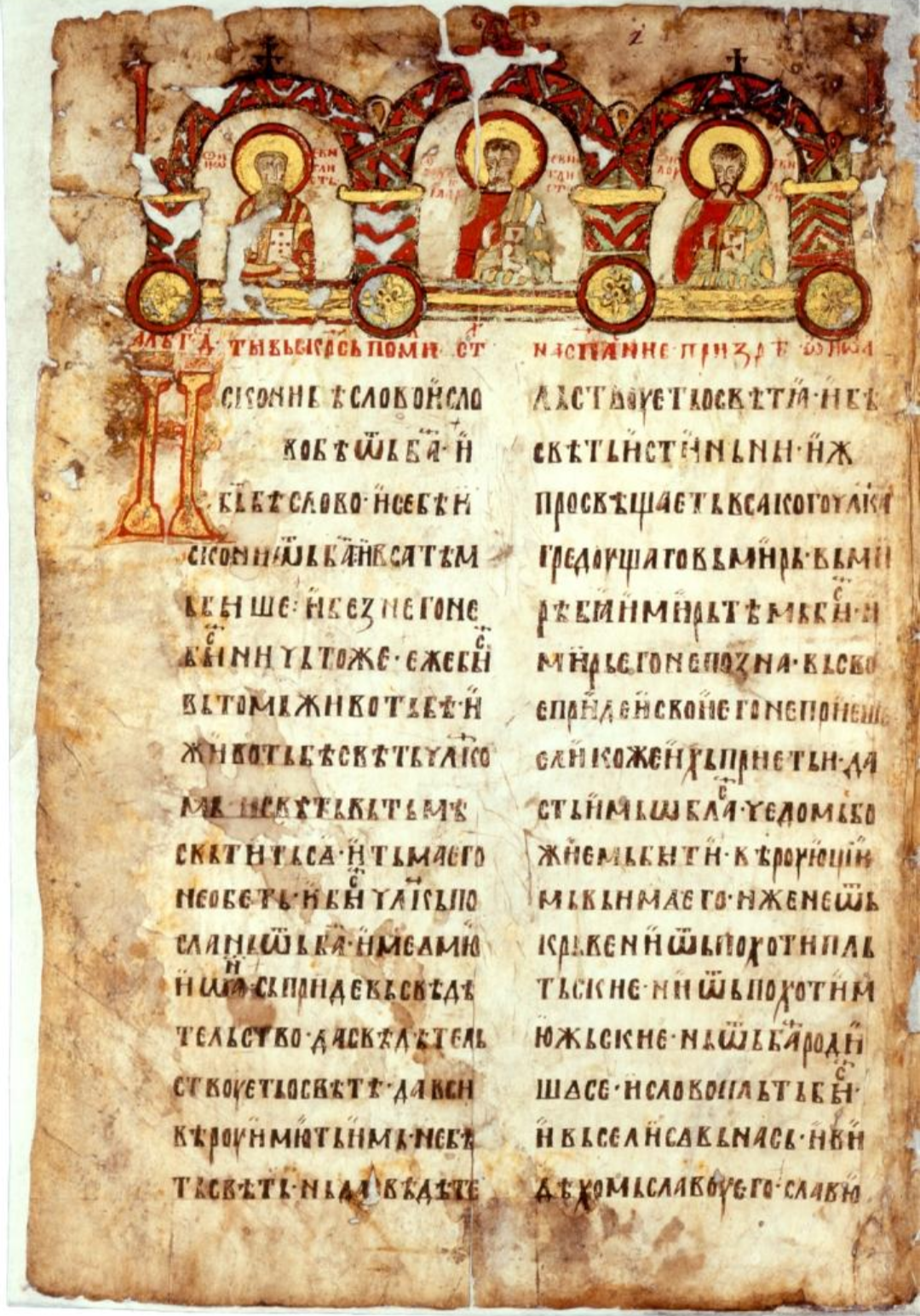
The Orthodox world is multilingual, but it shares a common liturgical and literary heritage. Its main language families are Hellenic (Greek), Slavic (Russian, Ukrainian, Belarusian, Serbian, Bulgarian, Macedonian), Romance (Romanian, Aromanian), Kartvelian (Georgian), Semitic (Arabic, with historic Aramaic and Syriac), and smaller Uralic (Karelian, Finnish) and Ossetian communities. Liturgically, Koine Greek and Church Slavonic have historically been the two great Orthodox languages, alongside Georgian, Arabic, and Romanian.
Orthodoxy is closely tied to three scripts: the Greek alphabet; the Cyrillic alphabet, developed in the First Bulgarian Empire in the late 9th century by the disciples of Cyril and Methodius, and today used by around 250 million people; and the Georgian script, whose three historical forms are inscribed on UNESCO’s Intangible Cultural Heritage list. Orthodox literary tradition includes Byzantine hymnography (St Romanos the Melodist, St John of Damascus), the spiritual anthology known as the Philokalia, medieval Slavic chronicles such as the Russian Primary Chronicle, and Shota Rustaveli’s 12th-century Georgian epic The Knight in the Panther’s Skin. In the modern era, Orthodox themes run deep in the novels of Dostoevsky and Tolstoy and the poetry of Greek Nobel laureates Seferis and Elytis.
Oriental Orthodox Churches: A Related but Separate Family
The Oriental Orthodox churches, which separated from the Eastern churches after the Council of Chalcedon in 451, share many features with Eastern Orthodoxy (liturgy, monasticism, icons, fasting) but are a distinct communion. They include the Armenian Apostolic Church, the Coptic Orthodox Church of Egypt, the Ethiopian and Eritrean Orthodox Tewahedo churches, the Syriac Orthodox Church, and, in India, the Malankara Orthodox Syrian Church of Kerala, part of the ancient Saint Thomas Christian tradition that traces its origin to the apostle Thomas’s legendary arrival on the Malabar coast in 52 CE. These communities deserve their own dedicated community profiles.
8. Faith, Worship, Festivals, and Pilgrimage
Orthodox worship centres on the Divine Liturgy, most commonly the Liturgy of St John Chrysostom, sung entirely (traditionally without musical instruments in most churches), with the congregation often standing throughout. Churches are filled with icons, sacred images of Christ, the Virgin Mary (Theotokos, “God-bearer”), and saints, which believers venerate by kissing and lighting candles before them. The iconostasis, a screen of icons, separates the sanctuary from the nave. Incense, candles, bells, and chanting create a strongly sensory religious experience.
Easter (Pascha) is the greatest Orthodox feast, far outranking Christmas. It is preceded by Great Lent and Holy Week and celebrated at midnight with candlelit processions and the proclamation “Christ is risen!” answered by “Truly He is risen!”, spoken in Greek, Slavonic, Romanian, Georgian, or Arabic. Many Orthodox churches, including those of Russia, Serbia, Georgia, and Jerusalem, still follow the Julian calendar, so Christmas falls on 7 January; others, including the Greek, Romanian, and Bulgarian churches, use the Revised Julian calendar and celebrate Christmas on 25 December. Nearly all Orthodox churches calculate Easter using the Julian reckoning, so Orthodox Easter usually falls later than Western Easter.
Other important feasts include Theophany (Epiphany, 6 or 19 January), when priests bless waters and, in Greece, Bulgaria, and Russia, young men dive into icy rivers or seas to retrieve a cross; the Dormition of the Theotokos (15 or 28 August); and the name days (feast days of one’s patron saint), which in Greece and many Balkan countries are celebrated more widely than birthdays. Great pilgrimage centres include Mount Athos in northern Greece, a self-governing monastic republic of 20 monasteries closed to women for over a thousand years; the Holy Sepulchre in Jerusalem, where the Holy Fire ceremony is held on Holy Saturday; Kyiv’s Pechersk Lavra; Moscow’s Trinity Lavra of St Sergius; the painted monasteries of Bukovina in Romania; the rock-hewn Meteora monasteries in Greece; and the Rila Monastery in Bulgaria.
9. Culture, Customs, and Social Practices
Across its many nations, Orthodox culture shares a number of recognisable customs rooted in the Church’s annual cycle and the village traditions of the Balkans and Eastern Europe. Fasting is central: devout Orthodox Christians abstain from meat, dairy, and often fish, wine, and oil on Wednesdays and Fridays and during four major fasting seasons (Great Lent, the Nativity Fast, the Apostles’ Fast, and the Dormition Fast), which together can cover close to half the year. This fasting discipline has shaped entire regional cuisines rich in bean, vegetable, and grain dishes.
Hospitality matters a great deal. In Slavic lands, guests are greeted with bread and salt; in Georgia, the elaborate supra feast is led by a tamada (toastmaster) who proposes a long sequence of toasts; in the Balkans, guests are welcomed with homemade fruit brandy (rakija) and sweet preserves. Among Serbs, the Slava, the family’s annual feast of its patron saint inherited through the male line, is a unique tradition inscribed on UNESCO’s intangible heritage list. Memorial customs are also distinctive: families mark the 3rd, 9th, and 40th days after a death with prayers and a special dish of boiled wheat with sugar and nuts (koliva in Greek, koljivo in Serbian, kutia in East Slavic tradition).
Small Cultural Things Worth Knowing
- The three-finger sign of the cross: Orthodox Christians cross themselves from right to left (the reverse of Catholics), joining thumb, index, and middle fingers to symbolise the Trinity.
- Red Easter eggs: Eggs are dyed deep red on Holy Thursday to symbolise the blood of Christ and cracked against each other in a game on Easter Sunday; the person whose egg survives is said to have good luck.
- Icon corners: Many Orthodox homes, especially in Russia and Ukraine, keep a “beautiful corner” (krasny ugol) with family icons and a hanging oil lamp.
- The Orthodox cross: The Russian and wider Slavic tradition often uses an eight-pointed cross, with a small upper bar for the inscription and a slanted lower footrest.
- Name days over birthdays: In Greece, Cyprus, Bulgaria, and much of the Balkans, a person’s saint’s day is often a bigger celebration than their birthday.
- Head coverings in church: Women traditionally cover their hair in church, especially in Russia, Ukraine, Georgia, and Romania; men remove their hats.
- Standing in worship: Most traditional Orthodox churches have few or no pews, and worshippers stand through services that may last two or three hours.
- Blessing of homes: Priests visit homes at Theophany to sprinkle holy water, a custom still widespread in Greece, Romania, and Bulgaria.
- Martenitsa and Mărțișor: In Bulgaria and Romania, people exchange red-and-white woven tokens on 1 March to welcome spring, a pre-Christian custom that coexists with Orthodox practice.
10. Marriage and Wedding Traditions
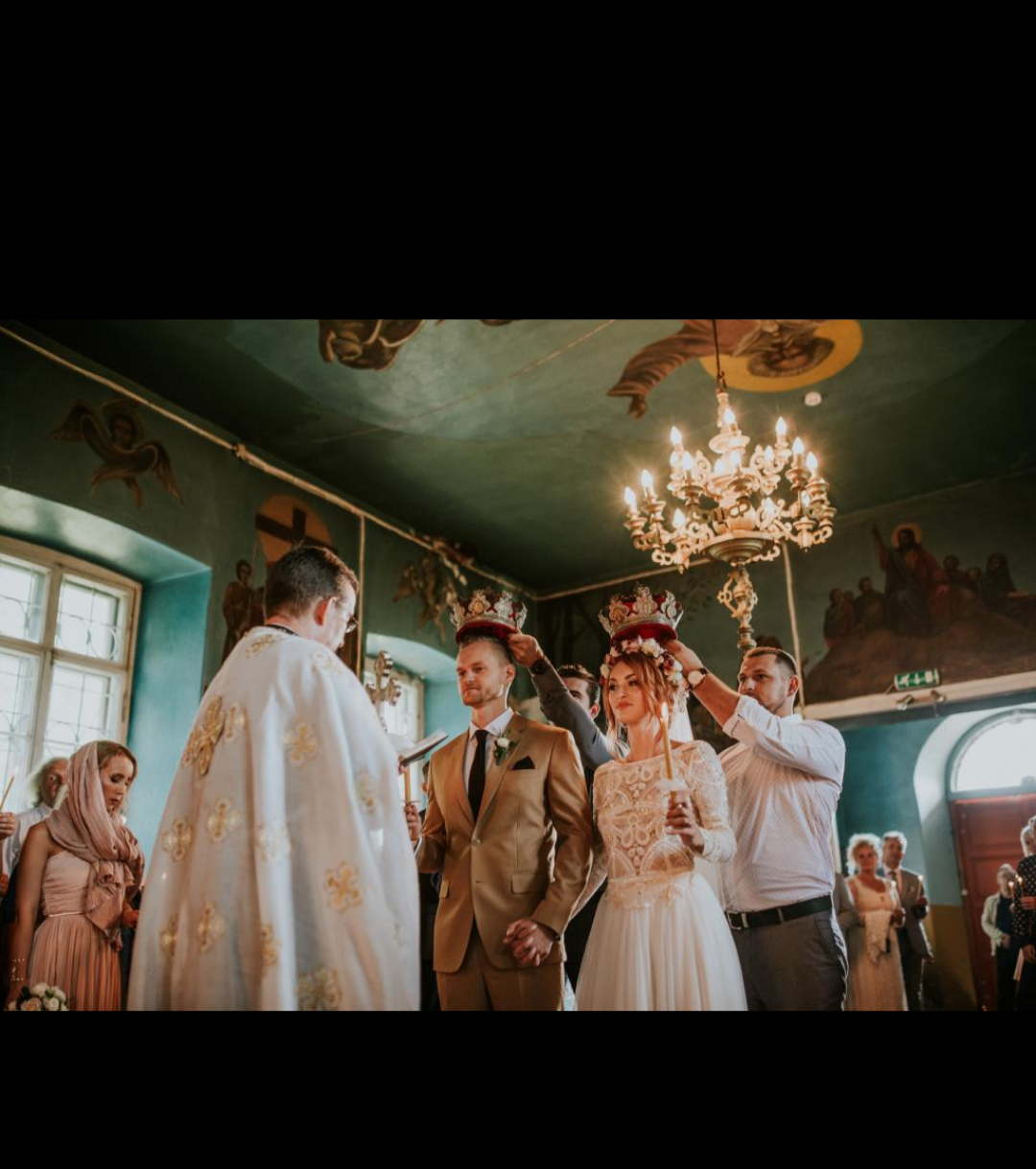
The Orthodox wedding is one of the most distinctive Christian marriage rites. It has two parts: the Betrothal, in which rings are blessed and exchanged three times, and the Crowning, the heart of the ceremony, in which the bride and groom are crowned (stefana in Greek, venchanie in Russian), linked crowns joined by a ribbon in the Greek tradition or metal crowns held above the couple in the Slavic tradition. The couple drinks from a common cup and is led by the priest three times around a table in the “Dance of Isaiah,” symbolising the journey of married life. Notably, the Orthodox rite has no exchange of vows in the Western sense; the marriage is sealed by the crowning itself.
Surrounding folk customs vary by nation. Greek weddings feature the koumbaros (best man and sponsor), the throwing of rice and sugared almonds (koufeta), and plate-smashing in some regions. Russian and Ukrainian weddings include the ritual ransom of the bride (vykup), the greeting of the couple with bread and salt by their parents, and the korovai, an elaborately decorated wedding loaf. Serbian and Bulgarian village weddings traditionally lasted several days, with brass bands, the kolo or horo circle dance, and the ritual testing of the bride. Georgian weddings are centred on the supra feast and polyphonic toasting songs. Historically, Orthodox canon law allows divorce and remarriage up to a total of three marriages, a notable difference from Roman Catholic practice.
11. Cuisine
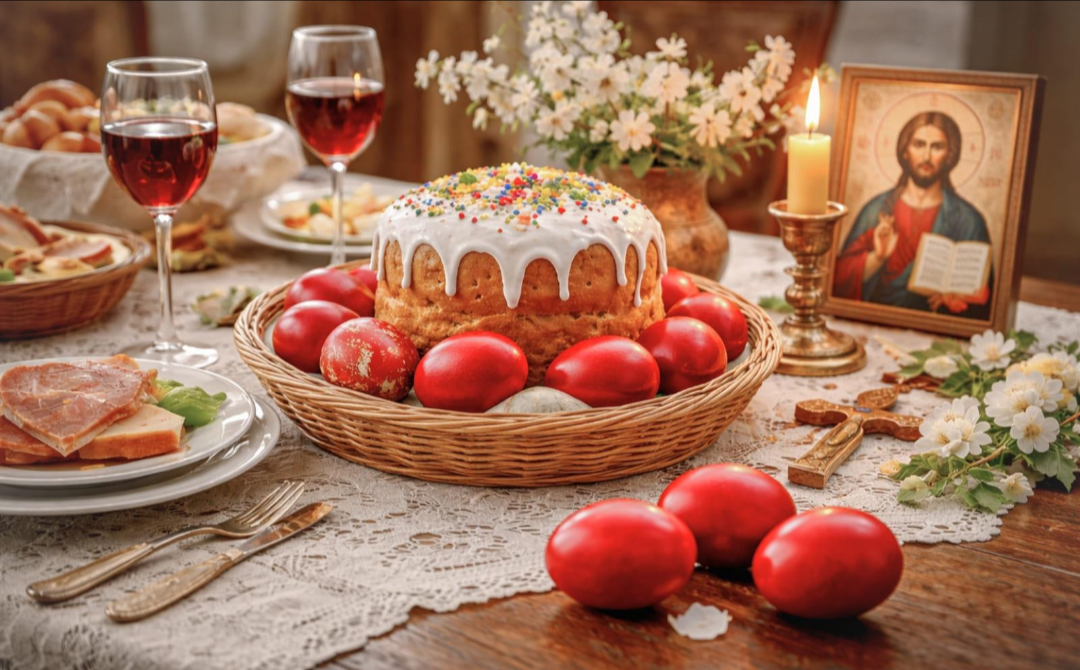
Orthodox cuisine is as diverse as its geography, but it is united by the rhythm of feasting and fasting set by the church calendar. Long fasting seasons have produced a remarkable variety of vegan dishes, while great feasts, especially Easter and Christmas, are marked by rich meat, dairy, and baked goods.
11.1 Feast and Ritual Foods
- Easter breads: Greek tsoureki, Russian kulich (paired with paskha, a sweet cheese dessert), Romanian and Moldovan cozonac, Serbian and Bulgarian kozunak, and Ukrainian paska: sweet, enriched breads baked and blessed for Pascha.
- Christmas Eve meals: Ukrainian and Belarusian Sviata Vecheria (Holy Supper) has twelve meatless dishes, beginning with kutia (wheat berries with honey and poppy seed); Serbian Christmas features the česnica, a round bread with a hidden coin.
- Koliva / kutia: Boiled wheat with sugar, nuts, and pomegranate, offered at memorial services.
- Magiritsa: Greek lamb-offal soup eaten after the midnight Easter service to break the Lenten fast; roast lamb on a spit follows on Easter Sunday.
11.2 Regional Cuisines
- Greek and Cypriot: Olive oil, bread, cheese (feta, halloumi), grilled fish and lamb, moussaka, souvlaki, spanakopita, lentil and bean soups, and fasting dishes known as ladera (vegetables cooked in oil).
- Balkan (Serbian, Bulgarian, Macedonian): Grilled meats (ćevapi, pljeskavica, kebapche), sarma (stuffed cabbage leaves), banitsa and burek pastries, ajvar (red pepper relish), shopska salad, yoghurt and white cheese, and plum or grape rakija.
- Romanian and Moldovan: Mămăligă (maize porridge), sarmale, ciorbă (sour soups), mititei (grilled sausages), and plăcintă (filled pastries).
- East Slavic: Borscht (beetroot soup, inscribed by UNESCO as part of Ukraine’s intangible heritage in 2022), shchi (cabbage soup), pelmeni and varenyky dumplings, blini (pancakes eaten especially during Maslenitsa, the pre-Lenten butter week), buckwheat kasha, pickled vegetables, kvass, and rye bread.
- Georgian: Khachapuri (cheese bread), khinkali (soup dumplings), walnut-based sauces, churchkhela (grape-must and nut sweets), and an 8,000-year winemaking tradition using clay qvevri vessels, also on UNESCO’s intangible heritage list.
- Levantine Orthodox: Shared Levantine cuisine including hummus, tabbouleh, kibbeh, and mujaddara (lentils and rice), with meatless versions widely eaten during Lent.
Savor Your Orthodox Heritage?
From Greek tsoureki to Russian kulich and Georgian khachapuri, the feast-and-fast table of the Orthodox world tells a story of faith and family. Discover if your DNA connects you to this living culinary heritage.
12. Traditional Dress and Ornaments
Traditional dress across the Orthodox world varies greatly by region, but certain patterns recur: embroidered white linen shirts, woven woollen garments, aprons and sashes with protective geometric patterns, and headgear that marked a woman’s marital status. Today these garments are worn mainly at weddings, church festivals, and folk performances.
- Greek: The men’s foustanella, a pleated white kilt-like skirt associated with the 1821 War of Independence and still worn by the Evzones presidential guard in Athens, and the women’s Amalia costume, together with richly embroidered regional island dresses.
- East Slavic: The embroidered Ukrainian vyshyvanka shirt (now a symbol of national identity celebrated with its own annual day), the Russian sarafan (a long pinafore dress) and kokoshnik (an ornate headdress), and the Belarusian red-and-white embroidered linen tradition.
- Romanian and Moldovan: The ie (embroidered blouse), part of the Romanian and Moldovan shirt-making art inscribed by UNESCO, worn with a woven wrap-around skirt (catrință) or apron.
- Serbian and Bulgarian: Embroidered shirts, woollen vests, and the Serbian šajkača cap for men; Bulgarian women’s costumes feature the sukman (a sleeveless tunic) with colourful aprons and silver belt buckles (pafti).
- Georgian: The men’s chokha, a long woollen coat with cartridge pockets across the chest, now a strong symbol of national identity, and the women’s kartuli kaba, a long gown with flowing sleeves and a lechaki (veil).
Religious ornaments are shared across all Orthodox peoples: a baptismal cross worn around the neck from infancy, small portable icons, and the prayer rope (chotki or komboskini), a knotted cord used for repeating the Jesus Prayer. Clergy dress is distinctive too: married parish priests wear beards and cassocks, while monks and bishops wear black robes and tall cylindrical hats (kamilavka) with veils.
13. Physical Traits
There is no single “Orthodox” physical type. A population of well over 200 million people spread from Crete to Siberia naturally shows wide variation. Broadly, physical traits follow the European north-south and Caucasus-Levant gradients described in Section 6. Northern and eastern Orthodox populations (Russians, Belarusians, northern Ukrainians) more frequently have lighter hair, eyes, and skin, including a relatively high frequency of light eye colours; Balkan populations such as Serbs and Montenegrins are among the tallest peoples in the world, with average male heights around 180-182 cm in some studies; Greeks, Cypriots, and Levantine Orthodox tend to have darker hair and eyes and olive skin typical of the eastern Mediterranean; and Georgians show features characteristic of Caucasian populations, often with dark hair and prominent facial features. Such descriptions are only statistical tendencies; there is enormous variation within every group, and physical appearance is not a reliable guide to anyone’s ancestry or religion.
14. Traditional Housing, Architecture, and Arts
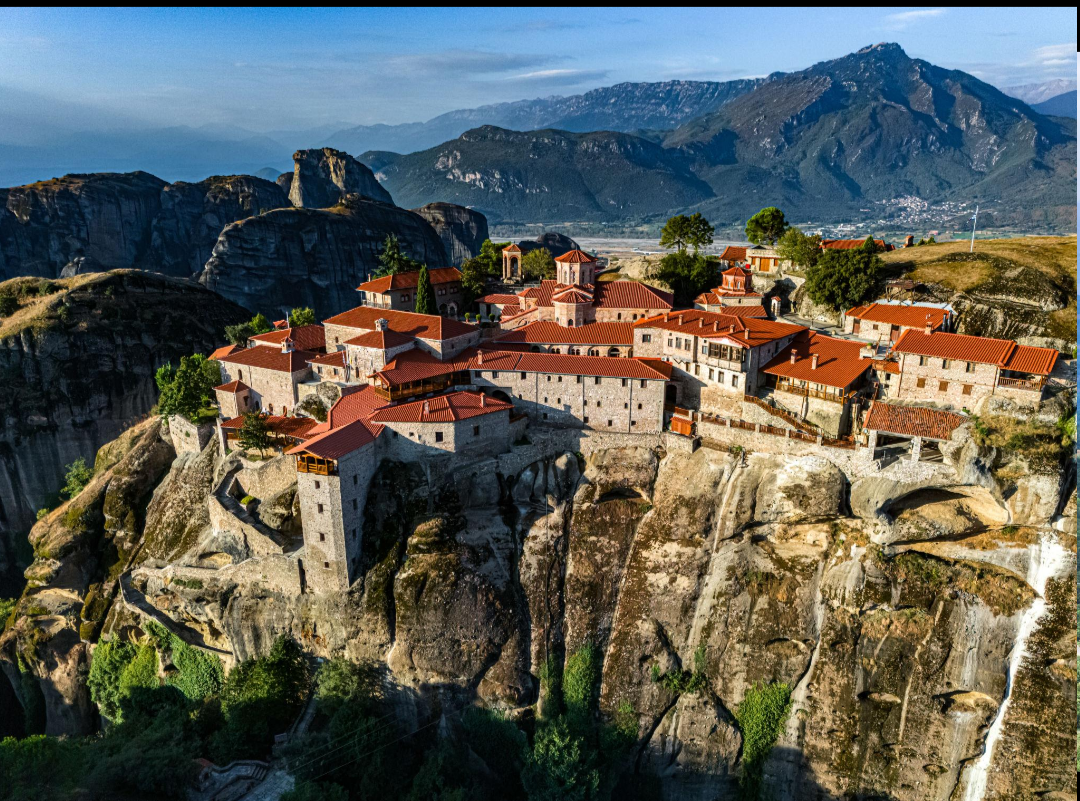
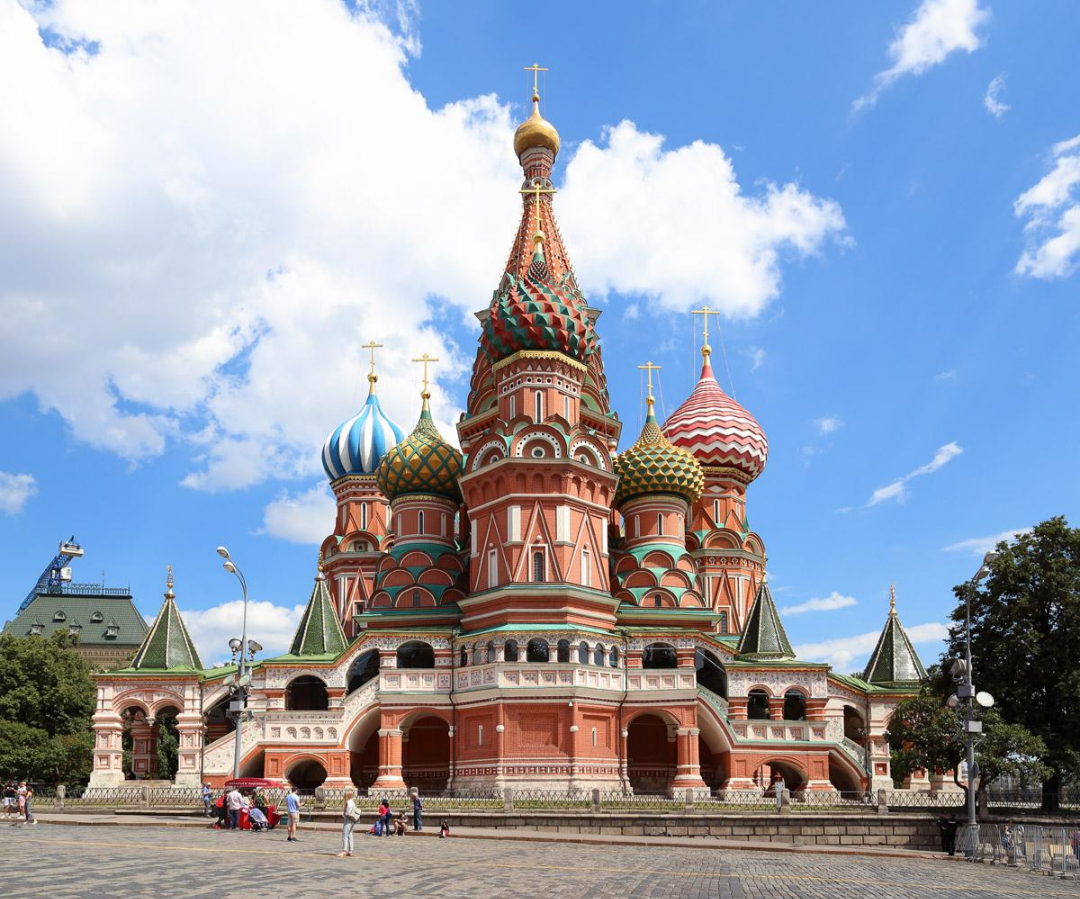
Orthodox church architecture developed from the Byzantine cross-in-square plan crowned by a central dome, representing heaven over the earthly world. Different regions developed their own variations: the multi-domed brick churches of Byzantine Greece; the onion-domed churches of Russia (such as St Basil’s Cathedral in Moscow and the wooden churches of Kizhi); the stone churches of Georgia with conical domes; the Serbian Morava school with decorative facades; and the unique exterior-painted monasteries of Bukovina, Romania. Wooden churches of the Carpathians and northern Russia are UNESCO World Heritage sites.
Icon painting is the signature Orthodox art, governed by strict traditions of form and symbolism rather than naturalism. Great icon painters include Andrei Rublev (Russia, c. 1360-1430), whose Trinity icon is considered a masterpiece of world art, and Theophanes the Greek. Other characteristic arts include Byzantine and Znamenny chant, Georgian polyphonic singing (UNESCO-listed), Easter egg decoration (such as the Ukrainian pysanka), woodcarving, and embroidery. Vernacular housing varied from Greek island whitewashed cubic houses to Balkan stone-and-timber houses, Russian log izbas with carved window frames, and Georgian stone towers in highland Svaneti.
15. Folklore and Oral Tradition
Orthodox Christianity has coexisted for a thousand years with older folk traditions in the countryside. Slavic folk belief preserved figures such as the domovoi (household spirit) and rusalki (water spirits), while seasonal festivals like Maslenitsa (the Russian pre-Lenten carnival, with the burning of a straw effigy of winter) and Ivan Kupala (midsummer, merged with the feast of St John the Baptist) blended pagan and Christian elements. Russian folk tales of Baba Yaga and Koschei the Deathless, the Serbian epic songs of the Battle of Kosovo (1389) sung to the one-stringed gusle (UNESCO-listed), the Greek demotic songs of the klephts, and the Romanian ballad Miorița are central oral traditions. Christmas carolling, known as koliada in Slavic lands, colinde in Romania, and kalanda in Greece, remains widely practised by children and young people.
16. Education, Livelihoods, and Jobs
Historically, most Orthodox peoples were agrarian: grain farmers on the Ukrainian and Russian black-soil plains and the Danubian lowlands; shepherds and transhumant herders in the Balkan and Carpathian mountains (including the Aromanian and Sarakatsani herders); olive, vine, and fishing communities in Greece and Cyprus; and wine growers in Georgia and Moldova. Greek and Levantine Orthodox communities were also prominent as merchants, shipowners, and traders throughout the Ottoman Empire and the Mediterranean; Greek shipowning families remain among the largest in the world today.
In the 20th century, industrialisation, especially under communism, transformed most Orthodox countries into urban societies with strong traditions of engineering, science, mathematics, and heavy industry. Russia, Ukraine, Belarus, Romania, and Bulgaria today have large IT and software sectors, and Eastern Europe is a major global hub for software development outsourcing. Common occupations today include engineering, IT, medicine, teaching, agriculture, manufacturing, tourism (especially in Greece, Cyprus, Montenegro, and Georgia), shipping, and public service. Within the diaspora, Greek-Americans are known for small business and restaurant ownership, Levantine Orthodox communities for trade and professions, and recent East European migrants for construction, healthcare, and technology work. Literacy rates in Orthodox-majority countries are generally above 97 per cent.
17. Diaspora
The Orthodox diaspora developed in several waves. The first large wave came from Greece, the Balkans, the Levant, and the Russian Empire between about 1880 and 1920, when economic hardship and persecution drove migration to the United States, Canada, Australia, Brazil, and Argentina. Greek communities flourished in New York, Chicago, and Melbourne (sometimes described as one of the largest Greek cities outside Greece); Syrian and Lebanese Orthodox Christians settled throughout the Americas; and Russian, Ukrainian, and Carpatho-Rusyn immigrants founded Orthodox parishes in Pennsylvania and the American Midwest. Russian Orthodox missionaries had earlier reached Alaska in 1794, where the church still has Indigenous Alaskan members today.
The second wave followed the 1917 Russian Revolution, when about one to two million “White” émigrés settled in Paris, Berlin, Belgrade, Harbin, and New York, founding institutions such as the St Sergius Theological Institute in Paris. The third wave came after 1945 with displaced persons and refugees from communism, and the fourth, largest wave came after 1989-1991, with millions of Romanians, Bulgarians, Ukrainians, Moldovans, Serbs, and Georgians migrating to Italy, Spain, Germany, the United Kingdom, and North America; the Romanian community in Italy and Spain alone numbers around two million. War and conflict have since added new waves from Syria and, since 2022, from Ukraine and Russia. Today the Orthodox Church in America, the Greek Orthodox Archdiocese of America, and the Antiochian Archdiocese are major institutions in the United States, and Orthodox parishes exist on every inhabited continent, including in India, where Russian and Greek-rooted parishes serve expatriates alongside the ancient indigenous Malankara Orthodox community.
18. Prominent Figures
18.1 Saints, Church, and Religious Life
- St John Chrysostom (c. 347-407): Archbishop of Constantinople and author of the most widely used Orthodox liturgy.
- Saints Cyril and Methodius (9th century): Missionaries to the Slavs and creators of the first Slavic alphabet.
- St Sava (1174-1236): First Archbishop of the autocephalous Serbian Church and a founding figure of Serbian culture.
- St Sergius of Radonezh (1314-1392): Founder of the Trinity Lavra and one of Russia’s most revered saints.
- St Nino (4th century): Female evangelist credited with converting Georgia to Christianity.
- Patriarch Bartholomew I (b. 1940): Ecumenical Patriarch since 1991, known internationally as the “Green Patriarch” for his environmental advocacy.
18.2 Political and Public Life
- Emperor Constantine the Great and Emperor Justinian I: Founders of the Christian Roman state in the East.
- Ioannis Kapodistrias (1776-1831): First head of state of independent Greece.
- Karađorđe Petrović (1768-1817): Leader of the First Serbian Uprising.
- Queen Tamar of Georgia (reigned 1184-1213): Ruler of Georgia’s medieval golden age, venerated as a saint.
18.3 Literature, Arts, and Music
- Fyodor Dostoevsky and Leo Tolstoy: Russian novelists whose works grapple deeply with Orthodox faith and morality.
- Andrei Rublev: Russia’s greatest icon painter.
- Pyotr Ilyich Tchaikovsky and Sergei Rachmaninoff: Composers who also wrote major Orthodox choral works (Rachmaninoff’s All-Night Vigil).
- Nikos Kazantzakis, George Seferis, and Odysseas Elytis: Leading modern Greek writers; Seferis and Elytis won the Nobel Prize in Literature.
- Mihai Eminescu and Constantin Brâncuși: Romania’s national poet and one of the founders of modern sculpture.
- Ivo Andrić: Nobel-winning Yugoslav novelist of The Bridge on the Drina.
18.4 Science, Sports, and Other Fields
- Dmitri Mendeleev: Creator of the periodic table of elements.
- Nikola Tesla: Serbian-American inventor, son of a Serbian Orthodox priest.
- Yuri Gagarin: First human in space (1961).
- Novak Djokovic: Serbian tennis player with a record number of Grand Slam titles, openly Orthodox.
- Nadia Comăneci: Romanian gymnast, first to score a perfect 10 at the Olympics (1976).
- Giannis Antetokounmpo: Greek basketball star of Nigerian parentage, baptised Greek Orthodox.
19. Conclusion
The Orthodox Christian world is held together by neither one language nor one nation, but by a shared faith and culture spread across a very large area. Its peoples, Greeks, Slavs, Romanians, Georgians, Arabs, and many others, carry very different ancestral mixes in their DNA, from Anatolian farmers and Bronze Age Aegeans to steppe herders, Balkan mountaineers, and ancient Levantine townspeople. Yet across that diversity they share the legacy of Byzantium: the Divine Liturgy and its icons, the Cyrillic, Greek, and Georgian scripts, the cycle of fasts and feasts, red Easter eggs and midnight processions, the crowning of brides and grooms, and a thousand-year memory of empire, conquest, survival, and revival. From the monasteries of Mount Athos to the wooden churches of northern Russia, and from Georgian supra tables to Greek-American parishes in Chicago, the Orthodox peoples carry a religious history, a mixed genetic past, and a living culture shared by hundreds of millions of people.
References
- [1]Pew Research Center. “Orthodox Christianity in the 21st Century.” 2017.
- [2]Ware, Timothy (Kallistos). The Orthodox Church. Penguin Books, revised edition.
- [3]McGuckin, John Anthony. The Orthodox Church: An Introduction to its History, Doctrine, and Spiritual Culture. Wiley-Blackwell, 2008.
- [4]Haak, W. et al. “Massive migration from the steppe was a source for Indo-European languages in Europe.” Nature, 2015.
- [5]Lazaridis, I. et al. “Genetic origins of the Minoans and Mycenaeans.” Nature, 2017.
- [6]Olalde, I. et al. “A genetic history of the Balkans from Roman frontier to Slavic migrations.” Cell, 2023.
- [7]Balanovsky, O. et al. “Two sources of the Russian patrilineal heritage in their Eurasian context.” American Journal of Human Genetics, 2008.
- [8]Haber, M. et al. “Genome-wide diversity in the Levant reveals recent structuring by culture.” PLoS Genetics, 2013.
- [9]UNESCO Intangible Cultural Heritage lists: Serbian Slava, Georgian qvevri winemaking, Georgian polyphonic singing, Ukrainian borscht, Romanian and Moldovan ie, gusle singing.
- [10]Encyclopaedia Britannica. Entries on “Eastern Orthodoxy,” “Byzantine Empire,” and “Great Schism.”
- [11]Note for publication: population figures and genetic percentages are approximate and should be checked against the latest census data and studies before publishing.
Frequently Asked Questions
Who are Orthodox Christians?
Orthodox Christians are members of the Eastern Orthodox Church, the second-largest Christian communion in the world, with roughly 220-260 million followers. They trace their church to the apostles and the Christian Roman (Byzantine) Empire centred on Constantinople, and today they live mostly in Russia, Ukraine, Romania, Greece, Serbia, Bulgaria, Belarus, Georgia, and the Levant, along with a large diaspora.
Is Orthodox Christianity an ethnicity?
No. Orthodoxy is a religious and cultural tradition shared by many ethnic groups, including Greeks, Russians, Ukrainians, Serbs, Romanians, Bulgarians, Georgians, and Arab Christians. In several countries, however, Orthodoxy is so closely tied to national identity that it functions as a strong marker of ethnic belonging.
What is the difference between Orthodox and Catholic Christians?
The two churches were one until the Great Schism of 1054. Their main differences concern the authority of the Pope (Orthodox churches do not accept papal supremacy), the filioque clause in the Creed, the use of leavened bread in communion, married parish clergy (allowed in Orthodoxy), liturgical language and style, and the church calendar. They share the same sacraments and much early theology.
What is the difference between Eastern Orthodox and Oriental Orthodox?
Oriental Orthodox churches (Armenian, Coptic, Ethiopian, Eritrean, Syriac, and the Malankara Orthodox of India) separated from the Eastern Orthodox after the Council of Chalcedon in 451 because of a disagreement over the nature of Christ. The two families share much in worship and tradition but are not in full communion.
Why do Orthodox Christians celebrate Christmas on 7 January?
Churches that follow the older Julian calendar, including those of Russia, Serbia, Georgia, Ukraine (partly), and Jerusalem, celebrate Christmas on 25 December by the Julian reckoning, which currently corresponds to 7 January on the modern Gregorian calendar. Greek, Romanian, Bulgarian, and several other churches celebrate on 25 December.
What DNA haplogroups are common among Orthodox Christians?
It depends on the region. R1a is very common among Russians, Ukrainians, and Belarusians; I2a is frequent among Serbs and other South Slavs; E-V13 and J2 are common among Greeks and other Balkan peoples; G2a and J2 are frequent in Georgia; and N1c appears among northern Russians. Maternal lineages are dominated by haplogroup H, as in most of Europe.
Are Greeks and Russians genetically related?
Both are European populations descended from the same broad mix of Anatolian farmers, steppe herders, and hunter-gatherers, but in different proportions. Greeks carry more Neolithic Anatolian farmer ancestry and cluster with southern Europeans, while Russians carry more steppe and northern hunter-gatherer ancestry and cluster with northeastern Europeans. Their shared religion reflects history, not close genetic kinship.
What is the traditional dress of Orthodox peoples?
It varies by nation: the Greek foustanella, the Ukrainian vyshyvanka, the Russian sarafan and kokoshnik, the Romanian ie blouse, and the Georgian chokha are among the best known. Common to all are the baptismal cross, the prayer rope, and head coverings for women in church.
What foods are associated with Orthodox Christians?
Easter breads (tsoureki, kulich, cozonac, paska), red-dyed Easter eggs, koliva or kutia for memorials, and a wide range of Lenten vegan dishes are shared traditions. Regional favourites include moussaka and souvlaki in Greece, sarma and ćevapi in the Balkans, borscht and blini in the East Slavic lands, and khachapuri in Georgia.
Why do Orthodox Christians fast so often?
Fasting is a spiritual discipline in Orthodoxy. Devout believers abstain from meat, dairy, and often fish, oil, and wine on most Wednesdays and Fridays and during four long fasting periods, preparing for the major feasts of Easter, Christmas, the Apostles, and the Dormition of the Virgin.
Where did Orthodox Christians migrate to?
Major migration waves went to the United States, Canada, Australia, Latin America, and Western Europe, beginning around 1880 and continuing after the Russian Revolution, the Second World War, the fall of communism, the Syrian civil war, and the war in Ukraine. Large Orthodox communities today live in New York, Chicago, Melbourne, London, Paris, Berlin, Rome, and Madrid.
Are there Orthodox Christians in India?
Yes. India is home to the ancient Malankara Orthodox Syrian Church and the Jacobite Syrian Christian Church of Kerala, both belonging to the Oriental Orthodox family and part of the Saint Thomas Christian heritage. There are also small Eastern Orthodox parishes serving Russian, Greek, and other expatriate and local communities.
What physical traits are typical of Orthodox Christians?
There is no single physical type. Northern Orthodox populations such as Russians and Belarusians more often have lighter hair and eyes; Balkan peoples such as Serbs and Montenegrins are among the tallest in the world; and Greeks, Cypriots, and Levantine Orthodox tend toward the darker hair and olive skin typical of the eastern Mediterranean. These are only broad averages with wide individual variation.
Who are some famous Orthodox Christians?
Well-known figures include Fyodor Dostoevsky, Leo Tolstoy, Dmitri Mendeleev, Pyotr Tchaikovsky, Nikola Tesla, Yuri Gagarin, Nadia Comăneci, Novak Djokovic, and Giannis Antetokounmpo, as well as saints such as John Chrysostom, Cyril and Methodius, and Sava of Serbia.