

Kodava Community
Explore the Kodava (Coorg) people of Kodagu — origins, DNA ancestry, clans, language, festivals, cuisine, and history. A complete community profile.
THE KODAVAS OF COORG
History, Culture, and Genetics of the Coorg Community
A community profile — origins, genetics, social structure, customs, cuisine, and legacy
1. Introduction: Who Are the Kodavas?
The Kodavas, also known as Coorgs, are an endogamous Dravidian ethnolinguistic community native to Kodagu (formerly Coorg), a hill district in the Western Ghats of the southern Indian state of Karnataka. They speak Kodava takk, a distinct Dravidian language, and form the single largest community in Kodagu district, historically accounting for roughly one-fifth of the district's population and over 30% of its Hindu population.
Kodavas are traditionally landowning agriculturists, known for a strong martial tradition, ancestor and nature worship, and a social structure organised around large patrilineal clans. Historians agree the community has inhabited Kodagu for well over a thousand years, making them among the earliest settled agriculturists of the region. Since the nineteenth century, coffee cultivation has been central to the community's economy, and Kodagu today produces more than a third of India's coffee.
2. Origins and Early History
2.1 Etymology
The word “Kodava” is derived from the root koda, variously explained by community and linguistic sources as relating to “mist,” “hills,” or “west,” all of which are associated with the district's location in the Western Ghats. “Kodagu,” the land, and “Kodava,’ the people and language, share this common root; in the Kodava language, Kodagu is known as Kodava Naad. During British rule, “Kodava” was anglicised to “Coorg.”
2.2 Puranic Tradition
Community tradition, recorded in the Kaveri Purana of the Skanda Purana, traces Kodava ancestry to Chandra Varma, a warrior of the lunar dynasty and son of the ruler of Matsya Desha, who is said to have settled the then-uninhabited forest land of Kodagu at the source of the river Kaveri and become its first Raja. This puranic account exists alongside the region's documented history and is treated by the community as part of its origin narrative rather than as verified historical fact.
2.3 Early Historical Record
Kannada inscriptions refer to the region as Kudagu Nadu, and in 1398 CE the Vijayanagara-era Kannada poet Mangaraja described the Kodavas in his lexicon as a warrior people fond of hunting. The earliest references to the wider Kodagu region appear in works of the Sangam period, when the Ezhimala dynasty administered the coastal Poozhinadu and the hilly Karkanadu, the latter encompassing parts of present-day Kodagu.
Over the following centuries, the region came under a succession of larger South Indian dynasties, including the Kadambas, Gangas, Cholas, Hoysalas, and the Vijayanagara Empire, before passing to the Haleri Rajas, who ruled Kodagu from around 1600 to 1834.
2.4 The British Period
In 1834, the East India Company annexed Kodagu following a brief conflict with the last Haleri ruler, Chikka Vira Rajendra, after which the Raja was exiled and Kodagu came under British administration as a nominally independent province. During this period, Kodavas entered politics, government service, medicine, education, and law, and the British recognised the community's martial traditions by recruiting Kodavas into the Indian Army. Many Kodavas served in both World Wars and in the conflicts that followed Indian independence.
Kodagu briefly became a separate state within the Indian Union upon independence in 1950, before being merged into Mysore State (renamed Karnataka in 1973) in 1956.
3. Genetics and DNA Ancestry
Kodavas are among the more distinctly studied populations in South Indian population genetics, owing to their long history of endogamy and their historically debated origins. A notable genome-wide study by researchers at the University of Delhi South Campus and the CSIR-Centre for Cellular and Molecular Biology (CCMB), Hyderabad — led by geneticist B. K. Thelma along with K. Thangaraj and colleagues, and published in the journal Communications Biology — analysed autosomal and uniparental (Y-chromosomal and mitochondrial) DNA from 144 Kodava individuals.
3.1 Paternal (Y-DNA) and Maternal (mtDNA) Lineages
The study found that Kodava mitochondrial DNA (inherited through the maternal line) is approximately 40% South Asian in origin, while Y-chromosomal DNA (inherited through the paternal line) shows a predominant mix of Eurasian, Middle Eastern, and India-specific haplogroups. This asymmetry — elevated West Asian or Eurasian signal on the paternal side against a strongly local maternal signal — is interpreted as evidence of male-dominated historical migration into the region, with incoming men subsequently marrying local women.
3.2 Population Substructure
The researchers identified three genetically distinct ancestral lineages within the modern Kodava population, informally labelled Coorg-1, Coorg-2, and Coorg-3, which appear to have diverged at different points in the past — Coorg-3 being the oldest, tracing back roughly 98 generations (approximately 3,000 years), and Coorg-1 diverging around 64 generations (approximately 1,900 years) ago. The study suggests these three lineages eventually admixed both genetically and socio-culturally, while practices such as family exogamy (marrying outside one's immediate clan) combined with community-level endogamy likely helped preserve traces of this ancestral separation over many centuries.
4. Social Structure and Clan System
Kodava society is traditionally organised into exogamous patrilineal clans known as okkas, each associated with an ancestral home. Marriage within one's own okka is traditionally avoided, while marriage within the broader Kodava community has historically been the norm, giving the community its endogamous character at the community level and its exogamous character at the clan level.
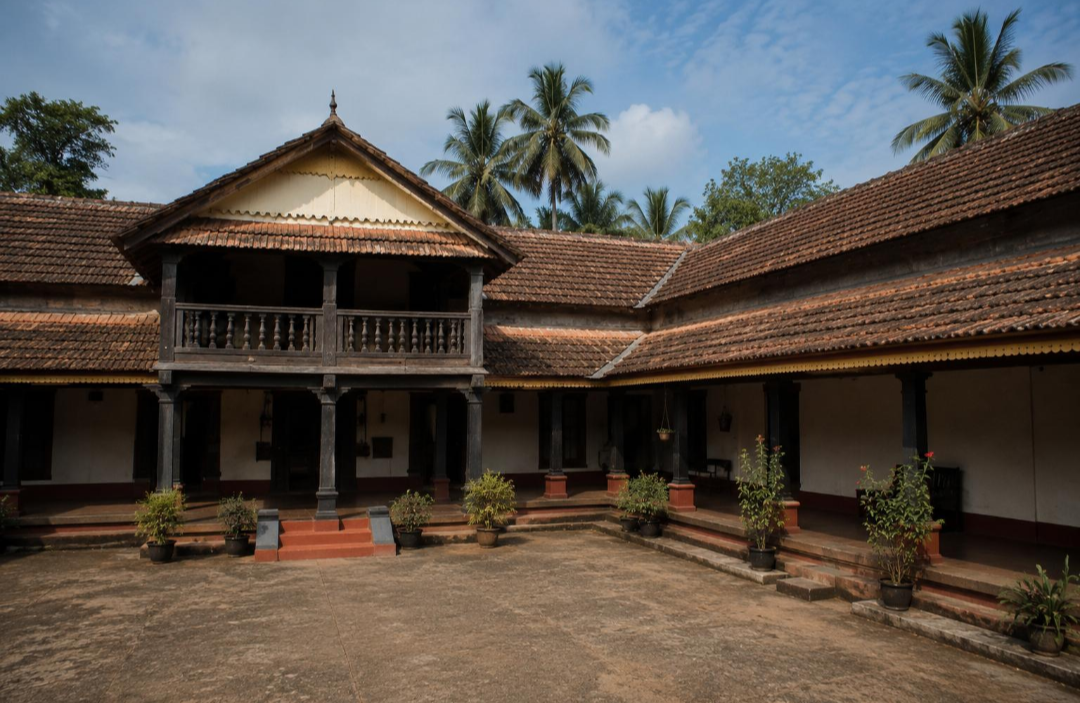
Each okka traditionally maintains an ancestral house, or ainmane, which serves as a focal point for family gatherings, festivals, and rites honouring the family's Guru Karana — a revered common ancestor. Kodava settlements have historically taken the form of scattered okka family groups across agricultural and forest land rather than dense townships, with the ainmane forming the heart of the rural landscape. A Kodava woman is traditionally referred to as a Kodavathi.
Historically, the community held a respected position among the landholding communities of the region, alongside groups such as the Nairs, Bunts, and Vokkaligas. Land in Kodagu was historically held under a distinctive tenure system known as Jamma tenure, under which agricultural land — along with rights over adjoining forest land (bane) — was held hereditarily, indivisibly, and largely by Kodava families, a system that has helped keep many family landholdings intact across generations.
5. Language
Kodava takk is an independent Dravidian language with its own vocabulary, distinct from but influenced by neighbouring languages including Kannada, Malayalam, and Tulu. It remained primarily a spoken language, without a standardised literary tradition, until the early twentieth century. The earliest known inscription believed to be connected to the language is the Bhagamandala inscription, dated to around 1370 CE.
Several scripts have been proposed for Kodava takk over the years, including one devised by Dr Koravanda Appaiah in 1887 and another by Dr I. M. Muthanna in 1970. In February 2022, the Karnataka Kodava Sahitya Academy formally adopted Dr I. M. Muthanna's script as the official script for the language. Kodava literature developed substantially through the efforts of writers such as Appaneravanda Haridasa Appachcha Kavi and Nadikerianda Chinnappa, whose early twentieth-century work remains foundational to the study of Kodava culture and folklore.
Besides the Kodavas proper, several other communities historically resident in Kodagu — including the Amma Kodavas and the Kodagu Heggades — also speak Kodava takk and share many customs with the wider Kodava community.
6. Religion and Belief System
Kodavas are predominantly Hindu, with a religious life centred on the worship of nature, ancestors, and weapons, alongside devotion to a local trinity: the goddess Kaveri (Kuladevi, or patron goddess, worshipped as the river Kaveri), Lord Igguthappa (regarded as the chief local deity, associated with rain, harvest, and rice), and the Guru Karana, the revered founding ancestor of each family.
Ancestor worship is a defining feature of Kodava religious practice: each clan maintains a kaimada, a shrine dedicated to its first ancestor, where the spirits of respected past family members are honoured, often symbolised by a sanctified stone rather than a conventional image, alongside ceremonial weapons. Families gather annually to make offerings to their ancestors.
Kodavas also maintain sacred groves known as devarakadu (literally, “God's forest”) on village lands, considered the abode of local deities and traditionally protected from hunting and tree-felling. Nearly every village maintains at least one such grove, which also serves as an important reservoir of local biodiversity. Major Kodava shrines include the temples at Talakaveri (the source of the river Kaveri), Bhagamandala, and Padi Igguthappa.
7. Festivals
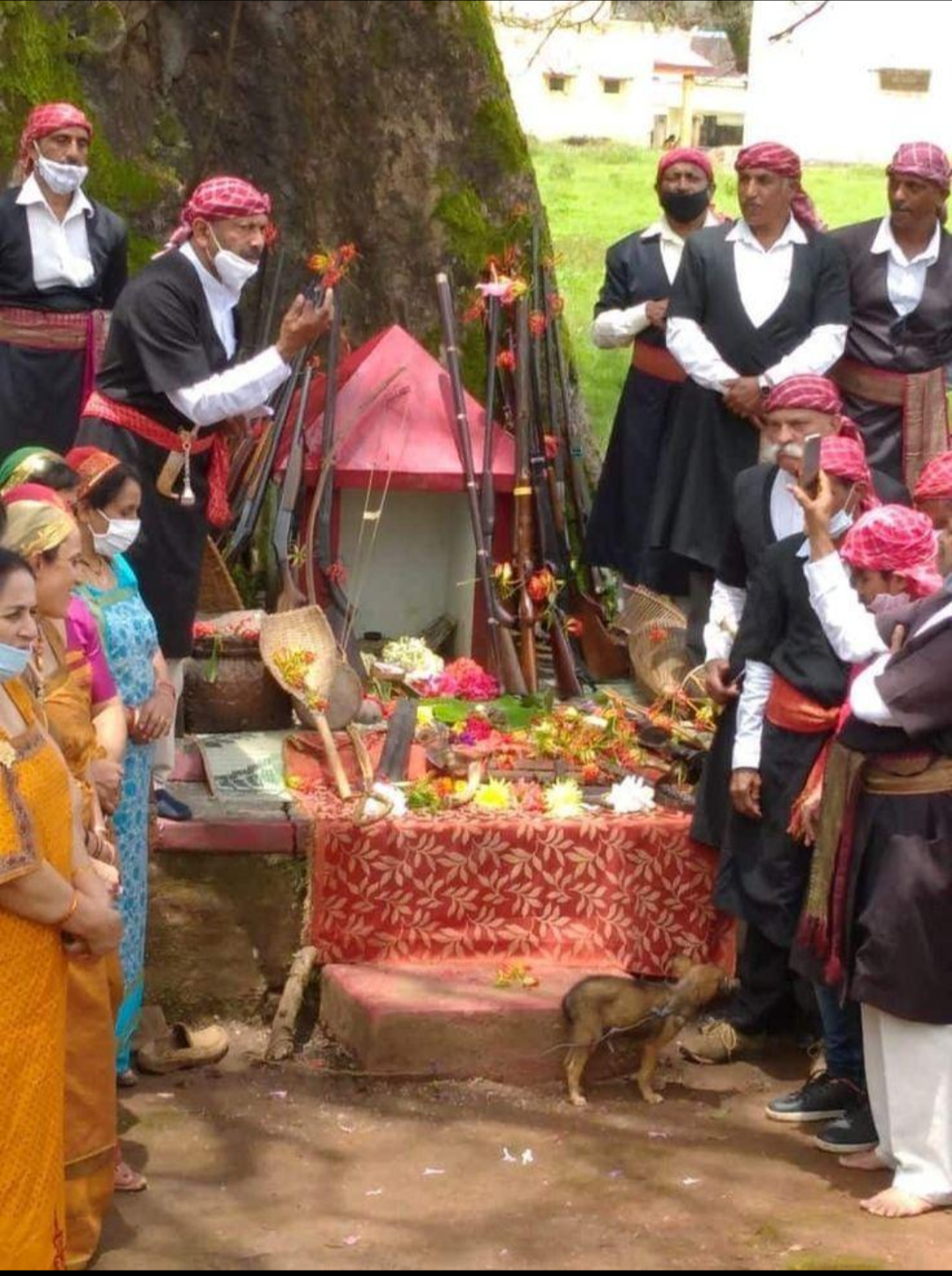
Kodava festivals are closely tied to the community's agricultural and martial traditions. The Kodava new year was traditionally observed on Bishu Changrandi (known as Vishu in neighbouring Kerala), and over time the community also adopted several pan-Hindu festivals such as Ugadi, Ayudha Puja (Dasara), and Mahashivaratri. However, three festivals are considered distinctly and originally Kodava:
- Kail Poldh (celebrated around 3 September): an “arms festival” marking the end of paddy transplantation, when family weapons are ceremonially taken from the household prayer room, cleaned, decorated with flowers, and worshipped, followed by community sporting contests such as marksmanship and traditional games held on the village mand (open ground).
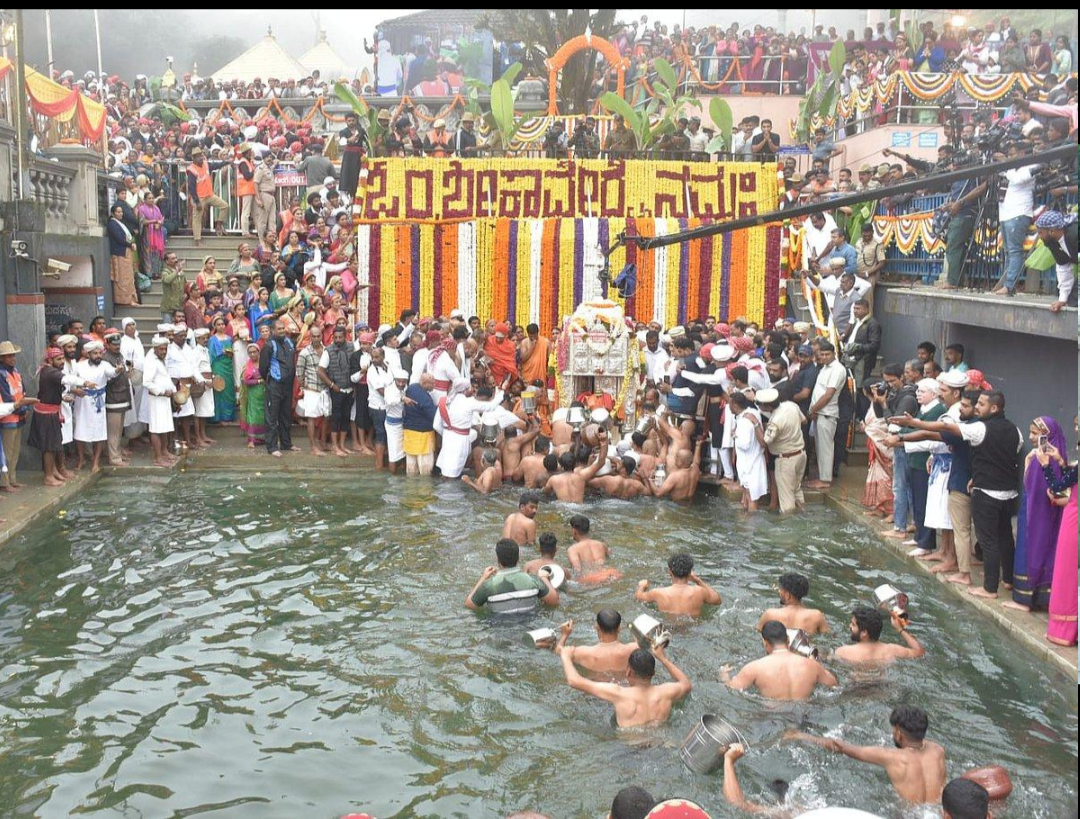
- Kaveri Sankramana (mid-October): a festival honouring the river goddess Kaveri, observed at her source at Talakaveri, where a fountain is believed to fill the holy tank at a precise astronomically determined moment; the water collected, known as theertha, is preserved in Kodava homes. This is the community's principal vegetarian festival, on which married women perform a puja to a vegetable symbolising the goddess.
- Puthari (late November or early December): the rice harvest festival, held on the night of a full moon, during which ancestral homes are decorated, the paddy harvest is symbolically gathered in a torch-lit procession to the fields, and offerings are made to ancestors before the family feasts together.
Villages across Kodagu also hold an annual or biennial Naad Namme (village festival), a multi-day community celebration involving processions, traditional performances, and worship at the local village temple, usually concluding with communal feasting.
8. Marriage Customs
Kodava weddings traditionally combine community ceremony with Hindu ritual, and, distinctively, have not historically required the presence of a Brahmin priest, being conducted instead by community elders. Marriage is exogamous with respect to one's own okka (clan) but otherwise takes place within the broader Kodava community. Traditional elements associated with Kodava weddings include community blessings from elders, the exchange of ceremonial gifts between families, and a Kodava-style mangalasutra known as the pathak, worn by married women alongside other traditional jewellery.
Weddings, like other major family occasions, are typically hosted at or in connection with the family's ancestral ainmane and involve the wider okka, reflecting the central role of the extended clan in Kodava social life.
9. Cuisine
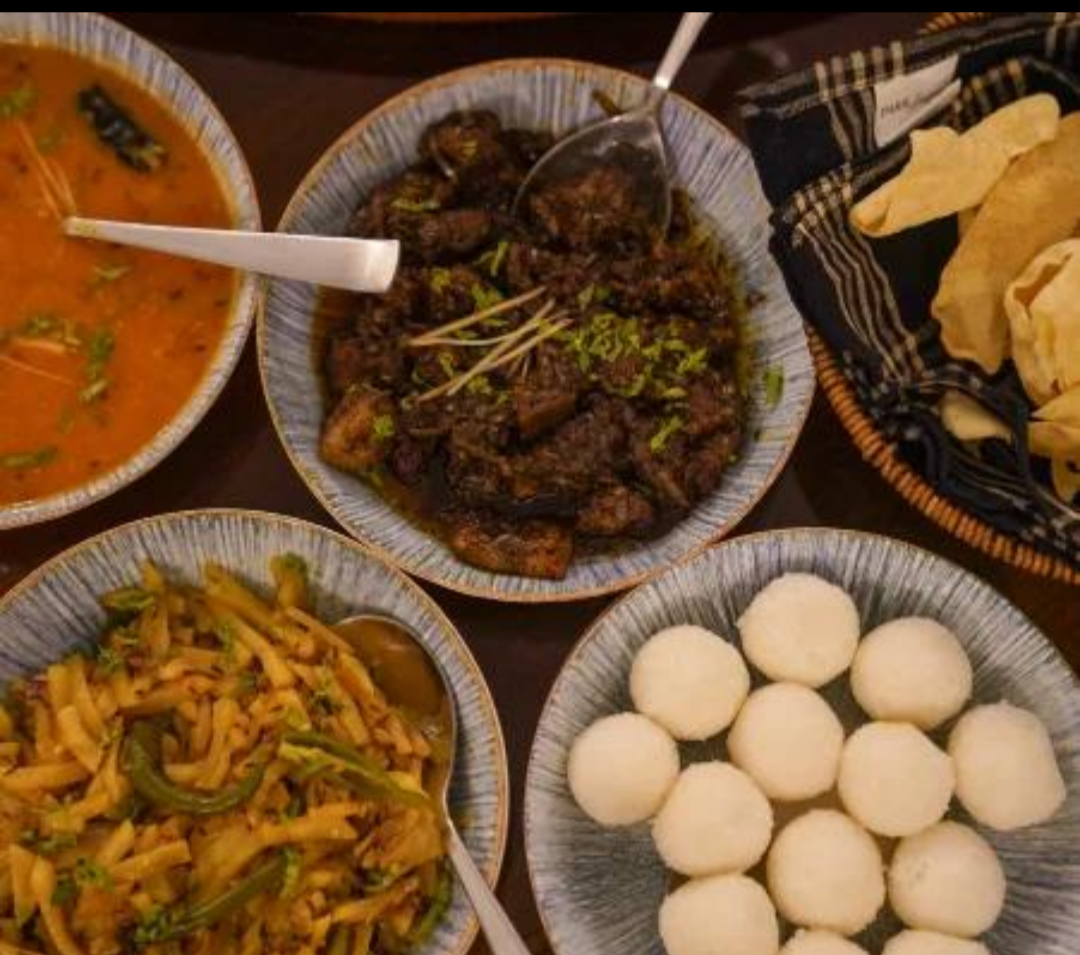
Kodava cuisine is a distinctive regional cuisine shaped by the district's monsoon-fed hill agriculture, rice cultivation, and forest produce. Boiled rice (koolu) is the community's staple, generally served at both lunch and dinner, and rice preparations such as kanji (rice gruel) are everyday fare.
- Pandhi curry: the community's best-known dish, a pork curry (traditionally made with wild boar) distinguished by the use of kachampuli, a dark, tangy vinegar made from Garcinia cambogia, and typically served with kadumbuttu (steamed rice balls).
- Kadumbuttu, otti, paaputtu, and noolputtu: steamed and pressed rice preparations that accompany curries; noolputtu (rice noodles) is often served with a Coorg-style chicken curry.
- Thambuttu: a sweet dish made from ripe bananas and roasted rice flour, prepared specially for the Puthari harvest festival.
- Akki payasa: a rice-based sweet dish prepared on festive occasions.
- Other specialities: bamboo shoot (bymbale) preparations, wild mushrooms and leafy greens, raw mango curry, and dishes using jackfruit, avocado (butter fruit), and river fish.
Meat, river fish, and alcoholic beverages are traditionally permitted in Kodava households and feature prominently at community feasts, with the notable exception of the Kaveri Sankramana festival, which is observed as strictly vegetarian.
10. Traditional Dress and Ornaments
Kodava traditional dress is among the most visually distinctive in South India. Men traditionally wear the kupya, a long, dark, wraparound robe cinched with an ornate waistband called the chele, along with a distinctive turban (mande thuni); the kupya is now largely reserved for ceremonial and cultural occasions. Ceremonial weapons — particularly the odi kathi (a machete-like knife) and peeche kathi (a curved dagger) — are traditionally worn by Kodava men on formal and religious occasions and feature in the community's official emblem.
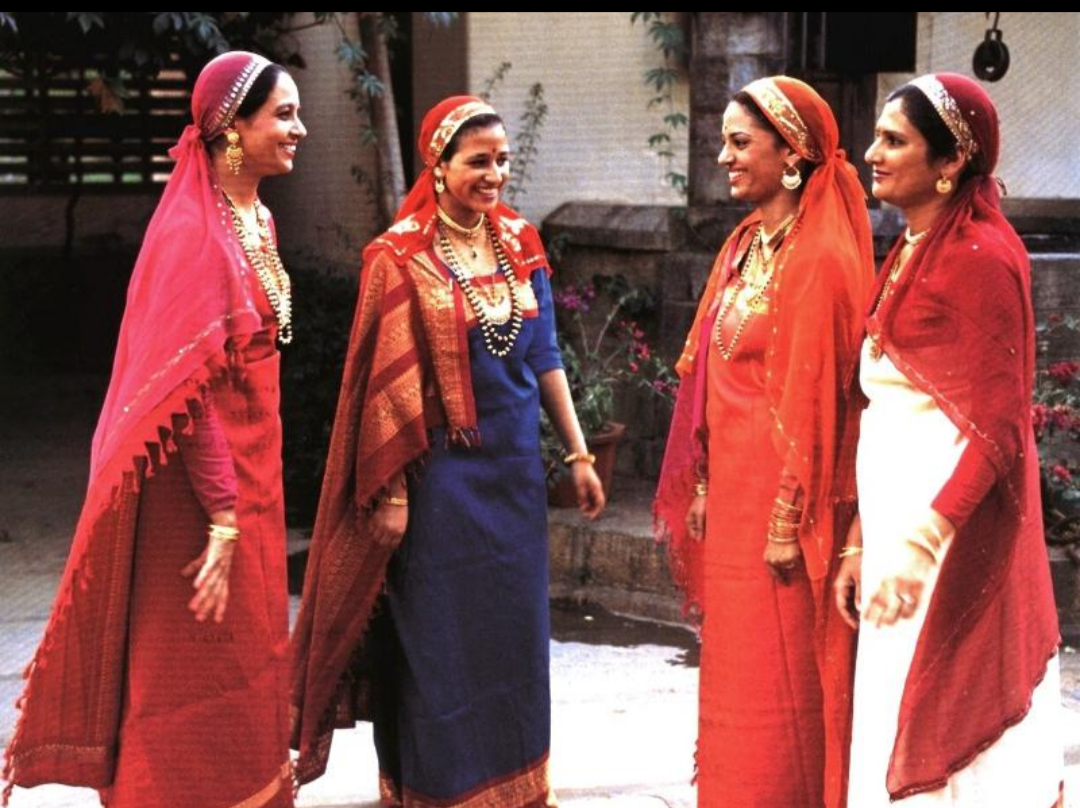
Kodava women wear the sari in a distinctive local style, with the pleats gathered at the back and the loose end pinned at the right shoulder, differing from typical Kannadiga or Malayali draping styles. The pathak, a Kodava-style mangalasutra, is worn by married women. The Kodava emblem itself — featuring the odi kathi, peeche kathi, and a shotgun — was designed by Muckatira Ponnappa Mandanna in the 1960s and has since become a widely recognised symbol of Kodava and Kodagu identity.
11. Traditional Housing and Architecture
The ainmane, or ancestral house, is the architectural and social centre of Kodava family life. These are traditionally large houses built around a central hall known as the nellakki nadubade, where the family's sacred lamp is kept continuously lit, and a kannikombare, or prayer room, where family deities and, on ordinary days, ceremonial weapons are kept. The ainmane serves as the venue for major family rites, festivals, and gatherings of the okka, and its upkeep is regarded as a shared responsibility of the extended family.
12. Folklore and Oral Tradition
Kodava oral tradition is rich in folk songs (known as pattu) and ballads describing clan histories, local deities, courtship, and agricultural life, passed down for generations before being systematically documented. The most significant compilation of this tradition is the Pattole Palame, assembled by the Kodava scholar Nadikerianda Chinnappa in the early twentieth century (published 1924), which remains the definitive written record of Kodava customs, folk songs, and oral history and is regarded as a foundational text of Kodava literature and ethnography.
The folk tradition also preserves memories of the community's historical links with temple towns of northern Malabar (in present-day Kerala), reflecting a long history of pilgrimage and trade across the Western Ghats.
13. Martial Tradition, Sports, and the Armed Forces
Kodavas have a long-standing martial tradition rooted in their history as an agriculturist community that also bore arms in defence of their land. This heritage is formally recognised in Indian law: Kodavas are exempt from certain provisions of the Indian Arms Act and are among the few communities in India permitted to possess firearms without a licence, an exemption with roots going back to the Indian Arms Acts of 1861 and 1878.
The community has a particularly notable association with the Indian armed forces, producing numerous senior officers, including two of independent India's most celebrated military leaders: Field Marshal K. M. Cariappa, the first Indian Commander-in-Chief of the Indian Army, and General K. S. Thimayya, a former Chief of Army Staff. Many other Kodavas have risen to the ranks of Lieutenant General, Major General, Brigadier, and Air Marshal, and the community counts numerous gallantry award recipients among its members.
Kodagu is widely regarded as the cradle of Indian field hockey, and more than fifty Kodavas have represented India in international hockey, several at the Olympic Games. The Kodava Hockey Festival, in which teams representing individual family clans compete, is recognised as one of the largest field hockey tournaments in the world by participant numbers. Kodavas have also achieved national and international distinction in tennis, squash, badminton, athletics, boxing, motor racing, and cricket.
14. Livelihoods and Economy
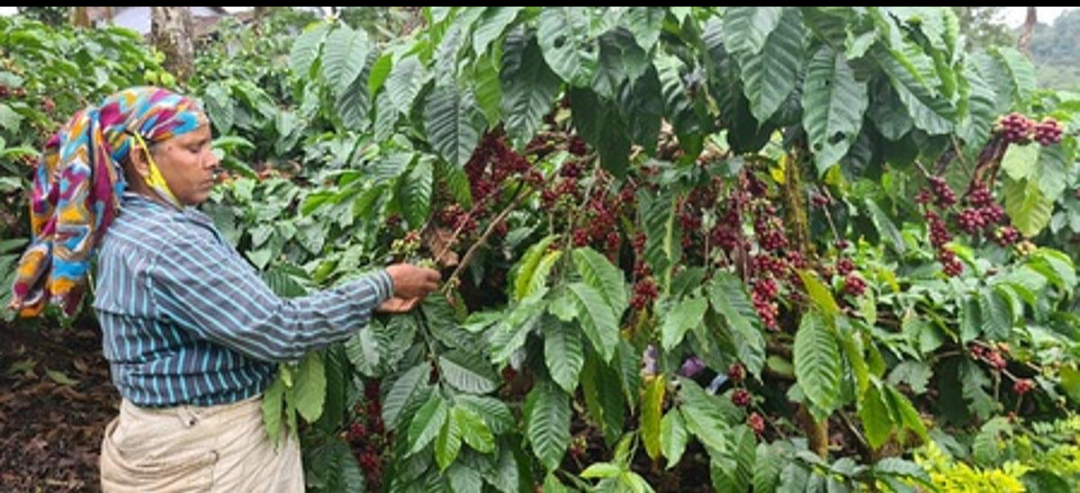
Kodavas have traditionally combined agriculture with martial service, cultivating paddy and, historically, crops such as pepper and plantains. Coffee cultivation, introduced to the Western Ghats region in earlier centuries and expanded significantly following the arrival of European planters after the British annexation of 1834, has since become central to the Kodava economy. Kodagu district today produces more than one-third of India's coffee, making it the country's most important coffee-growing district. Beyond agriculture, the community has historically shown strong representation in government service, the armed forces, medicine, law, and, more recently, business and the professions.
15. Diaspora
While Kodagu remains the community's historical homeland, many Kodavas have migrated to other Indian cities — particularly Bengaluru, Mysuru, and Mangaluru — as well as Chennai, Mumbai, Hyderabad, and Delhi, in pursuit of education and professional opportunity. A smaller diaspora is established internationally, including in North America, the United Kingdom, Australia (notably Sydney, where Kodavas are represented in the financial and healthcare sectors), and parts of the Middle East such as the UAE and Oman. Kodava Samajas (community associations) in these cities and countries help sustain cultural and social ties, hosting festivals, sporting events, and cultural gatherings such as Kodava hockey tournaments for the diaspora community.
16. Notable Figures
16.1 Military and Public Service
- Field Marshal K. M. Cariappa — first Indian Commander-in-Chief of the Indian Army.
- General K. S. Thimayya — former Chief of the Army Staff of India.
- C. B. Muthamma — the first woman officer of the Indian Foreign Service.
- C. M. Poonacha — Chief Minister of Coorg State (1952–56) and later Governor of Odisha and Madhya Pradesh.
16.2 Sports
- Rohan Bopanna — national and international tennis champion.
- Robin Uthappa — former Indian national cricket team player.
- Ashwini Nachappa and M. R. Poovamma — national athletics champions and Olympians.
- Joshna Chinappa and Ashwini Ponnappa — national champions in squash and badminton respectively.
16.3 Arts, Culture, and Public Life
- Rashmika Mandanna — actress, born to a Kodava family in Virajpet, Kodagu.
- Kaveri Nambisan and Sarita Mandanna — novelists whose works, including The Scent of Pepper and Tiger Hills, are set among the Kodava community.
- Kaveri Ponnapa — author of The Vanishing Kodavas (2013), a widely cited scholarly study of Kodava culture and cuisine.
- Nadikerianda Chinnappa — compiler of the Pattole Palame, the foundational document of Kodava folklore and customs.
18. Conclusion
The Kodavas of Kodagu represent a distinctive case among India's regional communities: an agriculturist and martial people whose clan-based social structure, ancestor worship, and closely guarded oral tradition have persisted for over a millennium in the hills of the Western Ghats, even as coffee cultivation, military service, and, more recently, professional migration have reshaped the community's economic and geographic footprint. From the ancestral ainmane and the sacred groves of the devarakadu to the genome-wide studies now tracing the community's deep ancestral lineages, and from the Pattole Palame's folk songs to a diaspora that spans Bengaluru to Sydney, the Kodava story is at once a distinct regional culture, a subject of active scientific inquiry, and a living tradition still practised today.
Frequently Asked Questions
Who are the Kodava people?
The Kodavas, also called Coorgs, are an endogamous Dravidian ethnolinguistic community native to Kodagu (Coorg), a hill district in Karnataka, India. They speak Kodava takk, are traditionally landowning agriculturists with a strong martial tradition, and form the largest community in Kodagu district.
Are Kodavas a caste or a tribe?
Kodavas are generally described as an ethnolinguistic community rather than a single caste or a Scheduled Tribe. They are included under certain Other Backward Classes categories in Karnataka's state list, and community organisations have at various times sought Scheduled Tribe recognition; this remains a matter of ongoing public discussion rather than settled classification.
What language do Kodavas speak?
Kodavas speak Kodava takk, an independent Dravidian language native to Kodagu. It was primarily an oral language until the early twentieth century, when written literature and, eventually, an official script (adopted in 2022) were developed for it.
What religion do the Kodavas follow?
Kodavas are predominantly Hindu. Their religious life centres on ancestor worship, nature worship (including sacred groves called devarakadu), and a local trinity comprising the goddess Kaveri, the deity Igguthappa, and the Guru Karana, or founding family ancestor.
What is Kodava DNA or ancestry, according to genetic studies?
A genome-wide study by researchers from the University of Delhi South Campus and CSIR-CCMB Hyderabad found that Kodava maternal (mitochondrial) DNA is about 40% South Asian in origin, while paternal (Y-chromosome) DNA shows a mix of Eurasian, Middle Eastern, and India-specific lineages. The study identified three distinct ancestral lineages within the population, the oldest dating back roughly 3,000 years, suggesting an early Bronze Age origin with later male-dominated migration into the region.
What is the Kodava community known for?
Kodavas are known for their martial tradition and strong representation in the Indian armed forces, their distinctive Pandhi curry (pork curry) and rice cuisine, their traditional dress (the kupya for men), their role in India's coffee industry, and their outsized contribution to Indian field hockey — Kodagu is often called the cradle of Indian hockey.
Why are Kodavas allowed to carry guns without a licence?
Kodavas are among the few communities in India exempt from certain licensing provisions of the Indian Arms Act, a recognition of their historical martial and militia role in Kodagu that dates back to the Arms Acts of 1861 and 1878, and which continues to apply today.
What is Pandhi curry?
Pandhi curry is a traditional Kodava pork curry, historically made with wild boar, flavoured with a distinctive dark vinegar called kachampuli (made from Garcinia cambogia). It is typically served with kadumbuttu, steamed rice balls, and is the community's best-known dish.
What are the main Kodava festivals?
The three festivals considered uniquely Kodava are Kail Poldh (an arms festival marking the end of paddy transplantation), Kaveri Sankramana (a vegetarian festival honouring the river goddess Kaveri at Talakaveri), and Puthari (the rice harvest festival, held on a full moon in late November or early December).
What is an ainmane?
An ainmane is a Kodava ancestral house, traditionally the focal point of an extended family clan (okka). It houses the family's sacred central hall (nellakki nadubade) and prayer room, and is where major family rites, festivals, and gatherings of the clan take place.
What is the Kodava clan or okka system?
Kodava society is organised into patrilineal clans called okkas, each linked to an ancestral house. Marriage is traditionally exogamous at the okka level (a person marries outside their own clan) but endogamous at the community level (traditionally within the wider Kodava community).
Who are some famous people from the Kodava community?
Notable Kodavas include Field Marshal K. M. Cariappa and General K. S. Thimayya (two of independent India's most senior military leaders), tennis player Rohan Bopanna, cricketer Robin Uthappa, athletes Ashwini Nachappa and M. R. Poovamma, and actress Rashmika Mandanna.
What is traditional Kodava dress called?
Kodava men traditionally wear the kupya, a long wraparound robe worn with an ornate waistband (chele) and a turban, now generally reserved for ceremonial occasions, along with ceremonial knives (the odi kathi and peeche kathi). Kodava women wear the sari in a distinctive local style, with the pleats gathered at the back and the loose end pinned at the right shoulder.
Why is Kodagu associated with coffee and hockey?
Coffee cultivation expanded significantly in Kodagu after European planters settled there following the British annexation of 1834, and the district now produces more than a third of India's coffee. Kodagu is also considered the cradle of Indian field hockey, having produced more than fifty international players, and hosts the Kodava Hockey Festival, one of the largest family-team hockey tournaments in the world.
References
- [1]Wikipedia. “Kodava people.” https://en.wikipedia.org/wiki/Kodava_people
- [2]Wikipedia. “Kodava language.” https://en.wikipedia.org/wiki/Kodava_language
- [3]Wikipedia. “Kodagu district.” https://en.wikipedia.org/wiki/Kodagu_district
- [4]Kushalappa, Mookonda. Deccan Herald — series of articles on Kodava festivals, including “Revering nature and culture,” “A unique temple festival,” “Time to soak in the revelry,” and “Mand — open air temples of Kodagu.” https://www.deccanherald.com
- [5]Research Matters (a public-outreach initiative of Gubbi Labs). “Genetic studies show Kodavas of Coorg have a complex, unique past.” https://researchmatters.in/news/genetic-studies-show-kodavas-coorg-have-complex-unique-past
- [6]Bopanna, P. T. Coorg Tourism Info (blog). “Origin of Kodavas (Coorgs): genetic study of Kodavas suggest they migrated from Eurasian and Middle Eastern regions” and “Genetic study of Kodavas: men first migrated to Kodagu (Coorg) and married local women.” https://www.coorgtourisminfo.com/blog/
- [7]Communications Biology (Nature Portfolio) — genome-wide study of the Kodava population by researchers from the University of Delhi South Campus and CSIR-Centre for Cellular and Molecular Biology (CCMB), Hyderabad.
- [8]Ganapathy, B. D. (1967). Kodavas (Coorgs), their customs and culture.
- [9]Chinnappa, Nadikerianda (1924). Pattole Palame (compilation of Kodava folk songs and customs).
- [10]Kamath, S. U. (1993). Karnataka State Gazetteer: Kodagu District. Bangalore: Government Press.
- [11]Richter, G. (1870). Manual of Coorg — A Gazetteer of the natural features of the country and the social and political condition of its inhabitants. Mangalore: C. Stolz, Basel Mission Book Depository.
- [12]The Economic Times. “Government continues British-era exemption given to Kodavas of Coorg for arms licence.” 30 October 2019.
- [13]The Hindu, Times of India, Deccan Herald, and Hindustan Times — various reports on Kodava sporting achievements, military service, and cultural events, cited in the Wikipedia community entry.