Nair Nair

Nair Community

Ethnicity · ethnicity · nair

The Nairs are a prominent Hindu community of Kerala, historically known for their warrior, administrative, and landholding roles and matrilineal traditions.

THE NAIRS OF KERALA
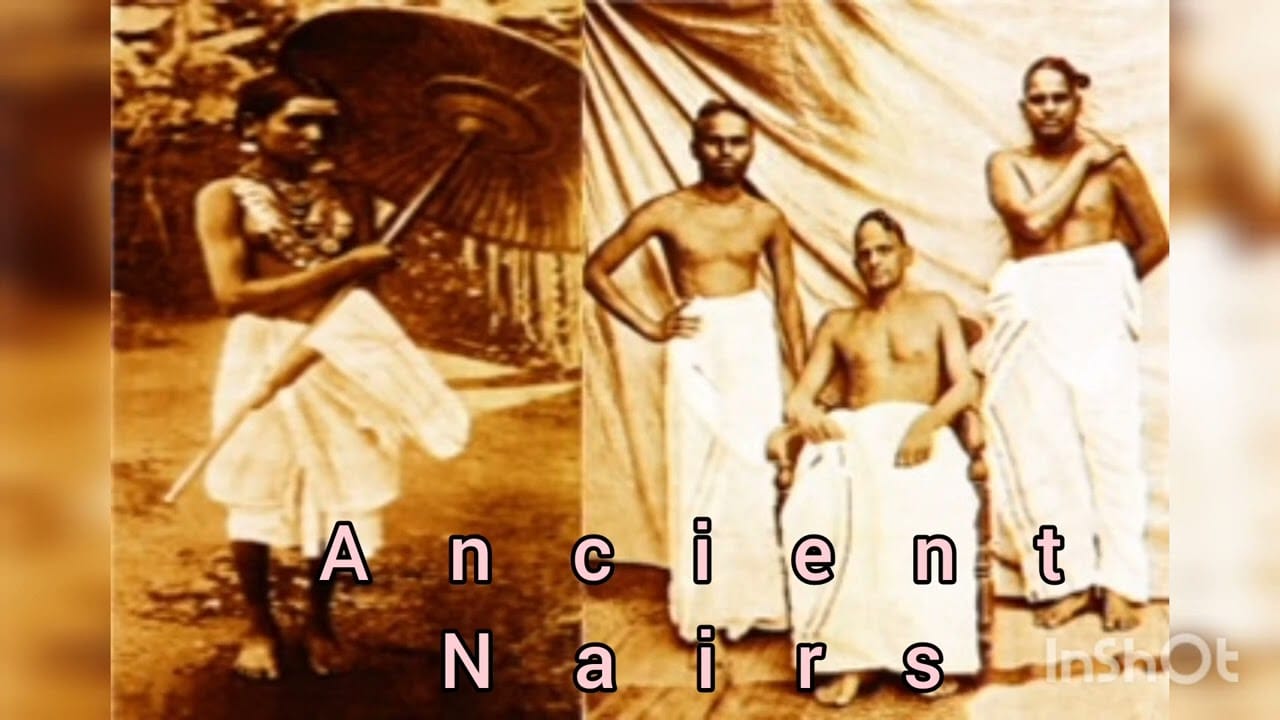
Sepia-toned historical photograph of Nair community members from Kerala. One man stands holding a ceremonial umbrella while three others pose in traditional white mundu attire, reflecting the dress, customs, and cultural identity of the Nair community in pre-modern Kerala.
Traditional Nair men of Kerala in a historic photograph, showcasing the community's distinctive attire, social status, and cultural heritage from the late 19th to early 20th century.
History, Society, Culture and Genetic Ancestry of a Matrilineal Warrior Community

The Nairs (also written Nayars, and known in Malayalam as Nayanmar or Nair) are one of the most historically prominent and widely discussed communities of Kerala, on India's southwestern coast. For roughly a thousand years, Nair families supplied the region's soldiers, estate-holders, temple trustees and palace officials, and their name is inseparable from three things that fascinate outsiders and insiders alike: the martial art of Kalaripayattu, the matrilineal family system known as marumakkathayam, and an unusually contested question of caste status that placed them somewhere between the Brahmin Namboothiris above them and the wider Dravidian population around them. This article draws together what is known about Nair origins, social organization, customs, historical trajectory, and from the last two decades of population genetics research, what DNA evidence adds to a debate that older written sources alone could never fully settle.

Who Are the Nairs?

Nair is an umbrella term for a large cluster of related castes and sub-castes native to Kerala, historically concentrated in the erstwhile kingdoms of Travancore, Cochin and Malabar. In the traditional social order the community occupied an intermediate but locally powerful position: below the small, highly endogamous Namboothiri Brahmin caste that monopolised priestly and much landowning authority, yet clearly above the numerically larger cultivating and artisan communities such as the Ezhavas/Thiyyas, and above the Scheduled Caste and Scheduled Tribe communities of the region. Because Kerala's caste system never mapped cleanly onto the four-fold varna model used further north, Nairs are variously described in colonial ethnography and community tradition as Kshatriyas (the warrior-ruler class), as Shudras of unusually high standing, or as a distinct 'Samantan' (noble) category particular to Kerala. There is no scholarly consensus on a single 'correct' varna label, and this ambiguity is itself one of the most discussed features of Nair identity.
The name is generally derived from the Sanskrit/Malayalam word for 'leader' or 'chief', reflecting the community's historical role as a class of local governors, feudal landlords and armed retainers. Population estimates today put the number of people identifying as Nair at somewhere between 15 and 20 million, making them one of the largest single communities in Kerala, alongside the Ezhava/Thiyya and Muslim (Mappila) populations.

Origins: Competing Theories

Where the Nairs came from, and how long they have been in Kerala, has been argued over by historians, community writers and, more recently, geneticists. Three broad explanations recur in the literature.
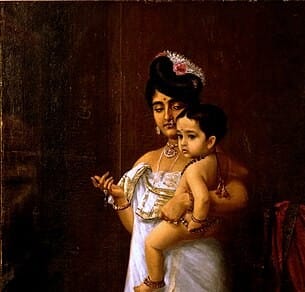
Historical painting depicting a Nair woman dressed in a white kasavu-style garment with gold borders, carrying a young child adorned with traditional jewelry. A dog sits beside her, while the indoor setting and attire illustrate the social life, family structure, and cultural heritage of the Nair community in Kerala.
A traditional Nair woman of Kerala holding a child in a classical portrait, reflecting the community's matrilineal heritage, elegant attire, and cultural traditions.

1. Northern migration and Nagavamshi descent

The community's own traditions, echoed in several colonial-era gazetteers, hold that the Nairs descend from Kshatriya or Nagavamshi ('serpent-dynasty') warrior groups who migrated south from the Gangetic plains or the Deccan in the early centuries of the Common Era, sometimes linked to the wider movement of Naga tribal confederacies across the subcontinent. Serpent (Naga) worship, still widespread in Nair households through sacred groves called kavu, is frequently cited as a cultural fossil of this claimed origin. A related theory ties Nair origins to the Ahichhatra region of North India and to the same migratory wave said to have produced the matrilineal Bunt community of coastal Karnataka.

2. Indigenous Dravidian development

An alternative and equally well-argued position, favoured by many historians of Kerala, is that the Nairs are fundamentally an indigenous Dravidian population that consolidated into a warrior-landowning class within Kerala's own feudal system, particularly after the ninth and tenth centuries CE, a period that saw repeated incursions by the Rashtrakuta and Chola powers and the growth of temple-centred, Brahmin-dominated local polities. On this reading, the community's northern-sounding titles and Kshatriya claims are a later cultural overlay, acquired through centuries of proximity to Namboothiri Brahmins rather than through any actual migration.

3. A composite, layered origin

A third and increasingly influential view treats the first two theories as complementary rather than contradictory: an indigenous Dravidian population absorbed successive, smaller streams of migrants and cultural influence from the north over many centuries, gradually consolidating into the community recognisable as 'Nair' by the early medieval period. As later sections show, this composite model fits the genetic evidence more comfortably than either single-origin story on its own.

Society and Family: The Taravad and Marumakkathayam

The institution for which Nairs are best known outside Kerala is marumakkathayam, a matrilineal system of descent and inheritance that was, until the mid-twentieth century, close to unique in mainland India (it was shared with the Bunts of Tulu Nadu and, in modified form, a handful of neighbouring Kerala communities such as the Ambalavasis).

Under marumakkathayam, property, lineage and identity passed through the female line. Children belonged to their mother's taravad an extended joint family occupying an ancestral home, often a large courtyarded house known as a nalukettu (four-sided) or the grander ettukettu (eight-sided). The taravad was headed by the senior-most male relative on the mother's side, the karanavan, who managed the joint property on behalf of the whole lineage rather than his own children. A man's property and titles passed not to his own sons and daughters but to his sister's children his nephews and nieces since it was they, not his own offspring, who belonged to his taravad.

Sambandham

Marriage in the older Nair system took the form of sambandham, a relatively informal conjugal alliance rather than a permanently binding marriage in the North Indian sense. A husband visited his wife at her taravad but had no rights over her property, and either party could end the arrangement with comparative ease. Sambandham is also historically significant because Namboothiri Brahmin families practised strict primogeniture: only the eldest son of a Namboothiri household was permitted to marry within the caste, so that family property would not fragment. Younger Namboothiri sons instead commonly formed sambandham alliances with Nair women. Over many generations this created a sustained, socially sanctioned channel through which Namboothiri paternal lineages entered Nair families a pattern with measurable genetic consequences discussed later in this article.

Kettu Kalyanam and other life-cycle rites

Traditional Nair life included several distinctive rites of passage, most notably the kettu kalyanam (or thalikettu kalyanam), a ceremonial 'mock marriage' performed for girls before puberty, in which a symbolic thali (marriage pendant) was tied by a ritual partner who bore no ongoing marital obligation. This was followed later in life by sambandham proper. These practices, along with the taravad and marumakkathayam system as a whole, were progressively legislated out of existence through a sequence of reform acts beginning in the late nineteenth century and culminating in the Kerala Joint Hindu Family System (Abolition) Act of 1976, which formally ended joint taravad ownership in favour of nuclear-family inheritance.

Warriors of Kerala: Kalaripayattu and Military Role
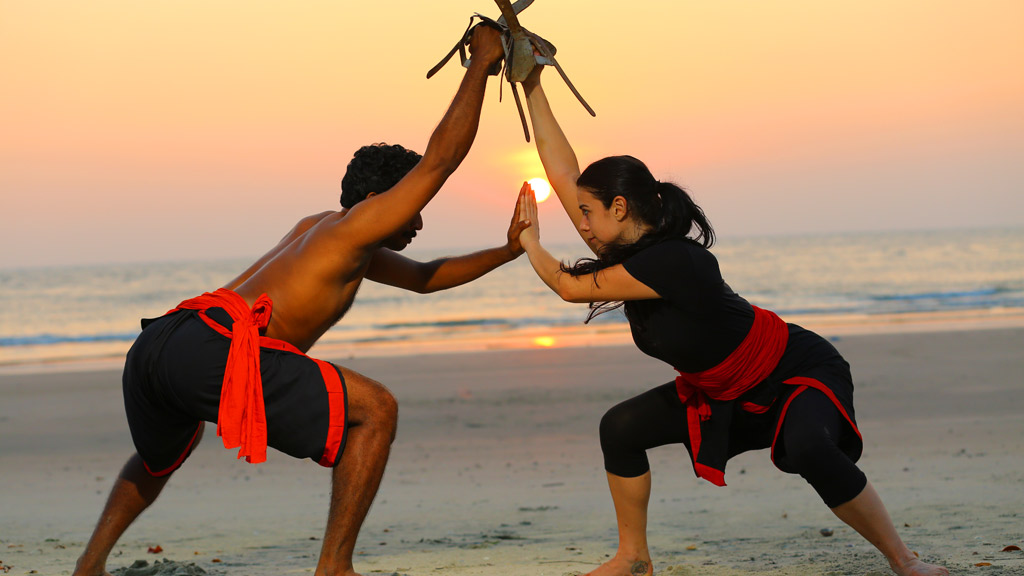
Two Kalaripayattu practitioners spar on a beach at sunset, wearing black training attire with red waist sashes. One holds traditional training weapons overhead while both maintain low martial stances, showcasing the agility, discipline, and techniques of Kerala's ancient martial art, Kalaripayattu.
Kalaripayattu practitioners demonstrate a traditional combat stance during a training session. Often associated with Kerala's martial heritage, Kalaripayattu has historically been practiced by Nair warriors and remains an important symbol of Kerala's cultural identity.

For most of the medieval and early modern period, Nairs formed the backbone of Kerala's fighting forces and its landed gentry. Nair boys were traditionally enrolled from a young age in a kalari, a martial-arts training ground, to learn Kalaripayattu widely regarded as one of the oldest systematised martial arts in the world, combining armed and unarmed combat, acrobatics, and a body of medical knowledge (marmam, or vital-point therapy) originally used to disable opponents and later repurposed for therapeutic massage. The northern (vadakkan) style of Kalaripayattu in particular is closely associated with the Nair community, and Nair sub-groups such as the Kurups and Panickers traditionally served as its hereditary teachers (asans/gurukkal).

Nair soldiery ranged from the household guards of local chieftains to elite suicide-squads (chavers) who swore to die fighting rather than accept defeat, most famously in the recurring wars between the Zamorin of Calicut and the Kingdom of Valluvanad over control of the Mamankam festival. Beyond warfare, Nairs staffed the civil and administrative apparatus of Kerala's princely states, held tenure over large tracts of temple and crown land as jenmis (landholders), and provided the officer corps of the Travancore and Cochin state forces well into the colonial period.

This martial prominence effectively ended under British rule. Colonial administrators regarded an armed, organised warrior caste as a standing threat to their authority, and Kalaripayattu training and the right to bear arms were formally suppressed from the late eighteenth century onward a ban issued after the Malabar rebellions of the 1790s that hollowed out a central pillar of Nair social identity. Interest in Kalaripayattu was later revived in the twentieth century, and it is now taught and performed both as a martial art and as a globally recognised cultural heritage practice.

Sub-Groups Within the Nair Community

'Nair' is not a single, internally uniform caste but a confederation of numerous endogamous sub-groups with their own historical roles, ritual status and, in some cases, distinct surnames among them Kiriyathil Nair, Illathu Nair, Swaroopathil Nair, Padamangalam Nair, Veluthedathu Nair, Kurup, Panicker, Menon, Pillai, Kartha, Nambiar and Vazhunnavar, among many others. Some sub-groups, such as Kiriyathil and Illathu Nairs, historically maintained particularly strict internal rules and closer ritual proximity to Namboothiri households; others, such as Kurups and Panickers, were defined by hereditary occupation (martial instruction); Padamangalam Nairs of some regions trace descent from Tamil Maravar temple-servant lineages. Because of this internal diversity, geography also mattered: Nair families of northern Malabar and those of southern Travancore developed somewhat different customs through differing patterns of contact with neighbouring communities.

Genetics of the Nair Community

Written and oral history can only take the origin question so far. Over the past two decades, whole-genome and haplogroup studies of South Asian populations including targeted sampling of Kerala communities have given researchers an independent line of evidence to test the migration, indigenous-development and composite-origin theories described above.

Autosomal ancestry: the ANI–ASI balance

Most South Asian populations can be modelled as a mixture of two deep ancestral components: Ancestral North Indian (ANI), which carries a substantial Iranian-farmer-related and, further back, West Eurasian steppe-pastoralist signal, and Ancestral South Indian (ASI), which is dominated by the deeply indigenous Ancient Ancestral South Indian (AASI) lineage that has been present in the subcontinent for tens of thousands of years. Kerala's traditional social hierarchy tracks this admixture gradient with striking regularity:
CommunityANI %ASI %Traditional status
Namboothiri Brahmin50–60%35–45%Brahmin
Nair40–50%45–55%Kshatriya / high Shudra (debated)
Ezhava / Thiyya30–40%55–65%OBC
Pulaya20–30%65–75%Scheduled Caste
Paniya (tribal)10–20%75–85%Scheduled Tribe
Approximate ANI/ASI ranges reported for Kerala community groups in published population-genetic studies; individual results vary.

Nairs sit in a clearly intermediate position: substantially more ANI-shifted than the numerically larger Ezhava/Thiyya community, but well short of the Namboothiri Brahmin profile. This is broadly consistent with the composite-origin model an ASI-majority population that absorbed a real, but partial, dose of northern-associated ancestry rather than either a purely local group or a transplanted northern one.

Y-DNA (paternal line) haplogroups

Y-chromosome studies, which trace direct father-to-son lineages, show a genuinely mixed paternal picture in Nair men:
HaplogroupApprox. frequencyAssociation
H-M6925–35%Deep indigenous South Asian lineage, 30,000+ years old locally
R1a-Z9315–25%Bronze Age Indo-Aryan/steppe-linked paternal expansion
L-M2010–20%Ancient South/West Asian lineage, possibly Indus-linked
J2-M1728–15%Neolithic Near Eastern farming expansion
R2-M1245–10%Ancient South Asian lineage
The presence of R1a-Z93 at meaningfully higher frequency than in Ezhavas (roughly 5–10%) but lower than in Namboothiri Brahmins (roughly 35–50%) is one of the more informative single data points here: it indicates a real, if partial, contribution of Indo-Aryan-associated paternal lineages to the Nair gene pool, plausibly linked historically to both the claimed northern-migrant founders and to the long-running sambandham alliances with Namboothiri men described above. At the same time, the dominance of H and the presence of L and R2 confirm that the great majority of Nair paternal lineages are of deep, local South Asian origin rather than recent northern arrival.

mtDNA (maternal line) haplogroups

Because marumakkathayam kept women resident in their natal taravad across generations, the maternal line offers a particularly clean window onto the community's older, more stable ancestry:
Haplogroup groupApprox. frequencyNotes
M (M2, M3, M5, M6, M18…)55–65%Dominant deep South Asian maternal lineage family
U (U2, U7)10–15%U2 is South-Asian-specific; U7 shows possible West Asian links
R (R5, R6, R7, R8)8–12%South-Asian-specific branches of the indigenous R lineage
N and W2–5%West Eurasian lineages reflecting limited maternal gene flow

The overwhelmingly local, South Asian character of Nair maternal lineages, set against a more diverse paternal picture, points to a sex-biased pattern of admixture: northern-associated ancestry appears to have entered the community disproportionately through men, exactly as the historical sambandham system Namboothiri men marrying into, but not being absorbed by, Nair taravads would predict. Because sambandham unions did not bring Namboothiri women into Nair lineages, Namboothiri-associated Y-DNA had a route into the Nair gene pool that Namboothiri mtDNA largely did not.

The Nair–Bunt connection

Nairs share a striking set of parallels with the Bunt community of coastal Karnataka (Tulu Nadu): both are matrilineal (marumakkathayam among Nairs, aliyasantana among Bunts), both were historically warrior-landowning classes, both maintain strong Naga (serpent) worship traditions, and both occupy a continuous stretch of India's southwestern coastline. Genome-wide studies comparing the two including recent whole-genome sequencing work that sampled Nair, Bunt and Kodava individuals together find that the three communities cluster closely with one another and share broadly similar mixtures of AASI-related, Indus-Periphery-related and steppe-related ancestry, alongside overlapping Y-DNA haplogroup profiles (notably H, R1a, L and J2). This does not amount to proof of a single shared founding population, but it is consistent with the long-standing oral tradition linking Nairs and Bunts to a common or related warrior lineage that spread along the western coast.

Nairs among other South Asian 'warrior' communities
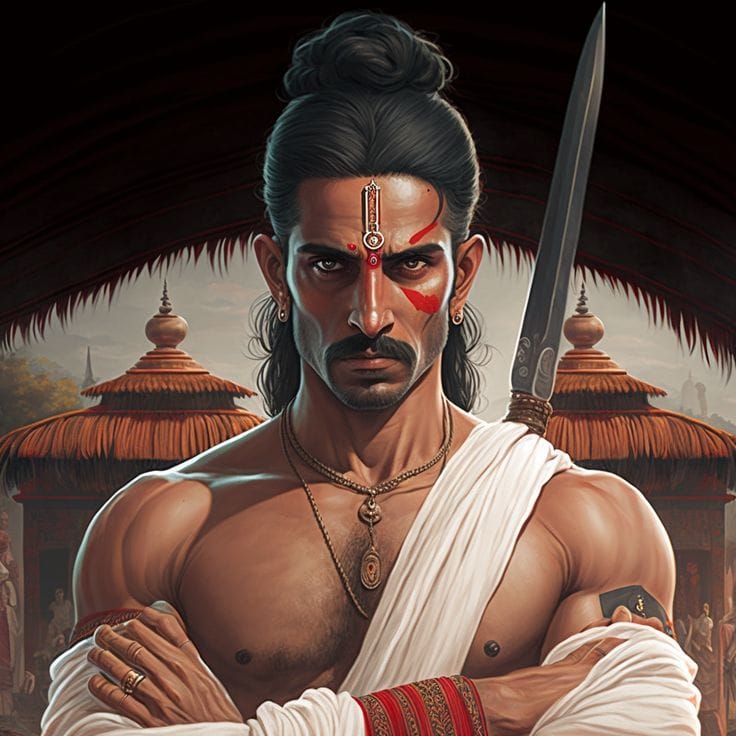
Digital artwork depicting a traditional Nair warrior standing confidently with crossed arms and a sword in the background. The figure wears a white garment, traditional ornaments, and sacred forehead markings, with Kerala-style temple architecture behind him, symbolizing the martial heritage and warrior traditions of the Nair community.
The Nairs of Kerala have long been recognized as a warrior community, historically serving as soldiers, military commanders, and protectors of local kingdoms. Their martial traditions, closely associated with Kalaripayattu, played a significant role in the political and military history of Kerala.
Placed alongside other communities historically associated with Kshatriya or martial status, the Nair genetic profile occupies a distinctly southern position on the ANI–ASI spectrum:
CommunityRegionANI %R1a %
RajputRajasthan / North India55–65%35–50%
MarathaMaharashtra45–55%20–30%
NairKerala40–50%15–25%
BuntCoastal Karnataka40–48%15–22%
ReddyAndhra / Telangana35–45%10–18%
VellalarTamil Nadu30–40%8–15%

The clear north-to-south gradient in ANI and R1a frequency across these communities mirrors their geography, and situates Nairs squarely as a South Indian population with a real but moderate northern genetic component neither the highly steppe-shifted profile of North Indian Kshatriya communities nor the almost entirely ASI-dominated profile of communities further to the east and south.

British Rule, Land Reform and the Decline of Nair Feudal Power
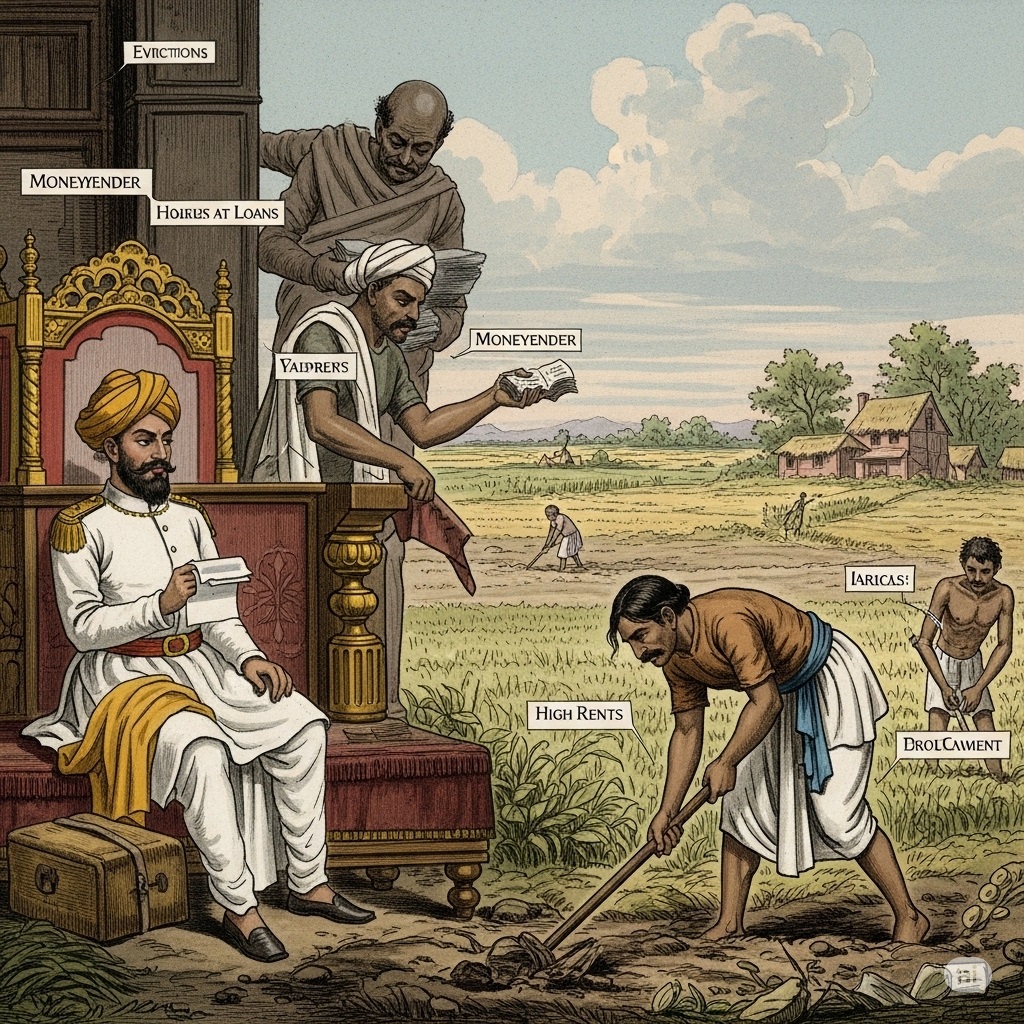
Illustrative artwork depicting a feudal landlord seated on an ornate chair while peasants work in agricultural fields. Labels referencing rents, moneylenders, evictions, and debt symbolize the agrarian hierarchy and tenancy system that existed before Kerala's land reforms. The image represents the decline of feudal landholding power and the transition toward a more equitable rural society.
Land reforms in Kerala during the mid-20th century transformed the state's agrarian structure, ending the dominance of traditional landlord classes, including many Nair jenmi families. The reforms redistributed land, strengthened tenant rights, and reshaped Kerala's social and economic landscape.

Nair social and economic dominance in Kerala was not static; it peaked under the pre-colonial and early colonial princely states and then eroded across several stages. The suppression of Kalaripayattu and the disarming of Nair households after the Malabar uprisings of the 1790s removed the community's traditional martial function. Nineteenth- and twentieth-century social reform, some of it driven by reform-minded Nairs themselves (such as changes allowing a karanavan to pass property to his own children rather than only to his sister's children), progressively weakened the joint taravad system. The most decisive change came with land reform legislation in independent Kerala most importantly the Kerala Land Reforms (Amendment) Act of 1969 which abolished the jenmi tenurial system and redistributed large agricultural holdings, ending the economic base of many Nair landlord families. The Kerala Joint Hindu Family System (Abolition) Act of 1976 formally dissolved taravad joint ownership altogether, completing the transition of Nair families to a nuclear, patrilineal-inheritance household structure much like that of other Indian communities today.

Religion, Culture and Everyday Life
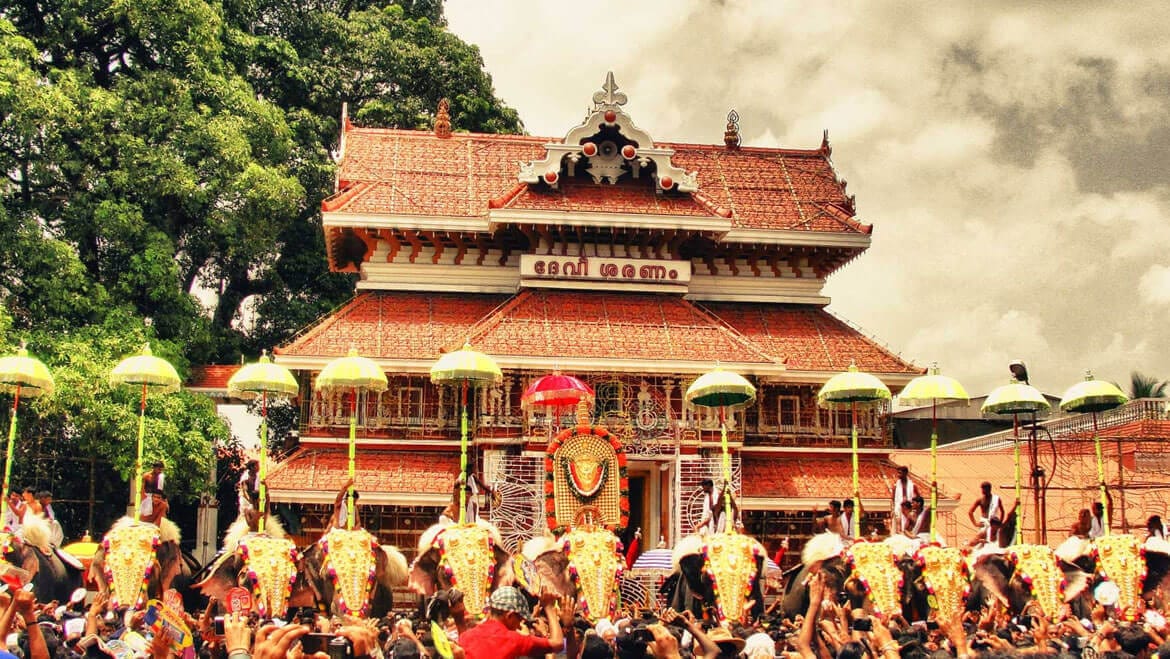
A grand Kerala temple during a vibrant religious festival, with caparisoned elephants, ceremonial umbrellas, and large crowds gathered for worship. The scene reflects the temple traditions, Hindu religious practices, and cultural heritage closely associated with the Nair community and Kerala society.
Most Nairs traditionally follow Hinduism and have historically been associated with temple-centered religious practices in Kerala. Festivals, temple rituals, ancestor worship, and devotion to deities such as Bhagavati, Shiva, Vishnu, Ayyappa, and Krishna continue to play an important role in Nair religious life.
Nairs are traditionally Hindu, closely associated with Kerala's temple culture, and historically served as trustees, patrons and armed protectors (paradevatha guardians) of major temples across the region. Serpent worship remains a distinctive household practice, expressed through sacred groves (kavu) maintained within many traditional taravad compounds and dedicated to Naga deities. Nairs are strongly linked with several of Kerala's classical performing arts, including Kathakali and Mohiniyattam, both of which developed under Nair and royal patronage, and with the region's temple festival calendar. Traditional Nair architecture — the nalukettu and larger ettukettu courtyarded houses — remains one of the most recognisable vernacular building forms of Kerala, even though very few families now maintain them as functioning joint households.
Nair cuisine, dress and naming conventions broadly follow wider Malayali Hindu patterns, with sub-caste surnames (Menon, Pillai, Nambiar, Kartha, Kurup, Panicker and others) continuing to signal historical occupational or regional sub-group identity even though they no longer correspond to any formal social distinction.

Nairs in the Modern Era

Today the Nair community is one of Kerala's largest and most urbanised and educated population groups, with a strong historical presence in the civil service, armed forces, judiciary, medicine, academia, cinema and public life, both within Kerala and across the wider Indian and NRI diaspora. The Nair Service Society (NSS), founded in 1914 by Mannathu Padmanabhan, has been the community's principal social and educational organisation for over a century, running a large network of schools and colleges and acting as a significant civic and political voice for the community in Kerala. While the caste-based privileges and land-based power of the pre-reform era are gone, Nair identity persists strongly as a cultural and social marker, and community organisations continue to play an active role in education, welfare and the preservation of traditions such as Kalaripayattu and taravad-linked temple festivals.

Frequently Asked Questions

Are Nairs Kshatriyas?
There is no single settled answer. Nair tradition and some colonial ethnographers describe them as Kshatriyas or as a Kerala-specific 'Samantan' noble class; other scholars classify them as high-ranking Shudras given that formal Kshatriya rites (such as the sacred thread ceremony in its Brahminical form) were not universally practised. Genetic evidence showing an intermediate ANI/ASI profile and moderate R1a frequency is consistent with a community that received real but partial northern/Indo-Aryan-associated input rather than either a pure northern-Kshatriya or a purely indigenous origin.
What is marumakkathayam and why is it significant?
Marumakkathayam is the matrilineal system of descent and inheritance historically practised by Nairs (and a few neighbouring communities), under which property and lineage passed through the mother's line and a man's heirs were his sister's children rather than his own. It shaped Nair family structure, marriage practice (sambandham) and, as genetic studies suggest, even the community's DNA, by channelling northern-associated paternal ancestry into Nair lineages through Namboothiri sambandham alliances while keeping maternal lineages locally stable.
Is the Nair–Bunt connection real?
Genetic studies lend some support to it. Nairs and Bunts show similar ANI/ASI admixture proportions, elevated and comparable R1a frequencies, overlapping Y-DNA haplogroup distributions, and, in some analyses, closer clustering to each other than to other communities in their own states. This is consistent with, though not conclusive proof of, a historically related founding population along the southwestern coast.
Why did Nair dominance in Kerala decline?
Several overlapping causes: the British suppression of Kalaripayattu and Nair militias after the 1790s Malabar uprisings; a series of legal reforms across the nineteenth and twentieth centuries that eroded the joint taravad system; and, decisively, post-independence Kerala land reform legislation that abolished the jenmi landholding system on which much Nair economic power rested, followed by the 1976 Act that ended joint-family property ownership altogether.

Conclusion

The Nairs of Kerala are, in every sense, a community shaped by convergence rather than a single origin story. Their matrilineal social system, their martial Kalaripayattu tradition, and their intermediate, much-debated position in Kerala's caste hierarchy all point toward a population that fused a deep, indigenous Dravidian foundation with real, centuries-long infusions of northern and Indo-Aryan-associated ancestry and culture arriving through migration, trade, temple politics and, distinctively, the sambandham alliance system with Namboothiri Brahmins. Modern genetics, still a young field for community-level studies in India, broadly confirms this composite picture: a population that is neither simply transplanted northern nobility nor simply local Dravidian gentry, but a genuinely blended people whose history is written both in their taravads and temples and in their DNA.

.

← All Communities · Atlas · GenoConnect