

Thiyya Community
A community for people of the Thiyya community — connect, explore ancestry, and share identity.
The Thiyya Community of Kerala
The Thiyyas (also spelt Tiyyas or Thiyyars) are one of the largest and most influential communities of Kerala, concentrated overwhelmingly in the Malabar region the districts of Kozhikode, Kannur, Kasaragod, and the erstwhile French enclave of Mahe. Traditionally associated with coconut cultivation, toddy tapping, Ayurvedic medicine, martial arts, and, in the colonial era, maritime trade, the Thiyyas occupied a distinctive and often contested position in Kerala's caste hierarchy: socially ranked below the Nairs yet above the so-called "polluting" castes, while also producing generations of physicians, scholars, freedom fighters, and social reformers who shaped modern Kerala.
This article brings together what is known about the Thiyya community from historical records, colonial ethnography, oral tradition, social history, and most recently population genetics, to give as complete a picture as possible of who the Thiyyas are and where they came from.
| Key FindingModern DNA studies show that Thiyyas carry roughly 55–65% AASI (Ancient Ancestral South Indian) ancestry, one of the highest proportions among Kerala's non-tribal communities, with a dominant H-M69 Y-DNA haplogroup that has been present in the Indian subcontinent for over 30,000 years. This places the community's deep genetic roots firmly within the Indian subcontinent, even though popular and colonial-era theories long proposed migration from Sri Lanka, Central Asia, or even the Mediterranean. |
|---|
Who Are the Thiyyas?
Etymology: What Does "Thiyya" Mean?
Dveepa / Theevu theory: The most widely cited derivation traces "Thiyya" to the Sanskrit "dveepa" or Malayalam/Kannada "theevu," meaning "island," via forms such as Dweeparu, Deevaru, and Thivar "islanders." This is linked to the theory that the community's ancestors migrated from the island of Sri Lanka (called Eezham in old Tamil) or from the Lakshadweep islands.
Sanskrit "Dvija" theory: An alternative and more flattering etymology, favoured by community writers, derives "Thiyya" from "Dvija" ("twice-born"), a term normally reserved for higher castes, suggesting the name once carried higher ritual status that was later eroded.
Arabic "sailor" theory: Some writers connect "Thiyya" to the Arabic "nu tiyya" (sailor; nu/nau meaning boat), pointing to the community's long history of seafaring and trade along the Malabar coast.
Tian Shan / Central Asian theory: A more speculative fringe theory associates the name with the Tian Shan mountain range in present-day Kyrgyzstan, tied to a broader (and largely unsubstantiated) claim of Central Asian origin discussed below.
Origin Theories: Where Did the Thiyyas Come From?
The Sri Lankan (Eezham) Migration Theory
The theory most repeated in colonial and early academic writing holds that the ancestors of the Thiyyas and Ezhavas migrated from Sri Lanka anciently called Eezham or Iram in Tamil bringing the coconut palm with them and settling first in Travancore before some groups moved further north along the coast to Malabar. This theory rests heavily on the etymological link between "Ezhava"/"Iravar" and "Eezham," and on the shared association of both regions with coconut cultivation, toddy tapping, and, in some tellings, Buddhism. William Logan, the British Collector of Malabar, endorsed a version of this account in the influential Malabar Manual (1887), describing the caste "now known as Thiyar or Iluvar" as having been "entrusted with the duty of planting up wastelands," and identifying "footrope right" and "ladder right" (both tied to coconut-palm climbing) as their traditional privileges under Hindu custom.
The Indigenous Dravidian Theory
The Buddhist Connection Theory
The Thirayar / Seafarer Theory
The Central Asian / "Out of Kyrgyzstan" Theory
A more speculative theory, popularised in the early 2000s by the Malayalam writer T. Damu in the book Lanka Parvam, proposes that the Thiyyas descend from a Central Asian people near the Tian Shan mountains of present-day Kyrgyzstan, who migrated south through northwestern India in antiquity allegedly predating even the Indus Valley Civilization. A related, more elaborate theory was advanced by Dr N. C. Shyamalan (father of filmmaker M. Night Shyamalan and a member of a prominent Thiyya family from Mahe) in his 2014 book North Africa to North Malabar: An Ancestral Journey, which used informal DNA testing of his own family to argue for a Central Asian route into Malabar, explicitly rejecting William Logan's Sri Lankan theory. In a similar vein, the 1999 book Influx: Crete to Kerala by M. M. Anand Ram argued, on linguistic grounds, for a Minoan (Bronze Age Cretan) origin, with ancestors said to have crossed north Africa before reaching Malabar.
| A Note on MethodWritten historical sources on the Thiyyas are overwhelmingly colonial-era ethnographic accounts (chiefly William Logan's Malabar Manual and the South Canara Manual) supplemented by 20th-century community histories written largely in response to those colonial accounts. Readers should treat all origin narratives — including the genetic ones — as evidence to be weighed rather than settled fact, since sample sizes in the available genetic studies remain modest and the historical record is incomplete. |
|---|
Historical and Social Position in Kerala
Caste Status and "Distance Pollution"
Traditional Occupations
Toddy tapping and coconut cultivation: The community's best-known traditional occupation was tapping toddy (palm wine) from coconut palms and cultivating coconut groves, an occupation tied to the "footrope right" and "ladder right" privileges recorded by William Logan.
Ayurvedic medicine: Many Thiyya families were hereditary vaidyars (traditional physicians), practising and safeguarding Ayurvedic knowledge across generations; several well-known Kerala Ayurvedic lineages trace their origins to the community.
Maritime trade: Thiyya families in the port towns of Thalassery, Kannur, Vadakara and Mahe built substantial fortunes as merchants, ship-owners, and later as food, timber, and liquor contractors to the British and French colonial administrations, taking advantage of Malabar's position on the Indian Ocean trade routes.
Martial arts (Kalaripayattu): The community maintained a strong martial tradition, with Thiyya kalaris (training schools) producing warriors, and the region's oral epics the Vadakkan Pattukal (Northern Ballads) celebrating Thiyya martial heroes and heroines such as Thacholi Othenan and Unniyarcha.
Government and colonial service: From the 18th century, Thiyya families in Malabar's colonial towns gained access to English and French education and rose to positions in the British and French colonial administrations, the judiciary, and later the professions (medicine, law, and teaching).
The Colonial Port Towns and "White Thiyyas"
Matrilineal Kinship: Marumakkathayam
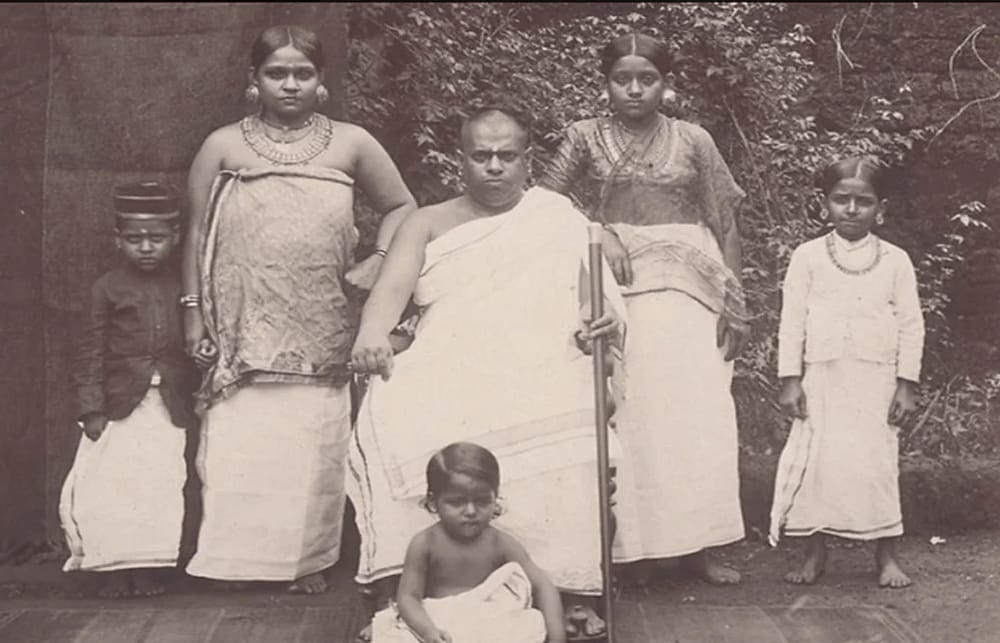
Like the Nairs, many Thiyya families in Malabar historically followed marumakkathayam, a matrilineal system of inheritance in which property and lineage passed through the female line within a taravad (matrilineal joint family). This distinguishes northern Malabar Thiyyas from the Ezhavas of Travancore and central Kerala, who more commonly followed the patrilineal makkathayam system a distinction some community writers cite as evidence that Thiyyas and Ezhavas, while related, developed along partly separate social and historical paths despite a common name imposed on both by colonial administrators.
Religion, Worship and the Illam System
Thiyya religious life traditionally centred on kavus (sacred groves) dedicated to Goddess Bhagavati and on ancestral and spirit worship, a pattern shared with the Ezhavas, Billavas, and other communities of the southwestern coast. This tradition is closely tied to Theyyam, the elaborate ritual dance-worship form of North Malabar in which performers embody deities and deified ancestors several important Theyyam traditions in Kannur and Kasaragod are performed by and for Thiyya communities. Kinship and marriage were traditionally regulated by illams (also called illakkars), lineage groupings roughly comparable to gotras, with marriage within the same illam historically prohibited; this restriction has substantially relaxed in recent generations. Over the centuries, the community's Bhagavati and spirit-worship traditions absorbed elements of Vedic Hindu practice, producing the syncretic religious culture visible in Malabar today.
What DNA Reveals About Thiyya Ancestry
Population genetics has, in the last decade, offered the first direct evidence with which to test the various origin theories described above. Several studies most notably a genome-wide autosomal and mitochondrial DNA study of southwestern coastal "warrior" and land-owning communities led by Dr Kumarasamy Thangaraj of the CSIR-Centre for Cellular and Molecular Biology (CCMB), Hyderabad, published in Genome Biology and Evolution have directly sampled Thiyya individuals alongside Nairs, Ezhavas, Bunts, and Hoysalas.
Autosomal Ancestry: The AASI-ANI Balance
| Kerala Community | ANI % | ASI/AASI % | Dominant Y-DNA | R1a Frequency |
|---|---|---|---|---|
| Namboothiri <a href="/communities/brahmin">Brahmin</a> | 50-60% | 35-45% | R1a (35-50%) | High |
| <a href="/communities/nair">Nair</a> | 40-50% | 45-55% | H-M69 (25-35%) | Moderate (15-25%) |
| <a href="/communities/syrian-christian">Syrian Christian</a> | 35-45% | 50-60% | H-M69 (30-40%) | Low-Moderate (8-15%) |
| Thiyya / <a href="/communities/ezhava">Ezhava</a> | 30-40% | 55-65% | H-M69 (35-45%) | Low (5-10%) |
| Pulaya | 20-30% | 65-75% | H-M69 (45-55%) | Very Low (2-5%) |
The CCMB study led by Dr Thangaraj adds an important nuance to this picture: it found that the Nair and Thiyya "warrior" communities in particular share a distinct component of ancestry linked to ancient migrants from northwest India, with an elevated Iranian-related ancestry signature similar to that seen in northern groups such as the Kamboj and Gujjar communities historically associated by some scholars with Indo-Scythian-descended migrants, or alternatively with Iron Age migrants from Ahichhatra in the Gangetic plain, who are said in tradition to have arrived as a warrior and landholding class. This northwestern-linked component sits alongside, rather than replacing, the community's dominant deep-indigenous AASI ancestry.
Y-DNA Haplogroups: The Paternal Line
H-M69 (roughly 35-45%): The single most common haplogroup, arising in the Indian subcontinent over 30,000 years ago and found across South Asia, but at notably higher frequency in Thiyyas than in Nairs (25-35%) or Namboothiri Brahmins (10-20%) strong evidence for a deep-indigenous paternal ancestry.
R2-M124 (roughly 10-15%): An ancient South Asian-specific lineage, distinct from the Indo-Aryan-associated R1a, likely present in the region for 15,000-20,000 years.
L-M20 (roughly 8-14%): A lineage with possible ties to the Indus Valley region and to the spread of Neolithic farming from the northwest, reflecting ancient rather than recent contact with populations to the north.
J2-M172 (roughly 5-10%): Associated with the ancient spread of Neolithic farming technology from the Fertile Crescent region into South Asia.
R1a-Z93 (roughly 5-10%): The haplogroup most strongly linked to Bronze Age Indo-Aryan migrations; its comparatively low frequency in Thiyyas (versus 15-25% in Nairs and 35-50% in Namboothiri Brahmins) indicates limited direct paternal gene flow from Indo-Aryan-associated populations, consistent with the community's traditional exclusion from the sambandham alliance system that linked Nair women with Namboothiri men.
Maternal Lineages (mtDNA)
Mitochondrial DNA, inherited only through the maternal line, shows an even more overwhelmingly indigenous South Asian profile in Thiyya women, dominated by ancient haplogroups M2 (roughly 50,000-60,000 years old, one of the oldest lineages in South Asia), M3, and M5, along with smaller contributions from R5a and other South Asian-specific M subclades. This maternal profile is strikingly similar across Thiyyas, Ezhavas, Nairs, and Pulayas alike, suggesting that whatever differences exist between these communities in paternal (Y-DNA) ancestry and social status, they share a common deep female ancestry rooted in Kerala's earliest human settlement implying that most historical gene flow between communities and regions was male-mediated rather than through large-scale female migration.
Thiyya, Ezhava and Billava: A Shared Genetic Continuum
Genetic comparisons between Thiyyas of Malabar, Ezhavas of Travancore and central Kerala, and Billavas of coastal Karnataka show no statistically significant differences in autosomal ancestry, Y-DNA haplogroup frequencies, or mtDNA distribution. All three groups show comparable AASI ancestry (roughly 55-70%), a dominant H-M69 paternal lineage, and closely overlapping maternal lineage profiles, and cluster tightly together on principal component analysis (PCA) plots relative to other regional communities. This supports the view that Thiyyas, Ezhavas and Billavas represent a single, broadly continuous ancestral population distributed along the western coast of South India, subsequently divided by different kingdoms, colonial administrations, and, in the Thiyya case, a partly distinct kinship system (marumakkathayam) and a modern movement toward a separate identity rather than by any deep biological divergence.
What the Genetics Says About the Origin Theories
- Sri Lankan migration theory: Not well supported. If Thiyyas descended from a substantial and relatively recent migration from Sri Lanka, a distinct genetic signature closer to Sinhalese or Sri Lankan Tamil populations would be expected. Instead, Thiyyas cluster tightly with other Kerala communities.
- Indigenous Dravidian theory: Strongly supported by the high AASI ancestry and the dominance of the ancient H-M69 paternal lineage and M2/M3 maternal lineages, all indicating tens of thousands of years of continuous ancestry within the subcontinent.
- Northwest-India "warrior migrant" theory: Partially supported. The CCMB study's finding of an elevated Iranian-related/northwest Indian genetic signal in Thiyyas (alongside Nairs) is consistent with historical traditions of a warrior/landholding class origin, though this represents an ancient admixture layer rather than a wholesale population replacement, and sits on top of a dominant indigenous AASI base.
- Central Asian (Kyrgyzstan) and Mediterranean (Minoan) theories: Not supported by any published population-genetic study. These remain speculative narratives outside mainstream historical and genetic scholarship.
Endogamy, Illams and Genetic Structure
Social Reform and the Sree Narayana Guru Movement
Notable Members of the Thiyya Community
- Ayyathan Gopalan (1861-1948): Physician and social reformer; founder of the Sugunavardhini movement and the Depressed Classes Mission in Kerala.
- Janaki Ammal (1897-1984): Pioneering botanist, cytologist and geneticist of international repute, known for her work on sugarcane genetics and the Chromosome Atlas of Cultivated Plants; born into a prominent Thalassery Thiyya family.
- Ayyathan Janaki Ammal (1881-1945): The first female surgeon from Kerala.
- C. K. Revathi Amma (1891-1981): Social activist from a well-known Thalassery Thiyya family.
- E. K. Krishnan (1841-1907): Civil servant and administrator; Deputy Collector and Diwan of Malabar.
- Moorkoth Kumaran ("Kumaran Master"): Writer, educationist and disciple of Sree Narayana Guru; prominent in Thalassery's social reform movement.
- Vagbhatananda Guru (Vayaleri Kunhikkannan Gurukkal): Religious teacher and social reformer of Thalassery.
- S. K. Pottekkat (1913-1982): Celebrated Malayalam novelist and travel writer, Jnanpith Award winner, from Kozhikode.
- O. V. Vijayan (1930-2005): Acclaimed Malayalam novelist and cartoonist, best known for Khasakkinte Itihasam.
- Thacholi Othenan and Unniyarcha: Legendary Thiyya martial heroes and heroine of the Vadakkan Pattukal (Northern Ballads), still celebrated in Malabar folklore and performance traditions.
Geographic Distribution and Population
- Kozhikode district: One of the largest concentrations of Thiyyas, historically under the Zamorin; home to major figures such as S. K. Pottekkat.
- Kannur and Thalassery: Historic centre of Thiyya trade, colonial-era prosperity, and social reform activity, under the Kolathiri/Chirakkal and later British administration.
- Kasaragod district: Northernmost Thiyya concentration, with cultural overlap into Tulunadu and the closely related Billava community of coastal Karnataka.
- Mahe: The former French enclave (now part of Puducherry union territory but geographically embedded in Kerala) with a historically prominent and prosperous Thiyya community shaped by close relations with French colonial administrators.
The Modern Thiyya Identity Debate
In recent decades, a section of the Malabar Thiyya community has actively pushed back against the colonial-era equation of "Thiyya" with "Ezhava," arguing that the two developed through partly separate historical processes differing kinship systems (matrilineal marumakkathayam among Malabar Thiyyas versus more commonly patrilineal makkathayam among Travancore Ezhavas), different ruling dynasties, different colonial administrations (British Malabar and French Mahe versus princely Travancore and Cochin), and, in the alternative-origin theories described above, different claimed points of ancestral origin. This has produced a body of community-authored histories from K. T. Anandan Master's 1935 Kerala Charithra Niroopanam to more recent works seeking an independent historical foundation for Thiyya identity distinct from the Ezhava/SNDP-centred narrative that dominated 20th-century Kerala historiography. Genetic studies, notably, tend to complicate rather than resolve this debate: they show Thiyyas and Ezhavas as genetically near-indistinguishable, even as social, administrative and cultural historians continue to document real differences in the two communities' regional histories.
Frequently Asked Questions
Are Thiyyas the same as Ezhavas?
Did the Thiyyas migrate from Sri Lanka?
What is the dominant Y-DNA haplogroup among Thiyya men?
What social reform movement is associated with the Thiyya community?
What was the traditional occupation of the Thiyya community?
Are Thiyyas classified as a Scheduled Caste or OBC in Kerala?
Conclusion
Genetic evidence now allows the community's many origin theories Sri Lankan migration, indigenous Dravidian roots, Buddhist heritage, northwestern warrior ancestry, and more speculative Central Asian or Mediterranean claims to be tested against hard data for the first time. The verdict so far is that Thiyyas are overwhelmingly of deep, indigenous South Asian ancestry, closely related to the Ezhavas of Travancore and the Billavas of coastal Karnataka, with a smaller but genuine layer of ancestry linked to ancient northwestern Indian migrants shared with the Nairs. Whether or not Thiyyas and Ezhavas ultimately come to be understood as one community or two, both history and genetics agree on one point: the Thiyyas are, at their core, a people whose roots in the Malabar coast run extremely deep.