

Meghalaya Genome Project Community
Explore your Meghalaya ancestry. Uncover the rich genetic diversity, matrilineal heritage, and unique history of the Khasi, Jaintia, and Garo peoples
MEGHALAYA GENOME PROJECT
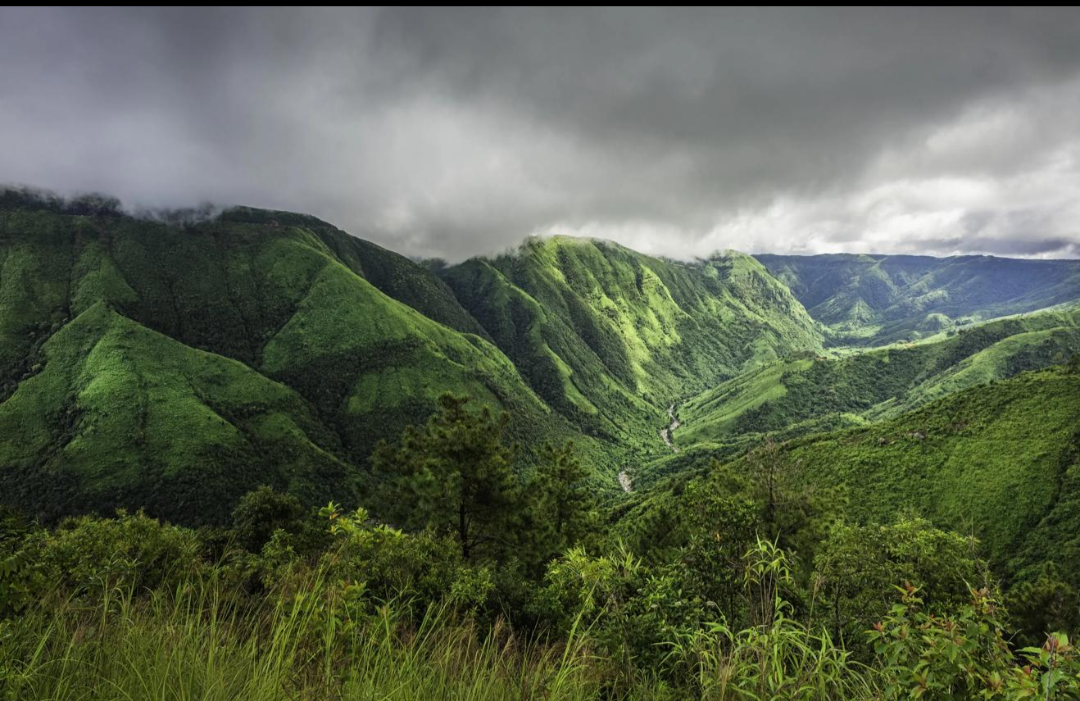
Geography, People, History, and Genetics of the Abode of Clouds
1. Introduction: Who Are the People of Meghalaya?
Meghalaya, a Sanskrit name meaning “the Abode of Clouds,” is a small hill state in Northeast India whose people are not a single ethnic group but a geography-defined population: the inhabitants, past and present, of the Shillong Plateau and its surrounding hills and border plains. At its heart are three indigenous peoples, the Khasi, the Jaintia (who mostly call themselves Pnar), and the Garo (who call themselves A·chik), together with smaller communities such as the Hajong, Koch, Rabha, Boro, Biate, Karbi (Mikir) and Mann, as well as long-settled Bengali, Nepali, Assamese, Marwari, Sikh and Bihari families, many of whom have lived in Shillong and the plains belts for generations.
This profile treats “Meghalaya” as a geography-of-origin community in the genealogical sense: a population united by territory rather than by one caste, language or religion. What makes it unusual in the Indian context is the meeting of two entirely different language families on a single plateau. The Khasi and Pnar speak Austroasiatic languages, distant relatives of Khmer and Mon in mainland Southeast Asia, while the Garo speak a Tibeto-Burman language closely related to Bodo and Dimasa. Both, strikingly, trace descent through the mother. Meghalaya is therefore home to one of the largest surviving matrilineal societies in the world, and to a genetic story that links India with Southeast Asia, the Himalaya and the Brahmaputra valley.
Bordered by Assam to the north and east and by Bangladesh to the south and west, Meghalaya sits on an ancient block of rock that rises sharply out of the plains of Sylhet. Its landscape of cloud-wrapped plateaus, plunging gorges, limestone caves and sacred forests has shaped almost everything about its people: how they farm, what they eat, where they build, how they worship, and why they remained politically and culturally distinct for so long.
2. Geography
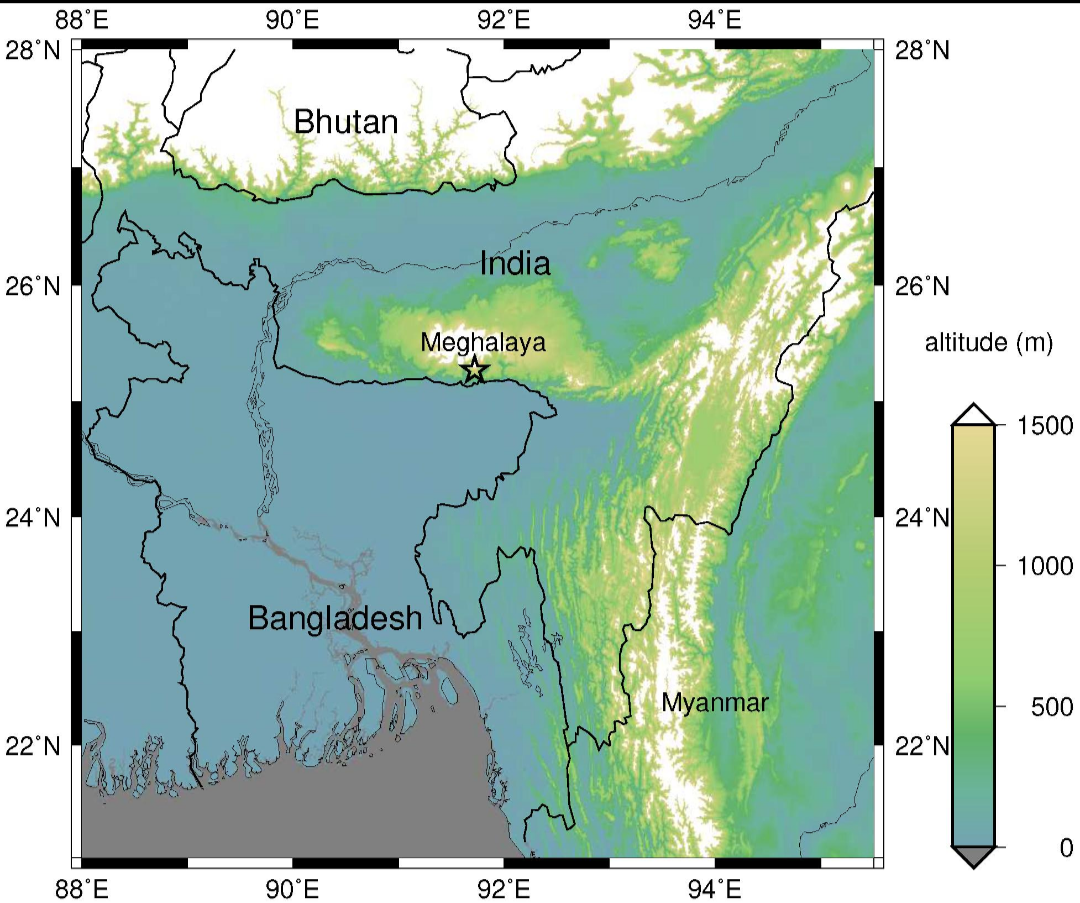
Meghalaya covers about 22,429 square kilometres, making it one of India’s smaller states, roughly the size of Mizoram or the country of Djibouti. It shares a long international border of around 440 kilometres with Bangladesh along its southern and western edges. The state occupies almost all of the Shillong (Meghalaya) Plateau, a detached, uplifted block of very old crystalline rock that is geologically an extension of the Indian peninsula, separated from the Chotanagpur region by the down-warped plains of the Bengal basin. Its highest point is Shillong Peak (Lum Shyllong), at roughly 1,960 metres above sea level.
The plateau falls away steeply to the south, where warm, moisture-laden monsoon winds from the Bay of Bengal are forced sharply upward. The result is some of the heaviest rainfall on earth. Mawsynram and Sohra (Cherrapunji), both in the East Khasi Hills, trade the title of the wettest inhabited place in the world, with long-term annual averages of around 11,000 to 12,000 millimetres. Yet only a few kilometres away the land drains so quickly through limestone and thin soils that winter water scarcity is a real problem, one of Meghalaya’s many paradoxes.
This terrain has created remarkable natural features: deep river gorges such as those of the Umngot (famous at Dawki for its glass-clear water), the Kynshi, the Myntdu and the Simsang (Someshwari); spectacular waterfalls such as Nohkalikai near Sohra; and the longest cave systems in the Indian subcontinent, including the Krem Liat Prah–Umim–Labit system in the Jaintia Hills and Krem Puri, often described as the world’s longest known sandstone cave. Protected areas include Nokrek National Park, core of a UNESCO-recognised biosphere reserve and the home of wild citrus (Citrus indica, the “memang narang”), and Balpakram National Park in the South Garo Hills, a canyon landscape the Garo regard as the resting place of departed spirits.
Meghalaya also gave its name to a unit of geological time. In 2018 the International Commission on Stratigraphy formally named the most recent stage of the Holocene the “Meghalayan Age,” beginning about 4,200 years ago, after a stalagmite from Mawmluh Cave near Sohra that records a sharp global drought at that time.
Administratively the capital is Shillong, the state is currently divided into twelve districts, and it is governed in part under the Sixth Schedule of the Indian Constitution through three Autonomous District Councils: the Khasi Hills, Jaintia Hills and Garo Hills councils.
Cultural-Geographic Sub-Regions
Long before modern district lines, the people of Meghalaya identified with older cultural regions, each with its own language or dialect, clan geography and history:
3. Origins and Early History
3.1 Prehistory and Early Settlement
Stone tools found in the Garo Hills, especially along the Rongram valley and at sites such as Selbalgiri near Tura, show that people were living in the western hills from the Palaeolithic onward. Neolithic finds, including polished stone axes and cord-marked pottery, have been reported from several sites in the Khasi and Garo Hills, and the plateau appears to have been part of a wider Neolithic world that linked the Brahmaputra valley with upland Southeast Asia. Archaeologists and linguists generally associate the arrival of Austroasiatic-speaking farmers, the ancestors of the Khasi and Pnar, with the spread of rice cultivation from the east, and the later arrival of Tibeto-Burman speakers, the ancestors of the Garo, with movements from the north and northeast. Exact dates remain debated.
3.2 Origin Traditions of the Khasi, Pnar, and Garo
Khasi tradition speaks of the Ki Hynniew Trep, the “Seven Huts” or seven families. In this account, sixteen families once lived in heaven and moved freely between heaven and earth by a golden ladder, or a sacred tree, at U Lum Sohpetbneng, the “Navel of Heaven” peak in Ri-Bhoi. When the link was broken, seven families remained on earth and became the ancestors of the Khasi-Pnar people. The phrase “Hynniewtrep” is still used today as a collective name for the Khasi and Jaintia peoples.
Garo oral tradition holds that the A·chik ancestors came from a northern homeland often identified with Tibet, crossed the Brahmaputra under legendary leaders such as Jappa Jalimpa, and gradually settled the western hills after long wanderings through the Brahmaputra valley. Like all migration legends, these traditions are best read as cultural memory rather than literal history, but they align broadly with the linguistic evidence placing Garo within the Tibeto-Burman (Bodo-Garo) family.
3.3 The Hima and the Jaintia Kingdom
Before British rule the Khasi Hills were organised into a patchwork of small states called Hima, each headed by a Syiem (chief) chosen from a particular matrilineal royal clan and advised by a council (dorbar) of clan elders. Some Hima, such as Khyrim, Mylliem, Nongkhlaw, Sohra and Nongstoin, became well known to colonial administrators. In the east, the Jaintia (Pnar) kingdom grew into a significant power whose rulers held both the Jaintia Hills and the fertile plains of Jaintiapur in present-day Sylhet (Bangladesh), with a summer capital at Nartiang and ancestral roots at Sutnga. The Garo, by contrast, had no large kingdom. Their society was organised around villages led by a nokma (headman), whose position was linked to the landholding of his wife’s matrilineal lineage.
3.4 British Contact and Resistance
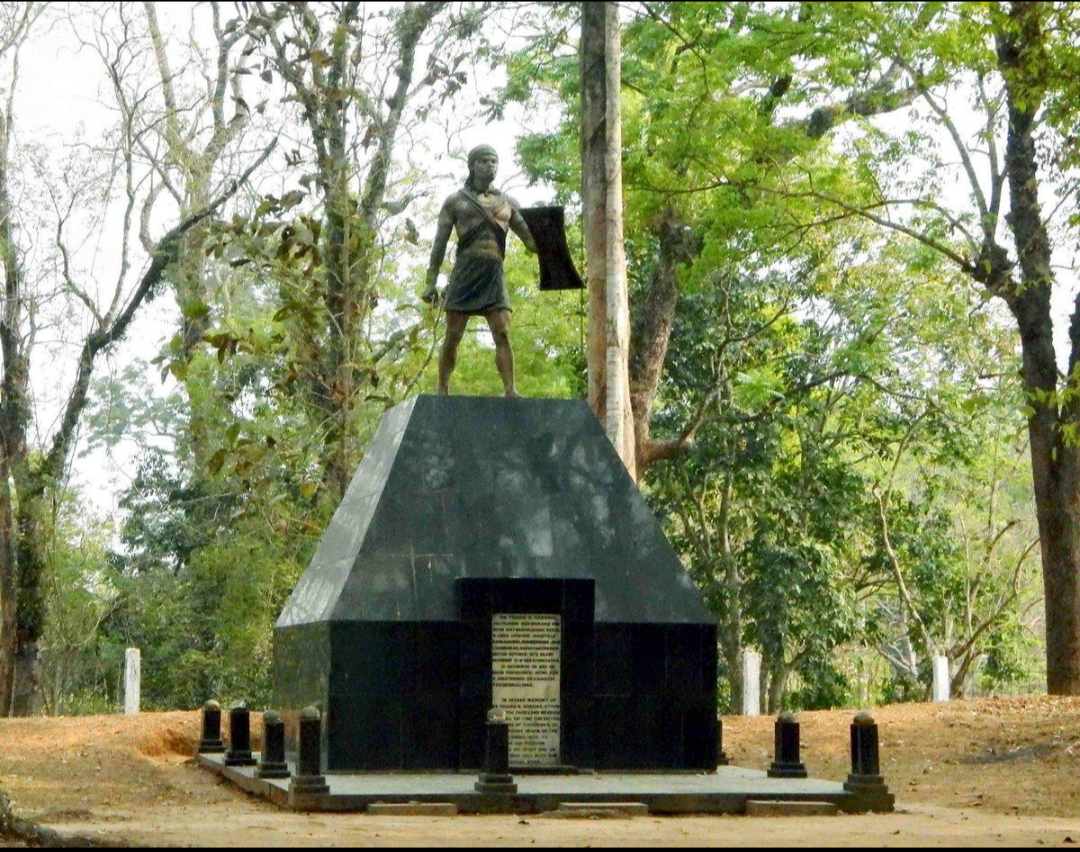
British interest in the hills grew after the East India Company acquired Sylhet and then Assam, when it sought a direct road linking the two through the Khasi Hills. In 1829, U Tirot Sing, Syiem of Nongkhlaw, led an attack on the British settlement at Nongkhlaw, beginning the Anglo-Khasi War, which lasted until his capture in 1833; he died in captivity in Dhaka in 1835 and is remembered as one of the state’s great heroes. The Jaintia kingdom was annexed in 1835. A major Jaintia uprising followed in 1860–1862 against new taxes and interference in local customs, led by U Kiang Nangbah, who was publicly hanged at Jowai in December 1862. In the Garo Hills, the warrior Pa Togan Nengminza Sangma fought British forces in 1872 and died in battle; he too is honoured as a freedom fighter.
3.5 Missionaries, Script, and Shillong as a Colonial Capital
In 1841 the Welsh Calvinistic Methodist missionary Thomas Jones arrived at Sohra and gave the Khasi language a written form using the Roman alphabet, laying the foundations of modern Khasi literacy. American Baptist missionaries played a similar role in the Garo Hills from the late 1860s onward, working from Tura. Christianity spread steadily over the next century and, together with mission schools, reshaped religion, education and public life. In 1874 Shillong became the capital of the newly created Chief Commissioner’s Province of Assam and developed into a pine-shaded hill station, nicknamed the “Scotland of the East.” The town was devastated by the Great Assam Earthquake of 12 June 1897, one of the most powerful earthquakes ever recorded in India, and was rebuilt in the distinctive “Assam-type” timber-frame style still visible in older neighbourhoods.
3.6 The Road to Statehood
At Independence, the twenty-five Khasi states acceded to the Indian Union, and the hill areas became part of Assam, with the Sixth Schedule granting them district councils. Concern over language policy, especially Assamese as the sole official language after 1960, led hill leaders to form the All Party Hill Leaders’ Conference and campaign peacefully for a separate state. Meghalaya was created first as an autonomous state within Assam on 2 April 1970 and became a full state of India on 21 January 1972, with Captain Williamson A. Sangma as its first Chief Minister and Shillong as its capital. The name “Meghalaya” itself was suggested by the geographer S. P. Chatterjee.
4. Demographic Profile and Population Size
According to the 2011 Census, Meghalaya had a population of 2,966,889, up from about 2.32 million in 2001. That decade’s growth rate, close to 28 per cent, was the highest of any Indian state. Current projections place the population at roughly 3.3 to 3.5 million, although no newer census figure is yet available. Population density, at about 132 persons per square kilometre in 2011, is far below the national average, and about four in five people live in rural areas.
| Indicator (Census 2011 unless noted) | Figure |
|---|---|
| Total population | 2,966,889 (projected ~3.3–3.5 million today) |
| Area | 22,429 sq km |
| Density | ~132 persons per sq km |
| Scheduled Tribe share | ~86 per cent |
| Khasi-Jaintia (all sub-groups) | ~1.4 million |
| Garo | ~0.8 million |
| Sex ratio | 989 females per 1,000 males (among the most balanced in India) |
| Literacy | ~74.4 per cent |
| Urban population | ~20 per cent |
| Religion | Christian ~74.6%, Hindu ~11.5%, indigenous faiths ~8.7%, Muslim ~4.4% |
Christianity is the religion of the large majority, divided among Presbyterian, Catholic, Baptist, Church of God and other denominations. A significant minority, especially among the Khasi and Pnar, continues to follow the indigenous faith known as Niam Khasi or Niam Tre, and a smaller number of Garo still follow the traditional Songsarek religion. Hindu communities include Bengali, Nepali and Hindi-speaking families as well as some plains tribes, and Muslims live mainly in the western plains belt of the Garo Hills and in Shillong.
Meghalaya’s near-equal sex ratio and the visible role of women in markets, trade and family property are often linked, at least in part, to its matrilineal traditions, though this is a subject scholars continue to study and debate.
5. Genetics and DNA Ancestry
Meghalaya is one of the most genetically interesting regions of South Asia because it sits on a crossroads between three great population worlds: the Indian subcontinent, mainland Southeast Asia, and the Tibeto-Himalayan belt. Its peoples cannot be understood simply through the Ancestral North Indian (ANI) and Ancestral South Indian (ASI) model used for most Indian populations. In fact, many early genome-wide studies of Indian ancestry set aside Northeast Indian groups precisely because they carry substantial East Asian-related ancestry that does not fit that two-way model.
5.1 Two Language Families, Two Ancestral Streams
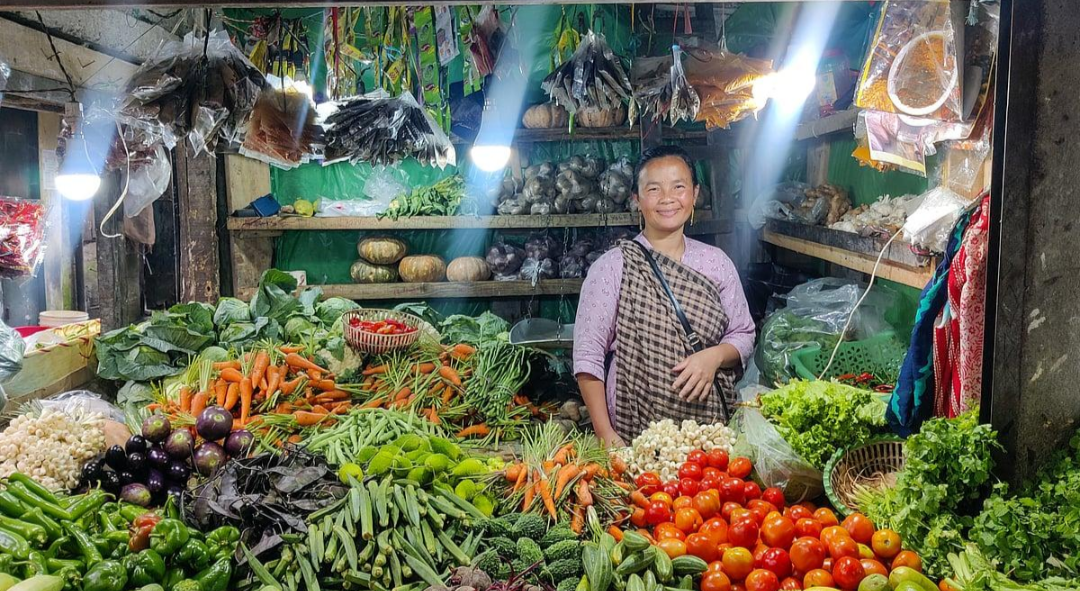
Broadly speaking, the Khasi and Pnar belong to the Austroasiatic stream and the Garo to the Tibeto-Burman stream. Both carry predominantly East Asian-related ancestry, but they arrived by different routes and at different times, and they show different paternal lineages. Both have also mixed, to varying degrees, with neighbouring South Asian populations over the centuries.
5.2 The Khasi and Pnar: A Missing Link to Southeast Asia
Studies of Y-chromosome (paternal) lineages have found that Khasi-Jaintia men carry very high frequencies of haplogroup O-M95 (now labelled O1b1a1a), a lineage that is widespread among Austroasiatic speakers of mainland Southeast Asia and also common among the Munda-speaking tribes of central and eastern India. A 2007 study by Reddy and colleagues described the Austroasiatic tribes of Meghalaya as a “missing link” between the Austroasiatic populations of South and Southeast Asia, since they are geographically and genetically intermediate between the two.
Genome-wide research has refined this picture. The Munda speakers of Jharkhand and Odisha carry mostly South Asian ancestry with a smaller Southeast Asian component, whereas the Khasi and Pnar carry a much larger share of East Asian-related ancestry. Researchers interpret this as evidence that Austroasiatic-speaking groups came into India from the east, with the Khasi-Pnar remaining closer to the original eastern source and the Munda mixing more heavily with older Indian populations as they moved west.
5.3 The Garo: A Tibeto-Burman Heritage
The Garo share the genetic profile typical of Tibeto-Burman speakers of Northeast India. Paternal lineages are dominated by East Asian haplogroups of the O2 (O-M122) family, particularly the O-M134 branch that is characteristic of Sino-Tibetan-speaking populations, while maternal (mitochondrial) lineages include East Asian haplogroups such as D, M7 and others, alongside a smaller share of South Asian M lineages. Genetically the Garo cluster most closely with other Bodo-Garo speakers such as the Bodo, Dimasa, Rabha and Tripuri, consistent with their linguistic relationship.
5.4 Matriliny and the Genome
Because the Khasi, Pnar and Garo trace descent and clan membership through the female line, and traditionally practised forms of matrilocal residence, geneticists have been interested in how these customs shape the distribution of mitochondrial DNA (passed from mothers) compared with Y chromosomes (passed from fathers). In many societies, women move to their husband’s village, which spreads maternal lineages widely; in matrilocal societies the pattern can be reversed. Studies of Meghalaya have generally found high genetic diversity within the Khasi-Jaintia groups and clear clustering by language family, but the precise effects of matriliny remain an open research question, and larger datasets are needed.
5.5 Genetic Diversity Within the State
A study of several Meghalaya tribes by Langstieh and colleagues found that the Khasi sub-groups (including the Pnar, War, Bhoi and Lyngngam) are closely related to one another and distinct from the Garo, and that despite their East Asian affinities they are also genetically distinguishable from populations of mainland East Asia. Non-tribal communities in the state, including Bengali, Nepali and Hindi-speaking families, carry the South Asian ANI-ASI ancestry typical of their regions of origin, making Meghalaya as a whole a genuinely layered population.
6. Language and Literature
English is the official language of Meghalaya, and Khasi and Garo are recognised as associate official languages in their respective regions. Khasi is an Austroasiatic language written in the Roman script, with several distinct varieties: standard Khasi (based on the Sohra dialect), Pnar or Jaintia, War, Bhoi, Lyngngam and Maram. Garo, or A·chik, is a Bodo-Garo language, also written in Roman script, with dialects such as A·we, Chisak, Matchi, Dual and Gara-Ganching. Hajong, Bengali, Nepali, Assamese and Hindi are also widely spoken, particularly in Shillong and the plains belts. The recognition of Khasi and Garo in the Eighth Schedule of the Constitution remains a long-standing public demand.
Written Khasi literature began with missionary translations in the 19th century but soon produced its own writers. U Jeebon Roy promoted Khasi education, publishing and the defence of indigenous religion, and U Soso Tham, often called the greatest Khasi poet, wrote Ki Sngi Barim U Hynniew Trep (The Old Days of the Khasis), a lyrical reflection on Khasi identity. Garo literature developed along a similar path, from mission publications to a modern body of poetry, fiction and journalism. Today Meghalaya also has a strong tradition of writing in English, with Shillong in particular producing well-known poets, novelists and journalists.
7. Religion, Festivals, and Sacred Landscapes
Religious life in Meghalaya combines a Christian majority with living indigenous traditions. Christmas and Easter are the biggest public occasions in much of the state, and Shillong’s churches, including the Cathedral of Mary Help of Christians, are major landmarks. At the same time, the indigenous faiths have been actively revived since the late 19th century, notably through the Seng Khasi movement founded in 1899 to preserve Khasi religion and culture.
- Shad Suk Mynsiem (Khasi): a spring “dance of the joyful heart,” held in April, especially at Weiking in Shillong, where young women in full regalia dance in the inner circle and men dance around them, a visual expression of Khasi ideas about protection and balance.
- Ka Pomblang Nongkrem (Khasi): a five-day thanksgiving festival at Smit, seat of the Syiem of Hima Khyrim, held in autumn for a good harvest and the prosperity of the people.
- Behdienkhlam (Pnar): held in July at Jowai and other Jaintia towns to drive away sickness and evil, featuring large decorated wooden structures (rath) and tree trunks (dienkhlam) carried and wrestled in muddy pools.
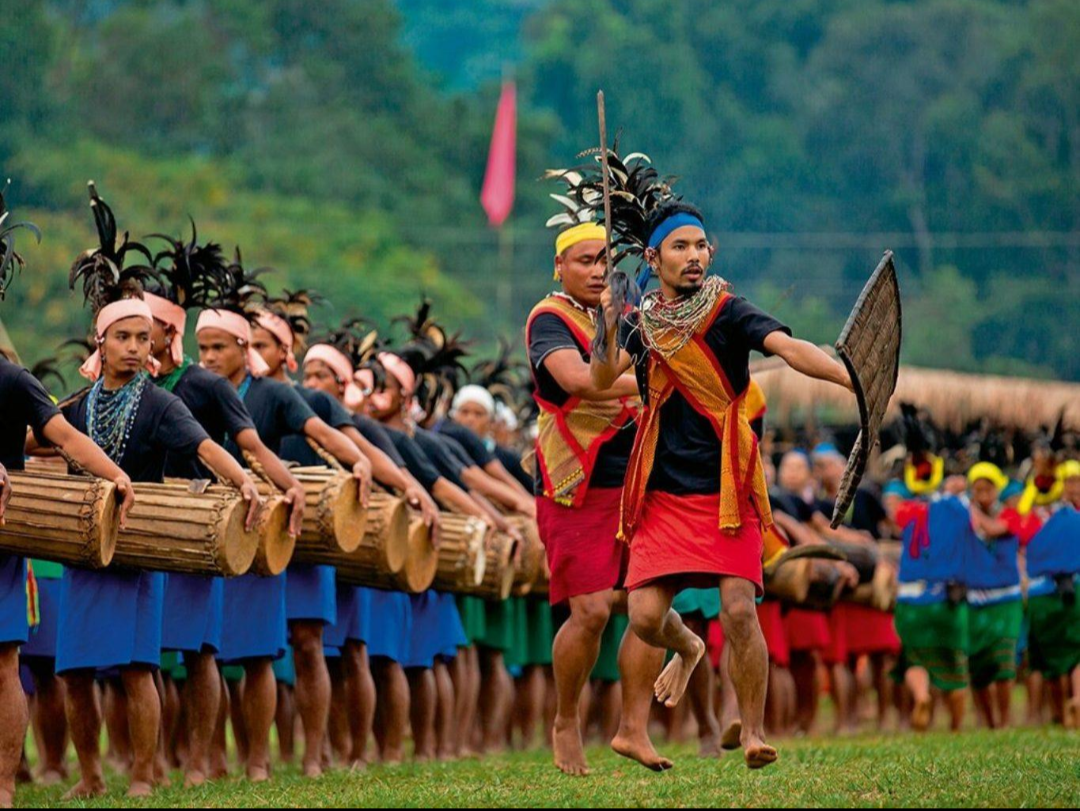
- Wangala (Garo): the post-harvest festival honouring Saljong, the sun god of fertility, famous for its “Hundred Drums” celebrations near Tura, with rows of dancers in feathered headgear moving to the beat of long drums called dama.
- Christmas, Easter and New Year: celebrated with great warmth across the state, with carol singing, church services and family feasts.
The landscape itself is sacred in many places. Sacred forests (law kyntang or law lyngdoh), such as the one at Mawphlang, are protected by custom and religious belief; no tree may be cut and nothing may be removed from them. Balpakram in the Garo Hills is regarded as the land where the spirits of the dead rest. The peak of U Lum Sohpetbneng in Ri-Bhoi is a site of annual pilgrimage for followers of the Khasi faith.
8. Matriliny, Clan, and Social Customs
The single most distinctive feature of Meghalaya’s indigenous societies is matriliny. Among the Khasi and Pnar, children take the clan name (kur) of their mother, and ancestral property passes through the female line. Traditionally the youngest daughter, ka khadduh, inherits the ancestral house and acts as custodian of family property and of the family’s religious duties. This is often misunderstood as “women rule”: in practice, the mother’s brother (u kñi) has historically held important authority in clan affairs, while fathers are deeply respected within the household, and political offices such as village headman have traditionally been held by men.
Among the Garo, descent likewise runs through the mother’s lineage (machong or mahari), and a chosen daughter, the nokna, becomes the heiress of the family property. Her husband, known as the nokrom, traditionally comes to live in her household and manages its affairs. Every Garo belongs to one of the major exogamous clan groups (chatchi), mainly Sangma, Marak, Momin, Areng and Shira, which explains why these surnames are so common in the Garo Hills.
Clan exogamy is a central rule in both societies: marriage within one’s own clan is considered a grave taboo, since clan members are regarded as descendants of a common ancestress. Village and local government is organised through traditional institutions that remain strong today. In the Khasi and Jaintia Hills, the Dorbar Shnong (village council) and its elected Rangbah Shnong (headman) manage local affairs; the Syiems and Doloi continue to hold customary roles; and in the Garo Hills, the nokma retains a traditional position tied to clan land.
Respect for elders, strong clan solidarity, community work and hospitality are shared values across the state. Visitors to a Khasi or Pnar home are traditionally welcomed with kwai, a preparation of areca nut, betel leaf and lime, which symbolises friendship and trust.
| Is Your Family Matrilineal?Meghalaya is one of the few places in the world where clan, name and inheritance still pass through the mother. Mitochondrial DNA follows that same maternal line. Discover what your maternal lineage says about your roots.[ Trace My Maternal Line → ] |
|---|
9. Marriage and Wedding Traditions
Marriage customs in Meghalaya reflect both matrilineal traditions and the influence of Christianity. Among the Khasi, marriage is traditionally a simple affair compared with many parts of India: there is no dowry, and after marriage the husband customarily joins his wife’s household or the couple sets up their own home, depending on whether the wife is the youngest daughter. Traditional Khasi marriages involve negotiation between the two families through a respected go-between, the exchange of kwai, and rites led by a priest or elder with rice beer offerings to the ancestors. Today most Khasi and Pnar marriages are church weddings, often followed by a large reception, though the matrilineal rules of clan membership and residence continue in many families.
Among the Garo, the traditional marriage rite is known as do·sia, in which a priest invokes the spirits and strikes a cock and a hen in a ritual to bless the union. Garo tradition is well known for the custom that the proposal traditionally comes from the woman’s side, and older accounts describe the ceremonial “capture” of a reluctant groom, who might run away several times before finally agreeing to marry. The traditional preference that a nokna marry a man from her father’s lineage, together with the enduring marriage bond between two lineages known as akim, reflects the Garo concern with maintaining ties between lineages over generations. Among Christian Garo families, church weddings are now the norm.
10. Cuisine
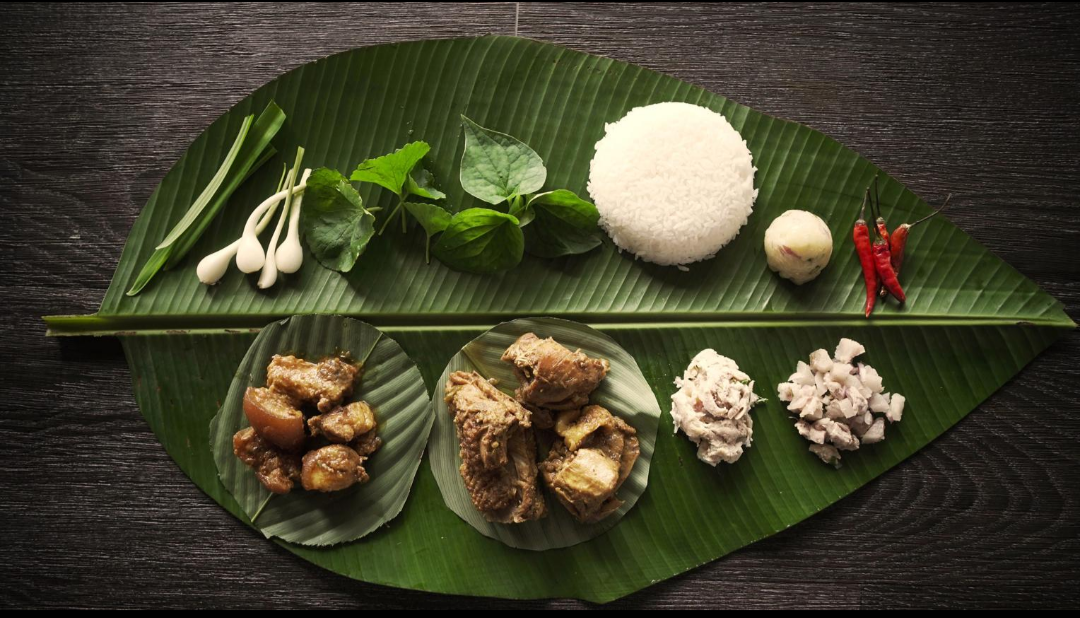
Meghalaya’s food is built on rice, pork, fish, fermented foods, fresh greens and local herbs, with little use of heavy spices, oil or dairy. Smoking, drying and fermenting are traditional techniques for preserving food through the long monsoon. Meat, especially pork, is central to festive meals, while wild herbs, bamboo shoots and sesame give the cuisine its distinctive flavours.
10.1 Khasi and Pnar Cuisine
- Jadoh: red or white rice cooked with pork (often with pork blood or offal), turmeric and ginger; the best-known Khasi dish and a favourite breakfast in Shillong’s eateries.
- Dohneiiong: pork cooked in a dark, rich paste of black sesame seeds.
- Tungrymbai: fermented soybean, cooked into a pungent, earthy relish, often with pork.
- Dohkhlieh: a fresh salad of boiled pork, onions, ginger and chilli, similar in spirit to a Southeast Asian meat salad.
- Pumaloi, putharo and pukhlein: steamed rice cakes, rice-flour pancakes and sweet fried rice cakes eaten at tea time or on festive days.
- Doh-sniang and jastem: other pork and rice dishes flavoured with local herbs, and kiad, the traditional rice spirit.
10.2 Garo Cuisine
Nakham bitchi: a sharp, smoky soup made from dried fish (nakham) and chilli, a signature taste of the Garo Hills.
Kappa: meat or vegetables cooked with an alkaline “soda” extracted from burnt plant ash or banana stems, a technique shared across much of Northeast India.
Wak pura and wak kapa: pork preparations, sometimes cooked with rice flour or bamboo shoot.
Minil songa: sticky rice cooked inside hollow bamboo tubes over a fire.
Chubitchi: traditional Garo rice beer, served at festivals and important family events.
10.3 Produce and Everyday Staples
Meghalaya is known across India for its high-curcumin Lakadong turmeric from the Jaintia Hills, Khasi mandarin oranges, the Memong Narang wild citrus of the Garo Hills, pineapples, ginger, black pepper, bay leaf, areca nut and honey. Several of these products have received Geographical Indication (GI) recognition in recent years. Everyday meals at home usually consist of rice with a meat or fish dish, boiled greens, a chutney of chilli and fermented fish or soybean, and seasonal fruit.
11. Traditional Dress and Ornaments
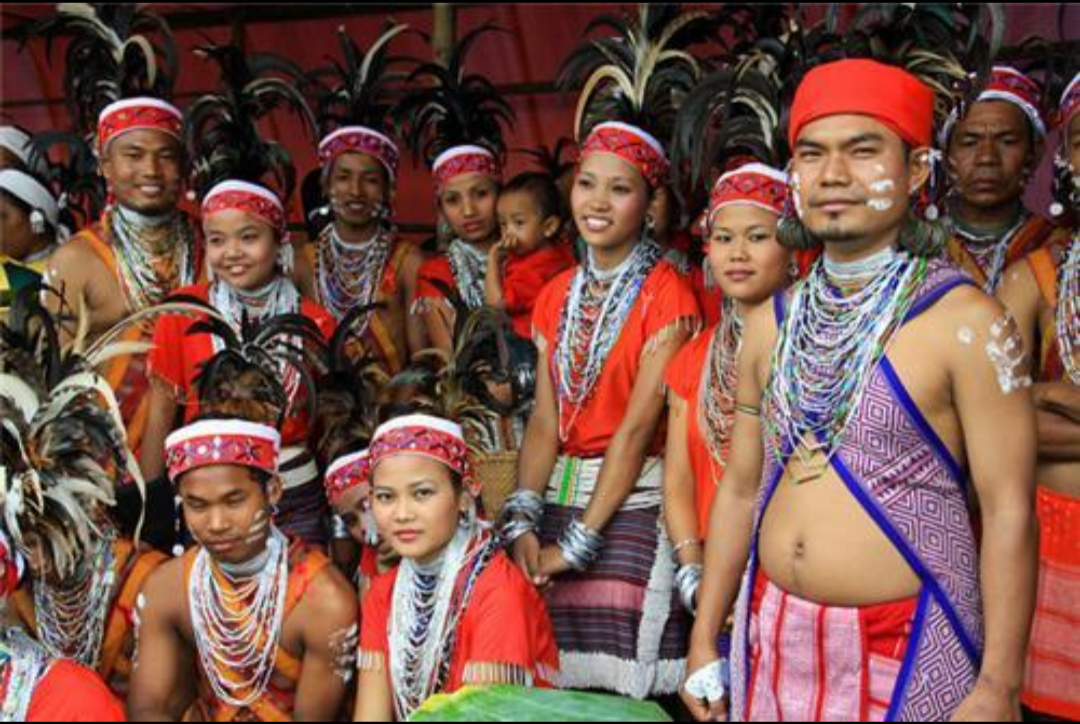
For Khasi women, the everyday traditional dress is the jainsem, two rectangular lengths of cloth pinned at the shoulders and worn over a blouse, often with a checked or plain shawl called ka jainkup draped over the shoulders in cooler weather and a headscarf (tapmoh khlieh). On festive and ceremonial occasions women wear richly woven silk (often the prized muga or ryndia eri silk) along with a silver or gold crown (ka pansngiat) with a tall plume at the back. Pnar women traditionally wear the thoh khyrwang or a distinctive checked cloth called kyrshah, while the jainsem is also widely worn.
Khasi and Pnar men traditionally wear the jymphong, a sleeveless, collarless coat with fringes and tassels, with a dhoti or trousers and a turban (jainspong) on formal occasions. Ceremonial dancers carry swords and whisks, and wear feathered head ornaments.
Among the Garo, women’s traditional dress is the dakmanda, a handwoven wrap-around cloth with a decorated border, worn with a blouse called dakshari. Men traditionally wore the gando, a woven loincloth, often with a turban. For Wangala and other festivals, men and women wear striking headgear decorated with hornbill or rooster feathers, and dancers carry drums or swords and shields.
Jewellery is an important marker of status and celebration. Khasi women wear chains of gold and coral beads (paila and kynjri ksiar) and heavy gold or silver earrings, while Garo women traditionally wore multiple brass rings in the ears (nadongbi) and bead necklaces. In modern life, people commonly mix traditional garments with Western clothing, and in Shillong the jainsem worn over jeans or with a stylish jacket is a familiar sight.
12. Physical Traits
There is no single physical type for a population of more than three million people drawn from several ethnic groups and migrant communities. In general terms, the indigenous Khasi, Pnar and Garo peoples share many features common across Northeast India and mainland Southeast Asia, reflecting their predominantly East Asian-related ancestry. These include a relatively light to medium brown skin tone, straight dark hair, sparse facial hair among men, and eye shapes with an epicanthic fold. Average height is modest by global standards, and people of the hills are often noted for their physical endurance on steep terrain, a product of lifestyle as much as ancestry.
Within these broad patterns there is wide individual variation, as well as measurable differences between groups. Communities of Bengali, Nepali and other origin living in Meghalaya show the physical diversity typical of their own home regions. It is also worth remembering that people from Meghalaya and the wider Northeast have often faced stereotyping and discrimination based on appearance in other parts of India, an experience recognised by government committees and widely discussed in public life. Physical appearance says very little about an individual’s language, culture or sense of identity.
13. Traditional Housing, Monoliths, and Living Architecture
Traditional Khasi houses were oval or rounded in plan, with low walls of stone, wood or bamboo and a thick thatched roof coming down almost to the ground, a design well suited to heavy rain and strong winds. In the Garo Hills, houses (nok) were traditionally built of bamboo and timber on raised platforms, and villages had a bachelors’ dormitory (nokpante) where young men learned crafts, traditions and village responsibilities. Shillong’s own heritage architecture is the “Assam-type” house, built with timber frames, lime-plastered walls and tin roofs after the 1897 earthquake.
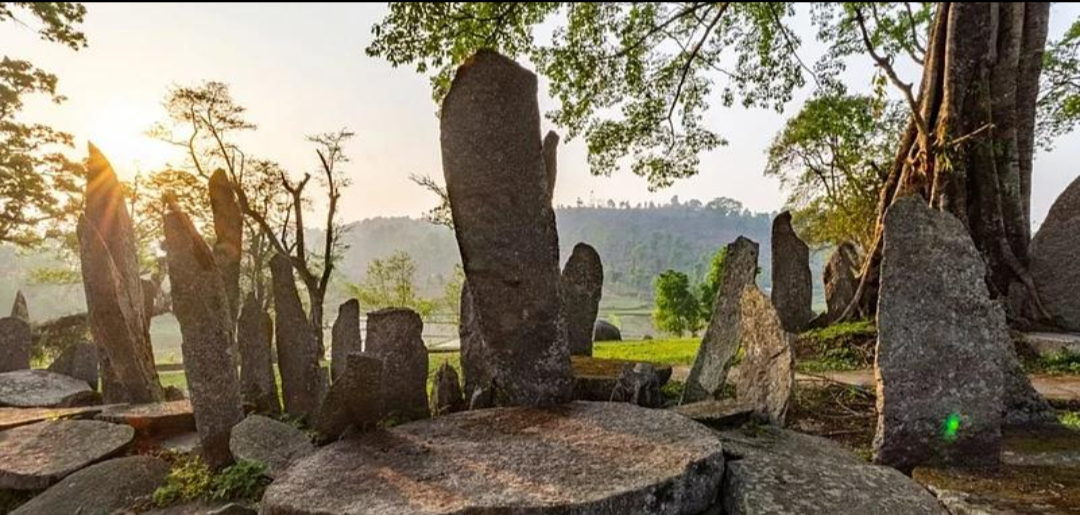
Meghalaya’s most remarkable structures, however, were not built with walls at all. Throughout the Khasi and Jaintia Hills are thousands of megaliths: upright stones (menhirs) raised to honour ancestors and flat table stones (dolmens) on which offerings were placed. The site at Nartiang in the West Jaintia Hills holds one of the largest collections in the world, including stones more than seven metres tall. Equally famous are the living root bridges (jingkieng jri), created by guiding the aerial roots of the Indian rubber tree across rivers until they form strong, self-renewing bridges. The double-decker root bridge at Nongriat is the best known. In 2022, the living root bridge landscapes of Meghalaya were added to India’s Tentative List for UNESCO World Heritage status.
14. Folklore, Music, and Oral Tradition
Meghalaya’s oral tradition is rich and closely tied to its landscape. Khasi folktales explain the origins of places and natural phenomena: the story of Ka Likai, a grieving mother whose tragic leap gave Nohkalikai Falls its name; the legend of U Thlen, a man-eating serpent whose descendants were believed to demand human blood; and tales of U Suid Nia, U Sier Lapalang, and the separation of heaven and earth. Garo folklore includes creation stories involving Tatara-Rabuga and the goddess Nostu-Nopantu, epic songs sung at Wangala, and ritual chants performed by the priests known as kamal.
Music has always been central. Khasi traditional instruments include the duitara (a plucked string instrument), the bom and ksing (drums), the tangmuri (a reed pipe), and the besli (flute), and the Khasi tradition of phawar, rhythmic chanted verses often improvised at gatherings, remains popular. Garo instruments include the dama (long drum), the rang (brass gong), the adil (buffalo-horn trumpet) and bamboo flutes. In modern times Shillong has earned the nickname “the rock capital of India,” with a vibrant Western music scene and choral tradition rooted in church music. Legendary singer Lou Majaw has held an annual Bob Dylan birthday concert in the city for decades, and the Shillong Chamber Choir gained national fame after winning India’s Got Talent in 2010.
15. Small Cultural Things: Everyday Meghalaya
Some of the most memorable details of life in Meghalaya are small, everyday customs that visitors and community members alike recognise instantly:
- Kwai for guests: offering areca nut, betel leaf and lime is a basic courtesy in Khasi and Pnar homes, and refusing it can seem unfriendly.
- Whistled names at Kongthong: in the village of Kongthong and nearby villages, each person is given a unique melodic tune, called jingrwai iawbei, by their mother, and people call one another by these tunes, earning it the name “the whistling village.”
- Unusual first names: Khasi families are famous for creative English first names, from familiar words and titles to names of famous people or objects, while the clan surname carries the real weight of identity.
- Teer: a traditional archery game in which archers shoot hundreds of arrows at a target; in Shillong, betting on the number of arrows that hit the target is a legal daily pastime.
- Football fever: football is almost a religion in the state; clubs such as Shillong Lajong have produced national players, and local matches draw large, passionate crowds.
- Clean villages: Mawlynnong in the East Khasi Hills has become famous as one of the cleanest villages in Asia, with bamboo dustbins lining its paths and strict community rules on cleanliness.
- Market women: Iewduh (Bara Bazar) in Shillong, one of the oldest traditional markets in the region, is run largely by women traders, reflecting the strong economic role of women.
- Clan surnames: Khasi surnames such as Lyngdoh, Syiem, Kharkongor, Marbaniang, Nongrum, Khongwir and Warjri, Pnar names such as Pde, Suchiang and Lamare, and Garo names such as Sangma, Marak and Momin, often reveal a person’s community and clan at once.
16. Education, Livelihoods, and Jobs
Agriculture remains the main source of livelihood for most rural families. Traditional shifting cultivation (jhum), known as rep shyrti among the Khasi, is still practised in parts of the hills, especially the Garo Hills, alongside settled wet-rice farming in valleys and terraced slopes. Major crops and products include rice, maize, potato, ginger, turmeric, pineapple, oranges, areca nut, betel leaf, black pepper, broom grass, tea, and honey. Horticulture and plantation crops have become increasingly important sources of cash income.
Mining has been a significant but controversial part of the economy. Coal mining through small “rat-hole” pits in the Jaintia and Khasi Hills was banned by the National Green Tribunal in 2014 over environmental and safety concerns, and questions about regulated mining continue to shape politics in the state. Limestone quarrying and cement manufacturing are also important industries, particularly in the Jaintia Hills.
Government service is one of the largest employers, and teaching, nursing, church work, banking and retail provide many jobs. Tourism has grown rapidly, with homestays, guides, drivers and restaurants in places such as Sohra, Dawki, Mawlynnong and Shillong. Shillong is a major educational hub for the Northeast, home to the North-Eastern Hill University (founded in 1973), the Indian Institute of Management Shillong, and many long-established schools and colleges. Literacy is relatively high, and English-language skills are widespread, which helps young people from Meghalaya find work in hospitality, aviation, customer service, IT-enabled services and the creative industries in other parts of India.
17. Diaspora
Meghalaya’s diaspora operates on two broad tracks. The first is historical and cross-border. The Khasi, Pnar and Garo homelands were divided by the 1947 partition, and substantial communities remain in Bangladesh: Garo communities in the Mymensingh, Netrokona, Sherpur and Tangail districts (including the Madhupur forest area), and smaller Khasi communities in the Sylhet region, where many work in betel-leaf cultivation. Garo and Khasi communities also live in neighbouring parts of Assam, and Garo settlements are found in Tripura and Nagaland.
The second track is modern migration for education and work. Young people from Meghalaya have moved in growing numbers to Guwahati, Delhi, Bengaluru, Pune, Mumbai, Kolkata and other Indian cities, where they work in hospitality, aviation, retail, healthcare and technology, and many return home after some years. Smaller communities live abroad, especially in the United Kingdom, the United States, Australia and the Gulf. Long-standing links between the Khasi Hills and Wales, dating back to the Welsh missionaries of the 19th century, continue through church, cultural and educational exchanges.
18. Prominent Figures
18.1 Political and Public Life
- U Tirot Sing (c. 1802–1835): Syiem of Nongkhlaw who led the Khasi resistance against the British in the Anglo-Khasi War of 1829–1833.
- U Kiang Nangbah (d. 1862): leader of the Jaintia uprising of 1860–1862, executed by the British at Jowai.
- Pa Togan Nengminza Sangma (d. 1872): Garo warrior who fought British forces in 1872 and is honoured as a freedom fighter.
- Rev. J. J. M. Nichols-Roy (1884–1959): Khasi statesman and member of the Constituent Assembly who played a key role in shaping the Sixth Schedule of the Constitution.
- Captain Williamson A. Sangma (1919–1990): leader of the hill state movement and first Chief Minister of Meghalaya.
- P. A. Sangma (1947–2016): former Chief Minister and Speaker of the Lok Sabha (1996–1998), a major figure in national politics.
- G. G. Swell (1923–2003): scholar-politician and Deputy Speaker of the Lok Sabha.
- Conrad K. Sangma: Chief Minister of Meghalaya since 2018, re-elected in 2023, and national president of the National People’s Party.
18.2 Literature, Arts, and Culture
- U Jeebon Roy (1838–1903): pioneer of Khasi education, publishing and cultural revival.
- U Soso Tham (1873–1940): celebrated Khasi poet, author of Ki Sngi Barim U Hynniew Trep.
- Kynpham Sing Nongkynrih: poet and translator writing in Khasi and English, one of the best-known literary voices of the Northeast.
- Patricia Mukhim: journalist, editor of The Shillong Times and a Padma Shri awardee known for her work on social issues.
- Lou Majaw: Shillong’s iconic singer and musician, known as the city’s Bob Dylan.
- Neil Nongkynrih (1970–2024): pianist and founder of the Shillong Chamber Choir, awarded the Padma Shri.
18.3 Sports and Other Fields
- Eugeneson Lyngdoh: midfielder for the Indian national football team and one of the most celebrated footballers from the state.
- Aiban Dohling and other Shillong Lajong products: players who have represented India and leading clubs in the Indian Super League.
- Meghalaya football team: reached the final of the Santosh Trophy, India’s national football championship for states, in 2023, a milestone for the state’s football culture.
19. Conclusion
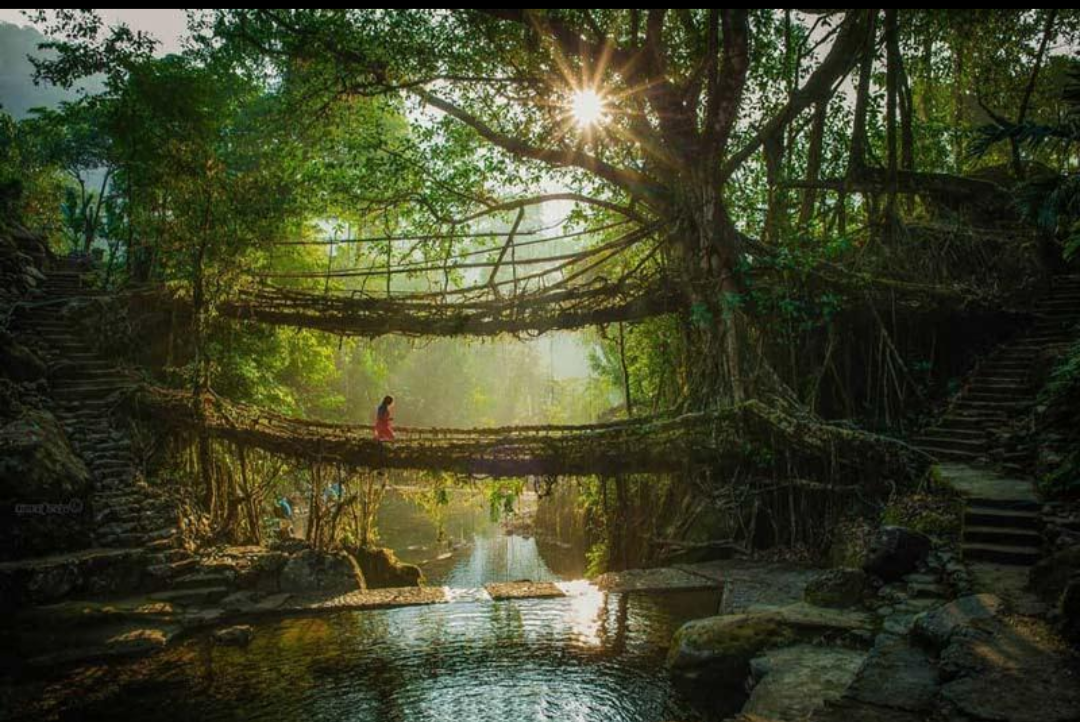
Meghalaya offers a rare case in which geography, language, custom and genetics tell a remarkably consistent story. On one ancient plateau, Austroasiatic-speaking Khasi and Pnar peoples, carrying a genetic link to the rice farmers of mainland Southeast Asia, live alongside the Tibeto-Burman-speaking Garo, whose ancestors came from the north and east. Both built matrilineal societies in which clan and inheritance run through the mother, both resisted colonial rule, both embraced written literacy through Roman script, and both have preserved their identities in a world of rapid change.
From the living root bridges of the Khasi Hills to the Hundred Drums of Wangala, from the monoliths of Nartiang to the music halls of Shillong, the story of Meghalaya’s people is at once a history of the hills, a genetic case study of human movement between South and Southeast Asia, and a living culture carried by a young, confident population in India and across the world.
References
- [1]Census of India 2011. Meghalaya: Primary Census Abstract and Religion Data. Office of the Registrar General and Census Commissioner, India.
- [2]Government of Meghalaya. Official state portal, meghalaya.gov.in.
- [3]Reddy, B. M. et al. (2007). “Austro-Asiatic tribes of Northeast India provide hitherto missing genetic link between South and Southeast Asia.” PLoS ONE 2(11): e1141.
- [4]Kumar, V. et al. (2007). “Y-chromosome evidence suggests a common paternal heritage of Austro-Asiatic populations.” BMC Evolutionary Biology 7: 47.
- [5]Chaubey, G. et al. (2011). “Population genetic structure in Indian Austroasiatic speakers: the role of landscape barriers and sex-specific admixture.” Molecular Biology and Evolution 28(2): 1013–1024.
- [6]Tätte, K. et al. (2019). “The genetic legacy of continental scale admixture in Indian Austroasiatic speakers.” Scientific Reports.
- [7]Langstieh, B. T. et al. (2004). “Genetic diversity and relationships among the tribes of Meghalaya compared to other Indian and continental populations.” Human Biology.
- [8]Cordaux, R. et al. (2004). “The northeast Indian passageway: a barrier or corridor for human migrations?” Molecular Biology and Evolution 21(8): 1525–1533.
- [9]Reich, D. et al. (2009). “Reconstructing Indian population history.” Nature 461: 489–494.
- [10]Walker, M. et al. (2019). “Subdividing the Holocene Series/Epoch: formalization of stages/ages and subseries/subepochs.” Journal of Quaternary Science 34(3): 173–186.
- [11]UNESCO World Heritage Centre. “Jingkieng Jri: Living Root Bridge Cultural Landscapes,” Tentative List of India (2022).
- [12]Gurdon, P. R. T. (1907). The Khasis. London: David Nutt.
- [13]Playfair, A. (1909). The Garos. London: David Nutt.
- [14]Nongkynrih, A. K. (2002). Khasi Society of Meghalaya: A Sociological Understanding. New Delhi: Indus Publishing.
Frequently Asked Questions
What ethnicity or ancestry are people from Meghalaya?
Meghalaya is home mainly to three indigenous peoples, the Khasi, the Jaintia (Pnar) and the Garo (A·chik), along with smaller tribes such as the Hajong, Koch, Rabha and Boro and long-settled Bengali, Nepali and other communities. Genetically, the indigenous peoples carry predominantly East Asian-related ancestry, with the Khasi and Pnar linked to Austroasiatic populations of Southeast Asia and the Garo linked to Tibeto-Burman populations of the Himalaya and Northeast India.
Are the Khasi and Garo the same people?
No. Although they live side by side and share matrilineal customs, the Khasi and Garo speak languages from entirely different families (Austroasiatic and Tibeto-Burman respectively), have different origin traditions, and show different paternal genetic lineages. They are best understood as two distinct peoples who have shared the same plateau for many centuries.
What DNA haplogroups are common in Meghalaya?
Khasi and Pnar men show very high frequencies of Y-chromosome haplogroup O-M95 (O1b1a1a), typical of Austroasiatic speakers in India and Southeast Asia. Garo men mostly carry O2 (O-M122) lineages, especially the O-M134 branch common among Tibeto-Burman speakers. Maternal lineages in both groups are dominated by East Asian mitochondrial haplogroups, with a smaller proportion of South Asian M lineages.
Is Meghalaya really a matrilineal society?
Yes. Among the Khasi, Pnar and Garo, children take their clan name from their mother, and ancestral property passes through the female line. Among the Khasi, the youngest daughter (ka khadduh) traditionally inherits the family home; among the Garo, a chosen daughter (nokna) becomes the heiress. However, matriliny is not the same as matriarchy, since men have traditionally held key roles in clan and political affairs.
What language do people in Meghalaya speak?
English is the official language, and Khasi and Garo are associate official languages. Khasi has several dialects, including Pnar, War, Bhoi and Lyngngam, and Garo has dialects such as A·we and Chisak. Hindi, Bengali, Nepali, Assamese and Hajong are also widely spoken.
What is the traditional dress of Meghalaya?
Khasi women traditionally wear the jainsem with a shawl called jainkup, and on festive occasions a silver or gold crown called ka pansngiat. Khasi men wear the sleeveless jymphong coat. Garo women wear the handwoven dakmanda with a blouse called dakshari, and Garo men traditionally wore the gando, with feathered headgear at festivals such as Wangala.
What food is Meghalaya famous for?
Meghalaya is best known for jadoh (rice cooked with pork), dohneiiong (pork in black sesame), tungrymbai (fermented soybean), dohkhlieh (pork salad), nakham bitchi (Garo dried fish soup) and steamed rice cakes such as pumaloi. The state is also famous for Lakadong turmeric, Khasi mandarins and pineapples.
What is the population of Meghalaya?
The 2011 Census recorded 2,966,889 people, and current projections put the population at around 3.3 to 3.5 million. About 86 per cent belong to Scheduled Tribes, of whom the Khasi-Jaintia group numbers about 1.4 million and the Garo about 0.8 million.
Where does the Meghalayan diaspora live?
Significant Garo and Khasi communities live across the border in Bangladesh, especially in Mymensingh, Netrokona, Tangail and Sylhet, and in neighbouring Assam and Tripura. Many young people from Meghalaya now live and work in Indian cities such as Guwahati, Delhi, Bengaluru and Pune, and smaller communities are found in the UK, the US, Australia and the Gulf.
Why is Meghalaya called the Abode of Clouds?
The name comes from the Sanskrit words megha (cloud) and alaya (abode). It reflects the state’s high plateau, where monsoon clouds from the Bay of Bengal regularly envelop the hills, and places such as Mawsynram and Sohra receive some of the highest rainfall in the world.
What is the Meghalayan Age?
The Meghalayan Age is the most recent stage of the Holocene epoch in geological time, beginning about 4,200 years ago. It was formally named in 2018 after a stalagmite from Mawmluh Cave near Sohra, which records a severe global drought that marks the start of this age.
Are people from Meghalaya genetically related to people in Southeast Asia?
Yes, especially the Khasi and Pnar. Genetic studies show that they share paternal lineages and ancestry with Austroasiatic-speaking peoples of mainland Southeast Asia, such as the Khmer and Mon, and they are often described as a genetic bridge between South and Southeast Asian Austroasiatic populations.
What physical traits are typical of people from Meghalaya?
There is no single physical type. In general, the indigenous peoples share features common across Northeast India and mainland Southeast Asia, such as straight dark hair, light to medium brown skin and an epicanthic eye fold, reflecting their East Asian-related ancestry. There is considerable individual variation, and appearance says little about a person’s language or identity.