

Rajput Community
A diverse community historically associated with warrior traditions, ruling lineages, and regional kingdoms in northern and western India..
The Rajputs of India
History, Culture, and Legacy of a Warrior Aristocracy
1. Who Are the Rajputs?
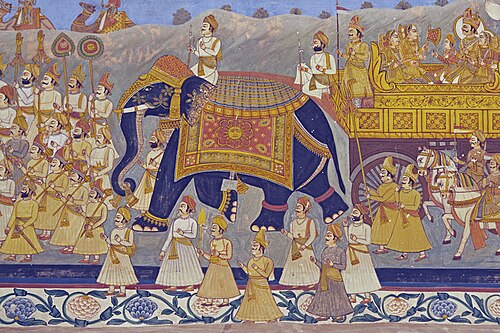
Ask someone from Rajasthan who a Rajput is, and you'll rarely get a one-line answer. The word itself comes from the Sanskrit rajaputra, “son of a king,” and in many regions the community goes by the older title Thakur instead. But behind that royal-sounding name sits a very large and varied population — farmers as much as former rulers — spread across Rajasthan, Gujarat, Madhya Pradesh, Uttar Pradesh, Bihar, Haryana, Himachal Pradesh, Uttarakhand, Punjab, and the Jammu region, with communities across the border in Pakistan and Nepal as well.
What ties this sprawling population together isn't blood so much as history: roughly a thousand years during which Rajput dynasties raised forts on hilltops, fought and allied with sultans and emperors, funded temples and painters, and shaped a code of martial honour that Rajasthani households still talk about today. Some Rajput families ruled kingdoms; far more worked the land, served in armies, or ran estates for those who did. Both threads belong equally to the story.
What follows is a tour through that history and the culture it produced — the clans and kinship rules, the gods and festivals, the food, the clothes, the forts, the horses, and the people, past and present, who carry the name.
2. Where the Story Begins
2.1 A Word That Changed Meaning
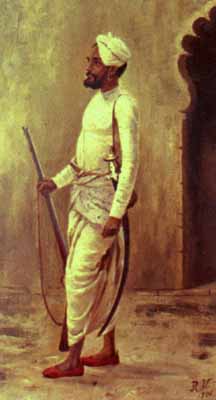
The term rajaputra shows up in inscriptions and manuscripts from as early as the seventh century, but it didn't originally mean what it means now. In its earliest uses it described a status — a mounted soldier, a chieftain's son, a landholder who owed service to someone above him — rather than a birthright passed down a family line. That changed gradually. Between roughly the twelfth and sixteenth centuries, as ruling families across the north and west of India settled into fixed territories and started commissioning genealogies (vamshavali) tracing their descent back to legendary kings, “Rajput” hardened into something closer to a hereditary identity, recognised as Kshatriya — the traditional warrior-ruler class of Hindu society.
2.2 The First Rajput Dynasties
By the eighth century a cluster of dynasties had risen to real power across northern, western, and central India — the Gurjara-Pratiharas, the Chahamanas (better known as the Chauhans) of Shakambhari and Ajmer, the Chaulukyas or Solankis of Gujarat, the Paramaras of Malwa, the Guhilas and later Sisodias of Mewar, the Chandelas of Bundelkhand, the Tomaras around Delhi, and the Gahadavalas of Kannauj. Later chroniclers grouped all of these under the Rajput banner. Whatever their exact origins, these were serious regional powers in their own right — they governed sizeable kingdoms, raised temple complexes that still stand, and kept court poets and scholars busy.
3. Forts, Sieges, and a Turning Point at Tarain
For the next several centuries, Rajput history reads a lot like the history of northern India's frontier politics. Bappa Rawal and his successors in Mewar pushed back early Arab incursions into Rajasthan following the conquest of Sindh. Centuries later, in 1191, Prithviraj Chauhan of Ajmer pulled together a coalition of Rajput rulers and beat Muhammad of Ghor at the First Battle of Tarain — only for Ghor to return the following year with a different army and a different result. The Second Battle of Tarain went the other way, and the years afterward saw the Delhi Sultanate take shape.
Chittorgarh and Ranthambore, among the great Rajput strongholds, were besieged more than once over the following two centuries. In the fifteenth century Rana Kumbha of Mewar turned back a combined invasion by the Sultans of Malwa and Gujarat and poured resources into fortification — Kumbhalgarh, the fort that bears his name, is one result. His grandson Rana Sanga later brought together a broad alliance of Rajput rulers and became, for a time, one of the most formidable powers in northern India; even Babur, writing about his own campaign against him, singled Sanga out as a serious rival.
No single figure from this era is remembered quite like Rana Pratap of Mewar — Maharana Pratap — whose long refusal to submit to Mughal authority, especially at the 1576 Battle of Haldighati, has made him something close to a byword for stubborn courage in Rajasthani memory. Part of that story belongs to his horse: Chetak, a Marwari stallion said to have carried the wounded Pratap clear of the battlefield before finally succumbing to his own injuries, is remembered in bardic verse almost as vividly as Pratap himself.
4. Under the Mughals: Rivals, Then Partners
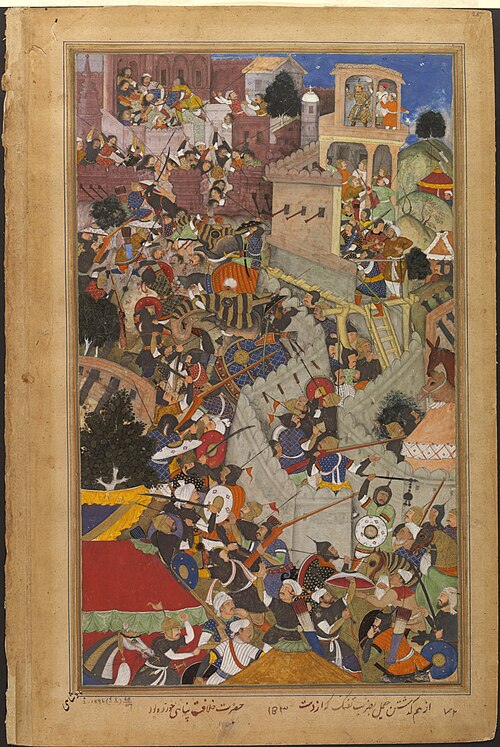
The relationship between Rajput rulers and the Mughal court shifted a great deal depending on the decade and the dynasty. From Akbar's reign onward, many Rajput houses moved from resistance to alliance, supplying generals, governors, and administrators to the empire while keeping control of their own territories. Raja Man Singh I of Amber became one of the most trusted commanders in Mughal service. Marriage alliances between Rajput royal families and the Mughals were part of this arrangement too — Jahangir and Shah Jahan were both born to Rajput mothers, a fact that shaped Mughal court culture in ways historians still study.
Mewar's Sisodia rulers held out longer than most against this pattern of accommodation, and when Mewar did eventually settle into a working relationship with the Mughals, it came only after generations of resistance rather than early negotiation. Rajput nobles and regiments remained a significant presence in Mughal military and administrative life well into the empire's later, more fractured decades, when weakening central authority gave several Rajput states a renewed measure of independence.
5. From Princely States to Modern Rajasthan
By the early nineteenth century, most of the major Rajput states in the region then called Rajputana had entered treaty relationships with the British East India Company: the Company recognised their internal self-rule in exchange for tribute and a degree of political oversight. Twenty-two Rajput princely states existed under this arrangement by the time of Indian independence in 1947.
Those states then acceded to the new Union of India and were merged into the state of Rajasthan over 1949 and 1950. The Dogra Rajput rulers of Jammu and Kashmir followed a similar path into independent India that same year. What's left of that princely world today — palaces, forts, family museums — has become central to how Rajasthan presents itself to visitors, and many families that once ruled these territories remain active in public life, heritage conservation, and Indian administration and the armed forces.
6. Clans, Kinship, and the Family Goddess
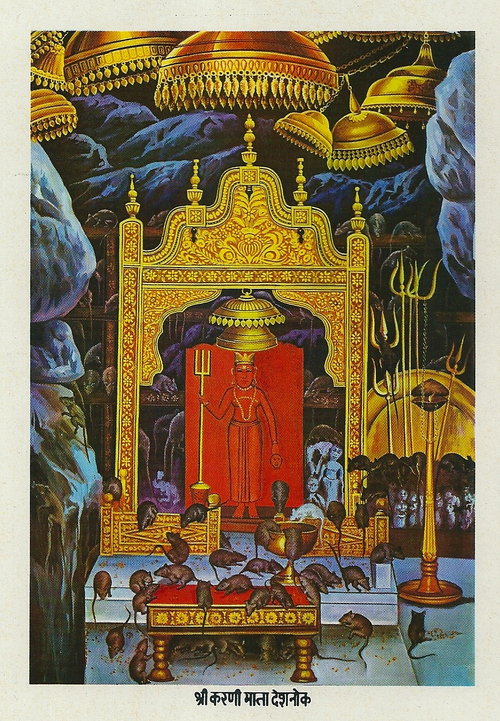
Rajput identity has always run through clan lines rather than a single unified structure. Genealogical tradition sorts the major clans into three broad lineages, or vansh: the Suryavanshi, tracing descent from the sun; the Chandravanshi (or Somavanshi), from the moon; and the Agnivanshi, tied to a fire-born origin story and traditionally including clans such as the Chauhan, Parmar, Solanki, and Parihar. Medieval texts back this classification up in their own way — the twelfth-century Rajatarangini lists thirty-six Rajput clans, while the fourteenth-century Varna Ratnakara names seventy-two, among them the Chauhan, Parmar, Chandela, Kachhwaha, Sisodia (Guhilot), and Bhati.
Underneath the vansh sit progressively smaller divisions — kul, then shakh (branch), then finer sub-branches still — and each of these is typically watched over by a kuldevi, a clan goddess whose worship binds the lineage together across generations and geography. It's this clan and sub-clan structure, more than anything written into scripture, that has historically governed who marries whom, who owes loyalty to whom, and how far a Rajput family's sense of “home” actually extends.
7. Gods, Goddesses, and the Festival Calendar
Most Rajputs are Hindu, and Lord Shiva features prominently in that faith — in Mewar particularly as Eklingji, long regarded as the actual sovereign of the former ruling house, with its maharanas traditionally styled as his regents rather than independent kings. Goddess Durga, worshipped in her fierce form as Sherawali Mata, is equally central, and Karni Mata — a folk goddess linked to the Bikaner region and famously associated with her temple's resident rats — is honoured as a kuldevi by several clans. In the countryside, folk deities such as Pabuji, Gogaji, and Ramdeoji draw devotion that owes as much to oral ballad and travelling performance as to formal temple ritual.
A smaller but historically important share of Rajputs are Muslim, concentrated mainly in Pakistan and parts of northern India, or Sikh — a reminder that “Rajput” has always been more a lineage and social identity than a single religious label. Alongside the wider Hindu festival calendar of Diwali and Holi, Navratri and Dussehra carry particular weight, and Teej and Gangaur are celebrated with real intensity. Gangaur especially — an eighteen-day spring festival honouring Gauri, Shiva's consort — is above all a festival run by women: married women fast and pray for their husbands' long lives, unmarried women pray for a good match, and processions carrying clay or wooden images of Gauri and Isar through cities like Jaipur and Udaipur remain among Rajasthan's most striking public rituals, historically patronised by royal households including the Kachhwahas of Jaipur.
8. Language, Bards, and Oral Literature
Rajput families speak whatever the regional language of their homeland happens to be — Rajasthani (with its Marwari, Mewari, and Dhundhari dialects), Hindi, Gujarati, Punjabi, or Bhojpuri, depending on where they settled. What set Rajput courts apart historically was less the language itself than what got done with it: patronage of Rajasthani, Braj, and Sanskrit poetry, and support for the Charan and Bhat communities, whose job was to compose heroic ballads and keep a clan's genealogy in order. The Prithviraj Raso, a sprawling heroic poem credited to the bard Chand Bardai, is the best-known product of this tradition and did more than entertain — it helped stitch together a shared sense of Rajput identity across clans that otherwise had little in common.
9. A Code of Honour, and the Habit of Hospitality
If there's a single thread running through Rajput self-image across regions and centuries, it's a code built around valour, keeping one's word, loyalty to lineage, and an almost reflexive hospitality toward guests — a value visitors to Rajasthan still remark on today. Genealogical memory matters enormously; family and clan gatherings, and the ongoing worship of the kuldevi, are less formality than active maintenance of who belongs where. Hunting expeditions, horsemanship, and martial sport were once inseparable from Rajput noble life, and much of that heritage survives in a more domesticated form today through polo, horse breeding, and shooting sports.
A Horse Worth a Legend
No discussion of Rajput martial culture gets very far without the Marwari horse — the desert-bred, inward-eared cavalry horse developed by the Rathore rulers of Marwar (the Jodhpur region) from at least the twelfth century onward, reportedly by crossing hardy local stock with Arabian bloodlines. Marwaris were prized less for speed than for endurance and an unusual, ambling gait known locally as the revaal, comfortable enough to cover long desert distances without wearing out horse or rider. Bardic tradition credits the breed with near-supernatural loyalty in battle — tales of Marwaris standing over a fallen rider rather than fleeing — and Chetak, Maharana Pratap's mount at Haldighati, remains the breed's single most famous individual. The line nearly died out after independence, when the princely patronage that had sustained it disappeared almost overnight, but conservation efforts from the mid-twentieth century onward have kept it alive, and Marwaris are bred today around Jodhpur, Udaipur, Jaipur, and Bikaner.
10. Weddings and Marriage Customs
A traditional Rajput wedding, especially in families that hold on to older customs, is not a one-afternoon affair. It typically stretches across several days and blends Hindu Vedic ritual with distinctly Rajasthani and Gujarati ceremony: a formal tilak (engagement) function, mehndi evenings where the bride's hands and feet are covered in henna, a baraat in which the groom — historically mounted on horseback or even elephant-back — processes to the wedding venue with his family in tow, and the pheras, the circling of the sacred fire that forms the core of the Hindu marriage rite itself, followed by a feast large enough to feed the whole gathering. Clans are traditionally exogamous — marriage within one's own kul is avoided — and for centuries these matches did double duty as alliances, tying one Rajput house to another across regions that might otherwise have had little reason to cooperate.
11. Cuisine: Desert Cooking, Royal Kitchens
Rajasthani food and Rajput food are, in practice, hard to pull apart — the state's culinary identity grew directly out of the courts, campaigns, and country households of its ruling community, shaped as much by an unforgiving desert climate as by royal appetite. Laal Maas is probably the dish most people know: a fiercely red mutton curry built on Mathania chillies, garlic, and yogurt, with a heat and colour that has made it something of a calling card for Rajasthani cooking generally. Dal Baati Churma runs it close for fame — hard wheat rolls (baati), traditionally baked by burying them in scorching desert sand while soldiers were on campaign, served with a spiced lentil dal and a sweet crumbled-wheat churma that turns the whole thing into a meal heavy enough to carry a person through a long day.
Hunting supplied its own repertoire — jungli maas, a game curry built from little more than meat, ghee, and whole spices, and maas ra soola, meat cooked on a skewer over open flame, both traceable to the shikar expeditions of Rajput nobility. The vegetarian side of the table is no less inventive: gatte ki sabzi turns gram-flour dumplings into a yogurt-based curry, and ker sangri makes a virtue of two things the desert actually produces — wild berries and beans — in a dish that could only have come from people who had to cook with what was in front of them. In the palace kitchens, meanwhile, a separate Rajwadi style developed: dried fruit, saffron, rosewater, and rich dairy, sweets such as ghewar served with real ceremony, sometimes finished with edible silver or gold leaf — food built for display as much as for eating.
12. What People Wore — and Still Wear
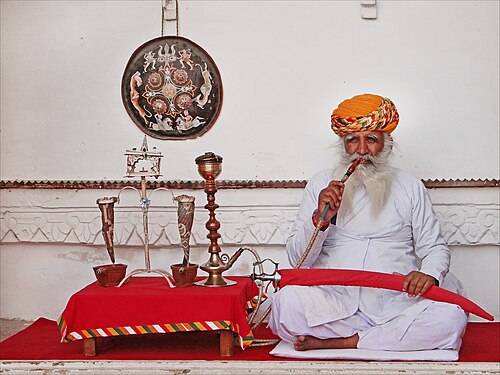
Start with the head, because in Rajasthan that's traditionally where the eye goes first. The safa, or pagri — a long strip of cloth, often nine metres or more, wound and pleated into a turban — has been Rajput headwear of choice for centuries, and it was never just practical protection against sun and sand, though it began that way. Colour and style carry real information: white for mourning or plain ceremony, saffron and red for weddings and celebration, and a tying style that, according to local saying, changes noticeably every fifteen kilometres or so across the state. Royal households historically kept their own signature styles — the Jaipuri pag of the Kachhwaha court is still recognisable at a glance — and the skill of tying one properly is a craft passed down inside families rather than taught in any formal school.
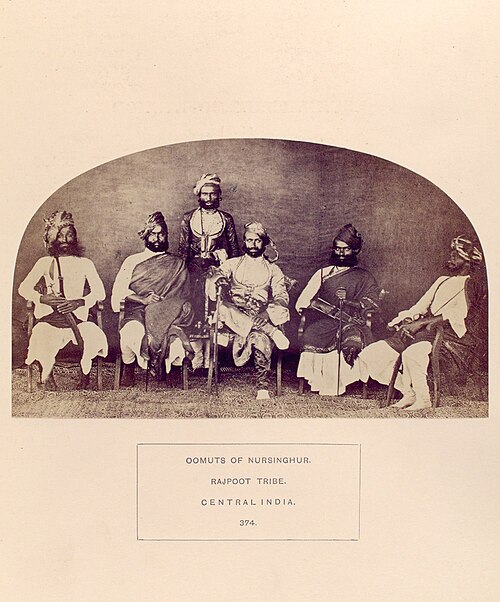
Below the turban, men traditionally wore an angarkha or bandi as an upper garment over dhoti or churidar, with the jama — a long fitted coat — and, in earlier centuries, a katar push-dagger reserved for formal or ceremonial dress. Rajput women's traditional wear centres on the ghagra-choli-odhni combination: a full, flared skirt, a fitted blouse, and a veil or wrap, usually in the tie-dyed bandhani or block-printed patterns that Rajasthan and neighbouring Gujarat are known for. Gold jewellery is not an afterthought here — pieces like the borla and rakhdi worn on the forehead, timaniyan necklaces, and heavy bangles have long signalled both status and marital standing within a family, and many of these pieces are still made and worn much as they always were.
13. Forts, Palaces, and Havelis
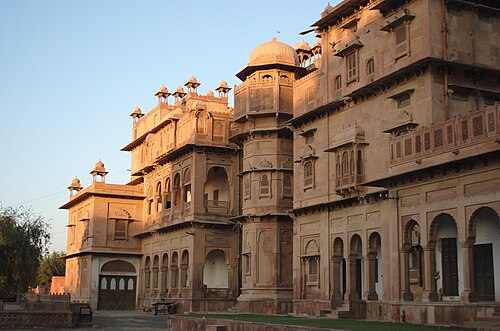
If Rajput history left one unmistakable physical signature, it's stone — hill forts and palaces built to dominate a skyline and, not incidentally, to survive a siege. Six of the most significant of these — Chittorgarh, Kumbhalgarh, Ranthambore, Gagron, Amber near Jaipur, and Jaisalmer — were jointly inscribed as the UNESCO World Heritage Site “Hill Forts of Rajasthan” in 2013, recognised specifically for how they demonstrate Rajput fort planning, art, and architecture across roughly a thousand years, from the eighth century to the eighteenth. Some of these fortifications run to twenty kilometres in circumference, walling in entire palace complexes, temples, and water-harvesting systems that Rajasthan still relies on today, not merely tourist curiosities.
Away from the great forts, Rajput architectural taste shows up just as clearly in the havelis — carved sandstone courtyard mansions with painted interiors and jharokha balconies projecting out over the street — and in palace complexes such as Mehrangarh in Jodhpur and Junagarh in Bikaner, along with the elaborate stepwells that Rajasthan's builders raised to manage a chronic shortage of water.
14. Ballads, Painted Scrolls, and Miniature Art
Long before anyone wrote Rajput history down in a book, it was being sung. Bhopa performers still travel with the Pabuji ki Phad, a painted scroll depicting the deeds of the folk hero Pabuji, unrolling it panel by panel as they narrate his story through the night — a genuinely living tradition rather than a museum piece. Dhola-Maru, a romantic epic set against the Thar Desert, occupies similar ground in Rajasthani oral memory. The Prithviraj Raso, mentioned earlier for its role in shaping Rajput identity, sits at the more literary end of this same bardic tradition.
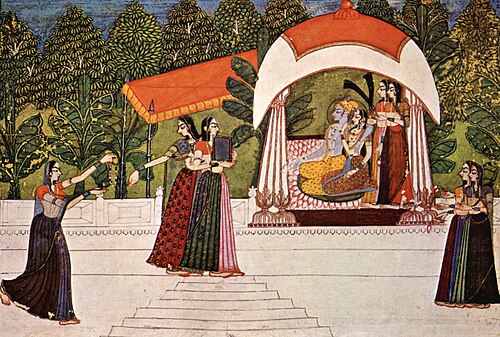
On the visual side, Rajput courts across Rajasthan, central India, and the Punjab Hills developed their own schools of miniature painting from roughly the sixteenth through nineteenth centuries — Mewar, Marwar, Bundi-Kotah, and Kishangarh each with a recognisably different palette and temperament. Rajput painting is usually discussed alongside Mughal painting of the same period, not as an imitation of it but as a genuinely separate tradition that borrowed from, and occasionally pushed back against, the imperial style next door — turning up in everything from court portraiture to devotional and literary scenes.
15. Where Rajputs Live Today
Rajput communities and the traces of former Rajput states stretch across Rajasthan, Gujarat, Madhya Pradesh, Uttar Pradesh, Bihar, Haryana, Himachal Pradesh, Uttarakhand, Punjab, West Bengal, and the Jammu region within India, and into Sindh, Punjab, and Azad Kashmir in Pakistan, where both Hindu and Muslim Rajput families are established. Nepal has its own Rajput community too, and the country's former ruling Shah dynasty traced its own lineage back to Rajput roots in Chittorgarh.
More recent migration has, as with most Indian communities, produced diaspora populations in the United Kingdom, North America, and the Gulf states, where community associations do the ordinary but essential work of keeping language, festivals, and clan ties alive a long way from Rajasthan.
16. People Worth Knowing
16.1 From the Chronicles
- Bappa Rawal (8th century) — founding figure of the Guhila/Sisodia line in Mewar, remembered for pushing back early Arab incursions into Rajasthan.
- Prithviraj Chauhan (12th century) — ruler of Ajmer and Delhi, who led a Rajput coalition to victory at the First Battle of Tarain in 1191.
- Rana Kumbha (15th century) — Mewar ruler who repelled a joint Malwa–Gujarat invasion and built extensively, including at Kumbhalgarh.
- Rana Sanga (early 16th century) — united a broad Rajput alliance and was regarded by contemporaries, including his rival Babur, as among the most formidable rulers of his age.
- Maharana Pratap (16th century) — remembered above almost anyone else for his long resistance to Mughal authority, especially at the Battle of Haldighati in 1576.
- Raja Man Singh I of Amber (16th–17th century) — leading Rajput general and administrator in Mughal service.
- Sawai Jai Singh II (17th–18th century) — founder of Jaipur and a serious astronomer in his own right, builder of the Jantar Mantar observatories.
- Mirabai (16th century) — Mewar princess turned Bhakti poet-saint, whose devotional songs to Krishna are still sung across India.
16.2 Closer to the Present
- Gayatri Devi (1919–2009) — Rajmata of Jaipur and a prominent member of India's Parliament.
- Vijaya Raje Scindia (1919–2001) — Rajmata of Gwalior and a long-serving parliamentarian.
- Bhairon Singh Shekhawat (1923–2010) — former Chief Minister of Rajasthan and Vice-President of India.
- Vasundhara Raje (b. 1953) — former Chief Minister of Rajasthan.
- Rajyavardhan Singh Rathore (b. 1970) — Olympic silver medallist in shooting, later a Union Minister.
None of this is a complete list — it can't be, given how broad the community is — but it gives a sense of the range: rulers and warriors, poets and astronomers, politicians and Olympians, across roughly eight centuries.
17. What the Identity Means Now
Rajput identity today lives less in politics or territory than in memory and maintenance — pride in a clan's particular history, upkeep of family forts and havelis (many now run as heritage hotels or small museums), continued worship of family deities, and active Rajput Sabhas and clan associations that stretch from Rajasthan out into the diaspora. A good number of former royal families remain closely involved in conserving and presenting Rajasthan's architectural heritage, which today is arguably the single most recognisable image of Indian royalty that most outsiders carry around in their heads.
18. Closing Thoughts
Strip away the legends and what's left is still a genuinely long story: dynasties that rose in the eighth century, centuries of shifting resistance and alliance through the Delhi Sultanate and Mughal periods, princely states under the British, and finally integration into independent India. It shows up in the ramparts of Chittorgarh and Kumbhalgarh, in the miniature paintings of Mewar and Kishangarh, in a scroll unrolled by a Bhopa singer at night, in Mirabai's hymns, in a plate of laal maas, and in family reunions that still open with a prayer to the kuldevi. Different pieces, but they add up to one of the more continuous and widely recognised threads in India's cultural fabric.
References
- [1]1. Encyclopaedia Britannica, “Rajput.” https://www.britannica.com/topic/Rajput
- [2]2. Wikipedia, “Rajput.” https://en.wikipedia.org/wiki/Rajput
- [3]3. Wikipedia, “Rajput painting.” https://en.wikipedia.org/wiki/Rajput_painting
- [4]4. Wikipedia, “Rajasthani cuisine.” https://en.wikipedia.org/wiki/Rajasthani_cuisine
- [5]5. Wikipedia, “Maharana Pratap.” https://en.wikipedia.org/wiki/Maharana_Pratap
- [6]6. Wikipedia, “Rana Sanga.” https://en.wikipedia.org/wiki/Rana_Sanga
- [7]7. Wikipedia, “Prithviraj Chauhan.” https://en.wikipedia.org/wiki/Prithviraj_Chauhan
- [8]8. Wikipedia, “Jai Singh II.” https://en.wikipedia.org/wiki/Jai_Singh_II
- [9]9. Wikipedia, “Mirabai.” https://en.wikipedia.org/wiki/Mirabai
- [10]10. Wikipedia, “Marwari horse.” https://en.wikipedia.org/wiki/Marwari_horse
- [11]11. Wikipedia, “Pabuji.” https://en.wikipedia.org/wiki/Pabuji
- [12]12. Wikipedia, “Gangaur.” https://en.wikipedia.org/wiki/Gangaur
- [13]13. Wikipedia, “Karni Mata.” https://en.wikipedia.org/wiki/Karni_Mata
- [14]14. Wikipedia, “Rajyavardhan Singh Rathore.” https://en.wikipedia.org/wiki/Rajyavardhan_Singh_Rathore
- [15]15. UNESCO World Heritage Centre, “Hill Forts of Rajasthan.” https://whc.unesco.org/en/list/247/
- [16]16. Ministry of Culture, Government of India, “Hill Forts of Rajasthan.” https://culture.gov.in/hill-forts-rajasthan
- [17]17. Department of Tourism, Government of Rajasthan, “Gangaur Festival.” https://www.tourism.rajasthan.gov.in/travel-diaries/itvaSthan.html
- [18]18. The Bit and Bridle, “Marwari Horse Breed Profile” (Chetak and the Battle of Haldighati). https://thebitandbridle.com/horse-breed/marwari-horse/
- [19]19. NativeBreed.org, “Marwari Horse — Complete Breed Guide.” https://www.nativebreed.org/marwari-horse/
- [20]20. Local Samosa, “Crowned in Culture: The Timeless Turbans of Rajasthan.” https://www.localsamosa.com/travel/turbans-of-rajasthan-7051416
- [21]21. India Royal Families, “Safa-e-Shan: Royal Turban Tying by Surendra Bana.” https://indiaroyalfamilies.com/royal-safa-tying-by-surendra-bana/
- [22]22. Aza Fashions, “Cultural Heritage of the Rajputi Safa in Weddings.” https://www.azafashions.com/blog/cultural-heritage-of-rajputi-safa-in-weddings/
- [23]23. WanderOn Travel Guide, “12 Famous Foods of Rajasthan.” https://wanderon.in/blogs/famous-foods-of-rajasthan
- [24]24. Swiggy Diaries, “Rajasthan's Culinary Heritage: The Art of Traditional Food.” https://blog.swiggy.com/food/rajasthan-culinary-heritage/