

Santhal Community
Santhal people, India's largest Adivasi community. Explore history, culture, Santali language, and DNA ancestry with Southeast Asian origins.
The Santhal People of India
History, Culture, Language, and Genetics of India's Largest Adivasi Community
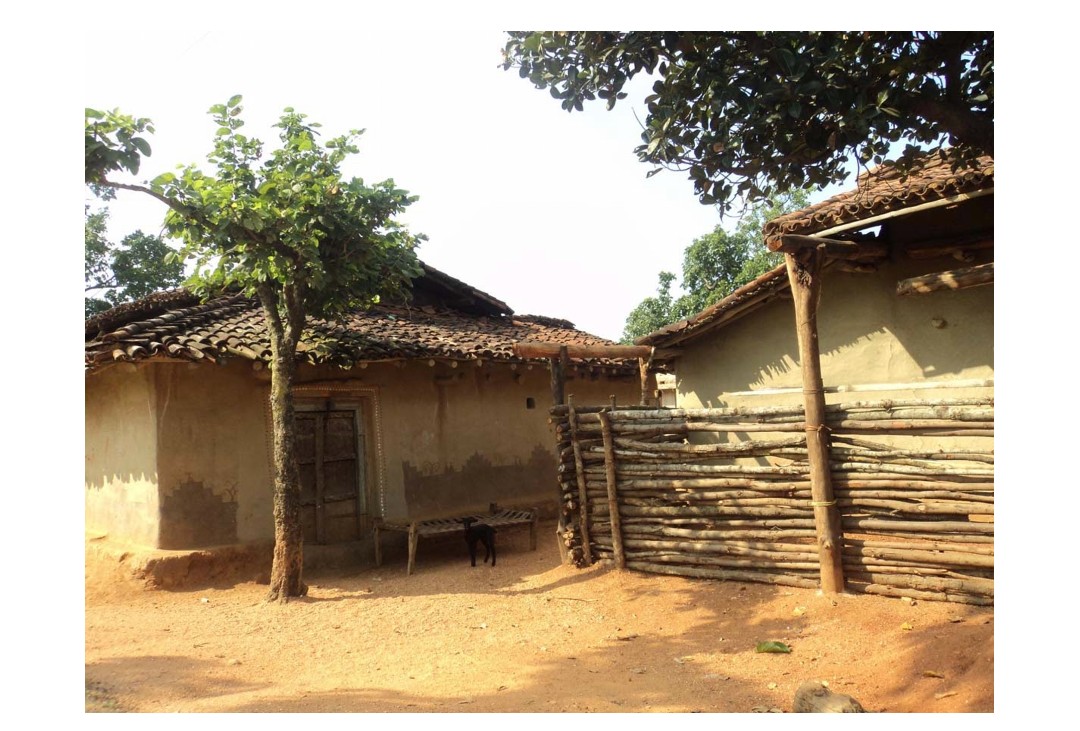
1. Introduction: Who Are the Santhal People?
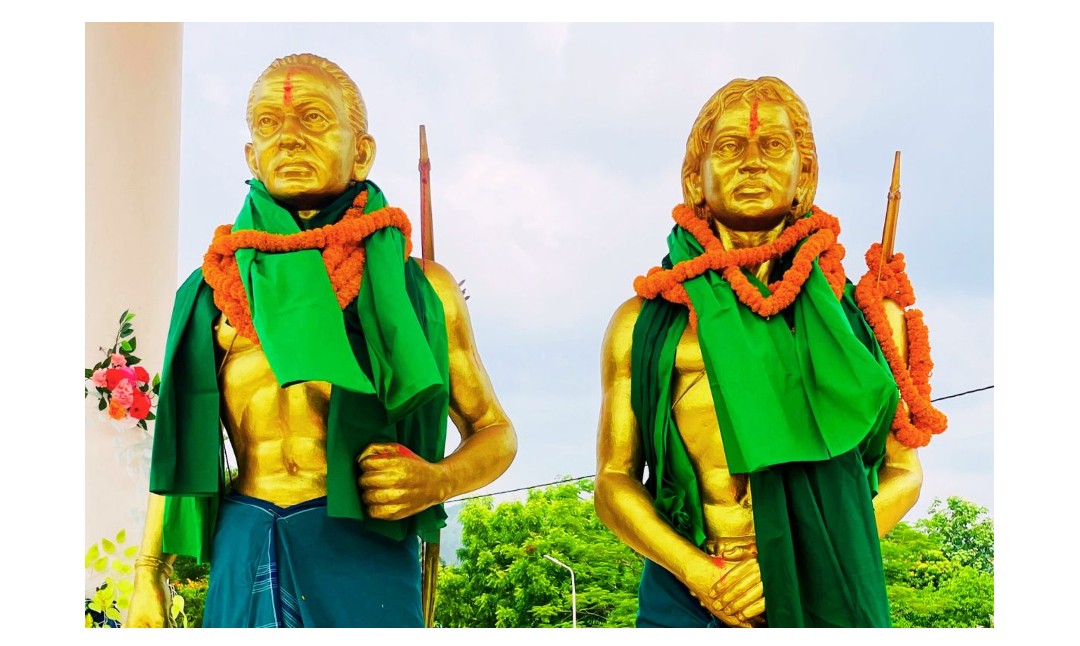
The Santhal (also spelled Santal) are the largest tribal, or Adivasi, community in India and one of the largest Austroasiatic-speaking ethnic groups anywhere in the world. Numbering roughly 7.5 million across South Asia, they are concentrated in the eastern Indian states of Jharkhand, West Bengal, Odisha, Bihar, Assam, and Tripura, with significant populations also living in northern Bangladesh and eastern Nepal. The Santhal form the largest tribal community in both Jharkhand and West Bengal.
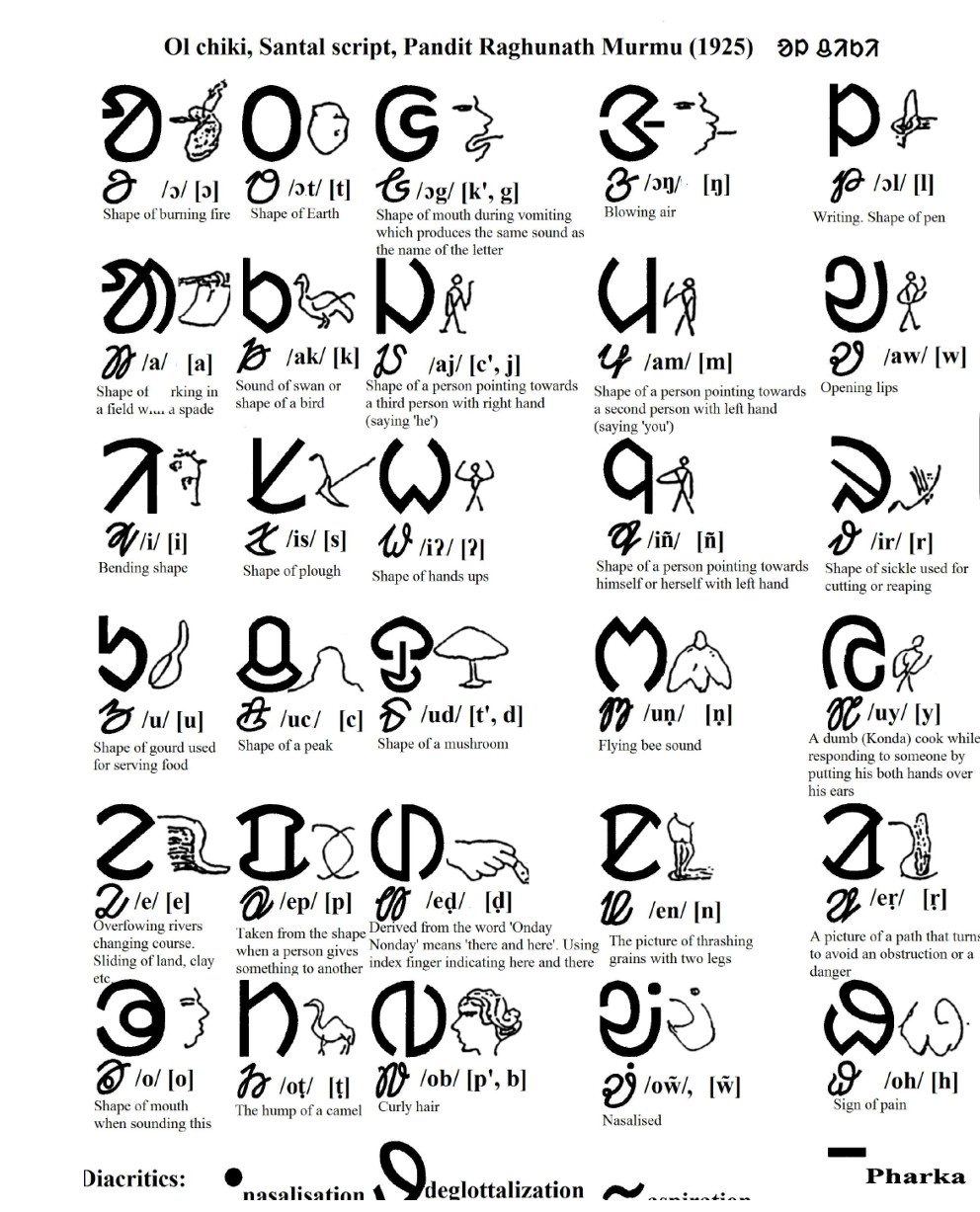
The Santhal call themselves Hor Hopon, meaning "child of man" or "child of human," reflecting a strong internal sense of shared humanity and kinship. They speak Santali, the most widely spoken language of the Munda branch of the Austroasiatic language family, and since 1925 have possessed their own dedicated script, Ol Chiki, invented by the Santhal scholar Pandit Raghunath Murmu.
This profile examines the community's linguistic and ancestral origins, the historical record of migration and settlement that shaped their present-day geography, the population-genetic evidence for their ancestry, their distinctive clan-based social structure, and the religion, language, customs, cuisine, and festivals that define Santhal identity today.
2. Origins and Early History
2.1 Linguistic and Ethnic Origins
The Santhal are classified by linguists as an Austroasiatic-speaking Munda ethnic group of the Indian subcontinent. According to linguist Paul Sidwell, Austroasiatic-language speakers most likely arrived on the coast of Odisha from mainland Southeast Asia roughly 4,000 to 3,500 years ago, subsequently spreading across eastern and central India and mixing extensively with the region's existing local populations. The Santali language remains, to this day, the most widely spoken member of the Munda language subfamily.
Because archaeological records for the Santhal are limited, their precise original homeland cannot be established with full certainty. The community's own oral tradition holds that their ancestors originated at a place called Hihiri, which scholars have tentatively identified with Ahuri in the present-day Hazaribagh district of Jharkhand. From there, tradition recounts, the community moved onto the Chota Nagpur Plateau and later to the Jhalda and Patkum regions before finally settling in the area of Saont (Silda) in the Midnapore region of West Bengal, from which the exonym "Santal" is thought to derive, via the Sanskrit/Bengali term for "plain land."
2.2 Settlement of the Damin-i-Koh and the Santal Parganas
The Santhal enter the documented historical record in the late eighteenth century, first appearing under the name "Soontars" in 1795. Following the depopulation of parts of Bengal after the famine of 1770, colonial administrators encouraged Santhal families to migrate into forested tracts and clear land for settled agriculture. In 1832, a large area of the Rajmahal Hills was demarcated as the Damin-i-Koh; over the following two decades, tens of thousands of Santhal families settled there, transforming forest into productive paddy fields and giving rise to what is now the Santhal Parganas region of Jharkhand, still regarded by the community as its cultural heartland.
As Santhal cultivators became more deeply drawn into a colonial cash and credit economy, many found themselves burdened by debt and land disputes with moneylenders and landlords. Discontent over these conditions, combined with taxation policy, culminated in the Santal Hul (Santal Rebellion) of 1855, in which some 30,000 Santhals under the leadership of the brothers Sidhu and Kanhu Murmu rose up against local revenue collectors and colonial authority. The uprising was eventually put down by colonial troops, but it prompted the creation of the semi-autonomous Santal Parganas administrative area, in which village headmen (manjhis) retained local authority and land transfers to non-Santhals were restricted. The Hul remains a defining event in Santhal historical memory and identity, commemorated to this day.
2.3 Twentieth Century to the Present
In the decades that followed, Christian missions introduced formal education to many Santhal communities, and Santhal families also began migrating to work on tea plantations in Assam and North Bengal, where descendant communities remain today. In the twentieth century, Santhal cultivators and leaders were active participants in agrarian and political movements across eastern India. In 2000, when Jharkhand was carved out of Bihar as a separate state, the Santal Parganas became one of its constituent divisions, cementing the region's association with Santhal identity and self-governance.
3. Geographic Distribution Today
According to the 2011 Census of India, the Santhal number approximately 6.57 million across five Indian states: Jharkhand (about 2.75 million), West Bengal (about 2.51 million), Odisha (about 0.89 million), Bihar (about 0.41 million), and Tripura. Smaller but well-established Santhal populations also live in Assam, largely descended from tea-garden labourers who migrated during the colonial period. Outside India, the Santhal are the largest ethnic minority in the Rajshahi and Rangpur divisions of northern Bangladesh (roughly 129,000 people as of 2021) and also have a sizeable population in eastern Nepal (over 51,000).
4. Genetics and DNA Ancestry
As one of India's largest and most extensively studied Austroasiatic-speaking populations, the Santhal occupy a distinctive place in South Asian population genetics, illustrating a clear and well-documented pattern of sex-biased ancestry from a prehistoric migration originating in Southeast Asia.
4.1 Paternal (Y-DNA) Lineages
Population-genetic surveys consistently report that Y-chromosome haplogroup O2a-M95 dominates the paternal lineages of Munda-speaking tribal groups of eastern India, and the Santhal show among the highest frequencies of any Austroasiatic population, with estimates in various studies ranging from roughly 55 to 65 percent or more. This haplogroup is believed to have originated in East or Southeast Asia and to have arrived in the Indian subcontinent several thousand years ago, most likely carried by the ancestors of today's Austroasiatic-speaking populations. Its very high frequency in the Santhal, alongside related Munda groups such as the Ho, Mundari, and Kharia, is regarded as the clearest Y-chromosome signature of the ancient Southeast Asian migration that also brought the Munda branch of the Austroasiatic language family into India.
4.2 Maternal (mtDNA) Lineages
In marked contrast to the elevated Southeast Asian paternal signal, maternal-line (mitochondrial) DNA among Munda-speaking populations, including the Santhal, overwhelmingly matches lineages found broadly across other South Asian populations, with only a small minority of mtDNA types showing a plausible East or Southeast Asian origin. This asymmetry — a Southeast Asian paternal signal paired with an essentially indigenous South Asian maternal signal — is described by researchers as a classic example of the "father tongue hypothesis," in which incoming male migrants intermarried with local women, whose maternal lineages then predominate in the resulting population over many generations.
4.3 Autosomal Ancestry
On the whole-genome (autosomal) level, the Munda-speaking populations of eastern India, including the Santhal, are notable for carrying an unusually high proportion of Ancestral South Indian / Ancient Ancestral South Indian (AASI) ancestry, the deepest and oldest genetic layer associated with the subcontinent's earliest modern human inhabitants. Where West Eurasian-related ancestry is present in Munda genomes, it is disproportionately of the Iranian-farmer-related type rather than the steppe-pastoralist-related component associated with many Indo-Aryan-speaking populations, and Munda populations characteristically carry very low frequencies of the R1a1a-Z93 Y-chromosome lineage often linked to that later steppe-related ancestry.
Genome-wide studies of Austroasiatic speakers in India model this ancestry as a two-way admixture between an early, largely unadmixed AASI-related South Asian population and an incoming Southeast Asian-related population, with the best available modern genetic proxies for the incoming group resembling populations from Laos and other parts of mainland Southeast Asia. Because this admixture occurred while the AASI component was still relatively unmixed with other ancestries later widespread in India, researchers place the arrival of the Austroasiatic-speaking ancestors of the Munda populations relatively early in the demographic history of the subcontinent, although the precise dating remains debated among specialists.
4.4 Interpreting the Genetic Evidence
Taken together, the Y-DNA, mtDNA, and autosomal evidence converge on a coherent picture: the Santhal and related Munda-speaking groups descend predominantly from a deep, ancient South Asian (AASI) population base, overlaid by a demographically significant but male-biased migration of Southeast Asian-related ancestry that also introduced the Austroasiatic language family into the subcontinent several thousand years ago. This makes the Santhal one of the clearest living examples in South Asia of a population whose linguistic ancestry (Austroasiatic) and dominant paternal genetic ancestry point toward the same Southeast Asian source, even though their maternal and broader genome-wide ancestry remains overwhelmingly South Asian.
This section summarizes findings from published population-genetics literature and consumer genomics research; ancestry estimates vary by study, sample size, and reference panel, and individual results from DNA testing may differ from community-level averages.
5. Social Structure and Clan System
Santhal society is organised around a foundational distinction between "sibling" (boeha) relations — those who share common descent — and "guest" (pera) relations with outsiders, a structure also found among several other tribal societies of central and eastern India. Families descended from a common recent ancestor, known as khunti or gusti, typically live near one another and share certain ritual obligations.
The community also recognises twelve exogamous, totemic clans known as pari (including Hansda, Murmu, Marandi, Kisku, Soren, Hembram, Tudu, Baskey, Besra, Chorey, Pauria, and Bediya), each traditionally associated with a natural totem such as an animal or plant. Marriage within one's own clan is strictly avoided, and each clan traditionally refrains from harming its associated totem. Local village affairs are traditionally administered by a village council headed by a manjhi (headman), assisted by other customary officeholders, reflecting a broadly consensus-based and comparatively egalitarian system of self-governance that has long been a hallmark of Santhal community life.
Ritual friendships between individuals of different ethnic communities, called phul, also create a recognised bond in which the friends' children treat one another as siblings and participate in each other's major life events.
6. Language and Script
The Santhal speak Santali, a Munda language of the Austroasiatic family and the most widely spoken language in that subfamily. For centuries Santali existed primarily as an oral language, occasionally rendered in borrowed scripts such as Bengali, Odia, Devanagari, or Roman when written down at all, none of which could fully capture its distinctive phonetics.
In 1925, the Santhal scholar and social reformer Pandit Raghunath Murmu (1905–1982), affectionately known as Guru Gomke or "the Great Teacher," devised Ol Chiki, a fully phonetic, thirty-letter alphabet created specifically for Santali rather than adapted from an existing script. Murmu went on to write novels, poetry, plays, grammars, and dictionaries in Ol Chiki, transforming Santali from a primarily oral language into a living literary tradition and becoming a foundational figure in modern Santhal cultural identity.
Santali was formally included in the Eighth Schedule of the Constitution of India through the 92nd Constitutional Amendment Act of 2003, granting it status as one of India's officially recognised scheduled languages, with Ol Chiki recognised as its official script. Santali today holds status as an additional official language in Jharkhand and West Bengal, is used in competitive examinations and educational settings, and in 2025 the Constitution of India itself was translated into Santali using the Ol Chiki script. In 2026, the script's centenary was marked with national celebrations inaugurated by the President of India, Droupadi Murmu, herself of Santhal heritage.
7. Religion and Belief System
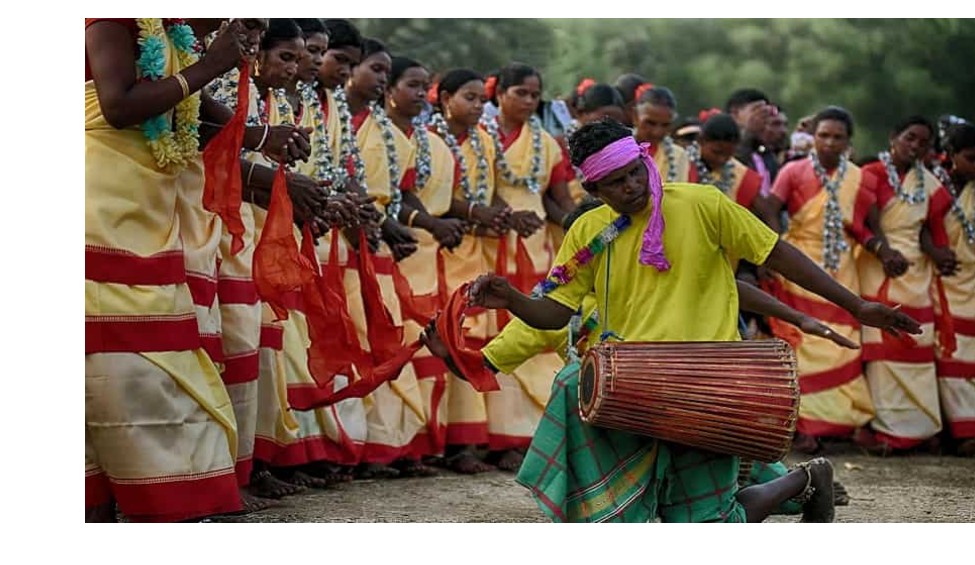
Traditional Santhal religion centres on a court of spirits known as bonga, who preside over different aspects of the world and are honoured through prayer and offerings at the village, household, ancestral, and clan levels. The bonga are understood as intermediaries between the visible world (noa puri) and an invisible reality (hana puri), the abode of a supreme creator most often called Marang Buru ("the Great Mountain") or Thakur Jiu ("the life-giver") — a figure many scholars describe as making Santhal religion, at its core, both monotheistic in its recognition of a single supreme being and pantheistic in its wider reverence for spirits associated with the natural world.
According to Santhal creation tradition, the world was originally water, inhabited only by Marang Buru and lesser spirits. Birds, given human souls, gave rise to the first man and woman, Pilchu Haram and Pilchu Budhi, whose children became the ancestors of the community's clans. This creation narrative, transmitted orally for generations, remains an important part of Santhal religious identity.
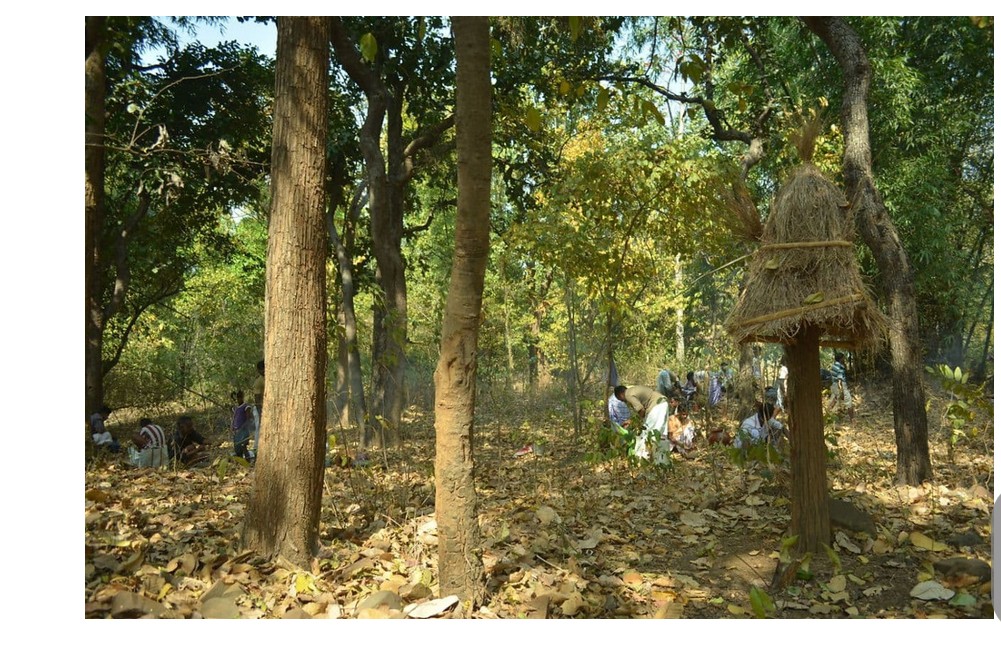
A defining feature of a traditional Santhal village is its sacred grove, known as Jaher or Sarna, typically set on the edge of the settlement and left undisturbed except during festivals, when natural, uncut stones within the grove represent the resident bongas. Religious leadership is generally provided by village-based ritual specialists rather than a formal priestly class, alongside a medicine-man figure known as an ojha who addresses illness attributed to malevolent spirits.
According to the 2011 Census, a majority of Santhals in India (about 63 percent) recorded their religion as Hinduism, while roughly 23 percent identified with Sarnaism (Sarna Dharam), an umbrella term for indigenous tribal religious practice, and a further share, concentrated in West Bengal, identify their faith as Sari Dharam, a related but distinct framework rooted in ancestral Santhal ethics and belief. About 5 to 6 percent of Santhals recorded as Christian, reflecting the historical influence of missionary activity in parts of the community. In 2020, the Jharkhand state assembly passed a resolution supporting the recognition of Sarna Dharam as a distinct religious code in the national census, reflecting an active and ongoing movement for religious self-identification within the community.
8. Culture and Social Customs
Santhal culture places strong emphasis on communal life, consensus-based decision-making, music, and dance, alongside deep reverence for nature and the agricultural cycle. Everyday social relations are governed by clearly defined kinship roles, and hospitality toward guests (pera) is an important social value, marked by specific welcome rituals performed by women of the household.
Art is an integral part of domestic life: the walls of traditional Santhal homes are often decorated with hand-painted murals depicting animals, hunting and dancing scenes, and geometric patterns, most famously during the Sohrai festival, when Sohrai wall art is created as both a devotional and decorative practice. Ceremonial items such as bridal palanquins are also finely carved and decorated.
9. Marriage Traditions
Santhal tradition recognises several distinct forms of marriage, ranging from the most elaborate and ceremonially rich, known as hapramko bapla ("ancestors' marriage"), to simpler and more informal arrangements. The most commonly practised form today is known as kesimek', in which a couple's wish to marry is formally acknowledged by both families through a structured negotiation process led by village intermediaries and headmen (manjhis) from each side.
In this process, a village-level intermediary known as the jog majhi travels between the two families to establish the couple's intentions and to help negotiate a bride price, paid by the groom's family to the bride's family, generally in cash today, though livestock or goods are also still exchanged in some communities. Importantly, Santhal custom holds that a couple should never be prevented from marrying purely over a disagreement about bride price, and the amount is generally kept modest. Following the agreement, celebrations take place, and the bride is ceremonially welcomed into her natal village as a guest before the couple departs for the groom's village, where the local headman offers a formal blessing for their marriage.
Santhal marriage customs are notable for their comparatively low degree of ritual complexity, the significant weight given to the wishes of the couple themselves, and their treatment of marriage negotiations as a matter for consensus and community involvement rather than rigid ritual prescription.
10. Festivals, Music, and Dance
The Santhal calendar is marked by a rich cycle of festivals tied closely to agriculture and nature worship, several of which remain among the most widely celebrated tribal festivals in eastern India.
- Sohrai — the principal and largest Santhal festival, celebrated over several days around the winter harvest (roughly the months of Paush–Magh in the Bengali calendar). It centres on giving thanks to the bonga spirits for the harvest, ritual reverence for cattle, the creation of elaborate Sohrai wall murals by women, and several days of communal feasting, singing, and dancing.
- Baha (Bahabanga) — the "flower festival," celebrated in spring and considered the second most important festival after Sohrai. It honours the blossoming of the sal and other flowers and is led by the village's spiritual functionary, the naeke, with prayers for protection from disease directed at village deities such as Marang Buru and Jaher Era.
- Karam — celebrated in the month of Aswin (September–October) to invoke prosperity and protection from misfortune. Two young people ceremonially bring branches of the karam tree from the forest, which are planted and honoured with offerings of rice beer and prayer.
- Other festivals — including Sakrat/Magh Sankranti, Dashain, and various local harvest and seasonal observances, round out a calendar deeply attentive to the rhythms of cultivation and nature.
Music and dance are inseparable from Santhal festival life. Group dances performed by lines or semicircles of dancers, accompanied by traditional drums — principally the tamak' and tumdak' — along with flutes and other instruments, are central to nearly every major celebration. Chadar Badar, a distinctive form of string puppetry performed with small wooden figures inside a miniature stage, is another well-known Santhal folk art form.
11. Cuisine
Santhal cuisine reflects the community's agrarian lifestyle and close relationship with the forest and its resources. The staple diet centres on rice, millets, and seasonal vegetables, supplemented by foraged wild greens, mushrooms, tubers, and other forest produce gathered according to season.
- Handia — a traditional fermented rice beer central to Santhal social and ceremonial life, served during festivals, weddings, and communal gatherings as an expression of hospitality and celebration.
- Meat and fish — including poultry, goat, and freshwater fish, prepared with local spices and frequently featured at festivals and life-cycle celebrations.
- Mahua — the flowers and fruit of the mahua tree, used both as food and to prepare a traditional distilled liquor that holds cultural and ceremonial significance in many Santhal communities.
- Forest greens and foraged foods — a distinguishing feature of Santhal cuisine, reflecting deep traditional ecological knowledge of edible wild plants, mushrooms, and tubers found in the sal forests of the Chota Nagpur Plateau and surrounding regions.
12. Traditional Dress and Ornaments
Traditional Santhal women's attire consists of two draped cotton garments: the panchi (or palhand), a plain, unbordered lower cloth roughly three metres in length wrapped around the waist, and the parhan (or panchi top), a fitted blouse worn above it, often completed with a length of cloth draped over one shoulder in the manner of a sari's pallu. Traditional dress historically favoured plain, undyed cotton rather than elaborate ornamentation, distinguishing it visually from more decorated tribal and non-tribal textiles of the wider region.
Traditional Santhal men's dress consists of a simple wrapped lower cloth (variously called a lungi or, in some regional descriptions, bhagwan) worn with a shirt or vest, along with a gamchha, a light cotton towel-like cloth commonly tied around the head or waist and used for a range of everyday purposes.
Ornamentation traditionally favoured natural and locally sourced materials — beads, shells, wood, and metals such as silver, copper, and brass — fashioned into necklaces (larmala or hasuli), bangles (sakom), earrings, and waist chains, worn especially during festivals, weddings, and other communal celebrations.
13. Traditional Housing and Art
Traditional Santhal homes are typically simple structures built from mud and locally available materials, arranged in villages organised around clan and kinship groupings. A defining artistic feature of Santhal domestic architecture is the tradition of hand-painted wall art, most famously the Sohrai murals created by women ahead of the winter harvest festival, depicting animals, hunting and dancing scenes, and geometric patterns using natural pigments. This mural tradition, along with finely carved ceremonial items such as bridal palanquins, represents one of India's most distinctive living traditions of tribal folk art.
At the centre of every traditional village stands the Jaher (sacred grove), left undisturbed outside of festival time, and the Majhi Than, a raised, thatched-roof mound near the headman's house where the spirits of past headmen are believed to reside and where major village decisions and disputes are traditionally settled.
14. Folklore and Oral Tradition
Santhal oral tradition is extraordinarily rich, encompassing creation myths, clan origin narratives, folk tales, riddles, and songs that were, for centuries, the primary vehicle through which community history, values, and religious belief were transmitted across generations. European ethnographers and missionaries in the late nineteenth and early twentieth centuries, notably Cecil Henry Bompas and Paul Olaf Bodding, documented and published extensive collections of Santal folk tales, riddles, and traditional medicine, work that remains an important reference for understanding pre-literary Santhal oral culture.
Since the invention of the Ol Chiki script in 1925, this oral heritage has increasingly been recorded in writing, with Santhal authors producing a growing body of poetry, fiction, drama, and scholarship in their own language and script, alongside a continued vibrant tradition of orally transmitted song and story at the village level.
15. Education, Livelihoods, and Socioeconomic Profile
Historically an agrarian community specialising in settled rice cultivation, many Santhal families continue to depend on farming, forest-based livelihoods, and agricultural labour, particularly in the Santal Parganas and surrounding regions of Jharkhand, West Bengal, and Odisha. Since Indian independence, and especially from the later twentieth century onward, growing numbers of Santhals have pursued education and moved into government service, teaching, healthcare, engineering, law, and other professional fields, supported by community and missionary-run educational institutions established from the colonial period onward.
The recognition of Santali in the Eighth Schedule and the continued promotion of Ol Chiki-medium education have supported growing rates of literacy and mother-tongue education within the community, alongside continued efforts to preserve traditional livelihoods and land rights in the community's historic heartland.
16. Diaspora
While the Santhal remain concentrated in their historic heartland of eastern India, a significant diaspora exists as a result of colonial-era and later migration. From the nineteenth century onward, many Santhal families moved to work on tea plantations in Assam and North Bengal, where descendant Santhal communities remain today, maintaining their language and cultural practices across generations.
The community was divided by the 1947 Partition of British India between West Bengal and East Bengal (later Bangladesh), and Santhal populations remain significant minorities in northern Bangladesh today. Smaller Santhal communities are also found in Nepal and, through more recent economic migration, in urban centres across India and, to a limited degree, further abroad.
17. Prominent Figures
The Santhal community has produced a wide range of leaders, writers, and public figures across politics, literature, science, and sport.
- Droupadi Murmu — 15th President of India (2022–present) and former Governor of Jharkhand, the first person of Santhal heritage to hold India's highest constitutional office.
- Sidhu and Kanhu Murmu — brothers who led the Santal Hul (Santal Rebellion) of 1855, celebrated today as foundational figures of Santhal resistance and identity.
- Pandit Raghunath Murmu (Guru Gomke) — inventor of the Ol Chiki script in 1925 and a pioneering novelist, poet, playwright, and grammarian in the Santali language.
- Shibu Soren — veteran political leader, founder of the Jharkhand Mukti Morcha, and former Chief Minister of Jharkhand, popularly known as Disom Guru.
- Hemant Soren — Chief Minister of Jharkhand and a prominent contemporary Santhal political leader.
- Babulal Marandi — first Chief Minister of Jharkhand following the state's creation in 2000.
- Mohan Charan Majhi — Chief Minister of Odisha, a prominent Santhal political leader from that state.
- G. C. Murmu — 14th Comptroller and Auditor General of India and the first Lieutenant Governor of Jammu and Kashmir (Union Territory).
- Hansda Sowvendra Shekhar — contemporary Santhal author known for acclaimed English-language fiction exploring Santhal life and identity.
- Purnima Hembram — track-and-field athlete who has represented India internationally.
This list is illustrative rather than exhaustive; the Santhal community has produced a substantial body of writers, scholars, athletes, and civic leaders across eastern India over the past century and a half.
18. Contemporary Reflections
Two themes recur in contemporary discussion of Santhal identity. The first is the ongoing revival and assertion of linguistic and religious identity, seen in the successful campaign for Santali's inclusion in the Eighth Schedule, the 2025 translation of the Constitution of India into Santali, the 2026 centenary celebrations of the Ol Chiki script, and the continuing movement, especially strong in Jharkhand, for formal recognition of Sarna Dharam as a distinct religious identity in the national census.
The second is the community's evolving relationship with land, livelihood, and modern institutions, as Santhal communities balance the preservation of traditional agrarian life, sacred groves, and customary governance with growing participation in education, government service, and national political life — exemplified most visibly by the election of a Santhal woman, Droupadi Murmu, to the presidency of India in 2022.
19. Conclusion
The Santhal represent one of the most historically significant and culturally distinctive tribal communities in South Asia: a population whose oral tradition, documented colonial-era history, and modern population genetics together point toward an ancient South Asian foundation overlaid by a demographically significant, male-mediated migration from Southeast Asia several thousand years ago. From the sacred groves and Sohrai murals of its villages to the Ol Chiki script created in 1925, and from the Santal Hul of 1855 to the presidency of Droupadi Murmu in the twenty-first century, the Santhal story is at once a genetic case study, a living regional culture, and an ongoing narrative of resilience, self-governance, and cultural revival.
References
- [1]1. Wikipedia. "Santal people." https://en.wikipedia.org/wiki/Santal_people
- [2]5. Scientific Reports. "The genetic legacy of continental scale admixture in Indian Austroasiatic speakers." https://www.nature.com/articles/s41598-019-40399-8
- [3]6. Brown Pundits. "The Munda as upland rice cultivators." https://www.brownpundits.com/2018/09/12/the-munda-as-upland-rice-cultivators/
- [4]7. Indo-European.eu. "Munda admixture happened probably during the ANI-ASI mixture." https://indo-european.eu/2018/09/munda-admixture-happened-probably-during-the-ani-asi-mixture/
- [5]8. iasgyan.in. "Ol Chiki Script Explained." https://www.iasgyan.in/daily-current-affairs/santhali-language-and-ol-chiki-script
- [6]9. ClearIAS. "Ol Chiki Script: Centenary of linguistic empowerment." https://www.clearias.com/ol-chiki-script/
- [7]10. Sanskriti IAS. "Ol Chiki Script at 100: A Milestone in Tribal Linguistic Heritage." https://www.sanskritiias.com/current-affairs/ol-chiki-script-at-100-a-milestone-in-tribal-linguistic-heritage
- [8]11. Adivasi Lives Matter. "The Making Of Santali Ol Chiki Script: In Conversation with Ram Chandra Baskey." https://www.adivasilivesmatter.com/post/the-making-of-santali-ol-chiki-script-in-conversation-with-ram-chandra-baskey
- [9]12. VillageSquare. "Bahabanga festival: A cultural identity of the Santhals." https://villagesquare.in/bahabanga-festival-a-cultural-identity-of-the-santhals/
- [10]13. Global Indian Network. "Is the Culture of the Santhal Tribe Disappearing?" https://globalindiannetwork.com/culture-of-the-santhal-tribe/
- [11]14. Creative Tribals. "Santhal Tribe: Indigenous People of Eastern India." https://creativetribals.com/santhal-tribe/
- [12]15. Indian Encyclopedia. "Santhali Dance: A Traditional Tribal Dance of Eastern India." https://indianetzone.wordpress.com/2026/03/16/santhali-dance-a-traditional-tribal-dance-of-eastern-india/
- [13]16. Utsavpedia. "Panchi and Parhan: Traditional Costumes in Jharkhand." https://www.utsavpedia.com/attires/traditional-costumes-for-the-women-of-jharkhand/
- [14]17. IndiaNetzone. "Traditional Dresses of Jharkhand." https://www.indianetzone.com/costumes_jharkhand