

Tamil Nadu Brahmin Community
Delve into the rich history, vibrant culture, and unique identity of Tamil Nadu Brahmins. Explore their origins, societal roles, Carnatic music legacy.
Tamil Nadu Brahmins
History, Culture, and Society of a South Indian Brahmin Community
Table of Contents
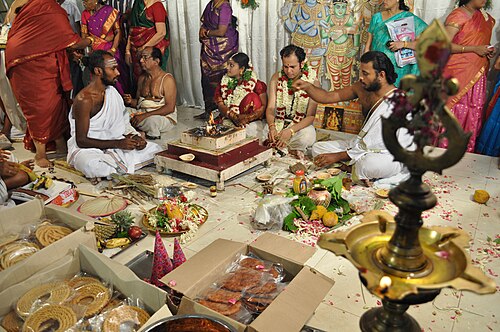
1. Introduction: Who Are Tamil Brahmins?
Tamil Brahmins — often shortened to "Tambrahms" in casual usage — are a Tamil-speaking Hindu Brahmin community native to the present-day state of Tamil Nadu, with historic populations extending into Kerala, Karnataka, and Andhra Pradesh. Population estimates for the community in India run to roughly half a million people, though widely cited scholarly and journalistic accounts note that Tamil Brahmins now make up a small and shrinking share of Tamil Nadu's overall population, a decline traced largely to twentieth-century out-migration rather than natural decline.
Traditionally associated with priestly, scholarly, and administrative roles rather than landholding or military service, the community is best known today for its historic dominance of Sanskrit and Tamil scholarship, its central role in Carnatic classical music and Bharatanatyam dance, its distinctive vegetarian cuisine, and — from the twentieth century onward — a striking concentration in science, engineering, the judiciary, and the global information-technology workforce. As with most caste-community histories in India, the account below draws on colonial-era ethnography, modern historical and sociological scholarship, and journalism; the earliest chapters rest on inscriptional fragments and tradition rather than continuous documentary record, and are noted as such.
2. Etymology and Origins
The origins of Brahmin settlement in the Tamil country are debated among historians, and — as with most caste-origin questions in India — no single account is universally accepted.
- Migration theory: The most widely cited scholarly view holds that Brahmin families migrated southward from northern and central India over the course of the first millennium CE, invited by Tamil kingdoms — chiefly the Cholas, Pandyas, and Pallavas — to serve as temple priests, court scholars, and administrators. According to this migratory view, many members of the Brahmin community originally based in the northern part of India migrated to the rich kingdoms of the South, particularly that of the Cholas in the Tamil country, in the first millennium AD.
- Genetic studies: More recent population-genetics research complicates a simple north-to-south migration story. Studies comparing Tamil Brahmins with other Tamil Nadu communities have found that Iyers and Iyengars form a genetic cluster together with high-ranking non-Brahmin Tamil communities such as the Veerakodi Vellalars, suggesting a more complex history of intermixture with local populations alongside any northern-origin ancestry. Genetic distance studies among South Indian Brahmins have also produced varying results depending on the comparison groups used, and remain a subject of ongoing academic discussion rather than settled fact.
- Land-grant and inscriptional evidence: Independent of migration theories, Chola- and Pallava-era inscriptions record royal grants of *brahmadeya* villages — land endowed tax-free to Brahmin settlers for the upkeep of temples and Vedic learning — which historians treat as firmer evidence for organised Brahmin settlement in the Tamil country from roughly the seventh century CE onward.
3. Historical Development
3.1 Chola and Pandya-Era Foundations
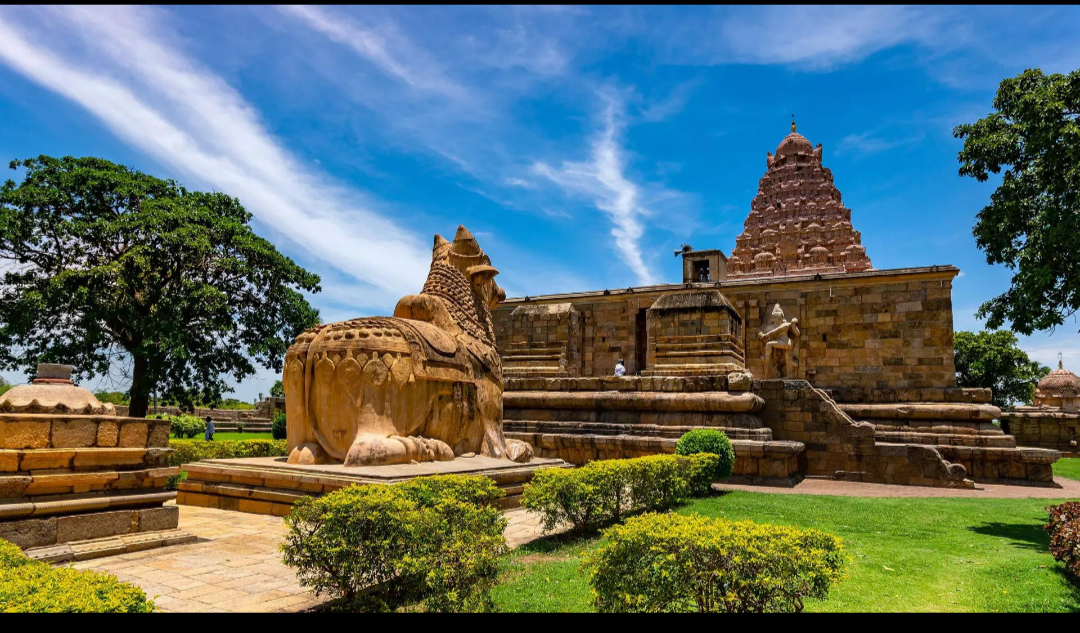
Brahmin settlements (agraharams) attached to temples and endowed through *brahmadeya* land grants expanded significantly under the Pallava and, especially, the Chola dynasties (9th–13th centuries CE), when temple institutions became major centres of landholding, learning, and local administration across the Tamil country. Brahmin scholars and priests served as temple functionaries, royal preceptors, and administrators of temple estates, while remaining formally distinct from the ruling and landowning Vellalar and other communities.
3.2 The Vijayanagara and Nayaka Periods
Following the decline of the later Cholas, the Vijayanagara Empire (14th–17th centuries) and its Telugu Nayaka governors in Madurai, Thanjavur, and Gingee patronised temples, literature, and the arts across the Tamil country, drawing Brahmin scholars, poets, and ritual specialists into court and temple life. The Thanjavur Nayaka and, later, Maratha courts (17th–18th centuries) became particularly important centres of Sanskrit and Telugu scholarship, and — significantly for later cultural history — of the emerging Carnatic music tradition, which drew heavily on Brahmin composers and performers even as it incorporated Telugu, Tamil, and Sanskrit compositions.
3.3 The Sri Vaishnava Schism
The title "Iyer" was used as a designation for all Tamil Smartha Brahmins during the medieval period, when they were organised as a single community. During the eleventh century, however, a breakaway sect formed a new community known as "Iyengars," who followed Sri Vaishnavism rather than the Smarta tradition. This split, associated with the theologian and philosopher Ramanuja (c. 1017–1137 CE), produced the two principal branches of the Tamil Brahmin community that persist to this day.
3.4 The Colonial Period
Under British rule in the Madras Presidency, Tamil Brahmins — already possessing a strong tradition of Sanskrit and, increasingly, English literacy — took disproportionately to Western-style education, the law, and government service. During the British Raj, Iyers and Iyengars came to dominate the civil and administrative services of the Madras Presidency, along with the legal profession, journalism, and early Indian science and mathematics. This period cemented the community's association with clerical, professional, and scholarly occupations rather than land or commerce.
3.5 Independence and Its Aftermath
India's independence in 1947 coincided with — and in Tamil Nadu was preceded by — a powerful anti-Brahmin political movement (discussed in Section 11) and, from the 1950s onward, an expanding caste-based reservation system in education and government employment. These quotas, which rose to 69 percent by the 1980s for a range of non-Brahmin community categories, effectively excluded Brahmins from many government jobs and higher-education seats, since the community was not eligible for reserved categories. This exclusion, combined with rhetorical campaigns portraying Brahmins as historical oppressors, contributed to a substantial exodus from rural Tamil Nadu toward cities and, eventually, abroad. By the late twentieth century this shift had reduced the community's share of Tamil Nadu's population from an estimated 3–4 percent in the 1950s to under 2 percent by the 2010s, a decline driven mainly by out-migration.
4. Social Structure and Sub-Groups: Iyers and Iyengars
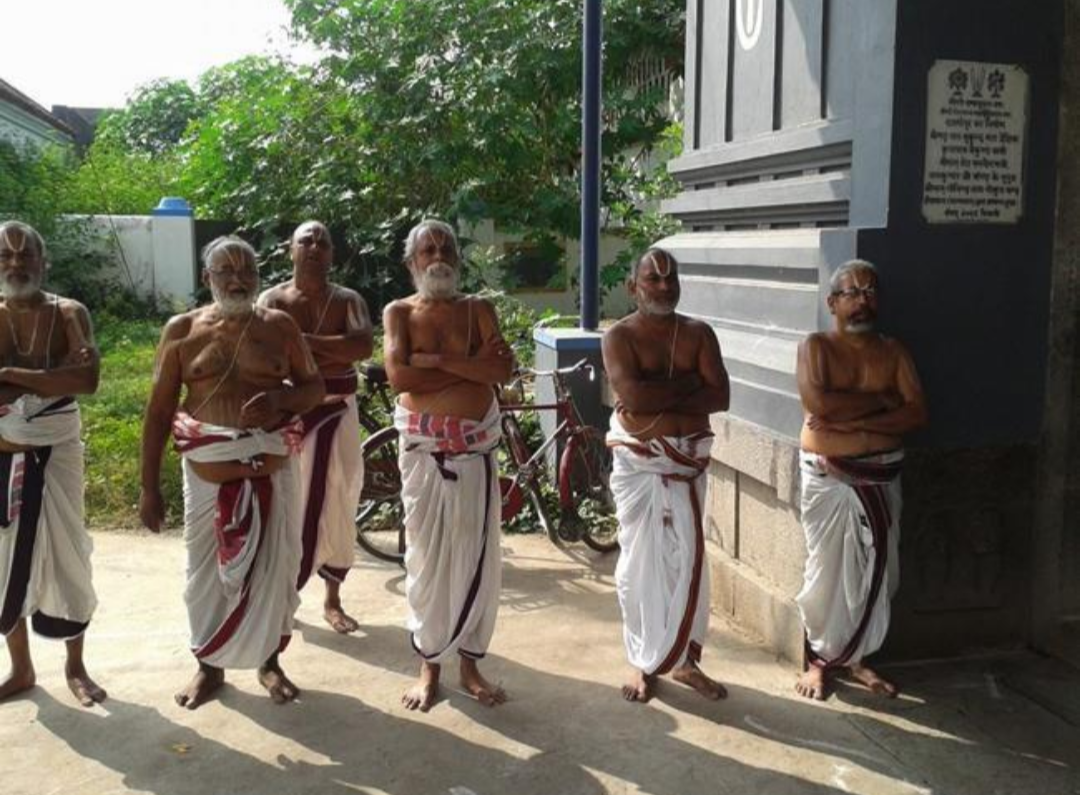
Tamil Brahmins are conventionally divided into two principal branches, distinguished by philosophy and sectarian affiliation rather than by region or occupation:
- Iyers (Ayyar/Aiyar): Followers chiefly of the Advaita Vedanta philosophy propounded by Adi Shankara and the associated Smarta tradition, worshipping Shiva, Vishnu, and other deities without exclusive sectarian preference. Iyers fall under the Pancha Dravida Brahmana classification of Indian Brahmins and are internally divided into denominations based on regional origin and ritual tradition, including groups such as Vadama, Brahacharanam, Ashtasahasram, Vathima, and Sozhia, each traditionally associated with a particular geographic origin within the Tamil country.
- Iyengars (Ayyangar): Followers of Sri Vaishnavism and the Vishishtadvaita philosophy propounded by Ramanuja, worshipping Vishnu (typically as Perumal) as the supreme deity. Iyengars are further divided into the Thenkalai and Vadakalai sub-traditions, distinguished by differing theological emphasis — the Thenkalai tradition places relatively greater weight on the Tamil devotional (Divya Prabandham) literature, while the Vadakalai tradition places relatively greater weight on Sanskrit Vedic texts. Iyengars traditionally wear a namam (a combination of thiruman and srichurnam) as a caste and sectarian mark on the forehead.
Like other Brahmin communities, Tamil Brahmins organise marriage and lineage around exogamous *gotras* and the particular Veda and Vedic recension (*shakha*) their families traditionally study, in addition to their Iyer/Iyengar and sub-denominational identity.
5. Religion and Philosophy
Tamil Brahmins are Hindu, and religious practice is organised around household and temple ritual conducted largely in Sanskrit, alongside a rich tradition of Tamil devotional literature. Daily and life-cycle rites historically centred on Vedic recitation (particularly of the Yajur, Rig, or Sama Veda, depending on family tradition), the sacred thread ceremony (*upanayanam*) marking a boy's initiation into Vedic study, and regular temple worship. Both branches maintain family deities (*kuladevata*) in addition to devotion to major pan-Hindu figures — Shiva and Vishnu among Iyers, and Vishnu/Perumal (together with his consort Lakshmi) among Iyengars. Historically, Tamil Brahmin men who underwent traditional Vedic training served as temple priests (*archakas* and *purohits*) for much of Tamil Nadu's Hindu population, a role that remains significant, though no longer universal, within the community today.
6. Culture, Language, and the Agraharam
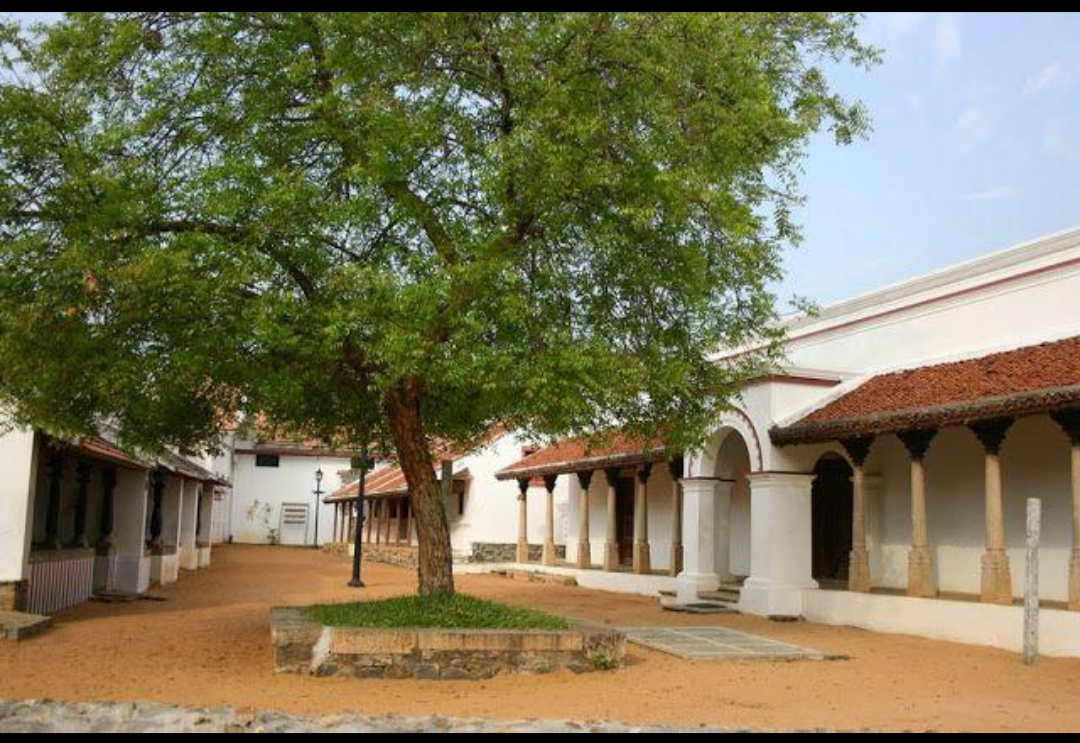
Traditional Tamil Brahmin community life centred on the *agraharam* — a street or cluster of streets, typically adjoining a temple, in which Brahmin families lived in close proximity, sharing ritual calendars, education, and social life. Agraharams were historically found in temple towns across Tamil Nadu, notably in the Thanjavur, Kumbakonam, Srirangam, Kanchipuram, and Madurai regions, and many surviving agraharam streets — with their distinctive rows of narrow, deep, tile-roofed houses opening directly onto the street — are now recognised as significant examples of vernacular Tamil architecture, even as many have been abandoned or fallen into disrepair following the community's twentieth-century urban migration.
The community speaks a distinctive dialect, Brahmin Tamil (sometimes called Iyer/Iyengar Tamil), marked by particular vocabulary, pronunciation, and idiom that differs noticeably from other Tamil dialects, along with fluency in Sanskrit for liturgical purposes. Family and social life traditionally placed strong emphasis on ritual purity, vegetarianism, education, and respect for elders and teachers (*gurus*), values that — as discussed in Section 10 — translated readily into an emphasis on formal education once government and professional employment opened up under colonial and independent India.
7. Marriage and Ritual Life
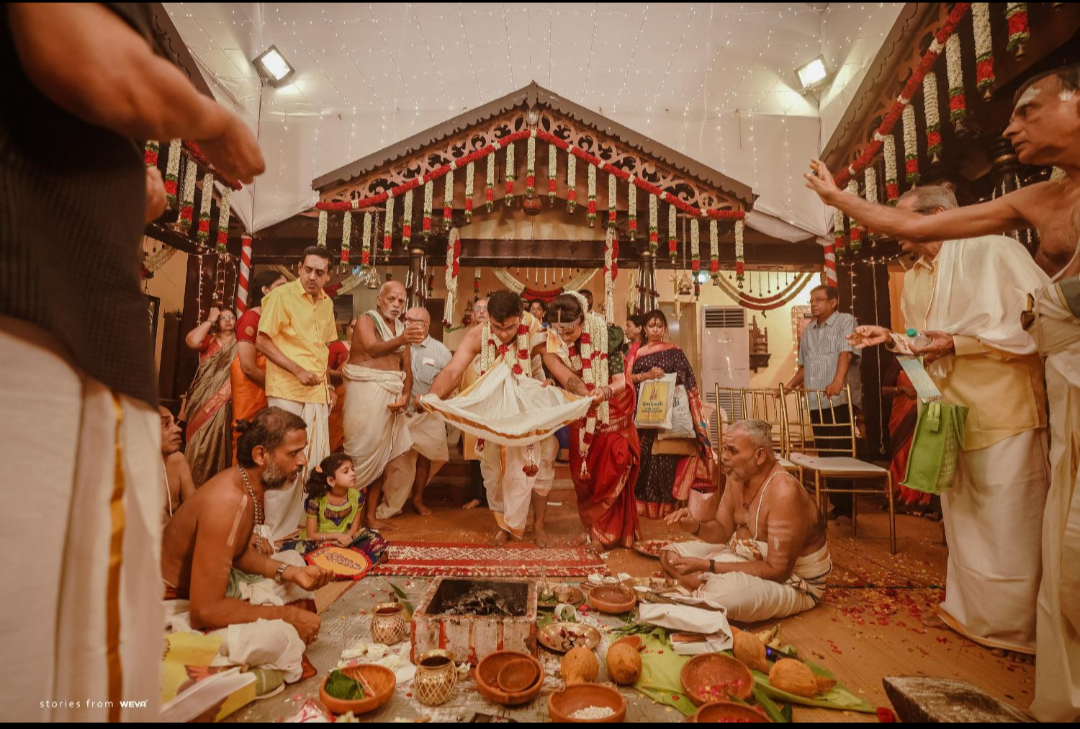
Traditional Tamil Brahmin marriages were arranged, endogamous (within the Iyer or Iyengar community, and often within the same sub-denomination), and exogamous with respect to gotra, following patterns common to Hindu Brahmin communities generally. A traditional wedding, historically conducted over several days, includes:
- Nichayathartham: The formal engagement, at which families exchange gifts and fix the wedding date.
- Nalangu: A playful pre-wedding ceremony involving the bride and groom in ritual games, often accompanied by teasing songs.
- Kashi Yatra: As among several other South Indian Hindu communities, a mock ritual in which the groom pretends to renounce worldly life for pilgrimage before being persuaded by the bride's father to marry instead.
- Oonjal: The bride and groom are seated on a swing and sung to by assembled women, symbolising the joys and sorrows of married life.
- Kanyadanam and Saptapadi: The bride's father formally gives her in marriage, followed by the couple's seven ritual steps around the sacred fire, the central Vedic rite of the wedding.
- Mangalyadharanam: The groom ties the *thali* (a gold pendant on a thread) around the bride's neck, marking the marriage.
As across urban and diaspora India generally, contemporary Tamil Brahmin weddings increasingly compress these rites into a single day and blend them with modern event conventions, and intercaste and inter-regional marriages, once rare, have become considerably more common among younger and diaspora generations.
8. Cuisine
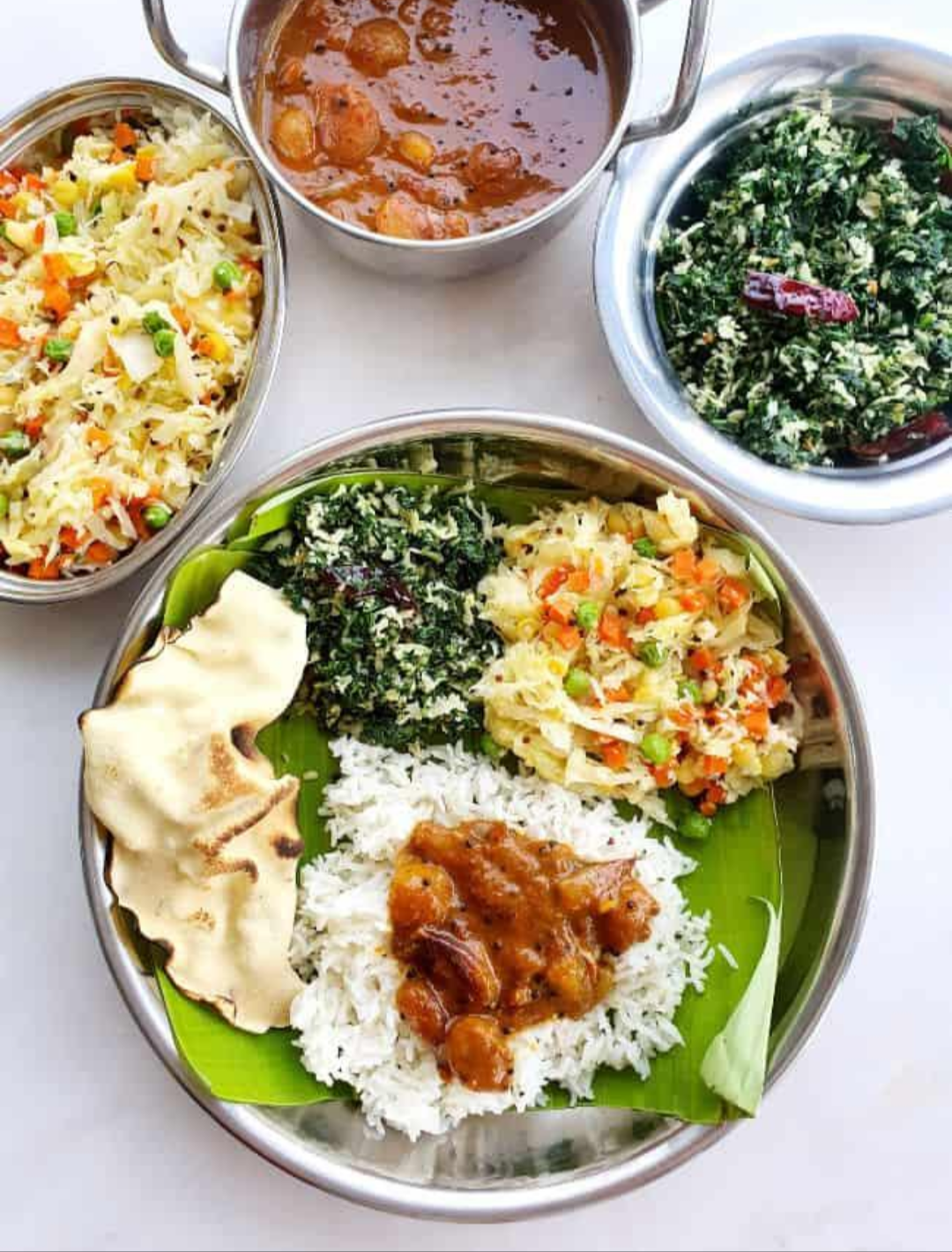
Tamil Brahmin cuisine is strictly lacto-vegetarian and traditionally avoids onion and garlic in its more orthodox (particularly Iyengar) forms, relying instead on asafoetida (*perungayam*) and other spices for depth of flavour. The cuisine is traditionally centred on a heavy mid-morning meal, or elai saapadu (banana-leaf meal), combining an array of dishes rather than a strict separation of breakfast and lunch. Signature preparations include:
- Sambar, thogayal, kootu, paruppu usili, vatha kuzhambu, kichadi, pachadi, and mor kuzhambu, the core lentil- and vegetable-based accompaniments to rice.
- Curd rice served with pickle, considered an essential closing course of the traditional meal.
- Two distinct culinary styles associated with the Iyer and Iyengar branches: Iyer cuisine alone reportedly encompasses some 27 varieties of sambar and 45 varieties of rasam, while Iyengar cooking more strictly follows sattvic principles by avoiding onion and garlic altogether, in contrast to some Iyer preparations, such as vengaya (shallot) sambar, traditionally served at weddings.
- A distinctive naming convention using the suffix *amudhu* ("nectar") for festive dishes — rasam termed sathamudhu, poriyal termed karamudhu, and payasam termed thirukanamadhu — alongside regional specialities such as filter coffee, idli, and vadai (with Iyengar vadai traditionally soaked in curd as *thayir vadai*).
9. Music, Dance, and the Arts
Tamil Brahmins have played an outsized role in the development and preservation of Carnatic classical music and Bharatanatyam dance since at least the eighteenth century. The "Trinity" of Carnatic music — Tyagaraja, Muthuswami Dikshitar, and Shyama Sastri, all active around Thanjavur in the late eighteenth and early nineteenth centuries — were Brahmins by birth (Tyagaraja's family, though Telugu-speaking, had settled in the Thanjavur region), and their compositions remain the core repertoire of Carnatic music to this day. Tamil Brahmin families in cities such as Chennai, and towns such as Thanjavur and Kumbakonam, have historically dominated the Carnatic concert circuit and its associated *sabha* (concert-society) institutions, a dominance that has itself become a subject of public debate in recent years, with musicians and critics — some from within the Brahmin community itself — questioning the tradition's historical exclusion of non-Brahmin performers and its close association with a single caste group. This tension came to a head in 2024–25 when a leading Carnatic vocalist's selection for the Music Academy's Sangita Kalanidhi award, and his public criticism of caste-based dominance in the field, provoked a heated public controversy dividing Carnatic musicians along ideological lines. Rukmini Devi Arundale, a Tamil Brahmin by birth, was separately instrumental in the twentieth-century revival and codification of Bharatanatyam as a respectable classical art form, moving it away from its earlier association with temple devadasis.
10. Education, Livelihoods, and Socioeconomic Change
Traditional Tamil Brahmin livelihoods centred on temple priesthood, Vedic and Sanskrit scholarship, and — from the colonial period — government service, teaching, law, and journalism, in contrast to landowning or mercantile castes elsewhere in South India. The community's early and enthusiastic embrace of English-medium education under British rule, combined with pre-existing traditions of literacy and rigorous scriptural memorisation, is widely credited by historians and sociologists with the community's disproportionate representation in the civil services, judiciary, and academia through the mid-twentieth century.
Following the reservation-driven exodus described in Section 3.5, the community redirected its traditional emphasis on education and merit-based achievement toward professional fields less affected by caste-based quotas — notably engineering, medicine, accountancy, and, from the 1980s and 1990s, software engineering and information technology, both within India and abroad. This shift has been the subject of academic study; sociologists C.J. Fuller and Haripriya Narasimhan, for instance, examined how Tamil Brahmins transformed themselves from a traditional, rural, high-caste elite into a new professional middle class in India, the United States, and elsewhere, tracing their migration from rural to urban areas and, later, transnational migration into engineering and IT employment.
11. The Self-Respect Movement and Twentieth-Century Upheaval
No account of modern Tamil Brahmin history is complete without reference to the Self-Respect Movement and the broader Dravidian movement founded by E. V. Ramasamy ("Periyar") in the 1920s. The Self-Respect Movement aimed at achieving a society in which non-Brahmin communities held equal rights, and was explicitly directed against what it termed "Brahminism." Historians have situated the movement within the broader context of Brahmin dominance over the civil and political society of the Madras Presidency in the early twentieth century, which the movement sought to dismantle through both political organisation and social reform.
Tamil Brahmins were frequently held responsible by followers of Periyar for the direct or indirect oppression of lower-caste communities, and the movement's rhetoric — including, on at least one notable occasion, a public call to "kill Tamil Brahmins" — was associated with instances of violence against Brahmins and contributed to a wave of mass migration out of the community's traditional home districts. The movement's more lasting social reforms included "self-respect marriages," conducted without Brahmin priests, which undermined the ritual monopoly Brahmin priests had held over Hindu weddings and reduced their associated costs, alongside sustained advocacy for widow remarriage, opposition to the devadasi system, and the promotion of intercaste marriage. The movement's influence extended well beyond Tamil Nadu, shaping Tamil communities in Sri Lanka, Burma, and Singapore as well.
This history remains a live and contested subject in Tamil Nadu's public life: Dravidian political parties descended from the movement continue to dominate the state's politics, caste and reservation policy remain central to state discourse, and, as the 2024–25 Carnatic music controversy illustrates (Section 9), debates over Brahmin social and cultural influence continue into the present day. Accounts of this history — including the extent and nature of pre-independence Brahmin social dominance, and the movement's methods and legacy — remain a matter of genuine scholarly and political disagreement, and readers are encouraged to consult multiple sources, including those cited below, for a fuller picture.
12. Diaspora
Today most Tamil Brahmins in India have family members living abroad, with a large number settled in the United States and working in information technology. Significant diaspora populations are also established in the United Kingdom, Canada, Australia, and the Gulf Cooperation Council countries, alongside older, colonial-era Tamil Brahmin communities in Sri Lanka, Malaysia, Singapore, and Burma/Myanmar, some of which predate the twentieth-century IT-driven migration by many decades. Diaspora communities have generally maintained strong ties to Carnatic music, Bharatanatyam, vegetarian dietary practice, and Tamil-language religious observance, supporting temples, cultural associations, and classical-arts institutions in their adopted countries — a continuation, sociologists such as Fuller and Narasimhan have argued, of the community's traditional emphasis on scholarship, ritual precision, and cultural transmission, now reconstituted as markers of a transnational professional middle class.
13. Notable Figures
Science and Mathematics
- C. V. Raman (1888–1970): Nobel Prize–winning physicist, discoverer of the Raman effect.
- Srinivasa Ramanujan (1887–1920): Self-taught mathematician of extraordinary intuition, celebrated for his contributions to number theory.
- Subrahmanyan Chandrasekhar: Nobel Prize–winning astrophysicist.
- K. S. Krishnan: Physicist and co-discoverer of Raman scattering.
- Alladi Ramakrishnan: Physicist and founder of the Institute of Mathematical Sciences (Matscience), Chennai.
- S. R. Srinivasa Varadhan: Mathematician and Abel Prize laureate.
Public Life and Law
- Alladi Krishnaswamy Iyer: Lawyer and member of the Constituent Assembly of India, involved in drafting the Indian Constitution.
- T. N. Seshan: Former Chief Election Commissioner of India, known for electoral reform.
- Shyamala Gopalan: Biomedical scientist and mother of former U.S. Vice President Kamala Harris.
- Vivek Ramaswamy: American entrepreneur and 2024 U.S. Republican presidential primary candidate.
Literature, Religion, and the Arts
- Ramanuja (c. 1077–1157): Hindu philosopher, theologian, and social reformer, founder of Vishishtadvaita philosophy.
- Subramania Bharati: Poet and Indian independence activist.
- U. V. Swaminatha Iyer: Tamil scholar credited with recovering and publishing classical Tamil literary texts.
- Rukmini Devi Arundale: Bharatanatyam dancer, choreographer, theosophist, and animal-welfare activist.
- Iravatham Mahadevan: Epigraphist noted for his work on Indus and Tamil-Brahmi inscriptions.
This list reflects individuals whose Tamil Brahmin background is documented in published sources; it is illustrative rather than exhaustive.
14. Contemporary Reflections
Contemporary discussion of Tamil Brahmins in scholarly and popular writing tends to circle two connected themes. The first is the community's historical journey from a small, ritually specialised elite to a geographically dispersed professional diaspora — a transformation driven as much by exclusion from Tamil Nadu's post-independence reservation system as by the community's own cultural emphasis on education. The second is the community's continuing, and contested, association with caste-inflected institutions such as Carnatic music and temple priesthood, which remain sites of active debate over representation, historical dominance, and reform within Tamil Nadu's cultural and political life. Both themes are approached very differently depending on the observer's political and social vantage point, and responsible accounts — including this one — should be read alongside the range of scholarly and journalistic sources available on the subject.
15. Conclusion
The documented history of Tamil Nadu's Brahmin community traces a path from temple- and court-based priestly and scholarly service under the Chola, Pandya, and Vijayanagara-era kingdoms, through a period of pronounced dominance in colonial-era administration, law, and education, to a mid-twentieth-century rupture driven by the Self-Respect Movement and post-independence reservation policy, and finally to a transnational professional diaspora shaped by science, engineering, and information technology. Along the way, the community has left a distinct and enduring cultural imprint — through Carnatic music, Bharatanatyam, a specific vegetarian culinary tradition, and a body of Tamil and Sanskrit scholarship — even as its demographic and political weight within Tamil Nadu itself has substantially receded. As with any caste community's history, the story told here rests on a combination of inscriptional evidence, colonial ethnography, and modern scholarship, and remains subject to ongoing historical and sociological debate, particularly regarding the community's social role before and after independence.
References
- [1]Wikipedia. "Iyer." https://en.wikipedia.org/wiki/Iyer
- [2]Wikipedia. "Iyengar." https://en.wikipedia.org/wiki/Iyengar
- [3]Wikipedia. "Tamil Brahmin." https://en.wikipedia.org/wiki/Tamil_Brahmin
- [4]Wikipedia. "Self-Respect Movement." https://en.wikipedia.org/wiki/Self-Respect_Movement
- [5]Hebbar Sreevaishnava Sabha. "About Us." https://hebbarsabha.org/about-us/
- [6]Academic Kids. "Iyengar." https://academickids.com/encyclopedia/index.php/Iyengar
- [7]Tamil Nadu Tourism. "Thanjavur Cuisine." https://tamilnadutourism.tn.gov.in/food/thanjavur-cuisine
- [8]The News Minute. "TM Krishna's Sangita Kalanidhi award row has become a battle of ideologies." https://www.thenewsminute.com/amp/story/tamil-nadu/tm-krishnas-sangita-kalanidhi-award-row-has-become-a-battle-of-ideologies
- [9]Fuller, C.J. and Narasimhan, Haripriya. *Tamil Brahmans: The Making of a Middle-Class Caste*. University of Chicago Press.
- [10]Bidoun. "Left Behind." https://next.bidoun.org/articles/left-behind
- [11]Joshua Project. "Brahmin Tamil in India." https://joshuaproject.net/people_groups/19982/IN
- [12]Grokipedia. "Tamil Brahmin." https://grokipedia.com/page/Tamil_Brahmin
- [13]Open Magazine. "Strapped to the Cause." https://openthemagazine.com/voices/strapped-to-the-cause
- [14]VisionIAS. "100 Years of the Self-Respect Movement in Tamil Nadu." https://visionias.in/current-affairs/monthly-magazine/2025-10-04/culture/100-years-of-the-self-respect-movement-in-tamil-nadu
- [15]doingsociology.org. "The Self Respect Movement, Tamizh Society and an Alternative Social Space." https://doingsociology.org/2021/09/20/the-self-respect-movement-tamizh-society-and-an-alternative-social-space-k-s-vaishnavi/