

Odisha Genome Project Community
Uncover your Odisha ancestry! Explore the rich history, diverse genetics, and cultural heritage of Eastern India's ancient Kalinga region
ODISHA GENOME PROJECT
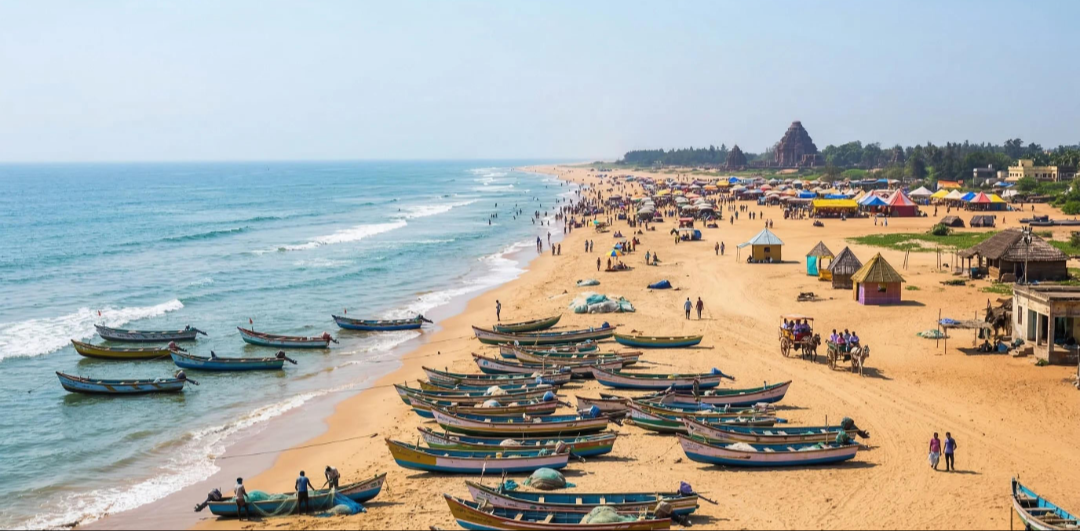
Geography, People, History, and Genetics of Eastern India's Kalinga Heartland
Table of Contents
1. Introduction: Who Are the People of Odisha?
Odisha, on India's eastern seaboard along the Bay of Bengal, is not a single ethnic community in the way a caste or a religious denomination is, but a vast geography-defined population: the inhabitants, past and present, of one of India's oldest continuously named regions. With a 2011 Census population of nearly 42 million (around 4.20 crore, now estimated above 46 million), Odisha's people are bound together less by a single bloodline than by a shared territory, a shared language (Odia), and a shared devotion to the deity Jagannath of Puri. This profile treats "Odisha" as a geography-of-origin community in the genealogical sense: the combined population of a defined territory, encompassing its many castes, its 62 recognised tribal communities, its coastal, upland and forest sub-regions, and its Hindu, tribal, Christian and Muslim residents, whose ancestors have farmed, fished, mined, wove cloth and sailed from this stretch of the eastern coast for well over two thousand years.
Bordered by West Bengal and Jharkhand to the north, Chhattisgarh to the west, Andhra Pradesh to the south, and a 485-kilometre coastline on the Bay of Bengal to the east, Odisha occupies the historic core of ancient Kalinga. Its cities and sacred sites — Puri, Bhubaneswar (the "Temple City of India"), Cuttack, Konark and Jajpur — have, across two millennia, served by turns as the seat of an empire that fought Ashoka to a standstill, a maritime power that carried Kalinga's merchants and monks to Java, Bali and Sumatra, and the spiritual home of one of Hinduism's four great pilgrimage seats (the Char Dham). Odisha is at once the ancient battlefield that turned a Mauryan emperor towards non-violence, the homeland of India's third-largest tribal population, the cradle of the Odissi classical dance and Kalinga temple architecture, and, in modern India, a demographic wellspring for migrant labour, mining and heavy industry, and a growing IT and education hub centred on Bhubaneswar.
2. Geography
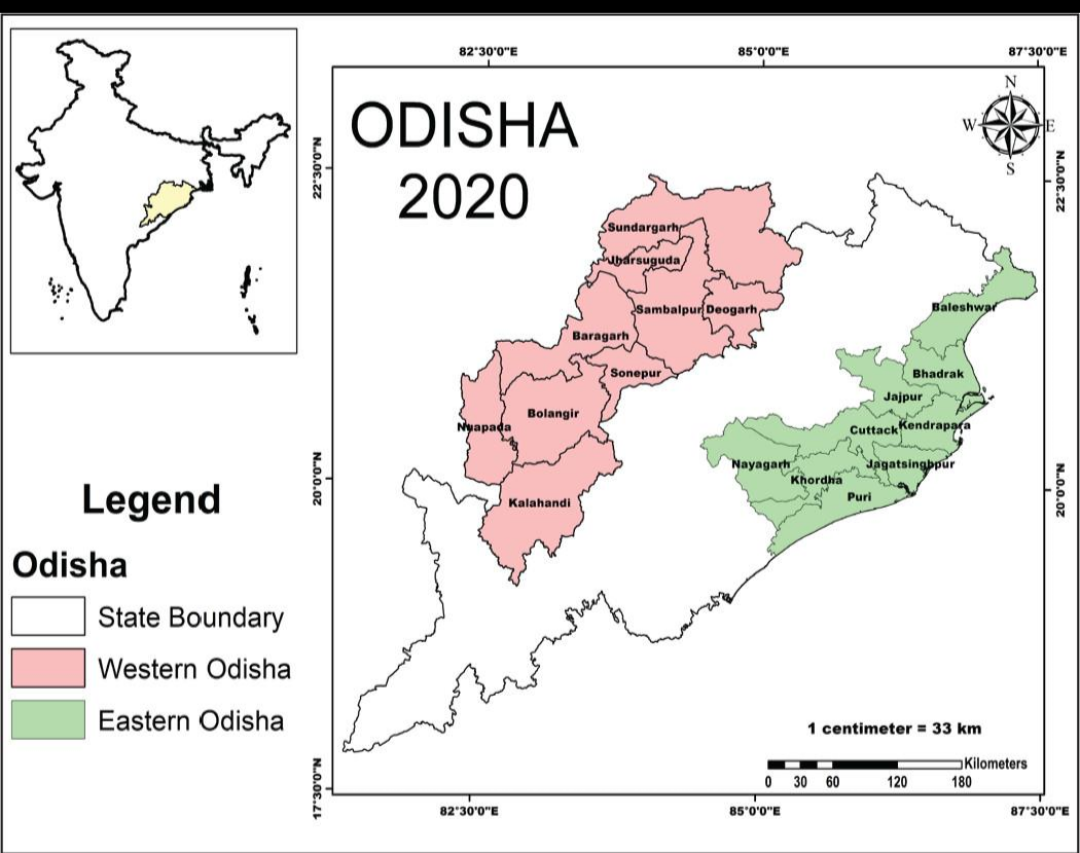
Odisha is the eighth-largest Indian state by area, covering approximately 155,707 square kilometres, and is divided into 30 districts. The state's terrain falls into four broad zones: the Northern Plateau, a forested highland covering Mayurbhanj, Kendujhar and Sundargarh, rich in iron ore, chromite and bauxite and studded with the Similipal massif; the Central River Basins, the upland tracts of the Mahanadi, Ib and Tel rivers running through Sambalpur, Balangir and Bargarh, historically drought-prone but the heartland of Sambalpuri Ikat weaving; the Eastern Coastal Plains, the immensely fertile, densely populated deltaic belt formed by the Mahanadi, Brahmani and Baitarani rivers, running from Baleswar through Cuttack, Khordha and Puri to Ganjam, and the ancient demographic and cultural core of the region; and the Eastern Ghats hill tracts in the south and south-west, comprising Koraput, Rayagada, Malkangiri, Nabarangpur, Kandhamal and Gajapati, a rugged, forested zone that is home to the densest concentration of Odisha's tribal population.
The state's major rivers — the Mahanadi, Brahmani, Baitarani, Subarnarekha, Rushikulya and Vamsadhara — drain eastward into the Bay of Bengal, and the Mahanadi delta in particular has long been Odisha's agricultural and demographic core, much as the Ganga-Yamuna Doab is to the Gangetic plain. Odisha's coast also holds Chilika Lake, Asia's largest brackish-water lagoon and a major wintering ground for migratory birds, along with the mangrove forests of Bhitarkanika and the beaches of Puri, Gopalpur and Chandipur. The state capital is Bhubaneswar, while Cuttack, sited at the apex of the Mahanadi delta, remains the historic commercial and cultural capital; the two together form Odisha's principal urban conurbation.
Cultural-Geographic Sub-Regions
Long before modern district boundaries, the people of Odisha identified themselves with older cultural regions, each with its own dialect, cuisine, and historical character:
| Region | Approximate Location | Notable Centres | Character |
|---|---|---|---|
| Coastal Odisha (Utkal heartland) | Mahanadi delta, central-east coast | Bhubaneswar, Puri, Cuttack, Jagatsinghpur, Kendrapara | Deltaic, densely populated core; seat of the Jagannath cult, Kalinga temple architecture and classical Odia court culture |
| Northern Odisha (Mayurbhanj–Baleswar tract) | Northern plateau and forest belt | Baripada, Baleswar, Kendujhar, Rourkela, Similipal | Forested, mineral-rich plateau; homeland of the Santal, Ho and <a href="/communities/munda">Munda</a> tribes; India's iron-ore and chromite belt |
| Western Odisha (Koshal / Sambalpuri region) | Upper Mahanadi basin, western upland | Sambalpur, Bargarh, Balangir, Sonepur, Jharsuguda | Drought-prone upland tract; homeland of the Sambalpuri dialect, Ikat (Bandha) weaving and the Nuakhai harvest festival |
| Southern hill tracts (Koraput–Kandhamal highlands) | Eastern Ghats, south and south-west Odisha | Koraput, Rayagada, Malkangiri, Nabarangpur, Kandhamal | Remote, hilly Eastern Ghats country; the state's densest concentration of tribal groups and Particularly Vulnerable Tribal Groups (PVTGs) |
| Southern coastal Odisha (Ganjam–Berhampur tract) | Rushikulya valley, southern coast | Berhampur (Brahmapur), Chhatrapur, Gopalpur | Odia–Telugu transition zone; distinct Ganjami/Brahmapuria dialect; historic port of Gopalpur and source of much of Odisha's Surat- and Gulf-bound migration |
A snapshot of the state's most and least populous districts illustrates the same coastal-to-highland contrast:
| District | 2011 Census Population | Note |
|---|---|---|
| Ganjam | 3,529,031 | Most populous district; southern coastal Odisha |
| Cuttack | 2,624,470 | Historic commercial capital, "Silver City" |
| Mayurbhanj | 2,519,738 | Largest tribal population; Similipal forests |
| Khordha | 2,251,673 | Contains state capital Bhubaneswar |
| Sundargarh | 2,093,437 | Steel and mining belt; Rourkela |
| Malkangiri | 613,192 | Highest proportion of Scheduled Tribes |
| Debagarh | 312,520 | Least populous district |
3. Origins and Early History
3.1 Kalinga, Odra and the Vedic-Epic World
Human habitation in the region reaches back to the Palaeolithic period, with tool finds across the Mahanadi and Subarnarekha valleys. In ancient texts the territory of present-day Odisha was known by several overlapping names — Kalinga along the southern and central coast, Odra (or Utkal) in the north and centre, and Kosala in the west — and the Mahabharata makes early reference to Kalinga and to Odisha's sacred river Vaitarani and the goddess Viraja at Jajpur. Kalinga was famous in antiquity for its fierce independence: when Chandragupta Maurya built his empire across most of North India in the 4th century BCE, Kalinga remained outside it, a prosperous, well-organised kingdom in its own right.
3.2 The Kalinga War and the Age of Kharavela
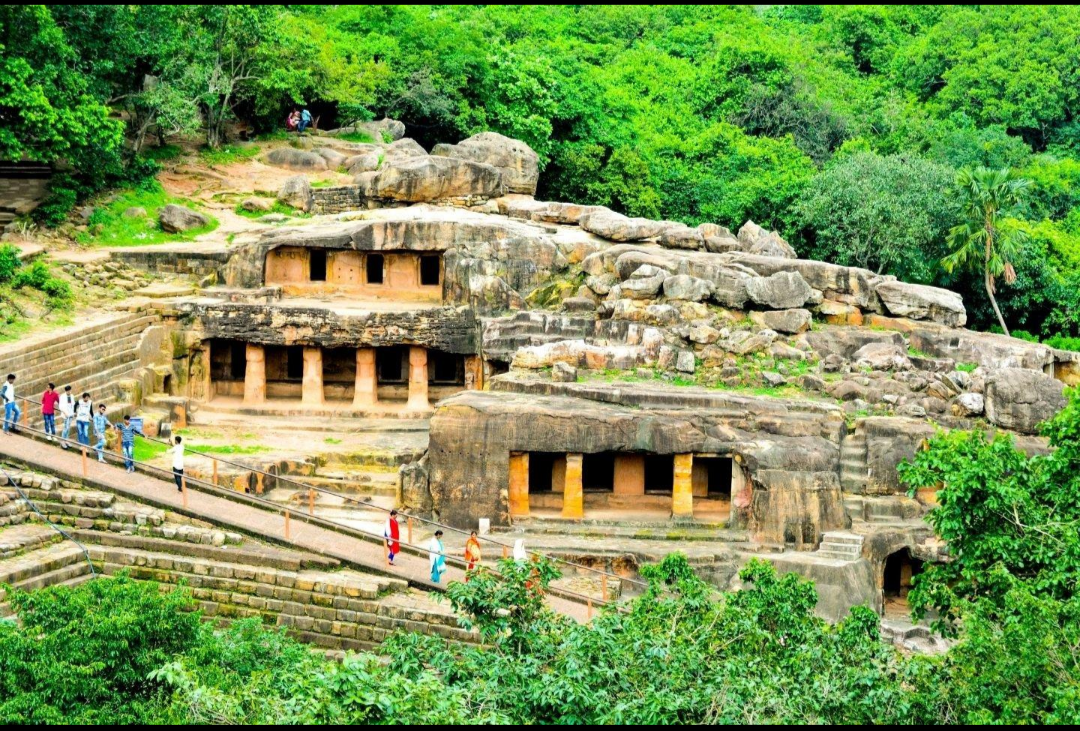
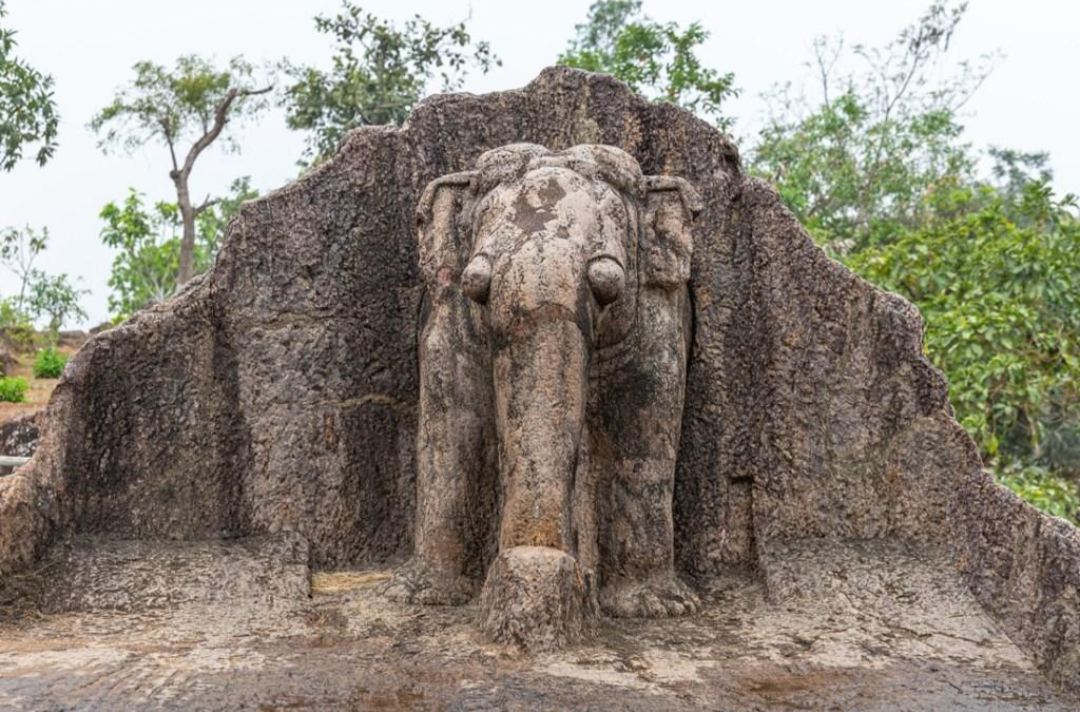
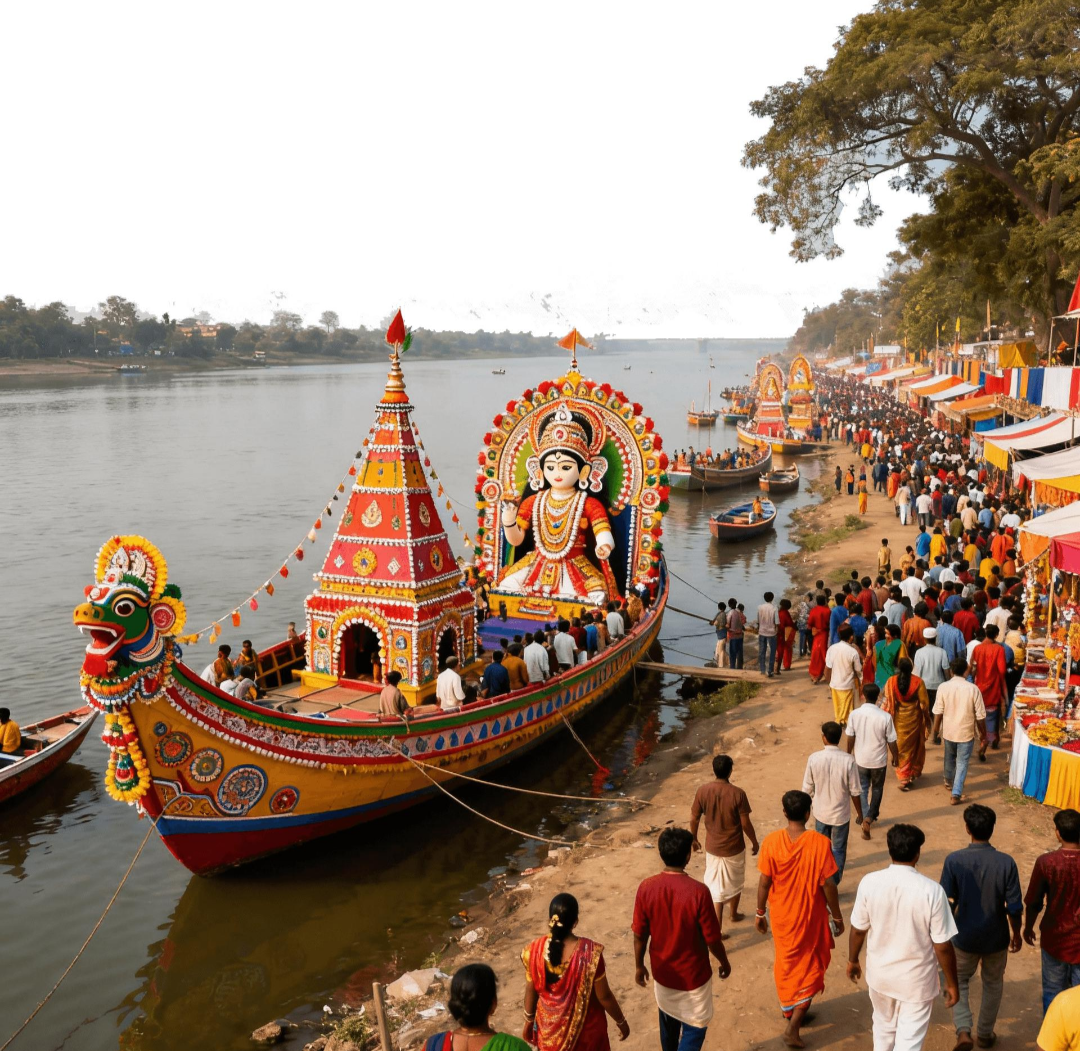
In 261 BCE the Mauryan emperor Ashoka invaded Kalinga, fighting one of the bloodiest wars of ancient Indian history; the scale of the carnage is traditionally credited with turning Ashoka towards Buddhism and non-violence, a transformation he recorded in rock edicts still visible today at Dhauli and Jaugada, near Bhubaneswar. Kalinga recovered its independence within a century, and by the 1st century BCE the Mahameghavahana (Chedi) dynasty ruler Kharavela had rebuilt it into a substantial regional power; his Hatigumpha inscription at the Udayagiri caves near Bhubaneswar describes him as Kalingadhipati ("Lord of Kalinga") and records extensive military campaigns as well as royal patronage of Jainism. From roughly the 1st century CE, Kalinga also emerged as a major maritime power, its merchant-sailors — remembered in Odia folk memory as the Sadhabas — trading across the Bay of Bengal to Java, Bali, Sumatra and Sri Lanka, a seafaring legacy still commemorated each year at the Bali Yatra festival in Cuttack.
3.3 The Bhauma-Kara, Somavamshi and Eastern Ganga Dynasties
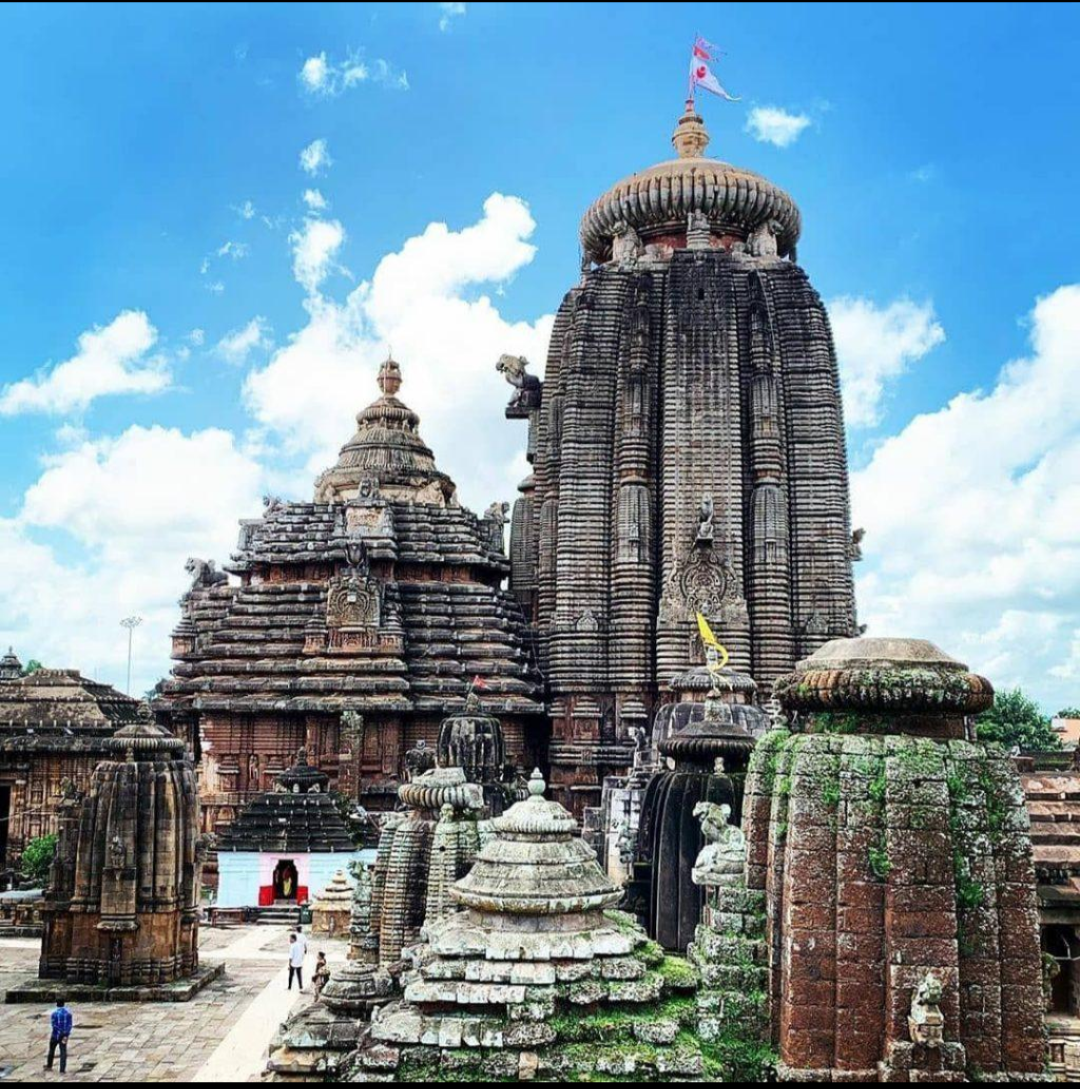
Kalinga was ruled by the Bhauma-Kara dynasty, notable for several ruling queens, through the 8th to 10th centuries CE, followed by the Somavamshi kings from their capital at Jajpur, who began construction of the great Lingaraja Temple at Bhubaneswar in the 11th century — still the largest Shaiva monument in the region. The region entered a golden age under the Eastern Ganga dynasty: the emperor Anantavarman Chodaganga Deva (1078–1150) unified the territory from the Ganga river to the Godavari, ruling from Kataka (Cuttack), and began construction of the Jagannath Temple at Puri, the monument that would come to define Odia religious identity. His successor Narasimha Deva I (1238–1264) built the Sun Temple at Konark, one of the supreme achievements of Kalinga temple architecture and today a UNESCO World Heritage Site.
3.4 The Gajapati Empire
Kapilendra Deva founded the Suryavamshi Gajapati dynasty in 1435, and under his rule and that of his successors Purushottama Deva and Prataprudra Deva, the Gajapati empire expanded at its height from Bengal to Tamil Nadu, becoming one of the major powers of medieval India — it is from Kapilendra Deva's reign onward that the land of the Odia-speaking people began to be called Odisha, synonymous with the older Odra-rashtra. Prataprudra Deva reigned as a contemporary and devoted follower of the Bengali saint Chaitanya Mahaprabhu, and his patronage helped cement the Vaishnava bhakti devotion to Jagannath that still defines Odia religious life. Gajapati power declined after a series of Afghan and Mughal invasions in the later 16th century, and the region subsequently passed under Mughal, then Maratha (Bhonsle of Nagpur) control, before the British East India Company annexed coastal Odisha in 1803.
3.5 Colonial Fragmentation, the Odia Language Movement, and the Formation of Odisha
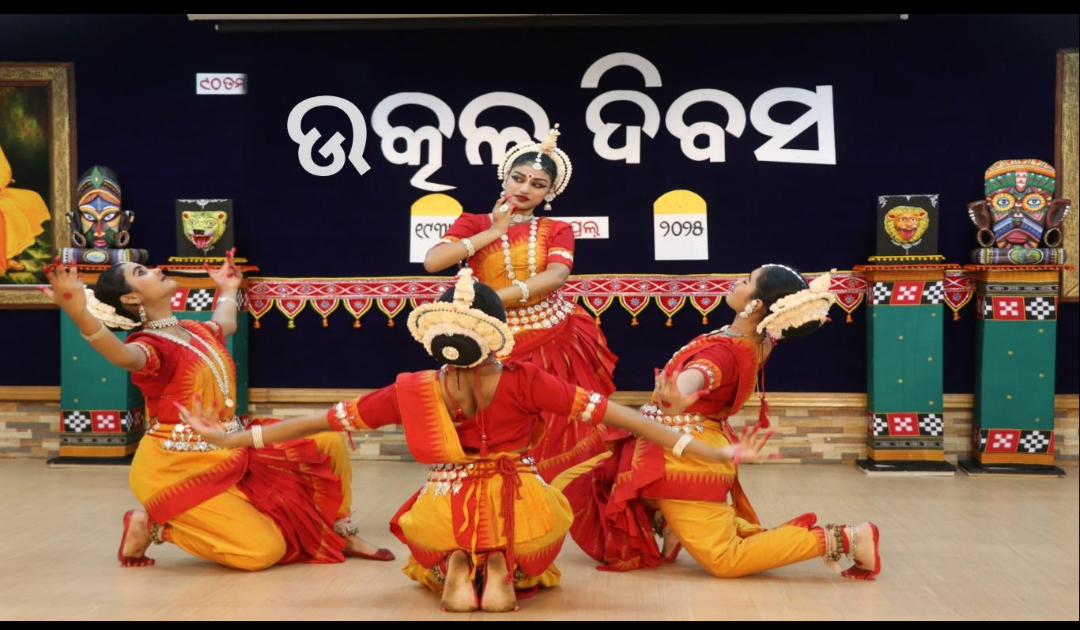
Under British rule, the Odia-speaking tracts were split across three separate administrative units — Bengal Presidency, Madras Presidency and the Central Provinces — a fragmentation compounded by the catastrophic Na Anka Durbhikshya (Great Famine of 1866), which killed roughly a million people and triggered large-scale distress migration out of the region. These pressures fed a linguistic-identity movement led by figures such as Madhusudan Das and Gopabandhu Das, who organised the Utkal Sammilani from 1903 to campaign for the reunification of Odia-speaking areas. Their efforts succeeded on 1 April 1936, when Orissa Province was created as British India's first province organised on linguistic lines — a date still celebrated annually as Utkal Divas or Odisha Day. Twenty-six Odia princely states merged into the new state after Indian independence in 1947, and in 2011 the state's name was formally changed from Orissa to Odisha, and its language from Oriya to Odia, by an Act of Parliament; Odia was also recognised as a Classical Language of India in 2014, one of only a handful of Indian languages to hold that status.
4. Demographic Profile
According to the 2011 Census, Odisha's population stood at 41,974,218 (roughly 4.20 crore), up from 36.8 million in 2001; current estimates place the population above 46 million. Odisha remains overwhelmingly rural, with around 83 per cent of its people living in villages, and its population density, at roughly 270 persons per square kilometre, is well below the all-India average, reflecting the state's large forested and hilly tracts. The 2011 sex ratio was recorded at about 979 females per 1,000 males, close to the national figure, and literacy stood at roughly 73 per cent, improving steadily but still below the national average, with a marked rural-urban and gender gap.
Religiously, Odisha is around 94 per cent Hindu — the second-highest proportion of any Indian state after Himachal Pradesh — with small Christian (about 2.8 per cent, concentrated among tribal converts in districts such as Kandhamal and Sundargarh), Muslim (about 2.2 per cent) and Sikh, Jain and Buddhist minorities. Odisha's Scheduled Tribe population, at 9,590,756 in 2011, is the third-largest of any Indian state after Madhya Pradesh and Maharashtra, comprising about 22.85 per cent of the state's population and spread across 62 recognised tribal communities, 13 of them classified as Particularly Vulnerable Tribal Groups (PVTGs) — the largest such concentration in India. Scheduled Castes account for a further 17 per cent of the population. Many tribal residents practise a blend of Hinduism and indigenous Sarna or animist traditions centred on nature and ancestor worship, alongside the state's dominant Jagannath-centred Hinduism.
5. Genetics and DNA Ancestry
As a long-settled coastal region with an exceptionally large and linguistically diverse tribal population layered beneath a Hindu caste society, Odisha offers a genetically stratified rather than uniform population — one that population geneticists have historically studied far less than better-known regions such as Punjab, Uttar Pradesh or Tamil Nadu, though this is now changing.
5.1 The Ancestral North Indian – Ancestral South Indian Gradient
Like the great majority of Indian populations, Odisha's caste Hindu communities descend from a mixture of two deeply diverged ancestral populations: Ancestral North Indians (ANI), related to Central Asian, Middle Eastern and European populations, and Ancestral South Indians (ASI), indigenous to the subcontinent and not closely related to any population outside it. Genome-wide studies estimate that this ANI–ASI admixture occurred roughly 1,900 to 4,200 years ago across India, with the ANI component consistently higher among traditionally upper-caste and Indo-European-speaking groups. Odisha's caste populations sit within this broad eastern Indian gradient, generally carrying a somewhat lower ANI component than populations of the Gangetic heartland, consistent with the state's position on the eastern periphery of the historic corridors of Indo-Aryan migration, and a correspondingly older, deeper ASI and Austroasiatic-linked substrate.
5.2 Regional Genetic Studies: Caste–Tribe Stratification
A 2020 autosomal STR study of 508 individuals from across Odisha found that the state's population shares its closest genetic affinity with the neighbouring populations of Jharkhand and central India, consistent with Odisha's location astride the eastern edge of the Chhotanagpur plateau and the Gangetic-Deccan transition zone. A separate forensic ancestry study comparing six endogamous groups within Odisha — including Brahmins, the Gopala and Kaibarta cultivator-fisher castes, and the Pana, Kandha and Savara communities — found that the state's population divides along a clear West Asian–East Asian genetic axis: Brahmin groups cluster distinctly and show relatively higher West Asian affinity, the Pana and Kandha cluster with other Dravidian-speaking Gond-related populations, and the Savara cluster closely with Munda-speaking tribal groups, reflecting deep genetic continuity within Odisha's Austroasiatic tribal communities. Odisha's 62 tribal groups belong to three distinct linguistic families — Austroasiatic (including the Kharia, Juang, Gadaba, Ho and Saora, among the linguistically oldest tribal populations in the state), Dravidian (including the Kondh/Kandha, Paraja and Oraon), and Indo-European — and genetic studies consistently find that its tribal communities show markedly deeper, more isolated genetic continuity than its caste communities, a pattern of long-term endogamy that a 2026 genomic study describes as leaving Odisha's tribal populations comparatively understudied but genetically distinctive within the wider Indian landscape.
5.3 Y-Chromosome, mtDNA, and Deep Ancestry
Broader studies of Indian Y-chromosome (paternal) lineages find eastern Indian populations, including Odisha, carrying a mix of deeply rooted indigenous South Asian haplogroups such as H and L, alongside the R1a lineage associated with the spread of Indo-Aryan languages; the state's Austroasiatic-speaking Munda-affiliated tribal groups (the Ho, Munda, Santal, Kharia, Juang and Saora among them) additionally carry paternal and maternal lineages tied to the ancient Austroasiatic migration into eastern India, a marker of deep, distinct ancestry not shared with Odisha's caste Hindu populations. On the maternal (mitochondrial DNA) side, as elsewhere in India, the indigenous haplogroup M and its subclades dominate, and studies find that Odisha's Munda-affiliated tribal groups show a comparatively higher East Asian-linked maternal component than the state's caste communities, which instead show a modestly higher West Asian-linked component — a genetic mirror of the state's linguistic and cultural caste-tribe divide.
6. Language and Literature
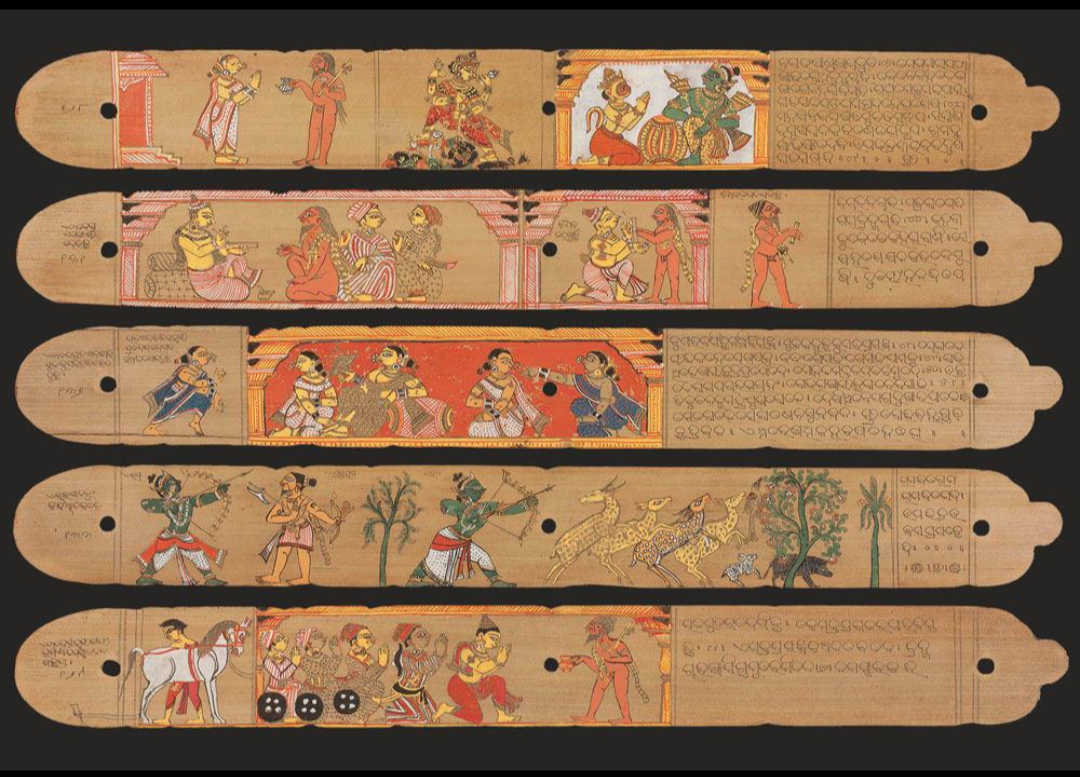
Odia, an Indo-Aryan language recognised as a Classical Language of India, is the state's official and literary language, spoken natively by around 82 per cent of the population and also present in neighbouring West Bengal, Jharkhand, Chhattisgarh and Andhra Pradesh. Regional dialects mirror the cultural sub-regions described above: Baleswari Odia in the north, Kataki (the basis of standard Odia) around Cuttack, Sambalpuri in the west, Ganjami or Brahmapuria in the south, and Desia in the south-west. Beyond Odia, the state's 62 tribal communities collectively speak a remarkable range of languages from three separate families — Austroasiatic languages such as Santali, Ho, Mundari and Sora/Sabar; Dravidian languages such as Kui/Kondh and Kurukh; and smaller Indo-Aryan tribal dialects such as Kisan and Sadri — making Odisha one of India's most linguistically diverse states.
Odia literature has an unbroken record stretching back to the medieval period. The 12th-century poet Jayadeva, born at Kenduli in present-day Puri district, composed the Sanskrit devotional classic Gita Govinda, a foundational text of Krishna bhakti still sung in temples across India. Sarala Das produced the first vernacular retelling of the Mahabharata in Odia in the 15th century, and the Panchasakha, a group of five Vaishnava poet-saints including Jagannath Das (author of the Odia Bhagavata) and Balaram Das, shaped Odia devotional literature during the Gajapati period. The Riti-era poet Upendra Bhanja is celebrated for his ornate courtly verse, while Fakir Mohan Senapati, author of the novel Chha Mana Atha Guntha, is regarded as the father of modern Odia fiction. Odisha has produced two winners of India's highest literary honour, the Jnanpith Award: novelist Gopinath Mohanty (1973) and poet Sitakant Mahapatra (1993).
7. Religion, Festivals, and Pilgrimage
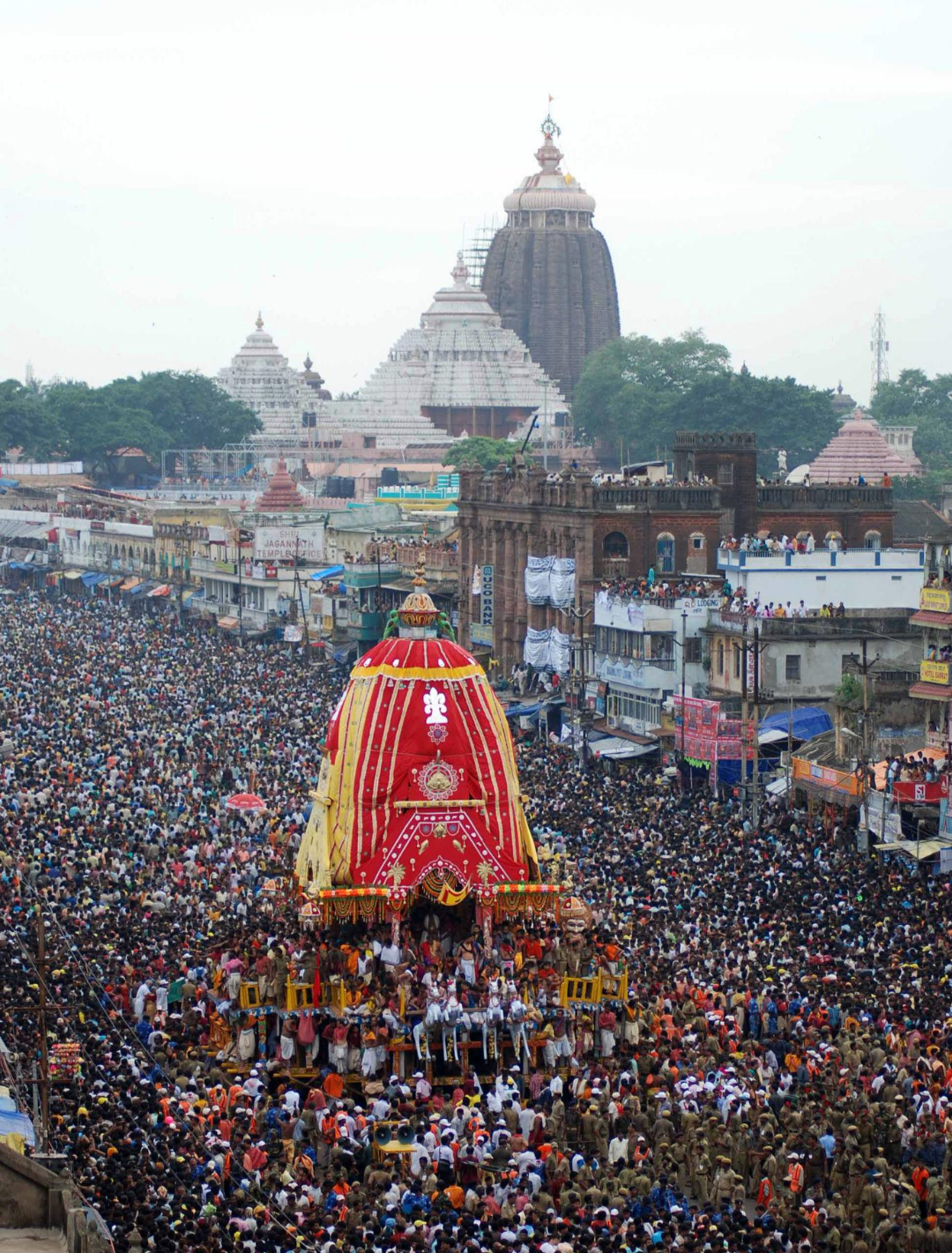
Odisha's religious life centres overwhelmingly on the cult of Jagannath at Puri, one of Hinduism's four Char Dham pilgrimage seats. The deities Jagannath, Balabhadra and Subhadra, carved from neem wood and ritually replaced every dozen or so years in the Nabakalebara ceremony, are worshipped in a form found nowhere else in mainstream Hinduism, and popular tradition traces their origin to a tribal Sabara king, Vishvavasu — an origin story that scholars read as evidence of an unusually deep syncretism between Odisha's tribal and Brahmanical religious traditions. The annual Rath Yatra (Chariot Festival), in which the deities are drawn through Puri on immense wooden chariots before vast crowds, is Odisha's most famous festival and gave the English language the word "juggernaut".
Bhubaneswar, the "Temple City of India", holds the 11th-century Lingaraja Temple, the region's foremost Shaiva shrine, alongside dozens of other Kalinga-era temples, while Konark's 13th-century Sun Temple ranks among the great monuments of world architecture. Odisha is also rich in older religious heritage: the "Diamond Triangle" of Ratnagiri, Udayagiri and Lalitgiri preserves major ancient Buddhist monastic complexes, and the Udayagiri-Khandagiri caves near Bhubaneswar, associated with King Kharavela, are among India's most important Jain rock-cut monuments. Beyond the Jagannath cult, major festivals include Durga Puja and Kali Puja; Raja Parba, a distinctive three-day festival in June celebrating womanhood and the earth goddess's fertility; Nuakhai, the western Odisha harvest festival marking the first eating of new rice; and Bali Yatra at Cuttack, commemorating the region's ancient maritime trade with South-East Asia. Many of Odisha's tribal communities practise Sarnaism or related animist traditions — worship of a supreme earth deity (often called Dharni or Basumata), sacred groves, and ancestor spirits — frequently alongside, rather than instead of, Hindu observance.
8. Culture, Customs, and Social Practices
Odisha's social fabric historically rested on a caste hierarchy distinctive within eastern India, from the Brahmin sevaks (ritual servitors) of the Puri Jagannath Temple — organised into dozens of specialised hereditary service categories — and the Karan scribe-administrator caste (the source of common Odia surnames such as Patnaik, Mohanty, and Das), through the numerically dominant Khandayat warrior-cultivator caste, to Dalit communities such as the Pana and Kandara. Running alongside this caste society, and giving Odisha much of its distinctive social character, is its exceptionally large and diverse tribal population, whose customary institutions — including, among several communities, youth dormitories (dhangada basa) that structure courtship and social learning for unmarried men and women — sit in close, often intermarrying, proximity to caste Hindu village life, particularly across the Eastern Ghats highlands of Koraput, Rayagada and Kandhamal. Extended-family and joint-household living remains common in both rural Hindu and tribal Odisha, and hospitality, communal festival participation, and village or clan solidarity remain strongly held social values.
9. Marriage and Wedding Traditions
Hindu weddings in Odisha broadly follow the North Indian Vedic pattern — including Nirbandha (formal betrothal), a haldi (turmeric) ceremony, the groom's Bariyatra procession, Saptapadi (seven ritual steps around the sacred fire), and a tearful Bidaai farewell for the bride — while carrying distinctive Odia elements such as the Jayee Anukolo rite and elaborate multi-day feasting drawn from the region's rich culinary tradition. Marriage has traditionally been arranged within caste, with community elders and astrological matching playing a central role. Among many of Odisha's tribal communities, marriage customs differ markedly from caste Hindu practice: several groups, including the Kondh and Saora, traditionally favour bride price over dowry, permit greater freedom of mate choice arising from dormitory-based courtship, and in some communities recognise elopement marriage (known locally as udalia) as a legitimate, if informal, path to marriage — practices anthropologists have long studied as markedly more egalitarian than the dowry-based norms of caste Hindu Odisha and much of North India.
10. Cuisine
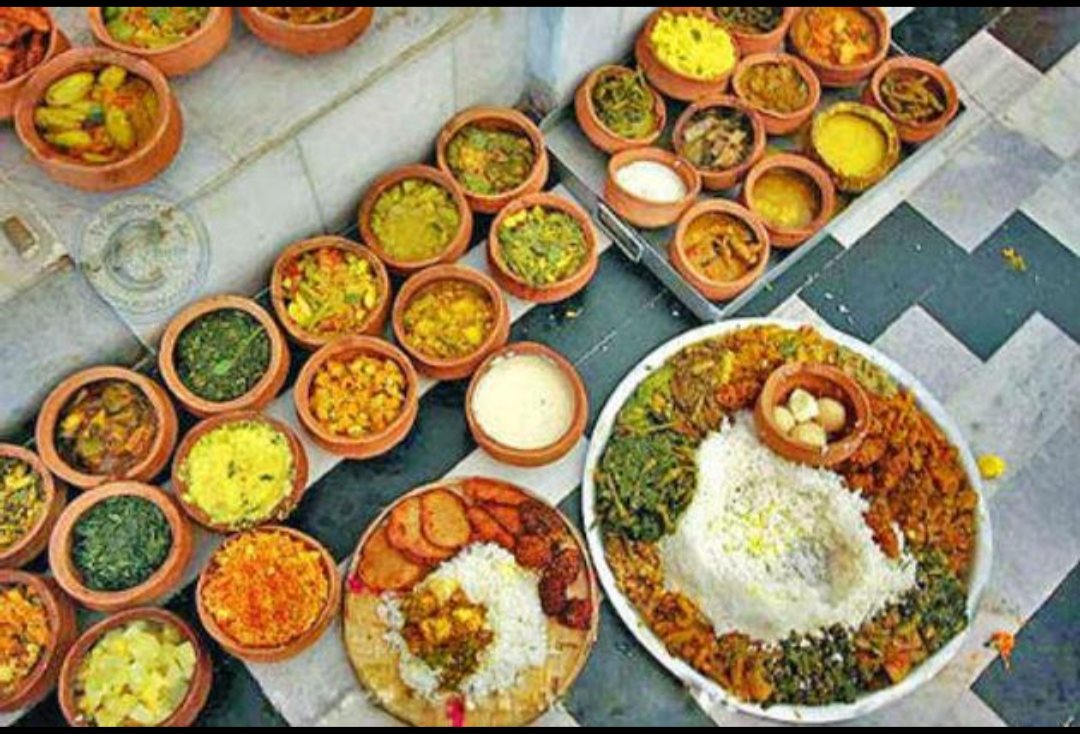
Odia cuisine favours lighter spicing and less oil than much of North Indian cooking, built around rice, lentils, locally grown vegetables, dairy (chhena, or fresh cheese, is central to Odia sweets), and, along the coast, fish and seafood. Food is traditionally served on brass or bronze plates, banana leaves, or disposable sal-leaf plates, and Odia cooks — particularly from the Puri temple tradition — have historically been sought after for their ability to cook strictly according to scriptural prescription.
10.1 Temple Cuisine and the Mahaprasad
The kitchen of the Jagannath Temple at Puri, the Ananda Bazaar, is often described as one of the largest temple kitchens in the world: earthen pots are stacked and cooked entirely over open wood fires to prepare the Chhappan Bhog, a ceremonial offering of 56 dishes, whose leftover portions are distributed to pilgrims as Mahaprasad — food considered sacred regardless of the eater's caste, a tradition of ritual commensality unusual within Indian temple practice.
10.2 Everyday and Regional Cuisine
- Pakhala Bhata — rice soaked or lightly fermented in water, eaten cold with fried vegetables, dried fish, or curd; considered Odisha's quintessential summer dish and celebrated each year on World Pakhala Day (20 March).
- Dalma — a lentil-and-vegetable preparation regarded as the everyday heart of Odia home cooking, and part of the temple's Mahaprasad offerings.
- Chhena Poda — a baked chhena (fresh cheese) dessert invented in Nayagarh district, often described as India's original cheesecake.
- Rasagola (Odisha Rasagola) — a syrup-soaked chhena sweet with a Geographical Indication (GI) tag granted in 2019, whose origin is the subject of a long-running, good-natured rivalry with the Bengali rosogolla.
- Machha Besara and Mansa Tarkari — fish and mutton curries cooked with a distinctive mustard-paste (besara) base.
- Santula, Dahi Baigana, and Chhatu (mushroom) Besara — lightly spiced vegetable and lentil preparations typical of everyday Odia meals.
- Pitha varieties (Enduri, Poda, Kakara) — an extensive family of steamed or roasted rice-flour cakes, sweet or savoury, central to Odisha's festival cuisine, particularly during the Raja and Makar Sankranti festivals.
Western Odisha's Sambalpur region additionally carries a distinct "tribal" culinary layer built on forest ingredients — bamboo shoot, mahua flower, and a range of wild greens and tubers — reflecting the food traditions of the region's Kondh, Munda and Gond communities.
11. Traditional Dress, Textiles, and Ornaments
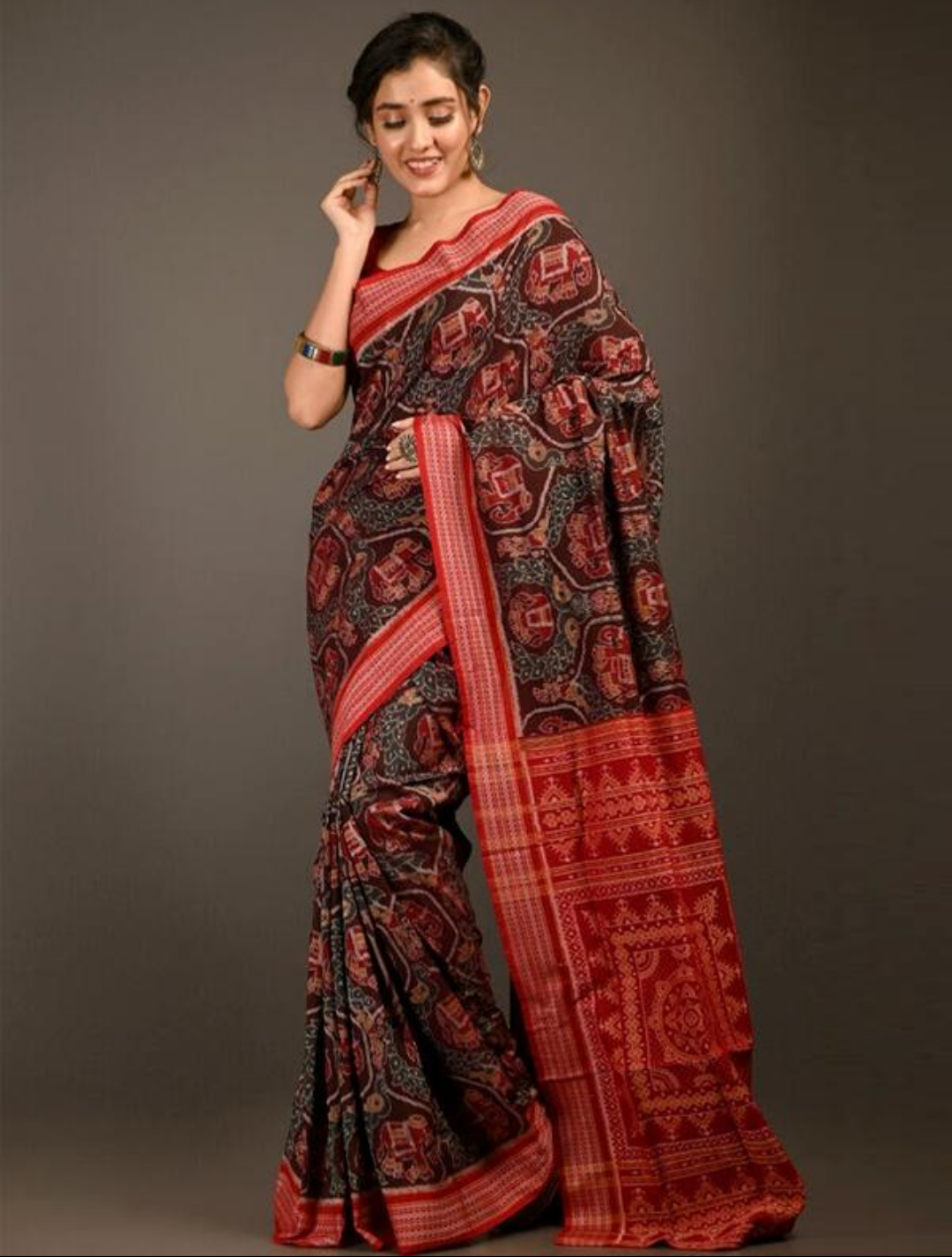
Odisha's textile traditions are built above all around handwoven Ikat, locally called Bandha — a technique of tie-dyeing yarn before weaving to create patterns with soft, feathered edges. The Sambalpuri sari, woven chiefly in Sambalpur, Bargarh, Balangir, Boudh and Sonepur, is Odisha's most recognised textile, incorporating motifs such as the shankha (conch) and chakra (wheel) that carry deep religious symbolism; it gained national prominence after Prime Minister Indira Gandhi began wearing it in the 1980s. Other celebrated regional weaves include the Bomkai and Berhampuri Patta silk saris of southern Odisha, and the naturally dyed Kotpad handloom textiles woven by tribal communities of Koraput district, which carry their own Geographical Indication tag. Women across the state also wear the salwar kameez for everyday use, while men traditionally wear the dhoti-kurta, often paired with a gamucha (a coarse cotton towel-scarf) for festival and ceremonial occasions.
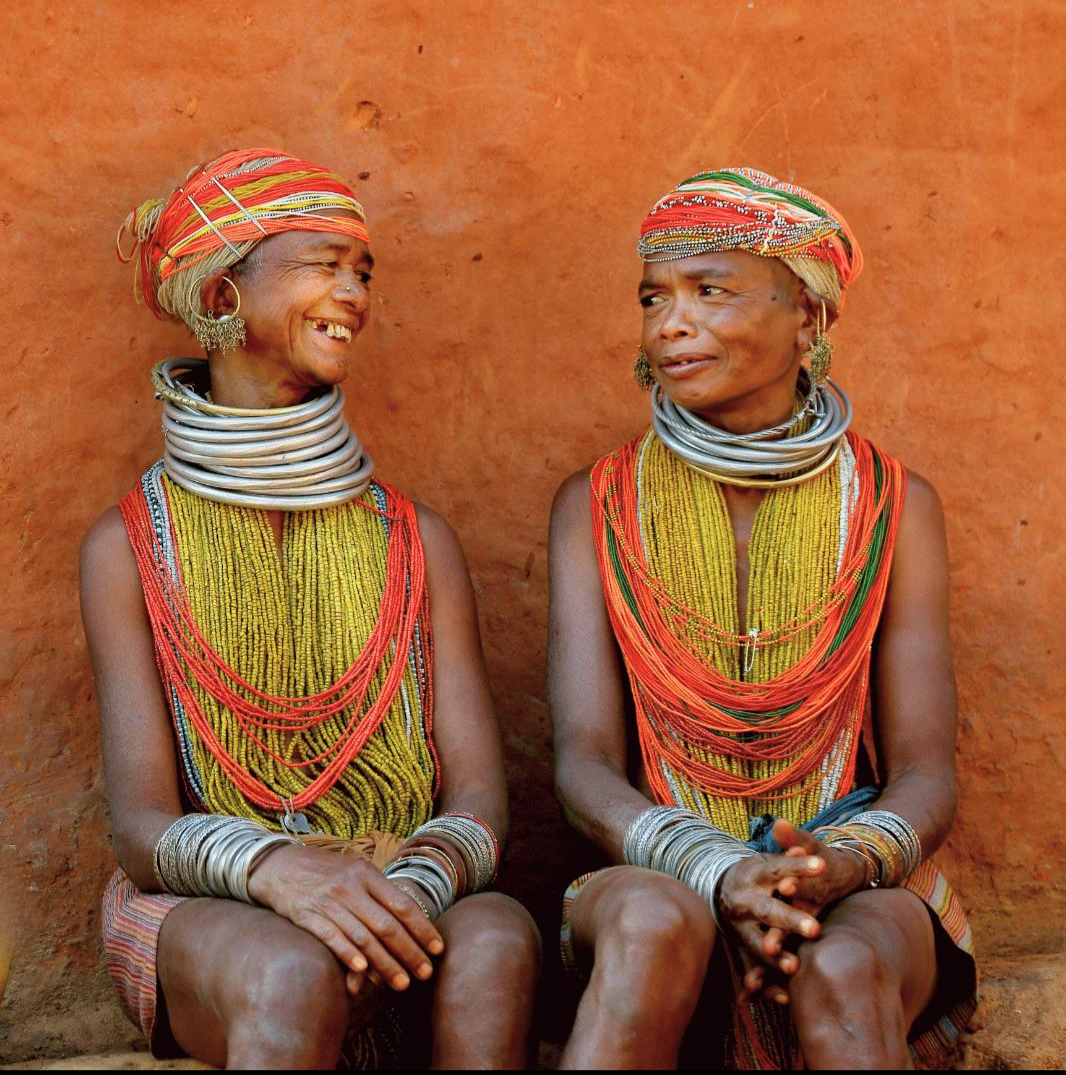
Odisha's tribal communities maintain their own distinct dress and adornment traditions, often markedly different from caste Hindu norms: women of the Bonda and Dongria Kondh tribes of the southern hill tracts are especially noted for elaborate layered bead necklaces and metal ornaments, while the Lanjia Saora of Rayagada are traditionally associated with fine bead jewellery and, historically, body tattooing. In the applied arts, Pipili in Puri district is famous nationally for its appliqué work (chandua), traditionally used for temple umbrellas and now for lampshades and bags, while the villages around Raghurajpur are celebrated for Pattachitra, the traditional cloth- and palm-leaf-based scroll painting of Odisha.
12. Traditional Housing and Temple Architecture
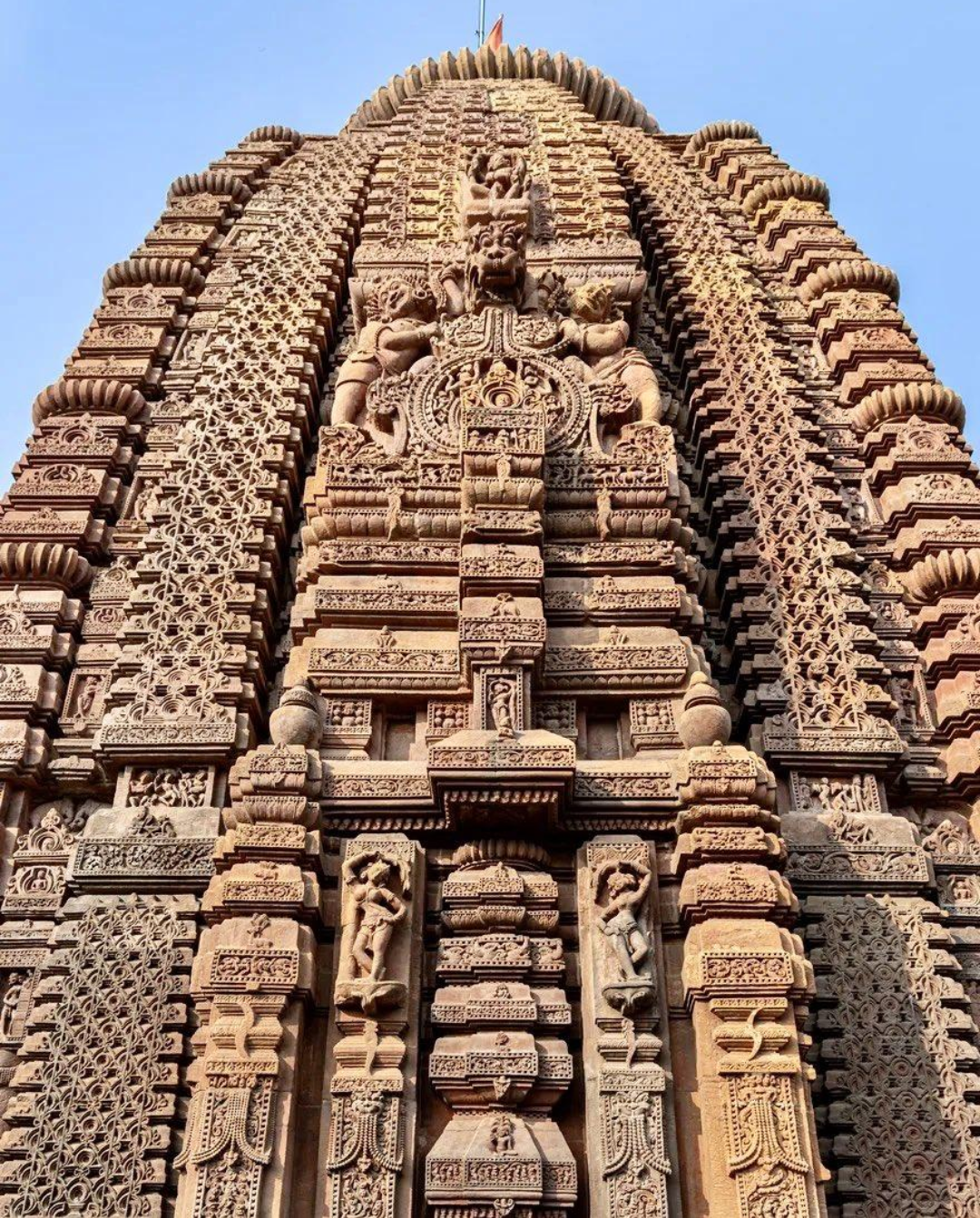
Rural Odisha's traditional dwellings typically combine mud or laterite walls with thatched or tiled roofs arranged around a central courtyard, while tribal villages across the southern hill tracts often follow distinct layouts, including totemic entrance gateways among some Kondh communities and, among the Saora, houses decorated with ritual wall murals known as Idital or iconography linked to shamanic worship. At the monumental level, Odisha's architectural legacy is defined by the Kalinga school of temple architecture, distinguished by its curvilinear Rekha Deul towers and pyramidal Pidha Deul halls: the Jagannath Temple at Puri, the Lingaraja Temple and the many smaller shrines of Bhubaneswar (earning it the title "Temple City of India"), and the Sun Temple at Konark, conceived as a colossal stone chariot for the sun god and now a UNESCO World Heritage Site, together represent one of India's most complete and continuous temple-building traditions.
13. Performing Arts and Folklore
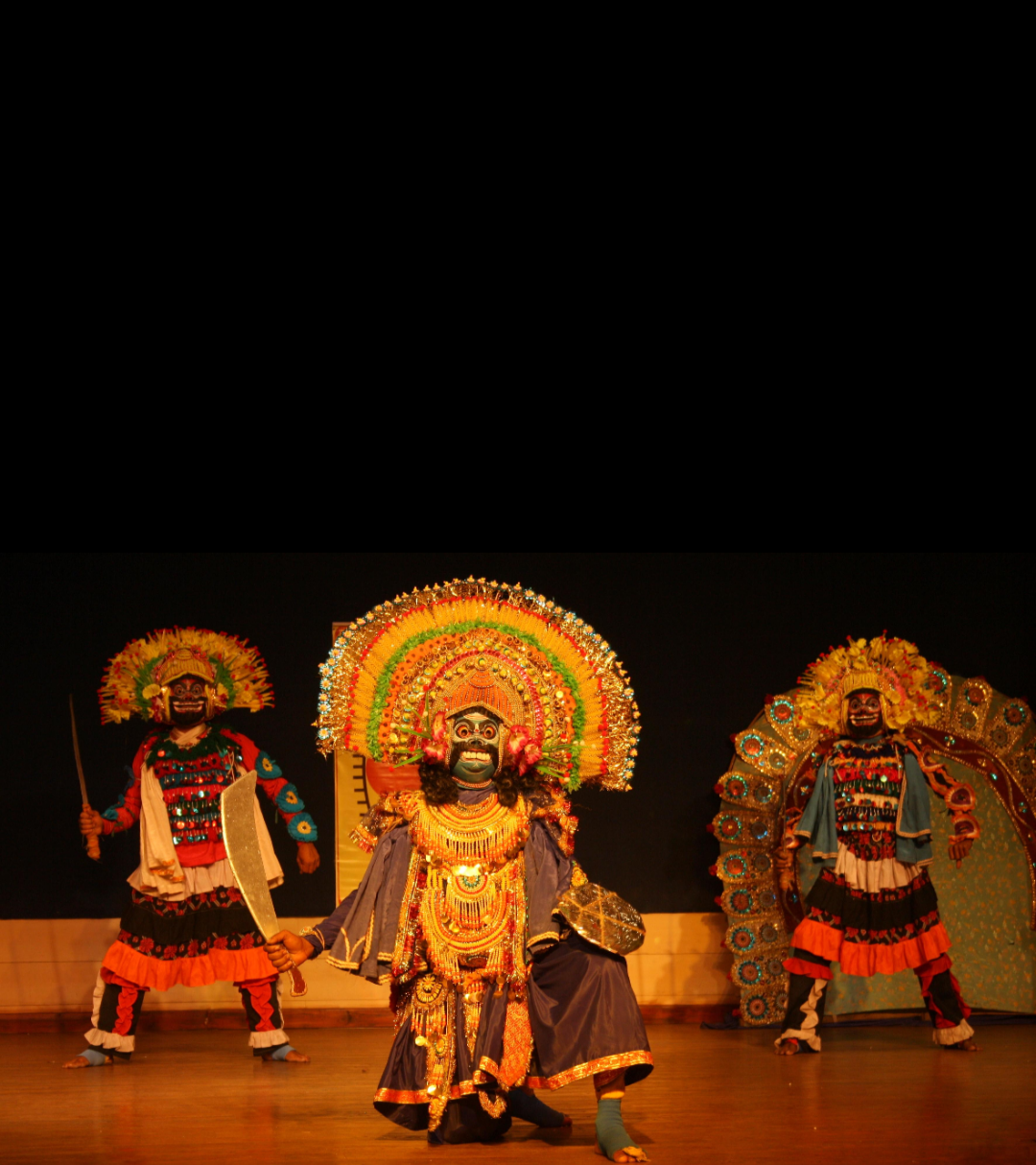
Odisha is home to Odissi, one of India's eight recognised classical dance forms, whose modern revival owes much to the guru Kelucharan Mohapatra; Odissi traces its roots partly to the Gotipua tradition, in which young boys trained by temple gurus perform dances associated with Krishna devotion, a practice still maintained at Puri. The state's other major performance tradition is Chhau, a masked, martial folk dance recognised by UNESCO as part of humanity's Intangible Cultural Heritage, whose Mayurbhanj variant is performed without masks and is distinctively Odia. Visual and craft traditions are equally rich: Pattachitra scroll painting, palm-leaf manuscript engraving (Tala Patra Chitra), Dhokra lost-wax metal casting practised by several tribal artisan communities, and the stone-carving traditions centred on Puri and Bhubaneswar, together with the contemporary art of sand sculpture, popularised worldwide by the Puri-based artist Sudarshan Pattnaik. Odisha's oral tradition runs deep as well, from Sarala Das's vernacular Mahabharata to the sung epics and seasonal folk songs preserved among Kondh, Santal and other tribal communities, many still transmitted primarily through oral performance rather than text.
14. Physical Traits
There is no single physical type for a population of more than 46 million spanning dozens of castes, 62 tribal communities and three separate linguistic families. In general terms, Odisha's coastal and caste Hindu populations fall within the medium-build, medium-stature range typical of eastern Indian Gangetic-plain-adjacent populations, while several of the state's Austroasiatic-speaking (Munda-affiliated) tribal communities, such as the Ho, Santal, Munda and Saora, have historically been noted in anthropological and forensic literature for distinct craniofacial and physical characteristics linked to their deep, comparatively isolated ancestry. As with the genetic picture described above, physical variation in Odisha tracks caste and tribal community lines shaped by centuries of endogamy far more closely than it tracks any single state-wide "Odia" phenotype, and older colonial-era anthropometric classifications of this kind are now understood by researchers chiefly as historical artefacts rather than reliable scientific categories.
15. Education, Livelihoods, and Socioeconomic Profile
Historically an agrarian, rice-growing economy centred on the fertile Mahanadi delta, Odisha is today also one of India's most important mineral and heavy-industry states: it is the country's largest producer of bauxite and chromite and a major producer of coal (centred on Talcher) and iron ore (concentrated in the Kendujhar-Sundargarh belt), underpinning industrial hubs such as the Rourkela Steel Plant (India's first integrated public-sector steel plant, commissioned in 1955), the National Aluminium Company (NALCO) at Angul and Damanjodi, Tata Steel's Kalinganagar complex, and the Paradip Port and refinery complex on the coast. Chilika Lake and the state's long coastline also support a substantial fisheries economy. Bhubaneswar has in recent decades grown into a significant education and IT services hub, anchored by institutions such as the Indian Institute of Technology Bhubaneswar, the National Institute of Technology Rourkela, and Ravenshaw University (established in 1868, the oldest degree-granting institution in eastern India).
Alongside this industrial growth, Odisha has a long, well-documented history of seasonal out-migration for work, particularly from the drought-prone western and southern districts historically grouped as the "KBK region" (Kalahandi, Balangir, Koraput), where agricultural labourers have for decades migrated seasonally to brick kilns and construction sites in Andhra Pradesh and Telangana. Odisha, and Ganjam district in particular, is also the source of a very large share of the migrant workforce in Surat's diamond-polishing industry in Gujarat, while smaller numbers travel for construction and services work to Kerala and other southern states. Literacy and per-capita income in Odisha remain below the national average, though both have risen substantially since the early 2000s alongside the state's mining, steel, and services-sector growth.
16. Diaspora
Odisha's diaspora history has several distinct layers. The oldest is the ancient maritime trade of Kalinga's Sadhaba merchant-sailors, who from around the 1st century CE carried Odia trade, and with it elements of Odia and Indian culture, across the Bay of Bengal to Java, Bali, Sumatra and Sri Lanka in present-day Indonesia — a connection still visible in cultural and artistic parallels between Odisha and Bali, and commemorated annually at the Bali Yatra festival in Cuttack. A second, colonial-era layer was the Odia mercantile migration to British Burma: from 1820 until 1941, ships sailed regularly between Gopalpur in Odisha and Yangon, carrying Odia traders and workers who built a substantial community and press of their own in Burma before trade collapsed following the Japanese bombing of Yangon in December 1941. Odisha, particularly its coastal districts, also contributed smaller numbers of labourers to the 19th- and early 20th-century indentured (girmitiya) emigration that sent workers from eastern India to British plantation colonies including Mauritius, Fiji, Trinidad, Guyana, Suriname and Natal, though this stream was considerably smaller in absolute terms than the much larger contingents recruited from neighbouring Bihar and Uttar Pradesh.
Within modern India, Odisha has become a major internal migrant-sending state: Surat in Gujarat hosts a very large Odia community, chiefly from Ganjam district, working in the city's diamond-polishing trade, while Bengaluru, Hyderabad, Chennai, Mumbai and Delhi-NCR have all attracted substantial numbers of Odia IT, engineering and public-sector professionals since the software-services boom of the late 2000s. Internationally, a smaller but well-established professional diaspora of Odia doctors, engineers, academics and IT professionals has settled in the United States, United Kingdom, and Gulf countries from the late twentieth century onward; the Odisha Society of Americas, founded in the 1970s, is among the diaspora's oldest cultural organisations, and Odia communities abroad continue to mark Rath Yatra and Nuakhai with organised community celebrations.
17. Prominent Figures
17.1 Political and Public Life
- Madhusudan Das (1848–1934) — "Utkal Gouraba", lawyer, industrialist and the foremost architect of the Odia linguistic movement that led to the formation of Odisha.
- Gopabandhu Das (1877–1928) — "Utkalamani", poet, educator and freedom fighter central to the Utkal Sammilani movement.
- Biju Patnaik (1916–1997) — pilot, industrialist, freedom fighter, and Chief Minister of Odisha, remembered for founding Kalinga Airlines and championing Indonesia's independence struggle.
- Naveen Patnaik (born 1946) — son of Biju Patnaik; founder of the Biju Janata Dal and Chief Minister of Odisha for five consecutive terms, 2000–2024.
- Harekrushna Mahatab (1899–1987) — freedom fighter, historian and Odisha's first Chief Minister after independence.
- Baji Rout (1926–1938) — a twelve-year-old boatman shot by police during the Indian independence movement, remembered as one of its youngest martyrs.
17.2 Literature, Arts, and Culture
- Jayadeva (12th century) — Sanskrit poet born at Kenduli, Puri district; author of the Gita Govinda, a foundational text of Krishna devotional literature across India.
- Sarala Das (15th century) — author of the first Odia-language retelling of the Mahabharata.
- Fakir Mohan Senapati (1843–1918) — regarded as the father of the modern Odia novel.
- Gopinath Mohanty (1914–1991) and Sitakant Mahapatra (born 1937) — Odisha's two Jnanpith Award-winning writers.
- Kelucharan Mohapatra (1926–2004) — Odissi dance guru central to the classical form's modern revival.
- Sudarshan Pattnaik (born 1977) — internationally celebrated sand sculptor and Padma Shri awardee.
17.3 Science and Sports
- Samanta Chandrasekhar (1835–1904) — self-taught, largely blind Odia astronomer, author of the Siddhanta Darpana.
- Dilip Tirkey (born 1977) — hockey legend and former captain of the Indian national team, from Odisha's Oraon tribal community; later a Rajya Sabha member.
- Dutee Chand (born 1996) — Olympic sprinter from a weaving family in Jajpur district, and India's first openly gay athlete.
- Rourkela's Birsa Munda International Hockey Stadium — the world's largest hockey stadium, host of the 2023 Men's Hockey World Cup, reflecting Odisha's status since 2018 as principal sponsor of the Indian national hockey teams.
18. Conclusion
Odisha represents a rare case of a geography whose ancient scriptural memory, temple-building genius, maritime past, and modern population genetics converge on a coherent, if internally diverse, regional story: an ancient Kalinga that stood apart from the Mauryan empire until Ashoka's war remade it, a golden age of Ganga and Gajapati temple-builders who raised Puri and Konark, a Sadhaba seafaring culture that carried Odia trade to Java and Bali, and a modern state that unites India's third-largest tribal population with a fast-growing industrial and IT economy — all while remaining, at its demographic base, a continuous coastal and highland population whose genetic ancestry still bears the imprint of millennia of settlement between the Mahanadi delta and the Eastern Ghats. From the wood-fired kitchens of the Puri temple to the bead ornaments of the Bonda hills, and from the Rath Yatra chariots that gave English the word "juggernaut" to the Odia diamond-polishers of Surat, the story of Odisha's people is simultaneously a religious history, a genetic case study, and a living regional culture carried by one of eastern India's largest and most diverse populations.
References
- [1]1. Wikipedia. "Odisha." en.wikipedia.org/wiki/Odisha
- [2]2. Wikipedia. "Eastern Ganga dynasty" and "Anantavarman Chodaganga." en.wikipedia.org
- [3]5. Census of India, 2011. Office of the Registrar General & Census Commissioner, India (population, district, and Scheduled Tribe data).
- [4]6. Reich, D. et al. "Reconstructing Indian population history" and "Genetic evidence for recent population mixture in India" (ANI–ASI admixture studies).
- [5]7. Sahoo, S. et al. "Genomic portrait of Odisha, India drawn by using 21 autosomal STR markers." International Journal of Legal Medicine, 2020.
- [6]8. Fine-scale genetic structure and population-specific clinically relevant variants in the indigenous tribal populations of India. medRxiv, 2026.
- [7]9. Forensic ancestry study of six endogamous ethnic groups of Odisha (mtDNA-SNP and autosomal STR comparison). discovery.researcher.life.
- [8]10. Britannica. "Odisha — Ancient History, Kalinga War, Temple Architecture." britannica.com
- [9]11. Odisha State Disaster Management Authority. "State Profile." osdma.org
- [10]12. Tribal Digital Document Repository. "Tribal Atlas of Odisha." repository.tribal.gov.in
Frequently Asked Questions
What ethnicity or ancestry are people from Odisha?
People from Odisha are not a single ethnicity but a large, internally diverse eastern Indian population encompassing many Hindu castes and 62 recognised tribal communities. Genetically, Odisha's caste Hindu population descends from a mixture of Ancestral North Indian (ANI) and Ancestral South Indian (ASI) ancestry, like most of India, while its large Austroasiatic-speaking tribal population carries a distinct, deeply rooted ancestry linked to the ancient Munda migration into eastern India.
Is Odisha Aryan, Dravidian, or tribal?
Odisha is genuinely all three, layered together. Odia, the majority language, is Indo-Aryan; several tribal languages such as Kondh and Oraon belong to the Dravidian family; and a further group, including Santali, Ho, Mundari and Sora, belongs to the separate Austroasiatic family. Odisha has the third-largest tribal population of any Indian state, and its genetics reflect this three-way linguistic and ancestral layering rather than a single origin.
What DNA haplogroups are common among people from Odisha?
Studies of eastern Indian populations, including Odisha, report deep South Asian paternal haplogroups such as H and L alongside the Indo-Aryan-linked R1a lineage among caste groups, while Odisha's Munda-affiliated tribal communities (Ho, Santal, Munda, Saora and others) additionally carry paternal and maternal lineages tied to ancient Austroasiatic migration. Maternal (mitochondrial) DNA across the state is dominated by the indigenous South Asian haplogroup M, with a somewhat higher East Asian-linked component among tribal groups than among caste Hindu populations.
What language do people in Odisha speak?
Odia, a Classical Language of India, is the official language and mother tongue of about 82 per cent of the population, with regional dialects including Baleswari (north), Kataki (central, the basis of standard Odia), Sambalpuri (west), Ganjami/Brahmapuria (south) and Desia (south-west). Odisha's tribal communities additionally speak a wide range of Austroasiatic (Santali, Ho, Mundari, Sora), Dravidian (Kui/Kondh, Kurukh) and smaller Indo-Aryan tribal languages.
What is the traditional dress of Odisha?
Women traditionally wear the sari, most famously the handwoven Ikat (Bandha) Sambalpuri sari, alongside the Bomkai and Berhampuri Patta silk saris and the tribal Kotpad handloom of Koraput. Men traditionally wear a dhoti-kurta, often with a gamucha (cotton towel-scarf) for festive occasions, while several tribal communities, particularly in the southern hill tracts, maintain their own distinct dress and elaborate bead or metal jewellery traditions.
What is Odisha famous for in terms of food?
Odisha is best known for Pakhala Bhata (fermented rice, eaten cold), Dalma (a lentil-vegetable preparation), and Chhena Poda, a baked cheese dessert often described as India's original cheesecake. The Jagannath Temple at Puri also maintains one of the world's largest temple kitchens, preparing the 56-dish Chhappan Bhog offering, whose leftovers are distributed to pilgrims of all castes as Mahaprasad.
Where did people from Odisha migrate to historically?
Kalinga's ancient Sadhaba merchant-sailors traded across the Bay of Bengal to Java, Bali and Sumatra from around the 1st century CE, a connection still marked by the annual Bali Yatra festival in Cuttack. From 1820 to 1941, Odia traders regularly sailed to British Burma via the Gopalpur–Yangon route, and smaller numbers of Odia labourers also joined the 19th- and early 20th-century indentured emigration to British plantation colonies such as Mauritius and Fiji. In modern India, Odisha, and Ganjam district especially, sends a very large migrant workforce to Surat's diamond-polishing industry, alongside growing professional emigration to Indian metros and abroad.
What tribal communities are found in Odisha?
Odisha is home to 62 recognised Scheduled Tribes, more than any other Indian state, including 13 Particularly Vulnerable Tribal Groups (PVTGs). The largest is the Kondh (or Kandha), concentrated in Kandhamal, Rayagada, Koraput and Balangir, followed by the Santal (Mayurbhanj), the Ho (Mayurbhanj, Kendujhar and neighbouring districts), the Munda, the Saora (or Sora) of the southern hill tracts, and dozens of smaller groups including the Bonda, Gadaba, Juang and Kharia.
Is Odisha genetically similar to Jharkhand, West Bengal, or Andhra Pradesh?
Autosomal genetic studies find Odisha's population shares its closest genetic affinity with neighbouring Jharkhand and broader central Indian populations, consistent with the state's location at the eastern edge of the Chhotanagpur plateau. Odisha's tribal communities in particular share deep ancestral links with related Munda- and Dravidian-speaking tribal populations across the Jharkhand-Odisha-Andhra Pradesh border belt, while its coastal caste populations sit within the wider eastern Indian ANI-ASI genetic gradient shared with West Bengal.
What is the Jagannath cult and the Rath Yatra?
The Jagannath cult centres on the worship of Jagannath, Balabhadra and Subhadra at the Puri temple, one of Hinduism's four Char Dham pilgrimage sites; the deities are carved from neem wood and periodically renewed, and popular tradition traces their origin to a tribal Sabara king, reflecting an unusually deep Hindu-tribal religious synthesis. The annual Rath Yatra chariot festival, in which the deities are pulled through Puri on massive wooden chariots, is Odisha's most famous religious event and the origin of the English word "juggernaut".
What is the difference between Odissi and Chhau dance?
Odissi is one of India's eight classical dance forms, a lyrical, temple-rooted style historically linked to the Gotipua tradition of boy dancers at Puri and revived in its modern form by guru Kelucharan Mohapatra. Chhau is a separate, masked martial folk dance recognised by UNESCO as Intangible Cultural Heritage; its Mayurbhanj variant, distinctively Odia, is performed without masks, unlike the Chhau traditions of neighbouring Jharkhand and West Bengal.
What physical traits are typical of people from Odisha?
There is no single physical type for a population of over 46 million spanning many castes and 62 tribal communities; in general, Odisha's coastal and caste Hindu populations tend toward medium build and stature typical of eastern India, while several Austroasiatic-speaking tribal communities show distinct physical characteristics linked to their deep, comparatively isolated ancestry. Forensic and genetic studies find measurable differences between Odisha's various endogamous communities, reflecting centuries of in-group marriage along caste and tribal lines rather than one uniform state-wide phenotype.
Why do so many Odia workers live in Surat, Gujarat?
Since the late 20th century, Surat's diamond-polishing industry has drawn a very large migrant workforce from Odisha, particularly from Ganjam district, where local networks of recruiters and established migrant communities have channelled successive generations of workers into the trade — Surat today hosts one of the largest Odia populations of any city outside Odisha itself.
Are Odisha's Brahmin and tribal communities genetically different?
Genetic-ancestry research on Odisha has found that its Brahmin communities cluster distinctly from the state's tribal groups and show comparatively higher West Asian-linked ancestry, while Odisha's Munda-affiliated tribes (such as the Saora) cluster closely with other Austroasiatic-speaking tribal populations and show deep, long-isolated genetic continuity. Both groups nonetheless share the same broad eastern Indian genetic backdrop shaped by thousands of years of shared regional settlement.